10 Best Rox Alternatives & AI Sales Agent Platforms in 2026

No time to lose? Summarize with AI
ChatGPT
Claude
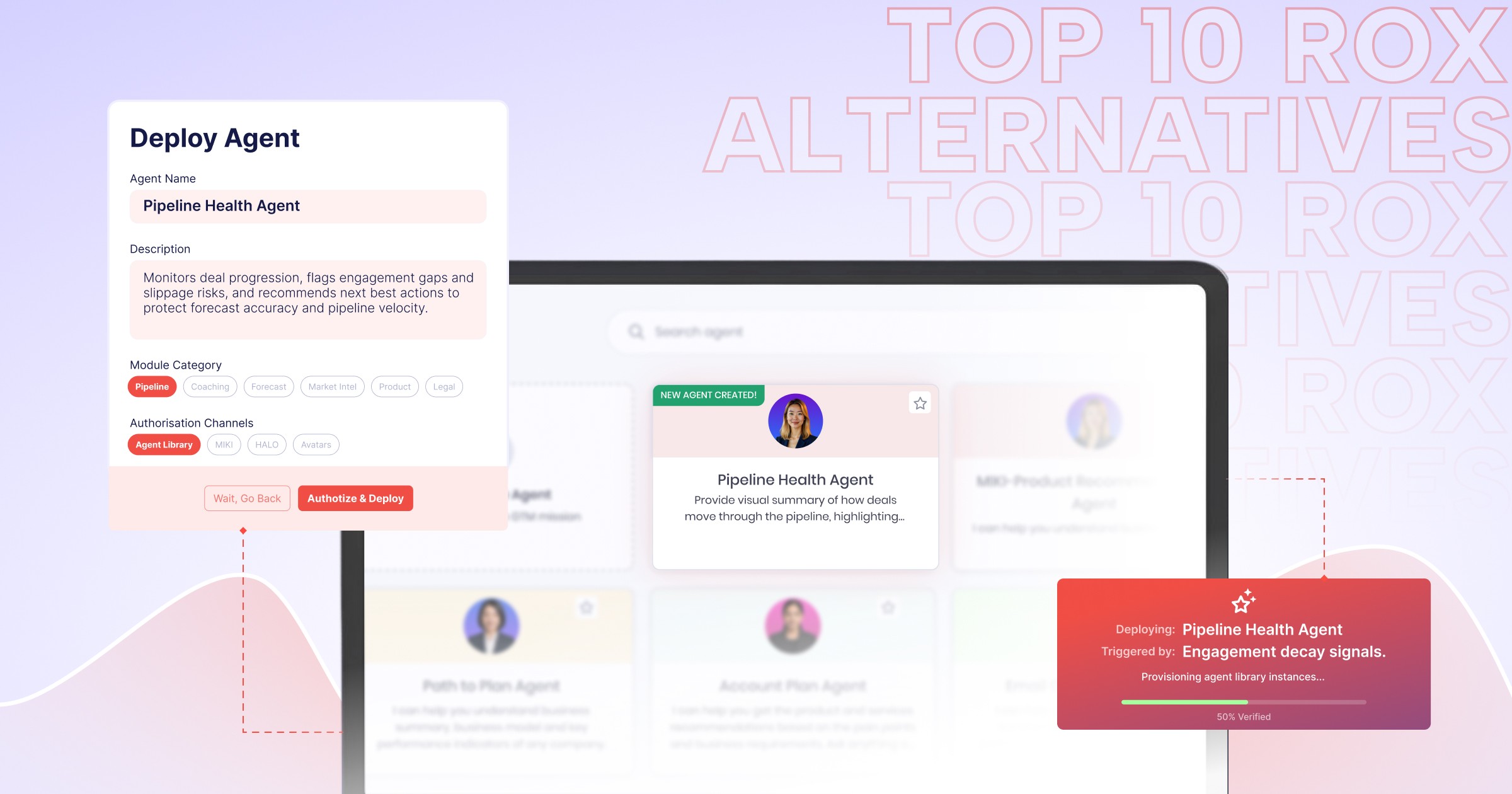
Rox burst onto the GTM scene in 2024 and hit a $1.2B valuation by early 2026, backed by Sequoia, GV, and General Catalyst. Its pitch, "Revenue. On autopilot.", captured a category that's been simmering for years: an autonomous agent swarm that prospects, enriches, engages, and reports across the sales cycle, replacing the patchwork of CRM, enrichment, sales engagement, and conversation intelligence tools most revenue teams cobble together.
But Rox isn't the only player betting on AI sales agents. The market in 2026 is crowded with serious alternatives, some narrower, some broader, several with materially different views on what an "agent" should actually do.
If your team is evaluating Rox, this guide compares the 10 best Rox alternatives, and the broader AI sales agent category, by capability, ideal customer, and where each falls short. Aviso lands at #1 because it solves a problem most agent platforms don't: grounding agents in a unified revenue intelligence layer rather than running them as a disconnected automation tier.
Rox Alternatives & AI Sales Agents at a Glance
# | Tool | Best For | Standout Feature | Limitation |
|---|---|---|---|---|
1 | Aviso | Unified revenue AI grounded in pipeline data | CI plus forecasting plus agentic execution in one platform | Larger surface area than a point agent |
2 | Artisan (Ava) | Outbound BDR replacement | "AI employee" branding plus integrated outreach | Outbound-only; no forecasting |
3 | Clay | GTM data enrichment plus AI workflows | Deepest enrichment plus Claygent agents | More platform than agent, needs ops to wire up |
4 | 11x (Alice / Mike) | AI SDR plus AI phone agent | Strong outbound voice plus email | Limited deal intelligence |
5 | Regie.ai | AI sales rep with sequence orchestration | Tight outbound plus content engine | Light on revenue intelligence |
6 | Salesforce Agentforce | Salesforce-native AI agents | Embedded in the CRM you already pay for | Salesforce-locked, heavy admin lift |
7 | Outreach (AI Prospecting) | AI inside an established SEP | Built on existing engagement workflows | Agent layer is bolted on |
8 | Lindy.ai | General-purpose AI agents incl. sales | Drag-and-drop agent builder | Not sales-specific; less deal context |
9 | Relevance AI | Multi-agent platform for GTM | Custom agent orchestration | Build-it-yourself complexity |
10 | Cognism | Sales intelligence plus AI assistant | Compliant European data plus AI search | Data-first, not agent-first |
How We Evaluated These Tools
We assessed each platform on five criteria that matter most to revenue leaders evaluating Rox: agent breadth (how much of the sales cycle the platform actually automates), grounding (whether agents are connected to real pipeline and CRM data), enterprise readiness (security, governance, audit), ICP fit (Global 2000 vs. mid-market vs. SMB), and execution depth (real outbound plus revenue intelligence vs. surface-level automation). We cross-referenced public pricing pages, customer interviews, G2 reviews, and recent press coverage from TechCrunch, Sequoia, GV, and AWS.
AI Sales Agents 101: How the Category Splits
The "AI sales agent" market in 2026 splits into three product archetypes. Knowing which kind you're buying matters more than picking the loudest brand.
Point agents are narrow specialists: an AI BDR (Artisan, 11x), an AI dialer, an AI scheduler. They replace one role or one workflow and integrate into your existing stack. They're easy to deploy and easy to measure. But they don't talk to each other, and the agent doesn't know whether the deal it's prospecting is forecastable.
Agent platforms are toolkits: Rox, Lindy, Relevance AI. They give you a swarm of agents plus an orchestration layer to point at your data. They're powerful and flexible, but you're effectively buying a sales OS, which means real implementation, change management, and a willingness to rebuild parts of your stack on top of the platform.
Unified revenue AI sits in a different category entirely. Platforms like Aviso treat AI agents as one execution layer inside a broader system that also handles forecasting, deal intelligence, conversation intelligence, and pipeline analytics. Agents in this model are grounded: they know the deal, the stage, the forecast, the rep's quota, and the buyer's history before they take any action. The trade-off: more platform, less plug-and-play.
Rox is firmly in the second camp. The question is whether your team needs a full agent platform, or whether you'd be better served by either a focused point agent or a unified revenue AI that puts agents inside a forecasting and pipeline engine.
What to Look for in a Rox Alternative
Before evaluating tools, decide where the AI agent fits in your existing GTM stack. The best fit depends on what your team actually owns end-to-end.
Core evaluation criteria:
Agent grounding. Does the agent see your real CRM, pipeline, and forecast data, or does it run on enrichment alone?
Coverage. Does the platform cover prospecting, engagement, conversation intelligence, and forecasting, or just one slice?
Governance & safety. AI governance, data lineage, audit logging, SOC 2, the boring stuff that matters more than the demo.
Integration footprint. Salesforce, HubSpot, MS 365, Slack, MCP, API depth.
Buyer fit. Built for Global 2000? Mid-market? Founder-led startups? The same platform rarely serves all three well.
Pricing model. Per-seat, per-action, per-agent, or platform-flat. Each has very different scaling economics.
The Best Rox Alternatives & AI Sales Agents in 2026
1. Aviso (Best for Unified Revenue AI Grounded in Pipeline Data)
Aviso is a unified revenue AI platform that treats AI agents as one execution layer inside a broader system covering forecasting, deal intelligence, conversation intelligence, and pipeline analytics.
The contrast with Rox is straightforward. Rox runs an agent swarm that automates the sales motion. Aviso runs the revenue engine, and exposes agentic execution on top of it. That means Aviso's agents see the deal, the stage, the forecast, the rep's quota, the buyer's history, and the pipeline-wide signals before they act. They're grounded in revenue truth, not just enrichment data.
For RevOps leaders consolidating their stack, this distinction matters. A grounded agent that updates the forecast when it acts is fundamentally different from an autonomous agent disconnected from the forecast.
Best for: Enterprise GTM teams and RevOps leaders that want AI agents inside a unified forecasting and pipeline platform, not as a parallel agent layer.
Limitations: Aviso is a comprehensive revenue platform, not a lightweight agent builder. Teams that just want a free outbound BDR will find the surface area larger than they need; full deployments take more setup than a point agent.
Rox vs. Aviso. Different bets on where AI value compounds in a revenue org. Rox bets on agents-as-the-platform: replace the stack, run the swarm, see the results. Aviso bets on agents-as-execution: keep the system of record, ground the agents in revenue data, and use AI to drive forecast accuracy and pipeline outcomes alongside outbound automation. Teams that want the agent layer to update the forecast (not just the inbox) tend to prefer Aviso.
2. Artisan (Ava, AI BDR)
Artisan popularized the "AI employee" framing with Ava, an AI BDR that builds lists, writes outbound, and runs sequences end-to-end. Strong brand, strong outbound execution, fast time-to-value.
Best for: SMB and mid-market teams that want to replace or augment their outbound BDR layer.
Limitation: Outbound-only by design. No forecasting, no conversation intelligence, no deal-level execution.
3. Clay
Clay is the GTM enrichment platform that quietly became the most loved tool in modern RevOps. Claygent (its agent layer) runs research and enrichment workflows that would normally take hours of manual ops work.
Best for: GTM ops teams that want a flexible workspace to enrich, segment, and orchestrate signals.
Limitation: Clay is a platform, not a turnkey agent. It needs an operator who knows what to wire up. Less prescriptive than Rox.
4. 11x (Alice & Mike)
11x runs Alice (AI SDR) and Mike (AI phone agent). Strong outbound voice presence, integrated email, and a clear "digital worker" positioning.
Best for: Outbound-heavy teams that want both email and phone outbound automated.
Limitation: Limited to outbound execution. No forecasting or deeper revenue intelligence.
5. Regie.ai
Regie.ai combines an AI sales rep with sequence orchestration and a content-generation engine. Built for SDR and AE workflows on top of existing sales engagement.
Best for: Mid-market sales teams that want AI rep coverage with a strong content layer.
Limitation: Lighter on revenue intelligence; the agent is engagement-focused.
6. Salesforce Agentforce
Agentforce is Salesforce's AI agent platform, embedded inside the CRM most enterprises already pay for. Strong enterprise governance and the gravity of the existing CRM data layer.
Best for: Salesforce-locked enterprises that want AI agents inside their existing system of record.
Limitation: Heavier admin lift to configure; Salesforce-only by design; agent depth still maturing relative to AI-native platforms.
7. Outreach (AI Prospecting Agent)
Outreach added an AI Prospecting Agent and Smart Email Assist on top of its established sales engagement platform. Reps already living in Outreach get AI capabilities without a new tool.
Best for: Existing Outreach customers who want to add AI agents without a stack rebuild.
Limitation: Agent layer is bolted onto an SEP, not built agent-first like Rox or Artisan.
8. Lindy.ai
Lindy.ai is a general-purpose AI agent builder with strong sales templates. Drag-and-drop agent creation, broad integration set, accessible price point.
Best for: Smaller teams and founders who want flexible AI agents across sales, ops, and support.
Limitation: Not sales-specific; less deal context, no native forecasting or pipeline analytics.
9. Relevance AI
Relevance AI is a multi-agent platform for GTM, with strong custom agent orchestration. Closer to Rox in ambition than most others on this list.
Best for: Technical RevOps teams that want to build custom agent workflows tied to their data.
Limitation: Build-it-yourself complexity; less prescriptive than turnkey agents.
10. Cognism
Cognism is a sales intelligence platform with an AI assistant layer. Especially strong on European compliance and data quality.
Best for: Teams selling into Europe that want compliant data with an AI search and assistant overlay.
Limitation: Data-first, not agent-first. The "agent" experience is closer to AI-assisted search than autonomous execution.
Rox vs. the Alternatives: Where Rox Still Wins
A fair evaluation has to acknowledge what Rox does well, which is meaningful for a startup that's only about 18 months old.
Agent breadth. Rox covers more of the sales motion (prospecting, enrichment, engagement, CI, account intelligence) inside a single agent fabric than most competitors.
Enterprise momentum. Real Global 2000 logos: MongoDB, Confluent, Ramp, Redis, OpenAI, adopting in production.
AI infrastructure. Built on Amazon Bedrock plus Perplexity API; SOC 2 Type II; thoughtful data lineage and governance posture.
Brand & ambition. "No SaaS. No CRM." is a strong narrative for greenfield deployments and AI-native companies.
Where Rox Falls Short
Disconnected from forecasting. Rox automates the motion but doesn't itself produce the forecast. Teams that need pipeline math end up with Rox plus a forecasting tool.
Stack-replacement risk. "No SaaS. No CRM." is bold positioning, but most enterprises run their book of record in Salesforce or HubSpot. Asking them to migrate their CRM to an agent platform is a heavy ask.
Maturity. Rox is 18 months old. Compared to platforms with 5 to 10 years of forecasting and deal-intelligence depth, the analytics layer is young.
Pricing visibility. Less transparent than mid-market AI agent tools. Rox sells primarily via direct enterprise motion.
When NOT to Switch from (or to) Rox
Rox is the right answer in a specific set of cases. If you're an AI-native company building greenfield, your team is small, and you're willing to use Rox as the system of record, Rox is genuinely well-positioned. If your existing CRM and forecasting setup is fragile and you'd rather rebuild than patch, Rox's "agent swarm replaces the stack" pitch is compelling.
It's the wrong answer when your enterprise has deep Salesforce or HubSpot investment, when forecasting accuracy is a CRO-level mandate, or when you need agents that update the forecast and pipeline truth, not just the prospect database. In those cases, a unified revenue AI platform like Aviso is the safer, faster path to value.
Why Teams Are Looking at Rox Alternatives in 2026
The 2026 AI sales agent market is shifting in three ways. First, agent-only platforms are running into the grounding problem: agents that don't see the forecast can't drive forecast outcomes. Second, enterprise buyers are pulling back from "rip and replace" pitches in favor of platforms that augment their CRM rather than replace it. Third, price scrutiny is rising: boards are asking sharper questions about per-seat or per-action AI spend, especially when ROI sits inside the existing revenue engine.
That's why "Rox alternatives," even at low search volume today, is worth covering proactively. Buyers will look.
Which Rox Alternative Should You Choose?
Use this decision framework based on your team's primary need:
Choose Artisan, 11x, or Regie if your only goal is replacing or augmenting the outbound BDR layer.
Choose Clay if you have a strong RevOps team and want a flexible enrichment plus workflow workspace.
Choose Salesforce Agentforce if you're Salesforce-locked and want the CRM vendor's native agent layer.
Choose Lindy or Relevance AI if you want general-purpose agent orchestration across sales, ops, and support.
Choose Aviso if you want AI agents grounded in a unified revenue intelligence platform that also handles forecasting, conversation intelligence, and pipeline analytics, not running as a disconnected automation tier.
Final Verdict
Rox is one of the most ambitious GTM platforms launched in the past two years and deserves the attention it's getting. But "agent swarm replaces the stack" is a bet on a specific buyer: Global 2000 teams willing to rebuild their revenue motion around an agent-first platform.
For most enterprise revenue teams, the better bet is AI agents grounded in a unified revenue intelligence engine. Aviso represents that path: one platform for forecasting, deal intelligence, conversation intelligence, and agentic execution, without forcing the team to abandon Salesforce or HubSpot.
See Aviso in action, book a demo
FAQs
What are the best Rox alternatives? The strongest Rox alternatives in 2026 are Aviso (unified revenue AI), Artisan (AI BDR), Clay (GTM enrichment), 11x (AI SDR plus phone), and Salesforce Agentforce (CRM-native agents). The right choice depends on whether you want a unified revenue platform, a focused point agent, or a build-your-own agent workspace.
Is Rox the same as Aviso? No. Rox is an agent swarm platform that automates the sales motion across prospecting, engagement, and account intelligence. Aviso is a unified revenue AI platform that combines forecasting, conversation intelligence, deal intelligence, and agentic execution in one system. Aviso's agents are grounded in pipeline data; Rox runs as a parallel agent layer.
What is an AI sales agent? An AI sales agent is an autonomous software system that performs sales tasks (prospecting, enrichment, outbound email, call handling, meeting prep) on behalf of human reps. The category splits into point agents (Artisan, 11x), agent platforms (Rox, Lindy, Relevance), and unified revenue AI (Aviso) where agents are grounded in a broader forecasting and pipeline engine.
Who are Rox's competitors? Rox competes with three groups: AI-native agent platforms (Lindy, Relevance AI), point sales agents (Artisan, 11x, Regie), and unified revenue AI platforms (Aviso, Clari). Salesforce Agentforce is also a competitor for enterprises looking to use their existing CRM vendor's agent layer.
Is there a free Rox alternative? Several AI sales tools offer free or free-trial tiers. Lindy.ai has a generous free plan; Clay has limited free credits. Most enterprise-grade Rox alternatives (Aviso, Salesforce Agentforce, full Artisan or 11x deployments) are paid annual contracts.
How much does Rox cost? Rox does not publish list pricing. Based on public reporting and customer references, Rox sells via direct enterprise motion priced by deployment scope rather than per-seat. Expect six-figure annual contracts.
Why would I choose Aviso over Rox? You'd choose Aviso if you want AI agents grounded in a unified revenue intelligence platform that also handles forecasting, deal inspection, and conversation intelligence, without replacing your CRM.
Read More Like This
