AI Sales Coaching: Use Cases, Metrics, and Rollout Plan

No time to lose? Summarize with AI
ChatGPT
Claude
What Is AI Sales Coaching
The Definition: Insights + Recommendations + Workflows
AI sales coaching is a cycle of observation, diagnosis, recommendation, reinforcement, and measurement. Unlike static dashboards that show what happened, AI coaching tells reps what to do next and embeds those recommendations into their workflow.
At its core, it combines three capabilities:
Insights: AI analyzes call recordings and transcripts, deal progression, and activity logs to surface coaching-relevant signals—e.g., "discovery questions in this call were surface-level" or "this deal hasn't moved in 30 days and has no next step."
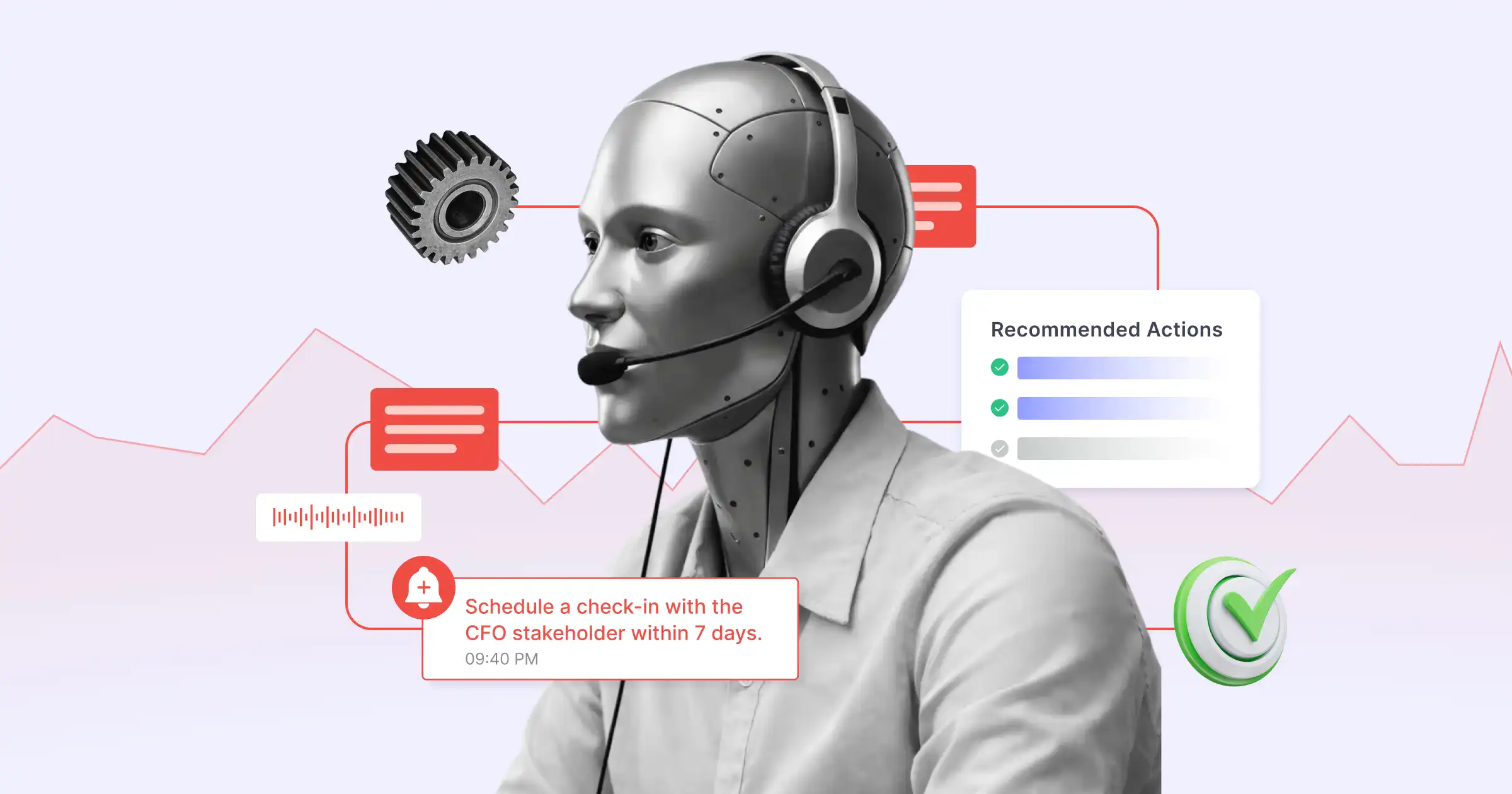
Recommendations: AI translates insights into specific, actionable coaching prompts—e.g., "Ask about their evaluation timeline and internal approval process" or "Schedule a check-in with the CFO stakeholder within 7 days."
Workflows: AI embeds coaching into the tools reps already use—call summaries with coaching tags, CRM alerts that trigger when a deal shows slip risk, manager dashboards that highlight coaching priorities, and certification modules that reinforce playbook skills.
Human Manager vs. AI Coach: Complementary Roles
The most successful AI coaching implementations maintain clear role separation:
Responsibility | AI Coach | Human Manager |
Detect patterns | ✓ (scales to 100+ reps) | Limited by time |
Recommend tactics | ✓ (consistent, fast) | ✓ (contextual, nuanced) |
Override or challenge | — | ✓ (judgment call) |
Handle tough feedback | — | ✓ (emotional intelligence) |
Performance management | — | ✓ (career, compensation) |
Quarterly calibration | — | ✓ (data + intuition) |
Managers use AI coaching insights to focus their one-on-ones on the highest-impact conversations—instead of scrambling to uncover what happened in last week's deals, they start from diagnosis and move straight to coaching and coaching reinforcement.
The Coaching Loop: Observe → Diagnose → Recommend → Reinforce → Measure
Every effective coaching interaction follows this five-step cycle:
1. Observe
AI passively ingests conversation data (calls, emails, meetings), CRM activity (deal movement, next steps, contact engagement), and behavior signals (discovery question count, talk-to-listen ratio, objection handling frequency). No rep action required.
2. Diagnose
AI compares what it observed against your playbook baseline. If your playbook says "reps should ask 5+ discovery questions per call," AI flags calls with 2–3 questions. If your process says "every deal must have a next step within 24 hours," AI flags deals that violate this rule.
3. Recommend
AI surfaces a specific, contextualized recommendation—not generic advice, but something tied to the rep's actual call or deal. For example: "In your call with Acme on 1/10, you asked about budget and timeline, but didn't explore their evaluation process or stakeholder map. Next call, open with: 'Help me understand who else will be involved in the evaluation, and what's your decision timeline?'"
4. Reinforce
AI doesn't just recommend once—it reinforces through multiple touchpoints: in-call coaching prompts, post-call summary tags, manager conversation starters, certification modules, and peer call playlists showing best-practice examples. Repetition builds muscle memory.
5. Measure
AI tracks whether the rep adopted the recommendation (e.g., did they ask stakeholder questions in the next 3 calls?), and whether adoption correlated with outcome lift (e.g., did cycle time shrink, did win rate move, did forecast accuracy improve?).
The AI Sales Coaching Framework: COPE
To implement AI coaching successfully, you need a structured framework to align the AI with your business outcomes. We call it COPE: Cohorts, Outcomes, Plays, Evidence.
C = Cohorts (Roles, Segments, Motions)
Definition: A cohort is a group of reps, teams, or motions that share the same sales methodology and outcome targets.
Cohorts allow you to tailor AI coaching to different roles and motions. For example:
Enterprise Account Executives: Focus on MEDDIC coverage, stakeholder mapping, and deal health metrics
Mid-market Sales Development: Focus on qualification, discovery, and meeting quality
Customer Success Managers: Focus on expansion conversations, renewal risk, and upsell path clarity
Geographic or vertical segment: Territory-specific playbook variations
Defining cohorts early ensures AI coaching delivers advice that's relevant to each rep's actual job.
O = Outcomes (Target KPI Deltas)
Definition: The specific, measurable business outcomes you want each cohort to move in the next 30–90 days.
Examples:
Enterprise AEs: +8% win rate, -15 day cycle time
SDRs: +12% meeting-to-qualified conversion, +20% meeting show-up rate
CS renewal reps: +5% renewal rate, -10 day sales cycle
Clear outcome targets allow you to (a) set realistic AI coaching scope, and (b) measure ROI at the end of the pilot.
P = Plays (Repeatable Coaching Interventions)
Definition: A "play" is a specific coaching intervention that your team has decided will drive the outcome for that cohort.
Examples:
Discovery Play: "In every qualified opportunity call, ask 5+ discovery questions covering business objectives, initiative timeline, evaluation process, stakeholder map, and success criteria."
MEDDICC Play: "Ensure every enterprise deal has documented coverage of Metrics, Economic Buyer, Decision Process, Decision Criteria, Identify Pain, Importance, and Champion."
Stage Compliance Play: "Every deal moving to the next stage must have a documented next step dated within 7 days."
Pipeline Hygiene Play: "Every deal in pipeline must have a last-activity date within 14 days and a next-step date within 7 days."
Plays are the "what" that AI coaches reinforce. AI watches to see which reps are executing the play, and flags those who aren't.
E = Evidence (Signals, Baselines, Attribution)
Definition: The data signals AI uses to measure whether plays are being executed and whether outcomes are moving.
For the Discovery Play, evidence signals are: discovery question count per call, question topics covered, and talk-to-listen ratio. Baseline: reps currently ask 2.3 discovery questions per call on average. Target: 5+.
For the Stage Compliance Play, evidence signals are: % of deals with a next step, next-step date recency, and stage-progression velocity. Baseline: 62% of deals have a documented next step within 7 days. Target: 90%+.
For the outcome (win rate), evidence signals are: deal close date, close status (won/lost), and rep attribution. This lets you measure: "Did reps who adopted the Discovery Play experience higher win rates?"
Use Cases: Where AI Coaching Delivers Fastest
1. Conversation Coaching
The problem: Sales managers can't listen to every call. Reps repeat the same mistakes across dozens of conversations. Skills degrade when feedback is delayed or inconsistent.
The solution: AI listens to every call and surfaces coaching signals in real-time or post-call.
Coaching signals tracked:
Talk-to-listen ratio (seller airtime vs. buyer airtime; target: 30–40% seller talk)
Discovery questions (e.g., "What are your key business objectives?" vs. surface questions like "How many users?")
Objection handling (does the rep address the objection or deflect?)
Competitor mentions (how does the rep position against named competitors?)
Question quality (open-ended exploratory vs. yes-no qualifying questions)
Stakeholder depth (does the rep identify economic buyer, decision maker, user, blocker?)
Workflow:
Call automatically transcribed and analyzed post-call
AI surfaces 2–3 coaching points in a structured summary: "What went well" + "Coaching tip for next time"
Manager receives a weekly digest of coaching priorities across their team
Rep can access their call summaries tagged with "talk-to-listen ratio low" or "great stakeholder discovery"
Manager can build a "playlist" of best-practice calls from top performers for reps to watch
Certification module reinforces a specific skill (e.g., "Ask 5 discovery questions") with reps completing a micro-challenge
Expected KPI movement: +3–8% win rate, +2–4 week ramp acceleration, +15% forecast accuracy improvement.
2. Deal Coaching
The problem: Deals stall because reps don't understand the customer's evaluation process, don't map stakeholders, or don't identify economic criteria. Forecast surprises occur because deal health isn't visible until it's too late.
The solution: AI analyzes CRM deal data (opportunities, contacts, activities, emails) and flags deals at risk or in need of coaching intervention.
Coaching signals tracked:
MEDDIC coverage (Metrics, Economic Buyer, Decision Process, Decision Criteria, Identify Pain, Importance, Champion)
Stakeholder mapping (is the economic buyer engaged? Are we talking to procurement or users instead?)
Next-step hygiene (every deal must have a next-step date; overdue next steps = stalled deals)
Competitor risk (is a competitor mentioned in deal notes? Are we losing mindshare?)
Slip risk (deal hasn't moved in 30+ days; activity has dropped; push-out probability high)
Renewal/expansion path (for existing customers, is the expansion deal scoped?)
Workflow:
AI analyzes opportunities daily/weekly
Alerts trigger on slip risk, missing MEDDIC coverage, or stale next steps
Manager sees a prioritized coaching list: "3 deals need stakeholder mapping intervention, 2 deals have overdue next steps"
Manager uses AI-generated talking points in 1:1: "Let's map the stakeholders in Acme—who's the economic buyer, and how do we engage them?"
Rep updates deal with AI-suggested actions
AI tracks whether the rep followed through (e.g., logged a call with the economic buyer within 7 days)
Expected KPI movement: +5–12% win rate, -10–20 day cycle time, +8–15% forecast accuracy improvement.
3. Pipeline Hygiene Coaching
The problem: Sales leaders can't trust the forecast because pipeline data is inconsistent. Deals linger in stages. Next steps are vague ("follow up next week") or missing. Reps feel micromanaged when forced to update CRM manually.
The solution: AI automatically monitors pipeline hygiene and coaches reps to maintain it through their daily workflow.
Coaching signals tracked:
Stage compliance (deal in correct stage based on next-step and activity dates?)
Next-step presence (every deal has a clear, dated next step)
Next-step timeliness (next step is within 7 days; if > 7 days, deal at risk)
Activity currency (last activity within 14 days; if > 14 days, deal stalled)
Activity type (is activity logged? Calls, emails, meetings—what type of engagement?)
Stale deal detection (deal hasn't moved in 60+ days; should it be archived?)
Workflow:
AI monitors every opportunity in the pipeline
AI generates recommendations: "Acme (Enterprise) has been in stage 3 for 45 days with no recent activity. Schedule a discovery call or advance to next stage."
Recommendation appears in rep's CRM feed or email digest (no extra app)
Rep either takes action (schedules call, updates next step) or marks as "not actionable" with a reason
Manager gets weekly hygiene scorecard: "John updated 92% of next steps on time, Sarah at 65%—coaching opportunity"
Manager discusses hygiene with reps in 1:1; AI provides talking points
Expected KPI movement: +8–15% forecast accuracy, -10 day cycle time, +5% stage conversion improvement.
4. Playbook Reinforcement
The problem: Sales reps get trained on the playbook once. Over time, behavior drifts. New reps don't internalize the methodology. There's no easy way to reinforce a specific skill without a full retraining.
The solution: AI detects when reps are executing playbook plays and celebrates wins; when they're deviating, it suggests micro-coaching and hands-on examples.
Coaching signals tracked:
Discovery question adherence (reps asking the 5 core discovery questions from your playbook)
Qualification criteria (reps confirming budget, timeline, and authority before advancing)
Call structure (reps opening with context-setting, moving to discovery, closing with clear next step)
Email best practices (short paragraphs, clear CTA, personalization, subject line quality)
Certification status (reps completing playbook certification modules; score trending)
Workflow:
Rep takes a call. AI analyzes it against the playbook discovery questions.
If the rep executed well: "Great discovery call! You covered all 5 key questions: objectives, timeline, evaluation, stakeholders, and success criteria."
If the rep missed some questions: "Consider adding these in your next call: 'Help me understand your evaluation timeline and process.'"
Managers assign micro-certification modules: "3 reps scored < 70% on MEDDIC—assign the 15-min MEDDIC video + quiz"
AI creates a "best-practice playlist" of calls from top performers executing the play
Managers can re-assign the module after observing rep drift
Expected KPI movement: +5–10% win rate, +2–3 week ramp acceleration, +15% playbook adherence.
5. New Rep Ramp
The problem: New reps struggle in their first 3–6 months. Managers don't have time to coach every early conversation. Reps feel lost and take longer to reach quota.
The solution: AI creates a structured onboarding path for new reps, with role-specific learning milestones and coaching reinforcement.
Coaching signals tracked:
Onboarding completion (has the rep watched core playbook videos? Completed certification?)
Conversation frequency (is the rep having the right number of conversations to learn—e.g., 20+ discovery calls in first month?)
Conversation quality (is the rep executing playbook behaviors—discovery questions, next steps—in early calls?)
Manager coaching cadence (is the manager scheduling weekly 1:1s in month 1–2, validating ramp progress?)
Quota progression (is the rep tracking to reach quota by month 4–6?)
Workflow:
Rep hired. AI triggers an onboarding workflow: "Welcome! Your onboarding path includes 5 core modules: Playbook, MEDDIC, Discovery, Qualification, Closing."
Each module includes: video, certification quiz, live-call observation guidelines, best-practice call playlist
As the rep takes calls, AI analyzes them and provides personalized feedback: "Your talk-to-listen ratio was 35% (great). Next time, dig deeper on timeline and evaluation process."
Manager sees a ramp dashboard: "Sarah (Day 45) has 65 conversations, MEDDIC mastery at 78%, discovery skills at 82%—on track to quota by month 5"
AI flags risks: "Carlos (Day 30) has only 28 conversations and is skipping discovery questions. Recommend intensive manager coaching this week."
Rep completes a certification and "graduates" to full autonomy once they hit proficiency thresholds
Expected KPI movement: -2–4 week time-to-quota, +20–30% faster ramp, +10% early quota attainment.
6. Manager Enablement
The problem: Sales managers are bottlenecked. They lack visibility into which reps need coaching and what to coach on. 1:1 agendas are ad hoc. They spend time on low-impact coaching instead of high-impact interventions.
The solution: AI generates manager coaching agendas, surfaces team trends, and provides talking points for high-impact conversations.
Coaching signals tracked:
Team trend analysis (which behaviors are trending down? Which are accelerating?)
Rep-level risk flagging (which reps are at risk of missing quota? Which need playbook reinforcement?)
Coaching priority ranking (which 3 reps should the manager focus on this week?)
1:1 agenda automation (AI suggests 2–3 topics for each manager 1:1 based on rep performance data)
Team cohort analysis (how is Team A trending vs. Team B on win rate? Cycle time? Forecast accuracy?)
Workflow:
Manager logs into their dashboard on Monday morning
AI surfaces: "This week's coaching priorities: John (5 deals stalled, needs deal hygiene), Maria (low discovery question count, needs conversation coaching), Hassan (overdue pipeline actions)"
Manager receives an auto-generated 1:1 agenda for each rep with talking points: "John, let's map out the 5 stalled deals. Here are specific next steps we could take..."
Manager runs 1:1, and AI tracks whether the coaching "stuck" (did John update the 5 deals with next steps in the next 48 hours?)
Manager sees team trend reports: "Win rate up 3% week-over-week, driven by improved discovery question adoption. Keep it up!"
Managers discuss trends in sales council meetings, informed by AI-generated insights
Expected KPI movement: +5–8% team win rate, +10–15% forecast accuracy, +15–20% manager coaching time efficiency.
Use Case Comparison Table
Use Case | Primary Signals | Manager Workflow | Rep Workflow | Expected Outcome Movement |
Conversation Coaching | Talk-to-listen, discovery questions, objection handling, stakeholder depth | Weekly coaching digest, call playlist curation, manager call reviews | Post-call summary tags, certification modules, peer playlists | +3–8% win rate, +2–4 week ramp |
Deal Coaching | MEDDIC coverage, stakeholder map, next-step hygiene, slip risk, competitor risk | Daily coaching priorities, deal-specific talking points, 1:1 agendas | Deal action prompts in CRM, manager coaching in 1:1, deal progression tracking | +5–12% win rate, -10–20 days cycle |
Pipeline Hygiene | Stage compliance, next-step presence, activity currency, stale detection | Weekly hygiene scorecard by rep, team trend analysis | CRM coaching prompts, nudges to update next steps, activity reminders | +8–15% forecast accuracy, -10 days cycle |
Playbook Reinforcement | Discovery adherence, qualification criteria, call structure, email best practices | Micro-certification assignments, playbook drift alerts, best-practice playlists | Video modules, certification quizzes, call recording reviews, skill assessments | +5–10% win rate, +2–3 week ramp |
New Rep Ramp | Conversation frequency, behavior quality, coaching cadence, quota progression | Ramp dashboard, risk alerts, manager coaching cadence prompts | Structured learning path, role-based modules, live-call feedback, progression milestones | -2–4 week ramp, +20–30% faster proficiency |
Manager Enablement | Team trends, rep risk flags, coaching priority ranking, 1:1 agenda automation | Auto-generated agendas, team cohort trends, coaching impact tracking | (Indirect: improved manager coaching quality) | +5–8% team win rate, +15–20% manager efficiency |
Metrics That Matter: Leading, Pipeline, and Outcomes
To succeed with AI coaching, you need to measure three types of metrics: leading indicators (is coaching being adopted?), pipeline health (are processes improving?), and outcome metrics (is revenue moving?).
Leading Indicators (Weekly)
These metrics tell you whether your coaching interventions are gaining traction and whether reps are changing behavior.
Coaching completion rate
Formula: (Reps with ≥1 coaching completion in week) / (Total active reps)
Source: AI coaching platform
Target: 70–85% for conversation coaching, 90%+ for deal coaching
Owner: Sales Operations / Sales Coaching Lead
Why it matters: If fewer than 60% of reps engage with coaching, the platform isn't reaching the team. May indicate UX issues, manager adoption resistance, or poor signal quality.
Discovery question adoption
Formula: (Calls with ≥5 discovery questions) / (Total calls with conversation data) × 100
Source: Conversation intelligence transcripts
Target: 75%+ (vs. baseline of 35–50% for most orgs)
Owner: Sales Coaching Lead
Why it matters: Direct proxy for playbook adherence. High adoption correlates with win rate improvement.
Next-step hygiene compliance
Formula: (Opportunities with next step dated ≤7 days) / (Total opportunities in pipeline) × 100
Source: CRM (Salesforce/HubSpot)
Target: 85–90% (vs. baseline of 50–65%)
Owner: Sales Manager / Sales Operations
Why it matters: Strong predictor of forecast accuracy and cycle time. Hygiene drift = early warning of pipeline risk.
Call activity per rep (weekly)
Formula: Count of calls logged per rep per week, averaged across team
Source: Conversation intelligence platform or CRM activity log
Target: 15–25 calls per rep per week (varies by role)
Owner: Sales Manager
Why it matters: Volume × quality = coaching impact. If call volume drops, coaching won't affect outcomes.
Pipeline Health Metrics (Weekly)
These metrics show whether your pipeline is healthier and more predictable as a result of coaching.
Stage conversion rate
Formula: (Opportunities advancing to next stage) / (Opportunities in stage) × 100, measured weekly
Source: CRM
Target: 40–60% (varies by stage; typically Stage 1→2 is lower, Stage 3→4 is higher)
Owner: Sales Manager
Why it matters: Early indicator of deal progression speed. Rising conversion = coaching is shortening sales cycles.
Time-in-stage (median)
Formula: Median number of days opportunities spend in each stage
Source: CRM
Target: Reduce by 10–20% from baseline over 60 days
Owner: Sales Manager
Why it matters: Direct measure of cycle time improvement. If deals are moving faster, coaching is working.
Deal slip rate
Formula: (Deals pushed to future period) / (Deals in commit this period) × 100
Source: CRM (compare weekly snapshots)
Target: <10% (baseline often 15–25%)
Owner: Sales Manager
Why it matters: High slip rate = coaching not preventing deal stalls. Low slip rate = strong forecast and manager coaching.
Stale deal detection
Formula: (Opportunities with no activity in 60+ days) / (Total pipeline) × 100
Source: CRM
Target: <5% (vs. baseline of 10–20%)
Owner: Sales Manager
Why it matters: Stale deals consume rep time and cloud forecast. Hygiene coaching should eliminate them.
Forecast accuracy (±10% range)
Formula: (Actual closed revenue) / (Committed forecast) ÷ (Committed forecast + Range)
Source: CRM (opportunity forecast vs. close status)
Target: ±10% or better (vs. baseline of ±15–25%)
Owner: Sales Operations / Finance
Why it matters: Gold standard for sales health. Forecast accuracy is the ultimate measure of coaching impact on pipeline predictability.
Outcome Metrics (Monthly / Quarterly)
These are the business metrics that ultimately justify AI coaching investment.
Win rate
Formula: (Deals won) / (Deals closed—won + lost) × 100, by cohort and rep
Source: CRM (close status)
Cadence: Monthly reporting, quarterly trend
Target: +5–12% lift from baseline (realistic over 60–90 days)
Owner: Sales VP / Revenue Operations
Why it matters: Direct revenue impact. Most organizations see 5–8% win rate improvement after 60 days of consistent coaching.
Average contract value (ASP) / Average selling price
Formula: (Total revenue closed) / (Count of deals won)
Source: CRM (opportunity amount, close date)
Cadence: Monthly
Target: +3–8% lift from baseline
Owner: Sales VP
Why it matters: Coaching can improve deal sizing through better stakeholder mapping and economic buyer engagement. Secondary lever for revenue impact.
Sales cycle length
Formula: (Close date) − (Opportunity created date), averaged
Source: CRM
Cadence: Monthly
Target: -10–20 day reduction from baseline (realistic over 90 days)
Owner: Sales Manager / Sales Operations
Why it matters: Shorter cycle = faster cash conversion and more reps hitting quota each quarter. Coaching shortens cycles by 10–20 days on average.
Quota attainment (% of team at 100%+)
Formula: (Reps at ≥100% of quota) / (Total active reps) × 100
Source: CRM or CPQ (commission plan)
Cadence: Monthly, end-of-quarter
Target: +10–15% lift from baseline
Owner: Sales VP
Why it matters: Bottom-line business metric. AI coaching improves rep productivity, and quota attainment is the clearest signal.
New rep ramp (time to quota)
Formula: (Count of days from hire date to first 100%+ quota month) ÷ (Total reps hired cohort)
Source: CRM + HRIS
Cadence: Rolling 3-month average
Target: -2–4 weeks from baseline
Owner: Sales Operations / HR
Why it matters: Ramp acceleration reduces training cost and accelerates revenue contribution. Strong secondary metric for AI coaching ROI.
Forecast accuracy
Formula: (Actual closed revenue in period) ÷ (Committed forecast from prior period)
Source: CRM + Finance
Cadence: Monthly
Target: ±10% vs. ±15–25% baseline
Owner: Sales VP / Finance
Why it matters: Predictability is foundational for business planning. Coaching improves forecast accuracy by strengthening deal health and rep discipline.
Adoption and Change Metrics
Active user rate (% of team)
Formula: (Reps who took ≥1 coaching action in 7-day period) / (Total active reps) × 100
Source: AI coaching platform
Target: 70–85%
Why it matters: If adoption is below 60%, coaching won't move outcomes. Target aggressive adoption in weeks 1–2.
Manager cadence adherence
Formula: (Managers who held 1:1s with coaching discussion in week) / (Total managers) × 100
Source: Manager self-reporting or calendar integration
Target: 90%+
Why it matters: Coaching amplifies when managers reinforce it. Without manager cadence, reps ignore AI recommendations.
Content/play usage rate
Formula: (Reps accessing playbook videos, certification modules, or call playlists in week) / (Total reps) × 100
Source: AI coaching platform
Target: 60–75%
Why it matters: Reps learning the playbook + AI coaching behaviors = faster skill development.
Metrics Dashboard Template
Metric | Formula | Source | Cadence | Owner | Current Baseline | 30-Day Target | 90-Day Target |
Coaching completion rate | (Reps with ≥1 completion / Total active reps) × 100 | AI platform | Weekly | Coach Lead | 35% | 70% | 80% |
Discovery question adoption | (Calls with ≥5 questions / Total calls) × 100 | CI platform | Weekly | Coach Lead | 38% | 65% | 78% |
Next-step hygiene | (Opps with next step ≤7 days / Total opps) × 100 | CRM | Weekly | Sales Ops | 58% | 75% | 88% |
Stage conversion rate | (Opps advancing / Opps in stage) × 100 | CRM | Weekly | Manager | 48% | 52% | 55% |
Time-in-stage (median) | Median days in stage | CRM | Weekly | Manager | 28 days | 25 days | 22 days |
Win rate | (Won / Won+Lost) × 100 | CRM | Monthly | VP Sales | 42% | 44% | 47% |
Cycle time | (Close − Create date), avg | CRM | Monthly | Sales Ops | 68 days | 60 days | 52 days |
Forecast accuracy | (Actual / Forecast) | CRM + FP&A | Monthly | VP / Finance | ±18% | ±14% | ±10% |
Quota attainment | (Reps ≥100% quota / Total) × 100 | CRM | Monthly | VP Sales | 64% | 68% | 75% |
New rep ramp | Days to first 100% quota month | CRM + HRIS | Rolling avg | Sales Ops | 142 days | 130 days | 115 days |
How to Calculate ROI: Revenue Lift + Efficiency Gains
AI coaching investment typically pays back within 60–120 days. Here's how to model the ROI for your organization.
Revenue Lift Model
Inputs:
Annual opportunity volume: How many opportunities does your org create in a year? (e.g., 2,400 opps)
Average deal size (ADS): (e.g., $150,000)
Current win rate: Baseline win percentage (e.g., 42%)
Sales cycle length: Days from creation to close (e.g., 68 days)
Team size: Total active revenue-bearing reps (e.g., 45 reps)
Annual quota per rep: (e.g., $800,000)
Uplifts (realistic from AI coaching, measured over 90 days):
Win rate delta: +5–8% (realistic for conversation + deal coaching) → 42% to 47%
Cycle reduction: -10–15 days (realistic for deal + hygiene coaching) → 68 to 55 days
ASP improvement: +2–5% (realistic from stakeholder mapping + deal sizing) → $150K to $157.5K
Rep productivity: +8–12% (realistic from ramp acceleration + time savings) → fewer reps needed for same revenue
Revenue lift calculation:
Additional Revenue=(Annual Opps×Win Rate Delta×ADS)+(Cycle Reduction Impact)+(ASP Delta)
Additional Revenue=(Annual Opps×Win Rate Delta×ADS)+(Cycle Reduction Impact)+(ASP Delta)
Example for a 45-rep team:
Annual opps: 2,400 (avg 53 per rep)
Current win rate: 42% (1,008 deals won/year)
New win rate: 47% (+5% lift) → 1,128 deals won/year
Win rate revenue lift: (1,128 − 1,008) × $150K = $18,000,000
Cycle time reduction impact (conservative):
Current cycle: 68 days → New cycle: 56 days (12-day reduction)
12 days ÷ 68 days = 17.6% faster cycle = ~8.8% more closed deals per rep per year (at constant pipeline)
8.8% × (1,008 deals × $150K annual revenue) ÷ 45 reps = ~$2,640,000
ASP improvement (conservative):
ASP lift: +3% ($150K → $154.5K) on base deal count
Additional ASP revenue: 1,008 deals × $4,500 = $4,536,000
Total annual revenue lift: $18M + $2.64M + $4.54M = $25.18M
(Note: These are cumulative improvements, not independent. Conservative approach: count 60–70% of modeled lift due to interdependency.)
Conservative revenue lift estimate: $25.18M × 65% = $16.4M annually
Efficiency Model
Manager time savings:
AI automates coaching discovery and agenda-setting: 3–5 hours saved per manager per week
Automated call summarization and coaching tagging: 2–3 hours per manager per week
Total savings: 5–8 hours per week per manager × 50 weeks = 250–400 hours/year per manager
Manager loaded cost: ~$35/hour (salary + benefits) → $8,750–$14,000 saved per manager annually
For a 10-person management team: $87,500–$140,000 annual savings
Rep time savings:
Reduced CRM manual entry (AI populates call summaries, next steps): 1–2 hours per rep per week
Reduced time looking for coaching or best-practice examples: 1 hour per rep per week
Total savings: 2–3 hours per rep per week × 50 weeks = 100–150 hours/rep/year
Rep loaded cost: ~$25/hour (salary + ramp-loaded) → $2,500–$3,750 saved per rep annually
For a 45-rep team: $112,500–$168,750 annual savings
Tool consolidation:
Many orgs replace 2–3 point solutions (conversation intelligence alone, pipeline management tool, etc.) with integrated AI coaching platform
Estimated savings: 1–2 additional tools at $500–$2,000/rep/year = $22,500–$90,000 annually
Total annual efficiency savings: $87.5K (managers) + $112.5K (reps) + $22.5K (tools) = $222,500 (conservative; could reach $408,750 with all uplifts)
Payback and Breakeven Example
Investment costs (year 1):
AI platform license: $150K/year (typical for 45-rep team: $3,000–$3,500 per rep annual)
Implementation and integration: $30K (one-time)
Training and change management: $20K
Total year 1 cost: $200K
Revenue return (year 1, conservative model):
Annual revenue lift: $16.4M (as modeled above)
Efficiency savings: $223K
Total benefit: $16.623M
ROI calculation:
ROI=Total Benefit−Total CostTotal Cost×100
ROI=
Total Cost
Total Benefit−Total Cost
×100
ROI=$16,623,000−$200,000$200,000×100=8,211%
ROI=
$200,000
$16,623,000−$200,000
×100=8,211%
Payback period: < 1 week (given the large revenue impact relative to software cost)
Realistic sensitivity check: Even if only 50% of modeled revenue lift materializes ($8.2M), ROI is 4,000%+. At 25% realization, ROI is still 2,000%+. The platform is exceptionally high-ROI as long as adoption and execution are strong.
Data and Platform Requirements
Minimum Data Needed
To launch AI coaching, your organization needs foundational data.
CRM data (required):
Opportunities: Account name, opportunity name, opportunity amount, close date, stage, last modified date
Stages: Defined sales methodology stages (e.g., Prospect, Qualified, Proposal, Negotiation, Closed-Won/Lost)
Next steps: A field in opportunities for the next activity, its type, and scheduled date
Contacts: Contact name, title, account, primary contact flag, email, phone
Activities: Call/meeting/email logs with date, type, subject, duration (for call activities)
Account hierarchy: Parent account, account segment (Enterprise/Mid-market/SMB), territory, industry
Conversation intelligence data (required for conversation coaching):
Call recordings: Audio files or MP3 uploads from sales calls
Call transcripts: Automatically transcribed or customer-provided transcripts
Call metadata: Date, rep name, customer name, duration, call disposition (demo, discovery, closing, etc.)
Calendar integration: Meeting titles and attendees to enrich call context
Optional but valuable:
Email logs: From Outlook or Gmail, for email coaching and follow-up quality analysis
Forecast submissions: Weekly/monthly forecast data to measure forecast accuracy uplift
Customer data: Customer company size, industry, location (for cohort segmentation)
CRM email: Emails logged in Salesforce/HubSpot for email coaching
AI Platform Capabilities to Prioritize
When evaluating AI coaching platforms, prioritize these capabilities:
1. Explainability
Can the AI explain why it flagged a deal or recommended an action? ("You flagged John's Acme deal as at-risk because: (a) 45 days in stage, (b) no activity in 20 days, (c) next step is overdue")
Explainability builds trust and helps managers validate recommendations.
2. Audit trails and governance
Can you see what the AI recommended, when, and to whom?
Can managers override or dismiss recommendations with a reason?
Can you track which recommendations resulted in action vs. which were ignored?
3. Feature controls and segmentation
Can you turn coaching signals on/off by team, role, or motion?
Can you customize playbooks by cohort (e.g., Enterprise AEs vs. SDRs follow different plays)?
Can you control which reps see which coaching signals?
4. CRM integration and workflow automation
Does the platform write data back to CRM (e.g., populate next steps, flag deals, create tasks)?
Can coaching alerts trigger workflows in CRM or other tools (e.g., Slack notification to manager)?
Can reps access coaching from within Salesforce/HubSpot, or do they need a separate app?
5. Attribution and correlation analysis
Can the platform measure: "Reps who completed this coaching intervention had X% higher win rate"?
Can it control for confounding factors (rep tenure, territory, deal size)?
Can it produce credible before/after impact analysis?
6. Manager and team dashboards
Does the platform surface coaching priorities for each manager (which 3 reps to focus on this week)?
Can managers filter by coaching type, priority level, time sensitivity?
Are trend reports (team win rate, forecast accuracy, deal velocity) automated?
7. Multi-language and localization support
Does the platform support calls in languages other than English?
Can coaching recommendations and playbooks be localized by region?
Security and Compliance
Encryption:
End-to-end encryption for call audio and transcripts in transit and at rest
Encryption key management and audit logs for encryption access
Access control (RBAC):
Role-based access: Reps see only their own data; managers see their team; executives see rolled-up metrics
Field-level security: Sensitive data (comp, career goals) restricted to specific roles
Consent and recording:
Proof of consent (two-party consent for calls, disclosure of recording)
Ability to flag calls as "do not analyze" (e.g., executive coaching calls)
Data retention and deletion:
Configurable retention policies: How long to keep call recordings and transcripts?
Right to deletion: Can customers request deletion of specific calls or reps' entire history?
Compliance certifications:
SOC 2 Type II (security, availability, confidentiality)
GDPR compliance (for EU customer data)
HIPAA (if selling to healthcare orgs)
CCPA compliance (for California-based companies)
Audit and privacy:
Activity logs for all data access (who accessed what, when?)
Data residency options (EU data stored in EU, etc.)
Regular security assessments and penetration testing
Integration Checklist
Integration | Priority | Use Case | Data Flow |
Salesforce | Critical | CRM sync, opportunity data, activity logging | Bi-directional (platform reads opps, writes coaching tags/next steps) |
HubSpot | Critical | CRM sync for mid-market teams | Bi-directional |
Zoom | High | Call recording capture, transcription, participant data | One-way (calls pulled to AI platform) |
Microsoft Teams | High | Call capture, transcript sync | One-way |
Google Meet | High | Call capture | One-way |
Gong / Chorus | Medium | Call data and insights (if already using CI) | One-way (optional data enrichment) |
Slack | Medium | Real-time coaching alerts to reps and managers | One-way (alerts push to Slack) |
Outreach / Salesloft | Medium | Cadence and activity data for SDR coaching | One-way |
Snowflake / Redshift | Medium | Data warehouse sync for BI/analytics teams | One-way (for advanced reporting) |
Looker / Tableau | Medium | Dashboard and reporting (instead of native dashboards) | One-way |
Rollout Plan: 30 Days + 90-Day Scale Plan
Week 1: Scope and Baselines
Days 1–2: Define cohorts and outcomes
Sales VP, Sales Ops, and Coaching Lead align on:
Which teams are in the pilot? (Start with 1–2 teams, 20–40 reps)
What cohort playbook will each team follow? (e.g., Enterprise AEs follow MEDDIC play; SDRs follow qualification play)
What are the target outcomes? (e.g., +7% win rate, -12 day cycle, 80% next-step hygiene)
Deliverable: 1-page cohort and outcome definition
Days 3–5: Measure baselines
Pull baseline metrics for the pilot cohort:
Win rate (last 3 months)
Average cycle time (last 3 months)
Next-step hygiene (current state)
Forecast accuracy (last quarter)
New rep ramp time (last 3 hires)
Call volume per rep
Discovery question adoption (pull 30 calls, manually audit)
Deliverable: Baseline metrics spreadsheet (will compare to week 4 and day 90 metrics)
Days 5–7: Set guardrails and success criteria
Define what success looks like:
Minimum 70% adoption rate by week 3
Manager cadence: 90% of managers hold coaching-focused 1:1s each week
No false positive alerts (coaching signals must be >80% accurate)
Rep satisfaction: >70% of reps rate coaching as helpful (optional survey)
Define escalation process: What happens if adoption < 50%? (Extended timeline, additional training, leadership intervention)
Deliverable: 1-page success criteria and escalation plan
Week 1 checkpoint (Thursday): Leadership review of baseline metrics and success criteria. Green-light for Week 2.
Week 2: Integrations and Playbooks
Days 8–10: CRM and CI integration
AI platform team connects to:
Salesforce/HubSpot (opportunities, contacts, activities, stages)
Conversation intelligence platform (Zoom, Teams, Gong, Chorus) or direct call uploads
Calendar system (to enrich call context)
Test data flow: Verify that a sample call is transcribed, a sample opportunity is synced, a sample activity is logged
Deliverable: Integration health check document (all systems connected, data flowing)
Days 10–12: Configure coaching signals and plays
For each cohort, configure:
Which coaching signals are active? (e.g., "Discovery questions" = ON, "Competitor mentions" = ON)
What are thresholds? (e.g., "Flag if discovery questions < 5 per call")
Which plays are enabled? (e.g., "Discovery Play," "MEDDIC Play," "Next-step Play")
What are automation rules? (e.g., "If deal stalled >30 days, auto-create coaching recommendation")
Deliverable: Coaching signal and play configuration document
Days 12–14: Create rep and manager playbooks
Rep playbook: 1-pager per rep showing:
"Your coaching signals" (what AI is watching for)
"Your target behaviors" (what we want you to do)
"Your resources" (playbook videos, certification modules, best-practice calls)
Manager playbook: 1-pager per manager showing:
"Your coaching priorities this week" (which reps, which behaviors)
"Your 1:1 talking points" (suggested agenda items + conversation starters)
"Your team trends" (win rate, forecast accuracy, cycle time)
Deliverable: Rep and manager playbooks (personalized per person/team)
Week 2 checkpoint (Thursday): Verify integrations are live, signals are configured, playbooks are distributed. Green-light for Week 3 pilot launch.
Week 3: Pilot Launch and Manager Cadence
Days 15–16: Train reps and managers
Rep training (30 min): "Here's the AI coaching system. Here's how to access it. Here are the behaviors we're coaching on. Here's how it helps you."
Live demo of coaching system (show a sample post-call summary with coaching tags)
Q&A
Reps get 1-pager with access instructions
Manager training (1 hour): "Here's how to use AI coaching to amplify your leadership. Here's your dashboard. Here's your weekly agenda-setting process. Here's how to coach with AI recommendations."
Live demo of manager dashboard and 1:1 agenda generation
Role-play: Manager shows how to coach using AI recommendation (e.g., "I see from the AI summary that your discovery questions could be deeper. Let's talk about the Acme call...")
Q&A
Days 17–21: Live pilot launch
AI system goes live for the pilot cohort
Reps start receiving post-call coaching summaries (if conversation coaching enabled)
Deals start getting flagged for coaching (if deal coaching enabled)
Managers start seeing their coaching priority list and 1:1 agendas (automated)
Daily checkpoint (manager sync): Sales manager + Coaching Lead + Platform team meet 15 min daily to catch issues:
Are there false positive alerts? (Flag signals with low confidence)
Are reps accessing coaching? (Adoption trending toward 70%+?)
Are managers using coaching in 1:1s? (Feedback from reps)
Any technical issues?
Friday (Day 21) readout: First week results. Adoption rate, engagement, early feedback, blockers.
Week 3 checkpoint: If adoption >60% and no critical technical issues, continue to Week 4. If adoption <40%, escalate to leadership and extend timeline.
Week 4: Measurement and Rollout Decision
Days 22–28: Measure pilot results
Pull week 1–4 metrics:
Adoption rate (% of reps engaging with coaching)
Manager cadence (% of managers holding coaching-focused 1:1s)
Early behavior adoption (e.g., % of calls with 5+ discovery questions week 1 vs. week 4)
Early outcome movement (win rate, cycle time—if enough deals close, may not have precision yet)
Rep sentiment (survey or interview: "Is coaching helpful? Intrusive? Timely?")
Compare to baseline and targets
Deliverable: Week 4 pilot results deck (adoption, early outcomes, feedback)
Days 28–30: Rollout decision
Leadership review of Week 4 results:
Did we hit 70%+ adoption? ✓ → Scale
Did we see early behavior adoption? ✓ → Scale
Did we maintain forecast accuracy (no false positives)? ✓ → Scale
Rep sentiment positive? ✓ → Scale
If all 4 are ✓, green-light rollout to full team. If 2–3 are ✓, extend pilot 2 weeks. If <2 are ✓, reassess platform/approach.
Rollout decision outcomes:
Green-light (expected): Roll out to full team. Start planning 90-day scale plan.
Extend pilot 2 weeks: Address top 2–3 blockers, re-measure, re-decide.
Reassess: May indicate platform limitations, insufficient training, or misaligned outcomes. Leadership decision: pivot approach or pause.
90-Day Scale Plan
Month 2 (Days 31–60): Expand cohorts and add advanced plays
Week 5–6:
Roll out AI coaching to second sales team (Sales Development Reps, if pilot was Enterprise AEs)
Repeat training and enablement with second cohort
Monitor adoption, adjust messaging/training based on feedback from Month 1
Week 7–8:
Add advanced coaching plays:
Conversation coaching: Add "email quality" and "objection handling" plays
Deal coaching: Add "competitor risk" and "stakeholder engagement" plays
Pipeline coaching: Add "stale deal automation" (AI auto-creates tasks to archive old deals)
Assign targeted certifications to reps who need skill development (e.g., "John needs MEDDIC certification")
Month 3 (Days 61–90): Connect to strategic initiatives
Week 9–10:
Integrate AI coaching data into forecasting and pipeline council processes
VP Sales uses AI-generated deal health scores and coaching priorities to inform forecast accuracy discussions
Managers use AI coaching insights to explain forecast variance (e.g., "Win rate up 6% due to improved discovery adoption")
Week 11–12:
Establish governance cadence:
Weekly: Coaching Lead reviews platform health (signal accuracy, adoption trends, escalations)
Monthly: Sales VP reviews impact dashboard (outcomes movement, ROI tracking)
Quarterly: Model recalibration (are coaching signals still accurate? Any behavior drift?)
Plan next-quarter initiatives:
Expand to additional teams or geographies
Add new coaching plays (e.g., "Email signature and follow-up best practices")
Integrate with customer success (can we coach on renewal conversations?)
Day 90 checkpoint: Full organization roll-out complete. All reps and managers trained. Platform stable. Early outcomes visible (win rate, cycle time, forecast accuracy). Governance cadence established. ROI tracking in place.
Governance and Change Management
Override and Escalation Workflows
AI coaching must operate with clear escalation paths. Managers need the authority to override or challenge AI recommendations without penalty.
Philosophy: AI recommendations are suggestions, not mandates. Sales judgment and context trump AI.
Implementation:
Rep receives AI coaching recommendation (e.g., "Schedule a call with the economic buyer in the Acme deal")
Rep can:
Accept and act: Takes the recommendation, logs the action
Dismiss with reason: "Already have econ buyer buy-in; moving forward" (provides context)
Escalate to manager: "Unsure about this one; let's discuss in 1:1"
Manager can:
Validate recommendation: Uses it as a 1:1 conversation starter
Override recommendation: "This deal is different; we're pursuing a different stakeholder strategy"
Escalate to Coaching Lead: "This recommendation seems off; may indicate signal misconfiguration"
Coaching Lead can:
Analyze override patterns: If 30% of reps override a specific recommendation, investigate if signal is miscalibrated
Refine signals: Adjust thresholds or rules to reduce false positives
Disable problematic signals: Temporarily turn off a signal until it's recalibrated
Manager Enablement Kit
Equip managers with the skills and resources to coach effectively using AI recommendations.
Manager toolkit includes:
1. Coaching playbook (5-page guide)
"How to use AI recommendations in your 1:1s"
"How to ask coaching questions (e.g., 'What would happen if you asked the economic buyer this question?')"
"How to give positive feedback on AI-recommended actions reps have taken"
"How to handle resistance ('This AI thing is intrusive')"
"How to escalate edge cases"
2. Weekly 1:1 template
Pre-filled agenda with AI-recommended coaching topics
Talking points and conversation starters for each topic
Space for manager notes and follow-up actions
3. Role-plays and scenarios
Scenario: Rep dismisses AI coaching recommendation. How do you coach?
Scenario: AI flags a deal as stalled, but rep says it's strategic. How do you validate?
Scenario: Your team's adoption is below 60%. What do you do?
4. Manager dashboard training
30-min recorded walkthrough of the manager dashboard
How to interpret adoption metrics, team trends, and coaching priority rankings
How to drill down from team metrics to individual rep trends
5. Monthly manager syncs
Sales VP or Coaching Lead facilitates monthly manager huddles (45 min)
Review: Team trends, wins and blockers, best practices from top-performing managers
Share: Refined coaching approaches, signal updates, new plays
Content Governance: Refresh Cycles and Versioning
AI coaching playbooks and signals need to evolve as your sales methodology and market change.
Governance process:
1. Quarterly playbook reviews (Sales VP + Sales Ops + Coaching Lead)
Are the coaching plays still aligned with our sales methodology?
Have we observed new behaviors that need coaching (e.g., "Reps should mention customer success in closing calls")?
Are there plays we should sunset (low adoption, lower impact)?
Decision: Keep, modify, add, or remove plays. Version increment (e.g., v1.0 → v1.1).
2. Signal recalibration (Coaching Lead + Platform team)
Review false positive and false negative rates for each signal
Example: "Next-step hygiene signal flagged 200 deals this month, but 45 were false positives (deal in special circumstances). Refine signal."
Recalibrate thresholds based on data (e.g., "Discovery question baseline was 2.5 q/call; it's now 3.8 q/call after Month 1 coaching. Raise target to 4.5?")
3. Change communication
When plays or signals change, communicate clearly to reps and managers
Example email: "Starting next week, we're adding a new coaching signal for stakeholder mapping. Here's what it means, why it matters, and how to respond."
4. Documentation and version control
Maintain a "playbook change log" (what changed, when, why, version)
Keep prior versions for reference (helps managers understand what reps were coached on historically)
Model Monitoring: Drift Checks and Quarterly Recalibration
AI models improve with more data, but they can also "drift"—i.e., become less accurate if the underlying patterns change.
Monthly drift check:
Signal accuracy: For signals that have ground truth (e.g., "discovery questions"), compare AI count to manual audit of 30 calls. Target: 95%+ accuracy.
Adoption trends: Are engagement rates stable, rising, or falling? (Declining engagement can indicate fatigue or signal inaccuracy.)
False positive rate: What % of flagged recommendations are being dismissed? (Target: <20% dismissal rate. >30% indicates signal miscalibration.)
Quarterly recalibration:
Rebuild or refit the model using latest data (e.g., retrain transcription model on Q1 calls; retrain discovery question classifier on Q1 best practices)
Re-baseline metrics (has the team's baseline win rate changed? Update targets accordingly)
Re-validate signal performance against new ground truth samples
Escalation triggers:
Signal accuracy drops below 85%: Pause signal, investigate, recalibrate
Adoption rate drops below 60%: Survey reps/managers for reasons, adjust training or signals
Outcome metrics plateau or decline: Analyze whether coaching fatigue, signal drift, or market conditions are responsible
Buyer's Guide: How to Choose an AI Coaching Platform
If you're evaluating platforms for AI sales coaching, use this 12-question framework and red flag checklist.
12 Evaluation Questions
Category | Question | Why It Matters | What to Look For |
Signal Quality | How accurate are the AI signals? Can you show me false positive/negative rates? | Poor signal quality undermines credibility. Reps and managers won't trust recommendations if they're consistently wrong. | Platform should provide accuracy metrics (95%+ on standard signals). Should show you sample calls with signal explanations. Should have a feedback loop to improve accuracy. |
Coaching Workflows | How does the platform embed coaching into rep workflows (CRM, email, calendar)? | Coaching only works if reps see it at the moment of impact (post-call, when updating a deal). If coaching is siloed in a separate app, adoption suffers. | Platform should integrate with your CRM, provide in-CRM coaching alerts, and allow reps to take action without leaving their primary tools. |
Manager Tools | Can managers easily identify which reps to coach on what this week? Are 1:1 agendas automated? | Managers are busy. If they have to manually curate coaching priorities, adoption will be sporadic. Managers need a dashboard that says "Focus on these 3 reps for discovery coaching this week." | Manager dashboard should surface top 3–5 coaching priorities, auto-generate 1:1 agendas with talking points, show team trends (win rate, forecast accuracy), and allow filtering by coaching type. |
Customization and Governance | Can you customize plays by cohort (role, region, motion)? Can managers override recommendations? | One-size-fits-all coaching doesn't work. Enterprise AEs need different coaching than SDRs. Managers need to override AI recommendations for edge cases. | Platform should allow you to define custom playbooks per cohort, let managers override/dismiss recommendations with reasons, and maintain audit trails. |
Attribution and Impact Measurement | Can the platform measure: "Reps who adopted this coaching behavior had X% higher win rate"? Can it account for confounding factors? | ROI measurement is critical for justifying investment. If the platform can't show that coaching moves outcomes, you won't be able to prove value or sustain leadership support. | Platform should provide before/after outcome analysis, control for confounding factors (rep tenure, territory, deal size), and show correlation between coaching adoption and outcome lift. |
CRM Integration and Data Flow | Does the platform write data back to CRM? Can coaching recommendations trigger CRM workflows? | Integration depth determines whether coaching becomes embedded in sales processes or remains a side tool. Deep integration (CRM writeback, workflow automation) is critical. | Platform should sync opportunities and activities bi-directionally, allow coaching alerts to create CRM tasks, and populate coaching tags and next steps directly in CRM. |
Conversation Intelligence | Does the platform come with built-in CI, or does it integrate with third-party CI? What call coverage do you get? | Not all orgs have conversation intelligence yet. Evaluate whether the vendor's built-in CI is sufficient or if you need to integrate with Gong, Chorus, or Zoom natively. | Platform should support major CI providers (Gong, Chorus, Zoom, Teams) and provide high transcription accuracy (95%+). If built-in CI, ensure it covers your calling platforms. |
Security, Compliance, and Data Governance | Does the platform meet your security requirements (SOC 2, encryption, RBAC)? How is PII handled? What's the data retention policy? | Coaching platforms are access-intensive (they access call recordings, transcripts, CRM data). Security posture matters. PII handling (do you want transcripts anonymized?) matters. | Platform should be SOC 2 Type II certified, offer end-to-end encryption, support field-level security (RBAC), and provide configurable retention policies. Ask for a security questionnaire. |
Explainability and Auditability | Can the platform explain why it recommended something? Can you audit what was recommended, when, and to whom? | If the platform is a black box, it will be hard to trust or improve. You need to understand why a deal was flagged or why a rep was recommended for coaching. | Platform should provide explainable reasoning for every recommendation (e.g., "Flagged because: (a) 45 days in stage, (b) no recent activity, (c) next step overdue"). Should maintain audit logs of all recommendations. |
Playbook and Content Management | Can you version and manage your sales playbooks in the platform? Can you assign micro-certifications and track completion? | Coaching playbooks need to evolve as your methodology changes. You need a system to version, distribute, and track learning outcomes. | Platform should support playbook versioning, role-based content assignment, certification tracking, and integration with learning paths. |
Ease of Implementation and Time-to-Value | How long does implementation take? When can I expect to see adoption and outcomes? What support do you provide? | Implementation timelines and support matter for change management. A 6-month implementation with minimal support will stall. A 2-week implementation with hands-on support will accelerate adoption. | Vendor should commit to 2-4 week implementation, provide dedicated implementation manager, offer training templates, and have 24/5 support. Ask for references from customers at your company size. |
Pricing and ROI Model | What's the pricing? Per-rep, per-team, or per-organization? Is there a free trial or pilot pricing? | Pricing models vary widely. Ensure you understand what you're paying for and whether the vendor will work with you on a pilot. | Pricing should be transparent and scaled to team size. Ask if the vendor offers a 30-day free pilot or discounted pilot pricing. Request a custom ROI model based on your metrics. |
Red Flags
🚩 "Our platform provides insights only—no workflows."
Insights alone don't drive behavior change. Coaching needs to flow into where reps work (CRM, email, calendar) and be followed up by managers in 1:1s. If the platform is dashboard-only, adoption will be <40%.
🚩 "No CRM integration or writeback."
If the platform can't sync with your CRM or write recommendations back, reps have to context-switch constantly. Adoption drops. Coaching becomes a side app instead of integrated process.
🚩 "We don't have an audit trail or transparency on our recommendations."
If you can't see why a recommendation was made or track who dismissed it and why, you can't improve the platform or trust its accuracy. Walk away.
🚩 "Our AI is completely proprietary and we can't explain how it works."
Black-box AI is a liability in B2B sales. You need to understand signal logic to maintain trust with reps and managers. Avoid vendors who treat their models as trade secrets and won't explain reasoning.
🚩 "You need a dedicated data scientist on your team to set this up."
Implementation should be straightforward. If the platform requires deep technical expertise from your team, the implementation will be prolonged and costly. Look for vendors who handle implementation.
🚩 "No field-level security or role-based access."
Coaching data is sensitive (rep compensation, forecast, deal details). The platform must support role-based access so that reps can't see each other's coaching, and executives can't access sensitive individual rep data.
🚩 "Pricing is custom; you have to ask.”
Lack of pricing transparency is a red flag. Transparent pricing (even if high) is better than opaque pricing that changes per deal. Ask for a public pricing page or a clear per-unit cost model.
RFP Checklist
Provide current customer references (at least 3, in your industry/company size)
Provide a security questionnaire and SOC 2 compliance report
Provide sample output (screenshots of coaching recommendations, manager dashboards, impact reports)
Agree to a 30-day free trial or pilot (with your data, in your environment)
Provide a detailed implementation timeline and support plan
Provide a custom ROI model based on your team size and baseline metrics
FAQs
Does AI replace managers in sales coaching?
Short answer: No. AI coaches the what (skill building and playbook reinforcement). Managers coach the why (motivation, career development, tough feedback).
Details: AI surfaces coaching opportunities and recommends interventions. Managers validate those recommendations, provide emotional support and context, and make high-judgment calls (e.g., "This deal is different; we're taking a different approach"). The best teams use AI and managers in tandem: AI handles breadth and consistency, managers handle depth and empathy.
Managers become more effective because of AI—they're freed from low-value activities (manually curating coaching priorities, remembering what happened in calls they didn't listen to) and can focus on high-impact coaching and career development.
What is the fastest AI coaching use case to launch?
Fastest time-to-value: Pipeline hygiene coaching.
Why: (1) It requires only CRM data (no conversation intelligence needed), (2) signals are straightforward to implement (next-step presence, deal age, stage compliance), (3) impact is immediate (forecast accuracy improves within weeks), (4) reps find hygiene coaching less intrusive than conversation coaching.
Timeline: 2-3 weeks to launch, 4-6 weeks to see measurable impact.
Second fastest: Deal coaching (MEDDICC coverage, slip risk detection). Requires CRM data + some conversation data, but signals are clear and adoption is high.
How do we ensure reps trust the AI?
Trust is built through:
Accuracy: If recommendations are accurate and relevant, reps will trust them. Start with high-confidence signals and gradually add more. If signal accuracy drops below 80%, you'll lose trust quickly.
Transparency: Explain why the AI made a recommendation. (E.g., "You were flagged for discovery coaching because your last 3 calls averaged 2.1 questions per call, below the team target of 5.") Explainability builds credibility.
Manager reinforcement: When managers validate and build on AI coaching in 1:1s, reps see it as useful rather than surveillance. Manager endorsement is critical for rep buy-in.
Non-punitive: Reps must know that dismissing or not acting on AI coaching won't hurt them. AI is advice, not a disciplinary mechanism. (If dismissals are high, investigate why the recommendation isn't resonating, rather than forcing compliance.)
Early wins: Celebrate reps who adopt coaching and see outcome improvements. Share stories: "Sarah started asking deeper discovery questions based on AI coaching, and her win rate went from 38% to 44% in 6 weeks." Social proof builds trust.
Rep feedback loop: Survey reps on coaching quality and act on feedback. If reps say "this recommendation doesn't apply to my deals," investigate and refine the signal. Reps will trust AI that listens.
How do we measure impact without bias?
Best practices for unbiased measurement:
Control group (optional but ideal): If launching to a pilot team of 40 reps, keep a control group of 10 reps not using AI coaching. Compare outcomes at day 90. (Note: Withholding coaching can feel punitive; alternative is to use historical control—compare pilot reps to same reps' performance in prior 3 months.)
Confounding variable controls: Win rate improvements can be driven by coaching or by market conditions (better leads that quarter) or by rep tenure (experienced reps perform better). Use statistical controls (regression analysis) to isolate the coaching impact from these factors.
Multiple outcome measures: Don't rely on win rate alone. Measure cycle time, forecast accuracy, deal velocity, and rep productivity. If all are moving, coaching is likely the driver.
Segment by cohort: Measure impact separately for Enterprise AEs vs. SDRs vs. CS. If coaching impact is cohort-specific (e.g., strong for SDRs, weak for AEs), dig into why. May indicate signal strength or methodology differences.
Time lag: Give coaching 4–6 weeks to show impact before drawing conclusions. Early-stage reps improve faster than experienced reps. New rep ramp coaching shows impact within 2 weeks; win rate coaching takes 6–8 weeks.
Attribution rigor: When measuring "reps who adopted this behavior had X% higher win rate," ensure you're tracking actual adoption (did they execute the behavior 3+ times?) vs. just receiving a recommendation.
How long does it take to implement AI coaching?
Realistic timelines:
Week 1: Scope, baseline metrics, playbook definition
Week 2: Integrations, signal configuration, playbook creation
Week 3: Pilot launch (1-2 teams, 20-40 reps)
Week 4: Measurement and rollout decision
Weeks 5-12: Full team rollout, scale plan execution
Full organizational rollout: 8-12 weeks for a 100+ rep organization.
Time-to-value: Adoption metrics visible in week 1-2. Outcome movement (win rate, cycle time) visible in 6-8 weeks.
Fastest path to ROI: Start with pipeline hygiene coaching (fast wins on forecast accuracy), then layer in conversation + deal coaching. This sequence reduces change fatigue and shows quick wins.
Key success factor: Avoid analysis paralysis. It's better to launch with 80% signal quality in week 2 than to wait for 100% perfection in week 6. You'll improve signals based on real-world data.
Conclusion
AI sales coaching is a proven lever for revenue growth—when implemented with clear playbooks, strong adoption discipline, and manager enablement. Organizations that combine AI coaching with solid sales methodology see win rate improvements of 5–15%, cycle time reductions of 10–20 days, and new rep ramp acceleration of 2–4 weeks.
Start small (1-2 teams in a 30-day pilot), measure rigorously (adopt the metrics framework in this post), and scale fast (rollout to full org in weeks 5-12). The ROI is exceptional—even conservative models show 2,000–5,000% returns.
Next steps:
Define your cohorts and outcomes (Which teams? What playbooks? What KPI targets?)
Baseline your current metrics (Win rate, cycle time, forecast accuracy, discovery question adoption)
Select and pilot a platform (Use the 12 evaluation questions and red flags above)
Launch your 30-day pilot (Follow the rollout plan; measure rigorously)
Scale to full organization (Weeks 5-12; expand use cases; connect to strategic initiatives)
Read More Like This