Sales Enablement Analytics: The One Number Most Programs Don't Measure

No time to lose? Summarize with AI
ChatGPT
Claude
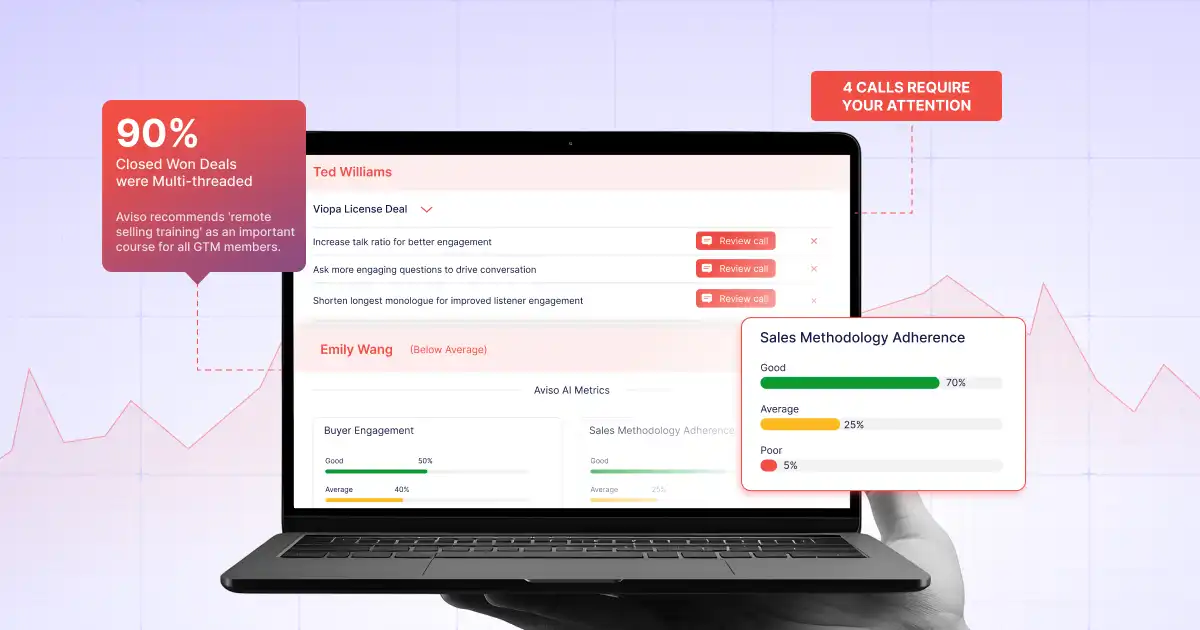
What does your sales enablement analytics dashboard actually measure?
Pull up any one of them. Count the panels about content uploaded, content viewed, certifications completed, training hours logged, playbooks accessed. Then count the panels about whether reps who consumed the content closed more deals than reps who didn't.
The ratio explains why most enablement programs feel important and prove inconclusive.
The work of sales enablement is to teach reps to win. The work of sales enablement analytics is to prove the teaching worked. Most programs measure the first half. The second half is where the budget gets defended.
A working definition
Sales enablement analytics is the practice of measuring whether an enablement program is changing rep behavior and deal outcomes, not just whether content is being produced and consumed.
That definition does one thing the standard definition doesn't.
It separates two things every program conflates. The first is whether the program ran. The second is whether the program worked.
A program that ran (content shipped, training delivered, certifications completed) can fail. A program that worked (rep behavior changed, deals closed faster, win rates moved) is the only kind a CFO will fund a second year of.
The three tiers of sales enablement analytics
Most enablement dashboards live at the bottom tier. The strongest programs operate at the top.
Tier 1: Activity metrics. Content uploaded. Sessions delivered. Certifications completed. Training hours logged. These are inputs. They prove the program ran. They do not prove it worked.
Tier 2: Engagement metrics. Content views. Time on page. Completion rates. Search queries. Quiz scores. These are intermediate. They prove reps engaged with the program. They still do not prove the program changed selling.
Tier 3: Outcome metrics. Win rate lift. Ramp time. Deal-stage conversion rates. Average deal size. Forecast accuracy. These are the metrics a CFO recognizes. They are also the metrics most enablement dashboards skip, because the data lives in a different system from the LMS.
A dashboard that stops at Tier 1 reports activity. A dashboard that climbs to Tier 3 reports impact.
The Lift Question
There is one operator question that, on its own, is more useful than any other enablement metric.
It is this: of two reps running the same play in the same segment, what is the win-rate gap between the rep who completed the enablement program and the rep who didn't? Call it the Lift Question.
The Lift Question forces the program to be measured the way a clinical trial measures a drug. You compare the population that got the treatment to the population that didn't, holding everything else constant. The gap is the impact. The gap is the budget defense.
In most enablement programs, the Lift Question is unanswerable, because the dashboard isn't structured to ask it. The fix is not a better LMS. The fix is a data architecture where enablement attendance is joined to deal outcomes by rep, segment, and play.
When the Lift Question becomes answerable, two things happen. Programs that work get expanded. Programs that don't get killed faster. The whole function compounds.
Metrics worth tracking, by audience
A sales enablement analytics dashboard is wasted if every audience reads the same number. Three audiences, three views.
For the enablement leader: program reach (percentage of reps completing each module), content effectiveness (win-rate lift for content tied to deals), and time to ramp.
For the sales leader: ramp time, win-rate lift by play, quota attainment lift for cohorts running the new motion, forecast accuracy improvement when reps use the play correctly.
For the rep: which plays they have been certified on, which plays correlate to their highest-converting deal stages, what to brush up on before the next call.
A program that produces three views of the same underlying data is operational. A program that produces one view (the leader view) is reporting. The dashboards that get used answer specific questions for specific roles.
Why most enablement analytics stop at Tier 1
Three structural reasons explain why so many programs never reach the Lift Question.
The first is system fragmentation. Enablement data sits in the LMS or content platform. Deal data sits in the CRM. Conversation data sits in the conversation intelligence tool. Without a join, the analyst cannot ask the lift question. Building the join is project work most teams defer.
The second is incentive misalignment. Enablement leaders are often measured on adoption (content viewed, training completed) instead of outcomes. The dashboard reflects the comp plan. The comp plan misses the point.
The third is fear. A program that gets measured at Tier 3 can be proven not to work. A program that stays at Tier 1 looks busy. Many programs prefer busy.
The fix on all three is the same. Tie the enablement system to the deal system at the rep level, change the comp plan to reward outcomes, and accept that some programs will get killed when the data lands. The ones that survive are real.
The shift AI is forcing
Two shifts are converging in enablement analytics. The first is the move from content-driven analytics to conversation-driven analytics. The second is the move from human reporting to AI-generated interpretation.
Conversation-driven analytics looks at what reps actually said on calls, not just what content they consumed. It can ask: did the rep deliver the new value proposition on the discovery call? Did they handle the new objection the way the training script taught? Did they get to the close differently after the new playbook landed?
AI-generated interpretation reads the underlying signal and tells the enablement leader why the win rate moved, not just that it moved. The dashboard stops being a wall of charts and becomes an explanation engine.
The combination changes what enablement analytics is. The old practice measured consumption. The new practice measures whether the conversation changed and whether the conversation that changed produced revenue that wouldn't otherwise have closed.
See What Outcome-Tier Sales Enablement Analytics Looks Like
If your enablement dashboard is full of content views and certification counts but cannot answer the Lift Question, the dashboard is the audit trail, not the asset.
Aviso brings the outcome layer to enablement analytics. Win-rate lift by play, by segment, by rep. Ramp time as a tracked variable, not a guess. Forecast accuracy correlated to which reps applied the new motion on which calls. One platform that ties enablement signal to revenue outcomes on a single signal graph.
Stop counting content. Start measuring lift.
Book a 30-minute demo of Aviso →
In the demo, you'll see how Aviso answers the Lift Question for your team, where your current enablement attribution gap sits, and what one quarter of outcome-tier analytics looks like in real numbers.
Frequently Asked Questions
What is sales enablement analytics?
Sales enablement analytics is the practice of measuring whether an enablement program is changing rep behavior and deal outcomes, not just whether content is being produced and consumed. The strongest programs operate at three tiers: activity (content uploaded, training delivered), engagement (content viewed, quiz scores), and outcomes (win-rate lift, ramp time, deal velocity). Programs that stop at activity report effort. Programs that reach outcomes report impact.
What are the most important sales enablement metrics?
The most important metrics fall into three categories. Activity metrics include content uploaded, sessions delivered, and certifications completed. Engagement metrics include content views, completion rates, and quiz scores. Outcome metrics, which carry the most weight, include win-rate lift by play, ramp time, deal-stage conversion improvement, quota attainment by trained cohort, and forecast accuracy when reps follow the new motion. A balanced dashboard includes all three, with outcome metrics weighted highest.
What KPIs should be on a sales enablement dashboard?
The KPIs that consistently belong on a sales enablement dashboard are win-rate lift attributable to the program, ramp time for new hires, deal-stage conversion by certified rep cohort, content effectiveness by deal stage, time-to-first-meaningful-deal for new reps, quota attainment lift, and program reach (percentage of reps completing each module). Adding KPIs beyond these usually dilutes attention. Removing any of them creates a blind spot.
What is the Lift Question?
The Lift Question is the single most useful question a sales enablement analytics program can answer. Of two reps running the same play in the same segment, what is the win-rate gap between the rep who completed the enablement program and the rep who didn't? The gap is the program's measurable impact. Most enablement dashboards cannot answer this question because the enablement system is not joined to the deal system at the rep level. Programs that fix that join can answer the Lift Question and defend their budget on outcome data.
How do you measure the ROI of sales enablement?
Sales enablement ROI is measured by isolating three uplift signals: win-rate lift in trained cohorts, ramp-time reduction for new hires, and quota attainment lift. Multiply each by average deal value and pipeline volume to translate the lift into revenue dollars. Subtract program cost. The remaining number is enablement ROI. Programs that can produce this calculation in less than a day have a real analytics stack. Programs that can't are flying on belief.
What is the difference between sales enablement analytics and sales analytics?
Sales analytics measures the sales motion broadly: pipeline coverage, forecast accuracy, win rate by segment, deal velocity, rep productivity. Sales enablement analytics is the subset focused on whether the enablement program is changing the sales motion. The two share the same outcome metrics but ask different causal questions. Sales analytics asks what is happening with the pipeline. Sales enablement analytics asks why the pipeline is happening differently after the program shipped.
What is AI sales enablement?
AI sales enablement uses machine learning to do three things a traditional enablement program does manually. First, it analyzes conversation data to detect whether reps are actually applying the training in live calls. Second, it generates personalized coaching recommendations for each rep based on their conversation patterns and deal outcomes. Third, it surfaces which content is correlated with closed-won deals at the deal-stage level. The result is enablement that moves from broadcast training to targeted intervention.
Which sales enablement platforms include strong analytics?
The strongest sales enablement analytics capabilities currently come from Highspot, Mindtickle, Seismic, Showpad, Allego, and Aviso. Highspot, Seismic, and Showpad lead on content analytics. Mindtickle and Allego lead on readiness and learning analytics. Aviso brings the outcome-tier analytics most pure-play enablement platforms struggle with, because Aviso ties enablement signal to forecasting, deal risk, and conversation data on a single revenue intelligence platform. The right choice depends on whether the team needs deeper content analytics or deeper outcome analytics.
How does Aviso help with sales enablement analytics?
Aviso connects the enablement layer to the outcome layer that most enablement platforms cannot reach. The platform ties rep training and content consumption to live conversation data, deal stage progression, forecast accuracy, and win-rate outcomes on a single signal graph. That means a leader can ask the Lift Question directly: which reps completed the new training, which calls applied the new play, and what did the win rate do as a result. Pure-play enablement tools usually stop at content engagement. Aviso starts where they stop.
Can Aviso replace a dedicated sales enablement platform?
For outcome-tier analytics (win-rate lift, ramp time, deal velocity, forecast accuracy attributable to training), Aviso replaces the analytics layer most dedicated enablement platforms try to bolt on. For content management, certification workflows, and learning paths, dedicated platforms like Highspot, Mindtickle, or Seismic remain the primary system of record. The most effective revenue orgs run a dedicated enablement platform for content and learning and use Aviso for the outcome analytics that prove the program worked.