ICP Scoring is Broken for Enterprise Marketing Teams. Here's How Agentic AI Fixes Lead Qualification.

No time to lose? Summarize with AI
ChatGPT
Claude
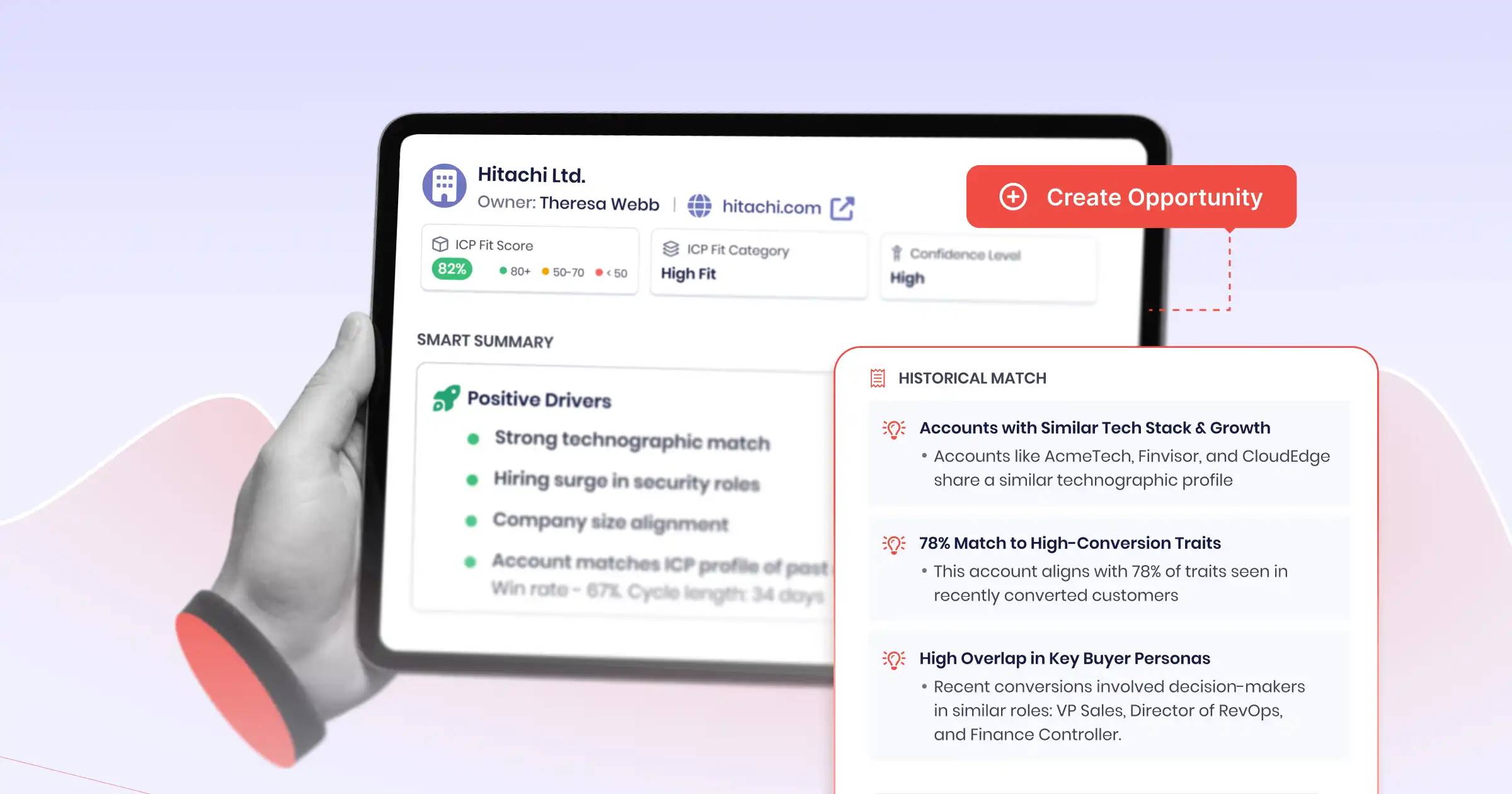
The short answer: Enterprise lead qualification fails when marketing and operations teams rely on superficial, static Ideal Customer Profile (ICP) definitions and manual lead qualification. Aviso’s ICP Scoring Agent turns lead qualification into an autonomous process by modelling your historic "Win Fingerprint" across 26+ data points, then automatically scoring incoming inbound leads and website traffic in real-time. It helps revenue teams eliminate pipeline bloat and prioritise ‘likely to win’ leads.
Your marketing ops teams are spending hours manually researching inbound leads, while your sales reps chase accounts that look good on paper but are structurally bound to lose.
The spreadsheets are unmanageable. The ICP definitions are shallow. High-intent, perfect-fit accounts sit idling in queues, while low-probability leads bloat your pipeline and waste sales cycles.
This is not an effort problem. It is a systems problem.
What Is ICP Scoring and Why It Keeps Failing
An Ideal Customer Profile (ICP) is a data-backed blueprint of the accounts that derive the most value from your product and deliver the highest lifetime value to your business. When done well, it aligns marketing and sales on exactly who to target, which leads to fast-tracking and determining where to deploy ad spend.
When done poorly, as is the case for most enterprise organisations, it is a generic, static document based on gut feeling and basic industry classifications that sits on a shared drive, completely disconnected from daily execution.
The failure is structural. Here is why traditional enterprise ICP scoring consistently breaks down:
Definitions are superficial. Most teams define their ICP using just three metrics: industry, employee count, and geography. They miss the hidden patterns—like specific technographic stacks, historic sales cycle lengths, and win/loss data—that actually dictate whether a deal will close.
Qualification is manual. Revenue operations teams must piece together data from enrichment tools, LinkedIn, and CRM histories just to determine if an inbound lead is worth routing to an Enterprise AE. This consumes dozens of hours of operations work every week.
Pipelines suffer from silent bloat. When definitions are shallow, leads that are fundamentally a poor fit slip into the pipeline. They advance through early stages, bloating the forecast, only to stall out late in the sales cycle.
Sales and marketing alignment fractures. Marketing claims victory based on high lead volume, while Sales complains that the leads are unwinnable. Without a shared, data-verified definition of a qualified lead, trust between teams erodes.
High-value leads slip through the cracks. When an inbound lead from a Tier-1 account arrives, it gets stuck in the same generic routing and manual verification queue as every other lead. By the time a human qualifies it, the competitor has already booked the meeting.
These problems persist because the underlying approach—asking humans to score complex accounts against rigid, simplistic rules manually—has not changed even as enrichment databases have grown larger.
What An Agentic ICP Scoring System Actually Means
Agentic ICP scoring means the system decodes your historical data, uncovers the patterns of your past deals, auto-creates your ICP definition, and dynamically scores every new lead. The marketing team provides strategic direction. The agent handles the data synthesis and real-time evaluation.
This is fundamentally different from traditional lead scoring systems (built through systems like Marketo or HubSpot) that rely on arbitrary point values assigned by a marketer (e.g., +10 points for downloading a whitepaper). An ICP Scoring Agent operates like an advanced data scientist. It maps your historical CRM data to discover your "Win Fingerprint"—the multi-dimensional signature of your most successful customers.
The agent's continuous output covers everything enterprise marketing teams need to optimise lead flow:
Dynamic mathematical model of your true ICP
Automated real-time scoring of inbound leads and website visitors
Deep-dive fit analysis across 26+ firmographic and behavioural criteria
Pipeline velocity and win-probability predictions
Automated high-tier routing triggers for instant sales handoff
The marketer’s job shifts from manually building complex lead-scoring rules to executing high-level campaign strategies against clear, high-probability segments.
Enterprise ICP Lead Qualification Best Practices Before You Automate Anything
Before deploying an AI agent, enterprise teams must understand what an actual, high-fidelity ICP requires. High-performing revenue teams look far beyond basic demographics to establish a true profile.
The Win Fingerprint Foundations
Advanced Firmographics & Regional Nuance: Moving past company size to analyse true organisational design, parent-subsidiary relationships, and regional buying variations.
Technographics: Understanding not just what software they use, but their technical maturity, legacy tech debt, and adjacent software spend.
Commercial Realities: Factoring in historical sales cycle lengths, average contract values (ACV), cost of acquisition (CAC), and multi-year retention rates.
Win/Loss Trajectories: Examining the precise inflection points where deals historically accelerate or completely stall out.
Mapping all of this manually across thousands of historical accounts and applying it to hundreds of daily web visitors is impossible at scale. This is the problem the ICP Scoring Agent was built to solve.
How Aviso’s ICP Scoring Agent Works
Aviso's ICP Scoring Agent ingests your historical data to construct your unique Win Fingerprint, then automatically monitors and scores incoming demand against that model.
Here is how the workflow operates in practice:
Step 1: Discover Your Unique ICP ‘Win Fingerprint’
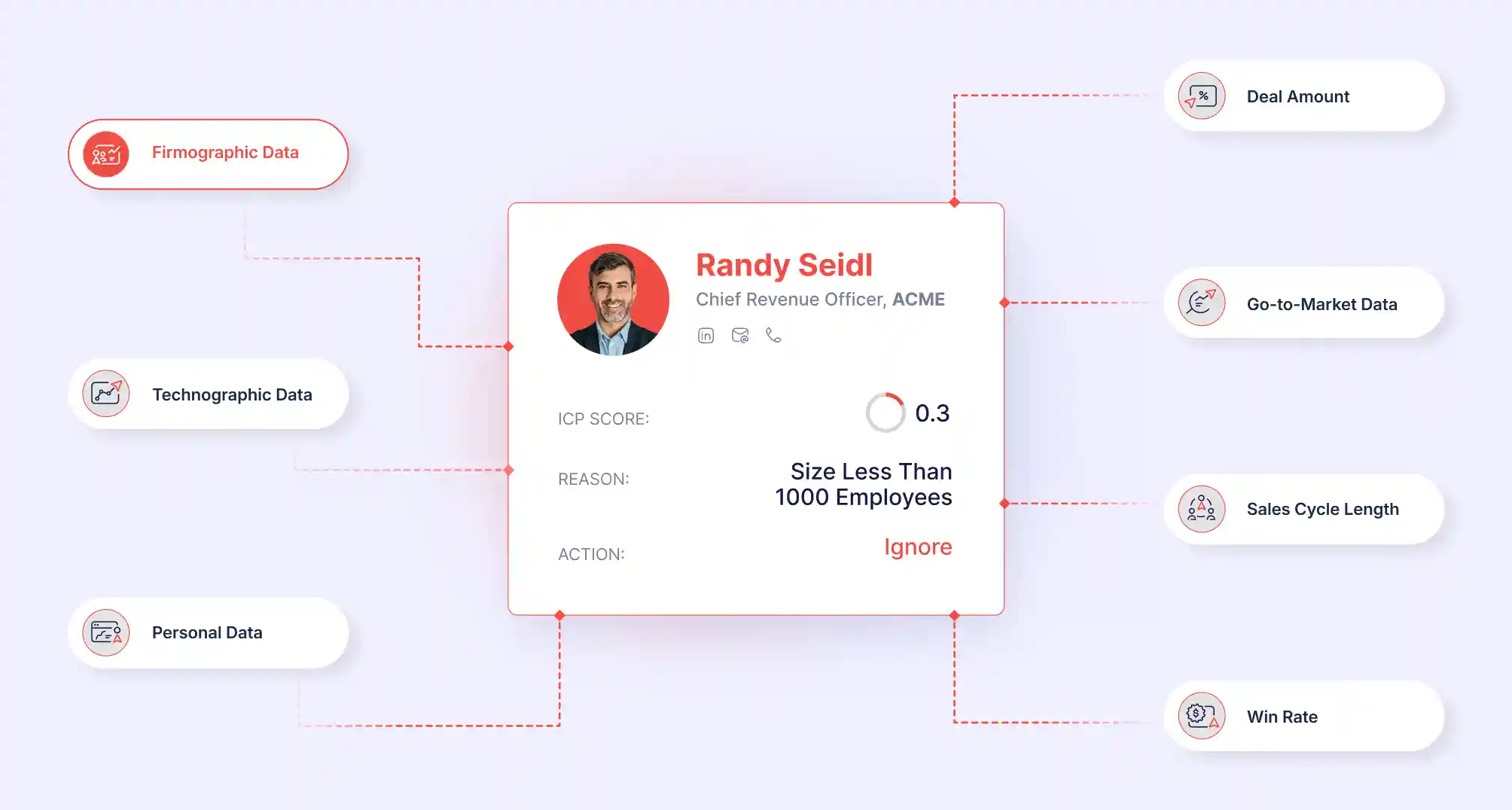
The agent connects to your CRM, historical opportunities, and closed-won/closed-lost archives. It instantly analyses firmographics, regions, technographics, sales cycle lengths, win rates, deal amounts, and over 26 other criteria to build a highly accurate, multi-variable model of your perfect customer.
Step 2: Auto-Create Your ICP Definition and Qualify in Real-time
As new inbound leads fill out forms or anonymous target accounts visit your website, the agent instantly cross-references them against the ICP definition created using the Win Fingerprint. It handles the backend pattern matching instantly.

Step 3: Explain the ICP Score For Every Lead
Unlike legacy marketing intelligence tools, where qualification lives in a black box, Aviso’s ICP Scoring Agent actually explains the reasoning behind each lead’s ICP score, enabling transparency and prioritisation.
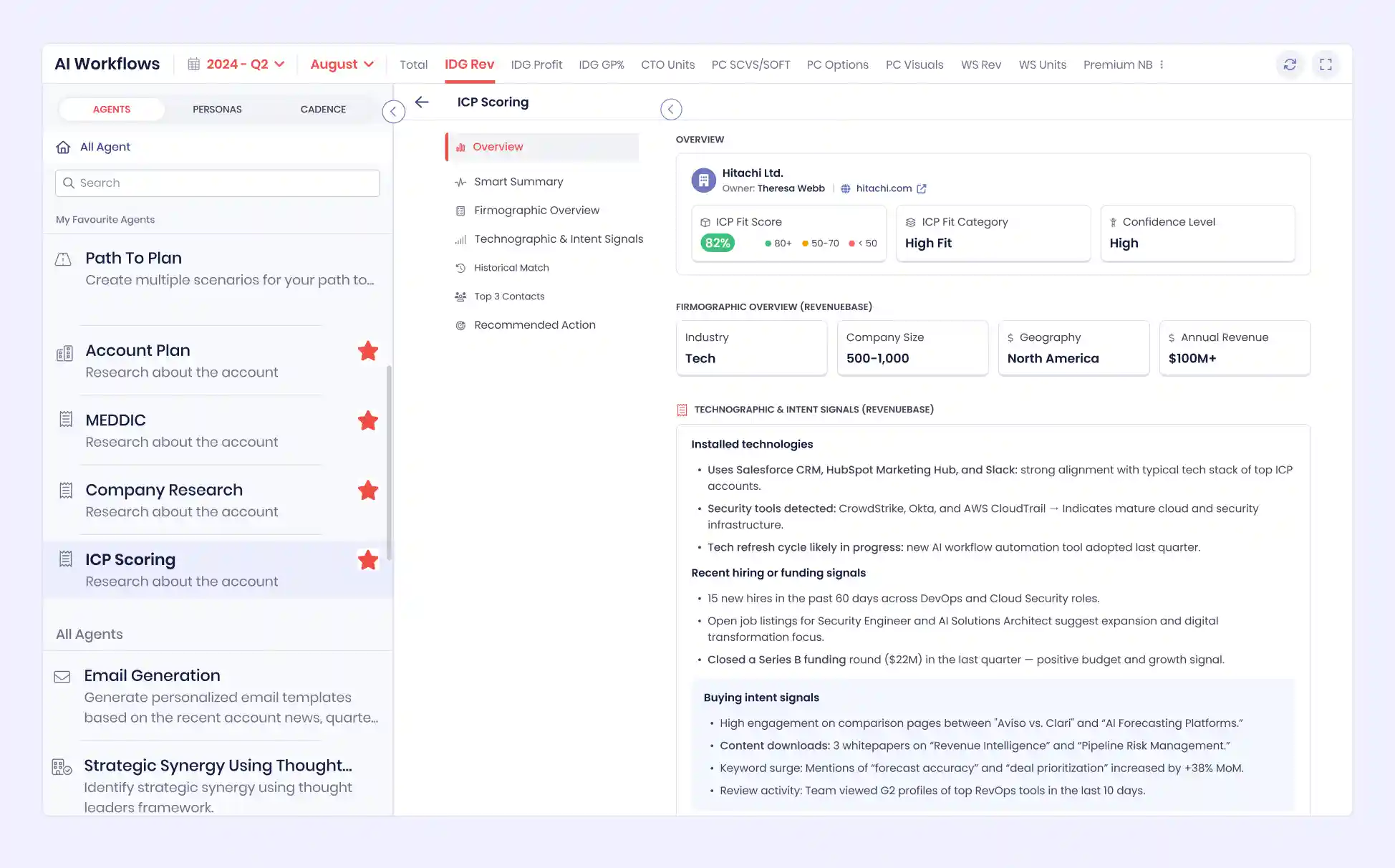
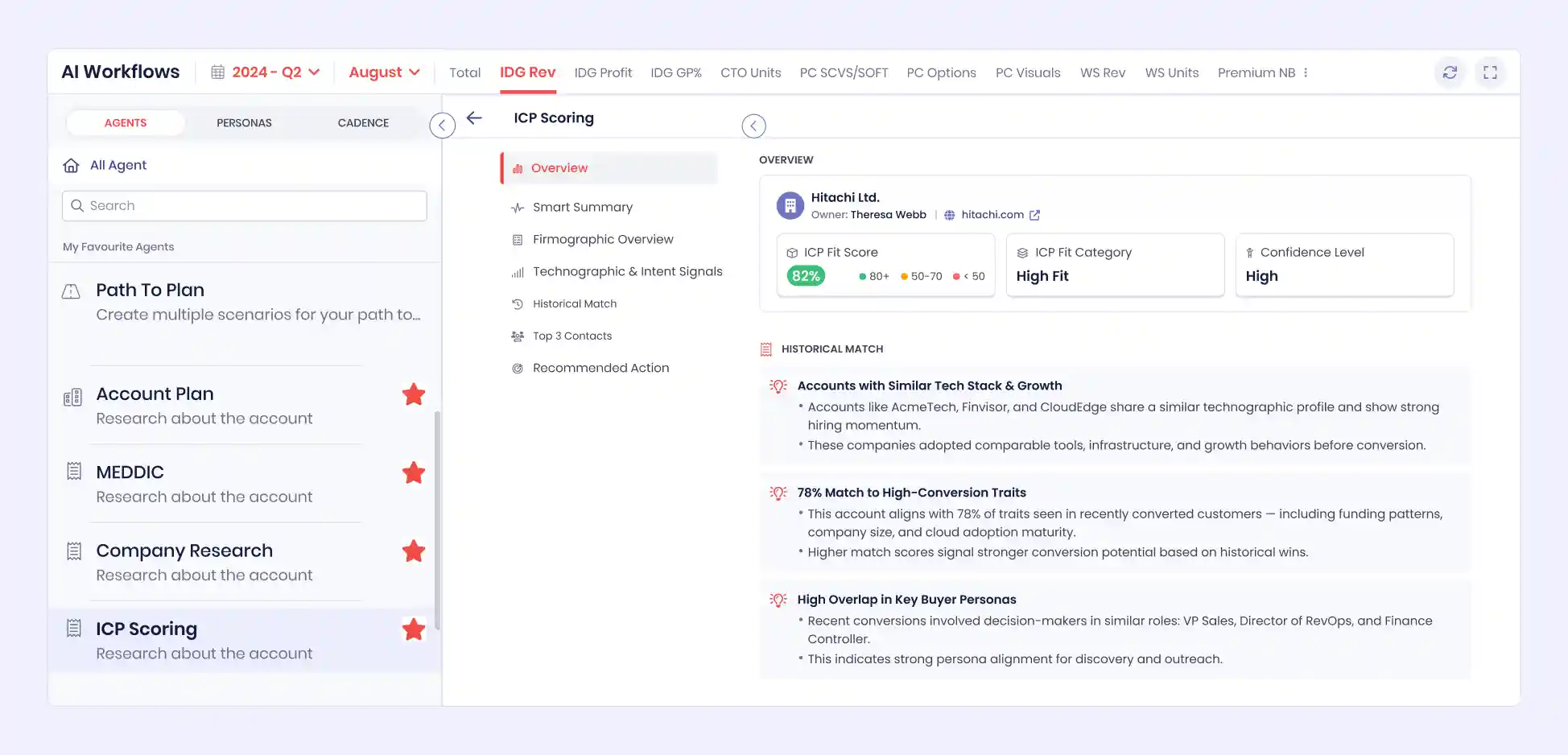
The ICP Scoring Agent summarizes its reasons for scoring the account using multiple parameters, explains positive and negative drivers and goes on to deliver specific scoring explanations. For instance, it elaborates:
1) Technographic Data and Intent Signal Capture
2) Matching Against Historical Conversion Patterns
3) Win Rate Against That Particular ICP Segment
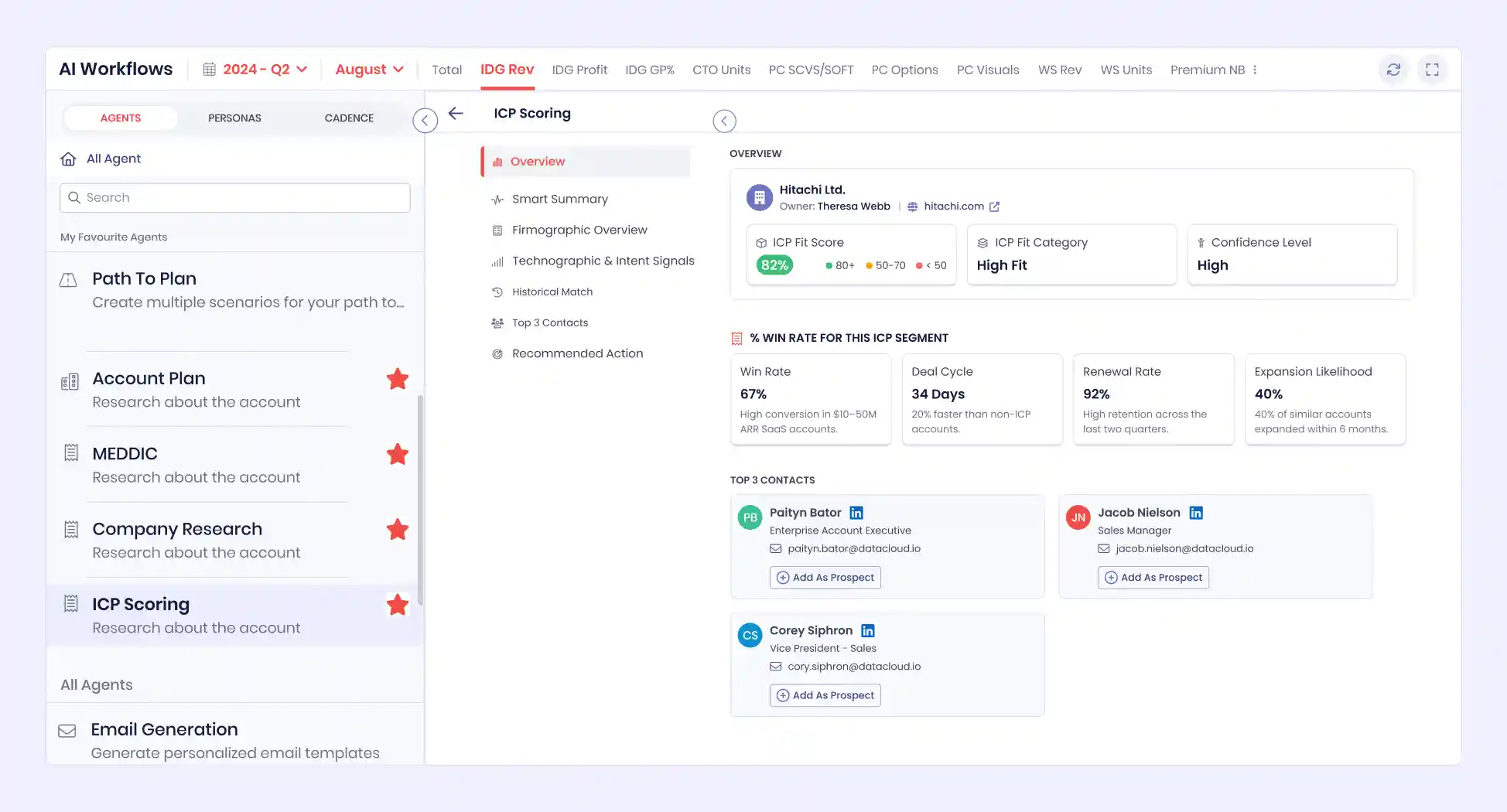
Step 4: Route and Assign Best-Fit Leads
The lead is assigned a precise ICP match grade. High-match leads bypass generic queues and are routed directly to Enterprise AEs with a full contextual summary, while low-match leads are cleanly segmented into automated nurture tracks.

What Enterprise Marketing Leaders Actually Get
The ICP Scoring Agent delivers macro outcomes across the entire Go-To-Market team:
Zero manual ops overhead. Marketing and RevOps teams stop chasing data gaps or manually reviewing lead sheets. The qualification layer is fully automated and source-verified.
Total sales-marketing alignment. Because the ICP model is built directly on historical sales wins, Sales can no longer claim marketing leads are unqualified. The criteria are objective, mathematical, and transparent.
Drastic reduction in pipeline bloat. By filtering out bad-fit leads before they become open opportunities, sales pipelines stay lean, clean, and highly predictable.
Accelerated speed-to-lead. Perfect-fit enterprise buyers are identified within seconds of hitting your ecosystem, allowing your sales team to engage them while intent is at its peak.
Traditional Lead Scoring vs. Agentic ICP Scoring
Traditional Lead Qualification | Aviso’s ICP Scoring Agent |
Marketers guess point values (e.g., +5 for email clicks) | Agent models real win patterns across 26+ deep ICP variables |
Relies on superficial data (industry, size) | Synthesises technographics, sales velocity, deal amounts, cycle lengths, and win rates |
Static rules that go stale and require constant adjustment | Continuously optimises its model as new deals are won or lost |
Results in a bloated pipeline full of low-probability leads | Keeps focus strictly on high-probability, high-value accounts |
Manual data enrichment and routing delays | Real-time enrichment, scoring, and instant routing |
The Bottom Line for Marketing Leaders
Your ICP should be an active operational engine, not a forgotten slide deck. When marketing ops spends hours manually filtering leads while sales waste time chasing bad fits, the system is the problem. Aviso’s ICP Scoring Agent gives your team automated qualification, real-time precision routing, and a clean pipeline built entirely on deal win/loss data.
Book a demo to see Aviso’s ICP Scoring Agent in action.
FAQs
1) How does the agent build the ICP "Win Fingerprint"?
The agent analyses your historical CRM data, evaluating both your closed-won and closed-lost opportunities. It looks at over 26 criteria—including deal size, technographics, sales cycle lengths, executive job titles, and regional data—to uncover the exact statistical patterns shared by your most profitable, high-velocity customers.
2) How is Aviso’s ICP Scoring different from standard lead scoring in marketing automation and lead qualification workflows?
Standard marketing automation tools score behaviour based on arbitrary points (like downloading a PDF). The Aviso ICP Scoring Agent scores firmographic and structural fit based on historical data science. It answers whether an account is fundamentally capable of buying and retaining your software, rather than just measuring if someone clicked a link.
3) Does ICP Scoring support anonymous web traffic or just form fills?
It supports both. When integrated with your digital channels, the agent identifies anonymous enterprise traffic via reverse-IP lookup, matches the company against the Win Fingerprint, and alerts marketing teams to high-value intent before a form is ever filled out.
Read More Like This
