Ideal Customer Profile (ICP): How AI-Powered ICP Scoring Drives Higher Win Rates

No time to lose? Summarize with AI
ChatGPT
Claude

Not all customers are equal. Strong sales and marketing teams understand this, but without a structured approach, targeting decisions often rely on instinct, outdated assumptions, or whoever is already in the pipeline. This is where the Ideal Customer Profile (ICP) becomes essential. It provides a data-driven definition of the companies most likely to buy, retain, and expand.
What Is an Ideal Customer Profile?
An Ideal Customer Profile (ICP) defines the companies that are the best fit for your product and the most valuable to your business. It operates at the account level and focuses on who you should sell to, not just who you can sell to.
Unlike traditional lead scoring, which tracks what a person does (like opening emails), ICP scoring focuses on what a company is. It answers the question: "Is this the type of business we actually want to sell to?"
Why ICP Scoring Matters
A well-defined ICP is a core driver of go-to-market efficiency:
It improves focus, leading to higher win rates, shorter sales cycles, and larger deal sizes
It aligns Sales, Marketing, and Product around high-value accounts
It reduces wasted effort on low-fit opportunities
Challenges with Conventional ICP Approaches
When the ICP is unclear or outdated, targeting breaks down. Sales teams commonly face:
Missed Opportunities: The risk of failing to attract and retain customers akin to those who have previously found success with the product or service.
Inaccurate Targeting: Heightened chances of marketing to the wrong audience, resulting in wasted resources and ineffective campaigns.
Limited Understanding of Customer Motivations: A constrained view of the factors influencing customers' purchasing decisions, leading to ineffective marketing strategies.
Overlooking Market Shifts: The danger of neglecting to adapt to evolving customer preferences and industry trends, potentially ceding market share to more nimble competitors.
This is where an AI-based real-time customer profiling system comes into play.
Aviso’s ICP scoring system assigns every account a score from 0 to 100 based on how closely it matches your highest-value customer profile. This enables teams to prioritize accounts with confidence and act on data instead of debate.
How Aviso's ICP Scoring Works
Aviso's innovative ICP scoring system is crucial in creating an ideal customer profile and identifying pursuit-worthy accounts through a robust, data-backed method. This system goes beyond traditional quota assessment qualifiers by blending solid ICP criteria with softer elements to assess an account's suitability for the pipeline.
Sales representatives are empowered by this system to quantitatively match accounts with the defined ICP, enhancing precision in their targeting efforts.
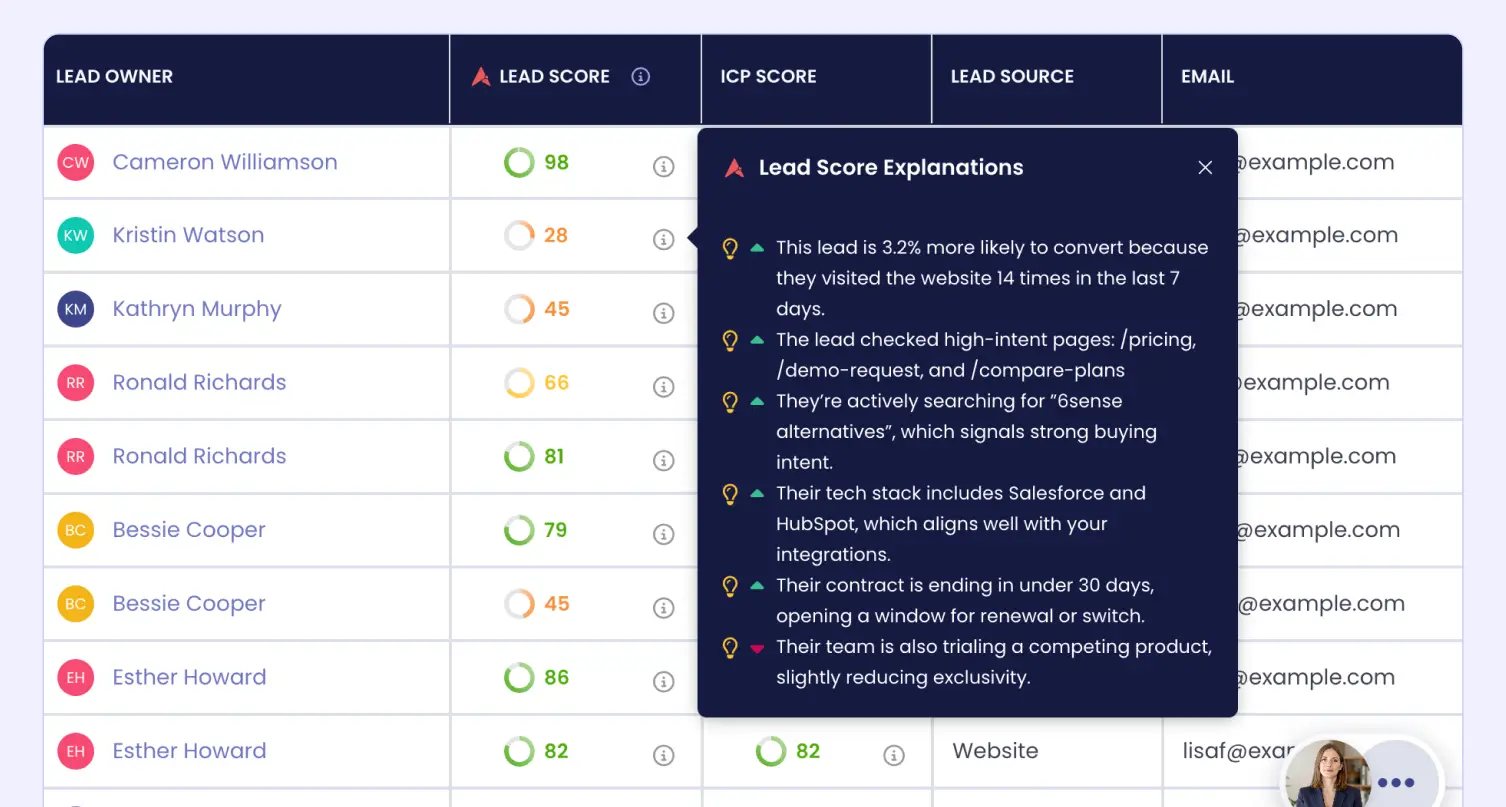
Moreover, Aviso’s ICP score goes beyond a static number by providing AI-generated explanations that make it actionable. Through the information icon (as shown above), users can access a clear breakdown of why an account is considered a strong or weak fit.
Clicking on the “i” icon reveals insights such as how closely the account aligns with your core target segments (industry and revenue range), whether its headcount matches your ideal customer profile, and how compatible its existing tech stack is with your product. It also highlights pattern-based signals, such as how similar companies have recently converted, and behavioral indicators, such as recent digital expansion, that may suggest buying readiness. At the same time, it surfaces potential risks, for example, historically longer procurement cycles for similar accounts.
Instead of being a black-box metric, Aviso’s ICP score acts as a transparent, explainable decision tool, helping users with the information needed to make informed decisions, providing a nuanced understanding of account dynamics. The result is a more strategic, data-backed approach to prioritization, messaging, and deal execution.
Key Signals Powering Aviso's ICP Score
Aviso's ICP scoring model draws on three categories of signals to evaluate account fit:
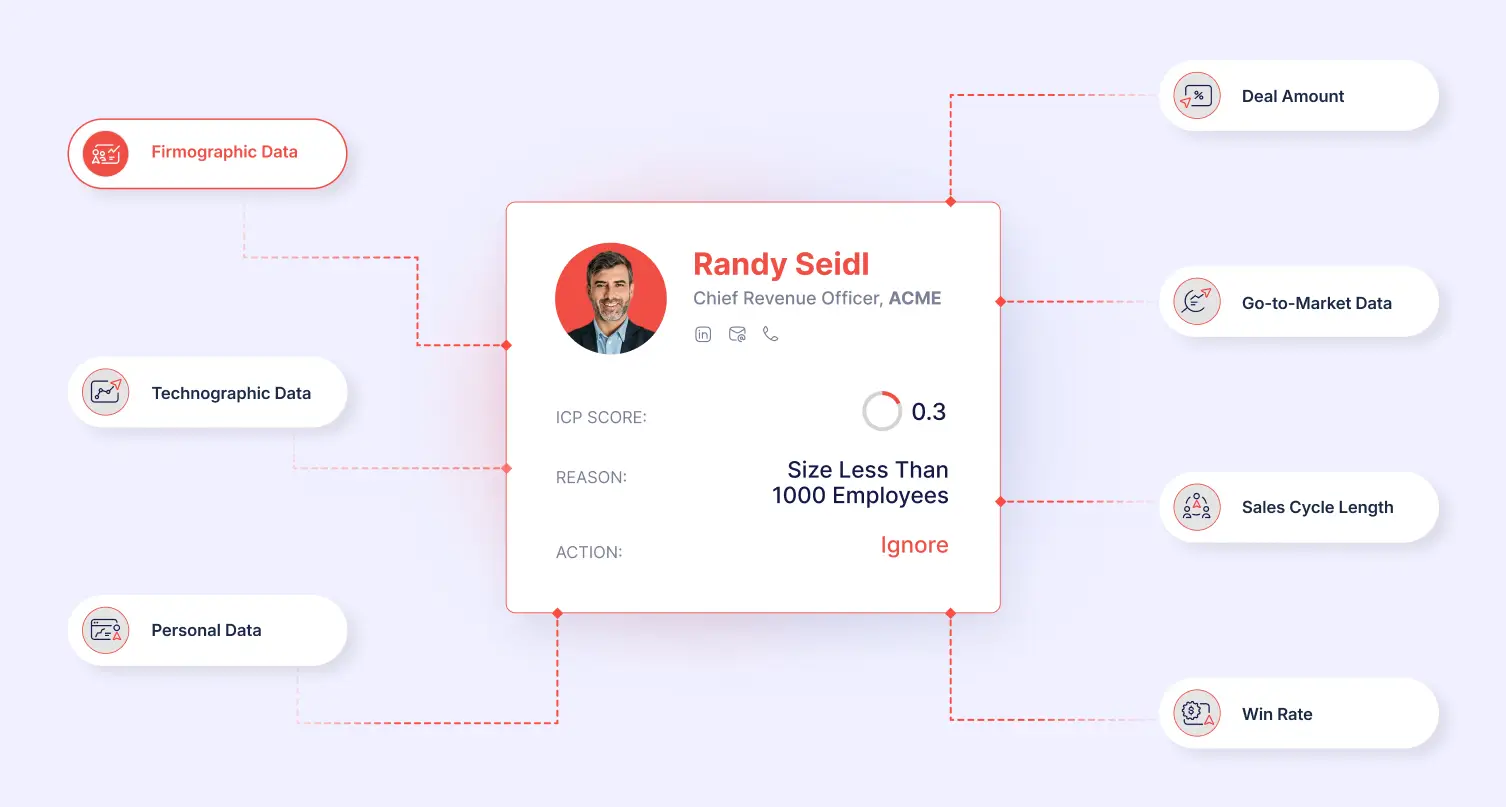
Firmographic: Employee count, revenue range, industry description, and HQ location, the structural foundation of account fit.
Technographic: ERP and ABM technographics, understanding the technology stack a prospect operates on.
Go-to-market: Sales and IT open roles, a real-time indicator of a company's growth trajectory and buying intent.
Together, these signals give sales and marketing teams a multi-dimensional view of each account, moving well beyond traditional firmographic-only filters.
Under the Hood: AI-Driven Win Pattern Analysis
Analyzing a customer's historical win patterns is a key step for Aviso's ICP scoring. This process designates closed-won accounts as Ideal Customers.
The AI model then delves into the specific attributes associated with these successes. These attributes include revenue, account source, team size, and location. This knowledge empowers the AI model to effectively categorize prospecting CRM accounts as potential Ideal Customers, enhancing target identification accuracy.
Moreover, Aviso introduces an ICP proximity score, providing users with a tool to optimize their efforts and time when pursuing new accounts.
A higher ICP score means a prospect closely aligns with ideal customer traits, streamlining identification and prioritization for increased conversion likelihood.
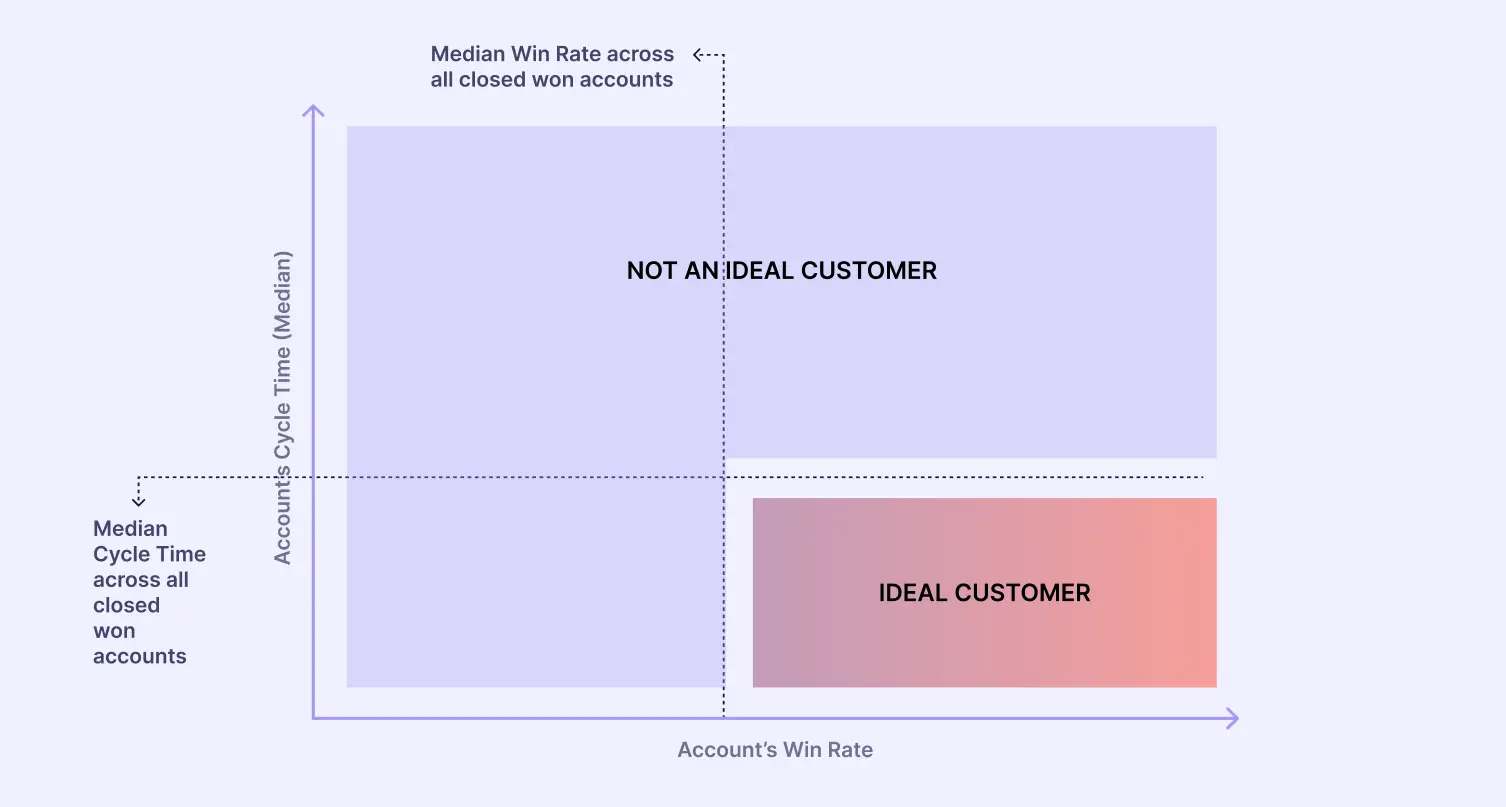
The selection of an Ideal Customer is based on three factors:
Win Rate: Percentage of won deals
Cycle Time: Average time to close deals
Account Size: Average deal amount
An ideal customer has a higher win rate and lower cycle time for similar-sized accounts. A higher ICP score means a prospect closely aligns with ideal customer traits, streamlining identification and prioritization for increased conversion likelihood.
Key Benefits of Aviso's ICP Score:
Precision Targeting: Pinpoint and prioritize prospects with the highest potential, directing sales and marketing efforts toward targeted accounts most likely to convert.
Customized Messaging and Communication: Craft tailored marketing and sales messages based on the distinctive characteristics of your customer profile, enhancing resonance with the buyer.
Enhanced Conversion Rates: Focus on customers aligning with the ICP, heightening the probability of converting opportunities into satisfied customers and delivering tangible value for your product or service.
Streamlined Sales Cycles: Simplify the sales process by concentrating on well-matched customers, resulting in shorter sales cycles and faster decision-making.
Optimized ROI: Efficiently allocate resources by honing in on the right customers, leading to a maximized return on investment.
Informed Product Development: Utilize insights from the ICP score to refine and elevate your products or services, aligning them more closely with the evolving needs of your existing customers.
Stop Guessing. Start Scoring.
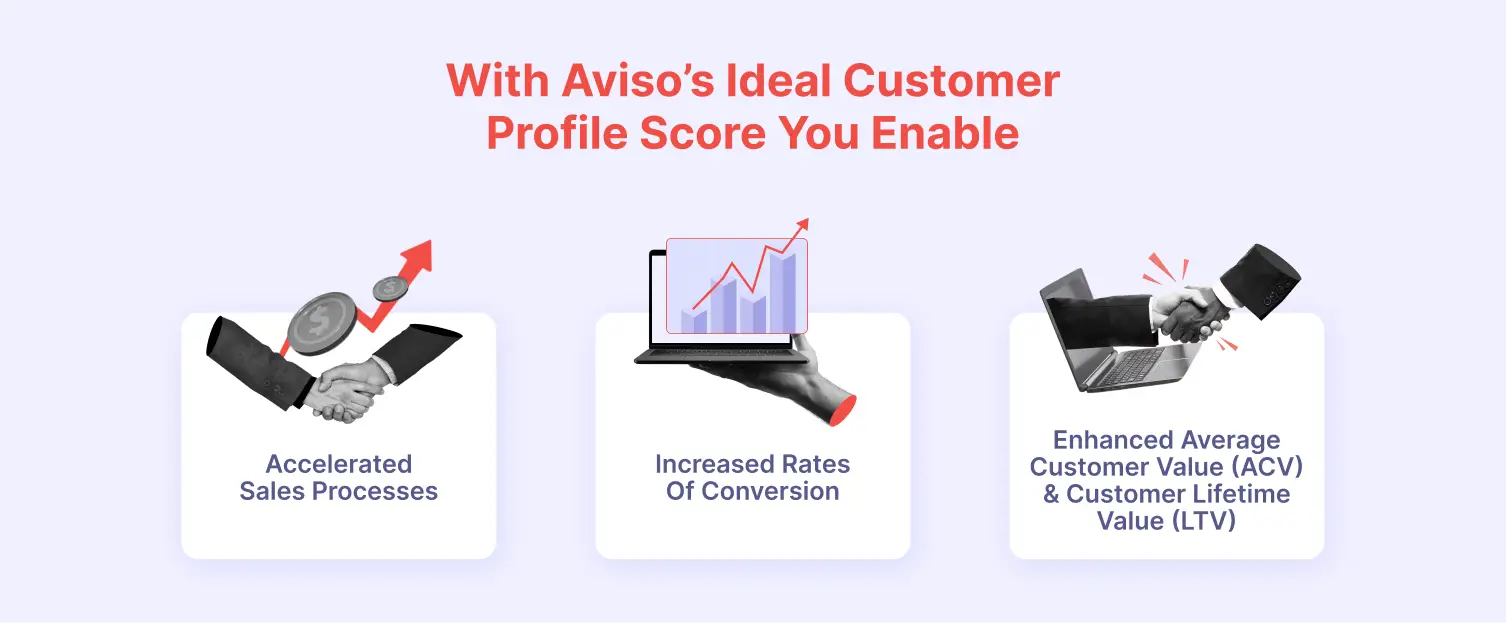
Aviso's ICP Score transforms account qualification by blending firmographic, technographic, and go-to-market signals with AI-driven win pattern analysis. By defining not just who you can sell to, but who you should sell to, the ICP score empowers go-to-market teams to act with purpose. Sales, Marketing, and Product align around the same high-fit accounts, reducing wasted effort and accelerating revenue-efficient growth.
This innovative system empowers sales teams to precisely match accounts with the ICP, streamlining efforts for improved targeting, communication, and conversion rates. Aviso's approach significantly shortens sales cycles, boosts ROI, and guides better product development and customer success.
If you're not already a customer, request a demo to discover how Aviso's ICP Score can help track ideal prospects based on your unique customer profile.
FAQs
What is an Ideal Customer Profile (ICP)? An Ideal Customer Profile (ICP) is a data-driven definition of the companies most likely to buy, retain, and expand with your product. It operates at the account (company) level and focuses on firmographic, technographic, and GTM signals — not individual buyer behavior. The ICP answers: "Which companies should we sell to?"
What does ICP stand for? ICP stands for Ideal Customer Profile. In B2B sales and marketing, the ICP is the structured definition of the company-level traits that make an account a best-fit prospect.
What is the difference between an ICP and a buyer persona? An ICP describes the company you should sell to; a buyer persona describes the individual inside that company. The ICP filters which accounts deserve attention (firmographic, technographic, GTM signals); the persona shapes how you engage the buyers inside them (role, goals, pain points). You need both.
How is an ICP score calculated? Aviso's ICP score is generated by an AI model that compares each account against the patterns of your historical closed-won customers. It blends firmographic signals (industry, revenue, headcount, geography), technographic signals (tech stack, ERP, ABM tools), and GTM signals (open sales and IT roles) to produce a 0–100 score. Higher scores indicate closer alignment with your highest-value customer profile.
How is AI-powered ICP scoring different from traditional ICP definitions? Traditional ICPs are static documents — built once, rarely updated. AI-powered ICP scoring is dynamic: the model learns from new wins and losses, updates account scores in real time as signals change, and explains its reasoning so reps can validate or override. The result is a living, transparent score instead of a one-time strategy doc.
Why does ICP scoring matter for sales and marketing? ICP scoring drives higher win rates, shorter sales cycles, and larger deal sizes by focusing teams on accounts that match the patterns of past success. It also aligns Sales, Marketing, and Product around a shared definition of "high-value account" — reducing wasted spend on low-fit opportunities.
How do you create an Ideal Customer Profile? The fastest method: pull your closed-won customers from the last 12–24 months, identify shared firmographic and technographic traits, layer in GTM signals (hiring patterns, expansion activity), define disqualifiers, and validate against accounts you've lost. AI-powered platforms like Aviso automate this entire process against live CRM data.
What's an example of an Ideal Customer Profile? A mid-market B2B SaaS ICP might look like: industry = SaaS or fintech; revenue = $50M–$500M ARR; employee count = 250–2,500; tech stack = Salesforce + modern data warehouse; GTM signal = hiring for RevOps or sales enablement in the last 90 days; disqualifier = under 100 employees. The right ICP is specific, evidence-backed, and anchored to the patterns of your past wins.
Read More Like This
