Leveraging Aviso's Engagement Grade for Strategic Sales Success

No time to lose? Summarize with AI
ChatGPT
Claude

In today's digital-first world, understanding the nuances of customer engagement has become as crucial as the pitch itself. It’s not merely about the volume of engagements—how many calls were made or how many emails were sent. Instead, it’s about the impact of those engagements: Which ones moved the needle, and why?
Aviso’s AI technology, powered by advanced AI and ML models, provides a clear, quantifiable measure of your team's connection with potential buyers. Central to this is Aviso’s Engagement Grade, a metric that evaluates the quality of interactions between sales teams and their prospects or customers, turning everyday communications into strategic assets.
This feature empowers organizations to transform raw interaction data into actionable insights, fostering better customer relationships and ultimately driving sales success.
What is an Engagement Grade?
Understanding the quality of buyer engagement is critical to knowing whether sales activity is actually driving progress. Think of Engagement Grade as a report card for your sales team’s interactions with buyers. It's all about measuring how well your team connects with potential and existing customers through emails, meetings, and other activities to assign a grade at Contact, Opportunity, and Account levels.
The grade you get, which ranges from A+ (highest engagement) to D- (lowest engagement), gives you an idea of how successful your interactions are and how likely they are to lead to successful deals. In simpler terms, the Engagement Grade is your cue card for spotting the strongest and weakest points in your communication efforts.
Aviso’s Engagement Grading Framework
Aviso’s AI evaluates deals the way experienced sellers do by looking beyond CRM fields to understand real buyer and seller behavior over time.
Each opportunity is treated as a living relationship network made up of stakeholders and their interactions. Instead of counting all activities equally, the model identifies which people, conversations, and patterns historically influence outcomes and gives those signals more weight.
To form this view, the model analyzes two complementary inputs:
Deal Context (CRM Data): Opportunity attributes such as stage, size, age, region, and historical performance anchor engagement in business reality and set expectations for what healthy progress should look like.
Buyer and Seller Interaction Signals (Engagement Intelligence): Aviso captures engagement across multiple behavioral dimensions to create a complete picture of deal health, not just activity volume:
Temporal signals track how engagement evolves over time, including responsiveness, consistency, and momentum, to identify acceleration or stall. This includes signals such as deal age and timing indicators such as deal day number or deal week number, response urgency between buyers and sellers, interaction timing, and reading effort associated with communications.
Intent signals analyze combinations of behaviors and conversation patterns to detect readiness, objections, or forward progress. Examples include emotional decision readiness, decision-stage conversations focused on approvals or evaluations, objection and concern signals, and indicators of progress such as clear next steps or action commitments.
Content signals evaluate the substance of interactions, such as questions, action items, and next steps, to distinguish meaningful dialogue from surface touchpoints. Signals in this category capture the presence of actionable content, questions from buyers, assigned action items, escalation indicators such as broader participation, and the overall depth and completeness of communication.
Sentiment and emotion signals interpret tone and confidence to surface optimism, hesitation, or risk early. These include overall sentiment, sentiment confidence, detection of emotions such as optimism or concern, and the strength with which those emotions are expressed.
Network evolution signals monitor how the buying group expands, including stakeholder participation, seniority, and multi-threading, to assess deal maturity. Examples include new participant entry, buyer and seller participation levels, involvement of senior decision-makers, cross-organization engagement, and whether communication is buyer-initiated or seller-driven.
Interaction context signals anchor insights in real activities such as emails and meetings and weigh the relative importance of each touchpoint. This includes understanding the type of interaction, the role meetings play in advancing engagement, and the relative priority or importance of communications.
Outcome alignment signals continuously learn from historical wins and losses so the system emphasizes engagement patterns proven to lead to successful deals. Engagement is evaluated in the context of whether similar patterns resulted in successful outcomes and how long those outcomes typically took to materialize.
By combining these dimensions, the model separates meaningful engagement from noise, surfaces risk and momentum earlier, and explains the drivers behind deal health.
In short, Aviso evaluates not just how much activity is happening, but when, how, with whom, and whether that engagement actually leads to wins.
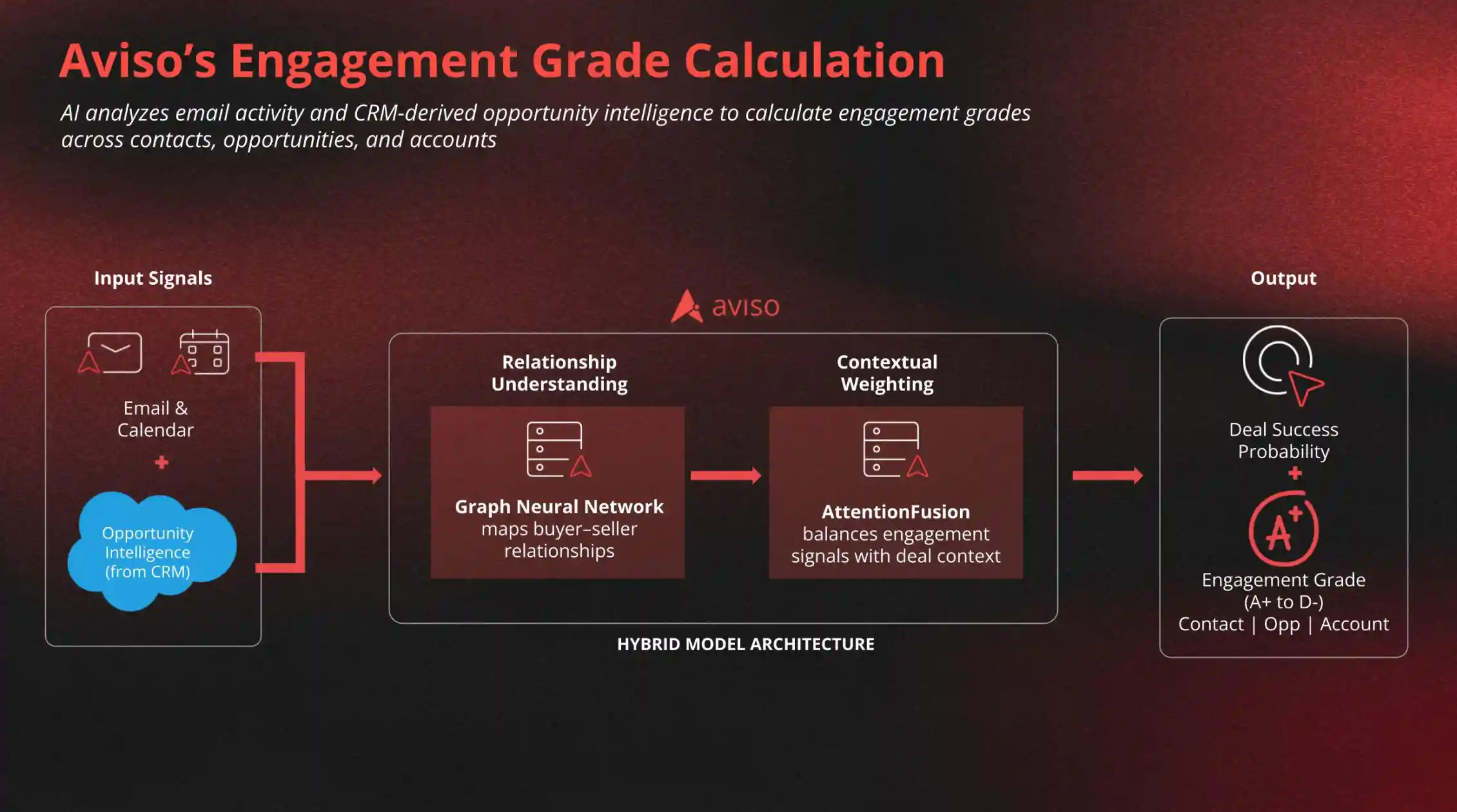
Engagement Grade Calculation
The Engagement Grade translates this intelligence into a clear, actionable score for business users.
Rather than assigning grades based on activity thresholds, Aviso uses an outcome-driven approach that connects engagement directly to deal success.
The hybrid grading approach combines data-driven learning with proven business best practices to produce an Engagement Grade that is both intelligent and practical.
Step 1: Understanding Engagement Through Interactions
The process starts with buyer–seller interaction data such as emails, meetings, responses, and conversation signals. These interactions help Aviso understand:
Who is engaging
How frequently and consistently engagement is happening
Whether conversations show momentum, urgency, or hesitation
This forms the foundation of how engagement is evaluated.
Step 2: Adding Opportunity Intelligence Signals
Engagement is then evaluated in the context of the specific opportunity and account.
Expectations vary by deal stage, size, and sales cycle, so signals are normalized to reflect what “healthy” looks like for that situation. This helps the system understand:
Which deal the engagement belongs to
Where that deal sits in the overall sales motion
Step 3: Learning From Deal Outcomes
The system compares current engagement patterns to those observed in thousands of past deals to determine which behaviors consistently correlate with wins or losses.
Patterns commonly associated with success—such as buyer-initiated conversations, executive involvement, and sustained multi-threaded engagement—carry more weight than surface activity.
The goal is to answer:
“Does this engagement resemble deals that actually close?”
Step 4: Incorporating Business Best Practices
In addition to model-based insights, Aviso also incorporates proven sales and operational expectations, such as the presence of meaningful buyer conversations at key points in the deal.
These act as guardrails, ensuring engagement grades remain practical and trustworthy, even as buyer behavior evolves.
Step 5: Generating the Final Grade
Analyzing emails, meetings, and other activities, grades are assigned at contact, opportunity, and Account levels, ranging from A+ (highest engagement) to D- (lowest engagement). Higher grades indicate better buyer engagement, which can lead to improved deal outcomes.
Where Grades Appear
Grades are surfaced at the levels where teams take action:
Opportunity-Level: deal momentum and health
Account-Level: overall relationship strength across opportunities and account interactions. When no opportunities are active, the grade reflects ongoing engagement patterns within the account, helping teams understand whether engagement is building or declining ahead of pipeline creation.
Contact-Level: individual buyer engagement within each deal
Result: a single, consistent grade that clearly shows whether engagement supports success, signals risk, or requires action—without exposing users to model complexity.
Enhanced Engagement Grade
Aviso’s latest Engagement Grade introduces a more accurate and outcome-aligned way to measure buyer engagement. The updated model learns from real deal results, adapts to changing buyer behavior, and evaluates engagement more holistically to reflect how modern deals actually progress.
Key enhancements include:
Continuously Adapts to Buyer Behavior
Grades are refreshed based on recent deal outcomes, allowing the system to evolve with changing sales motions and buyer expectations. In practice, opportunities with current signals such as active meetings, executive participation, and inbound buyer responses consistently surface stronger engagement, ensuring grades stay relevant and timely.More Outcome-Driven
The model prioritizes engagement patterns proven to lead to closed deals rather than raw activity counts. Validation shows that opportunities with buyer-initiated communication, positive sentiment, and sustained back-and-forth interactions score higher, while seller-driven or sporadic activity alone does not inflate grades.Captures Complex, Multi-Threaded Engagement
Modern deals involve multiple stakeholders, overlapping conversations, and varying urgency. The new model evaluates these signals together, not in isolation. Accounts with broader buyer participation, cross-opportunity engagement, and consistent interaction across stakeholders demonstrate clearer grade separation, providing a more reliable view of true deal and account health.
Why is the Engagement Grade Important?
The engagement grade is not just a score; it's a guidepost for your sales strategy, offering insights into how your interactions allocate resources effectively. Here's why it matters:
Prioritize Deals: Engagement Grades help identify deals and accounts that are more likely to succeed. High grades indicate strong buyer interest, making them ideal candidates for focused effort.
Monitor Deal Health: Grades provide an early indication of whether a deal requires more attention. Lower grades signal areas where your team can take corrective actions to improve engagement.
Support Strategic Decisions at an Account Level: By analyzing engagement trends, you can optimize your team’s activities and tailor communication strategies to strengthen buyer relationships.
Engagement plan with significant buyer contact: Engagement Grades help identify influential buyer contacts, enabling your team to focus on building stronger relationships with decision-makers. By prioritizing senior stakeholders, scheduling strategic meetings, and crafting personalized outreach, you can align your efforts with their needs. Strengthening connections with key contacts fosters trust, enhances collaboration, and improves deal success.
Integrating Engagement Grades into Daily Sales Practices
Incorporating Engagement Grades into daily sales activities can transform how teams manage their pipelines and interact with clients. Here are some actionable tips on how sales teams can utilize these insights effectively:
Daily Check-Ins: Begin each day with a quick review of Engagement Grades across active deals. This helps prioritize which clients need immediate attention and which ones are progressing well.
Targeted Communication Plans: Use grades to tailor communication strategies. For high-grade interactions, maintain or increase engagement levels. For lower grades, develop a plan to boost involvement through more personalized and frequent communications.
Training and Coaching: Analyze patterns in Engagement Grades to identify areas where sales teams may need additional training or coaching. For instance, if a team consistently scores low in engaging senior decision-makers, targeted training in this area might be beneficial.
Feedback Loops: Integrate feedback mechanisms where sales teams can discuss what works and what doesn’t based on the Engagement Grades they receive. This encourages continuous improvement and adaptation of strategies.
Incorporate into Sales Meetings: Regularly discuss Engagement Grades in sales meetings to ensure all team members are aligned and understand the importance of each interaction with buyers.
Mastering the Art of Engagement: Concluding Thoughts
Using Aviso’s Engagement Grade helps improve sales performance by focusing on the quality of buyer interactions. Strong communication, regular meetings, and engagement with key decision-makers improve engagement scores and increase the likelihood of winning deals.
Regularly monitoring your Engagement Grades will not only allow you to prioritize deals with higher success potential but also signal areas requiring more focus. Tailoring your engagement strategies based on these insights will enhance performance and build stronger buyer relationships.
Are you ready to elevate your sales strategies with actionable insights and a clear focus on what truly drives deal success? Discover the full potential of Aviso's Engagement Grade and see how our AI-driven platform can make a difference in your sales performance. Book a demo with Aviso today!
Read More Like This