Revenue Intelligence Platforms: What They Actually Are (and What Most of Them Aren't)

No time to lose? Summarize with AI
ChatGPT
Claude
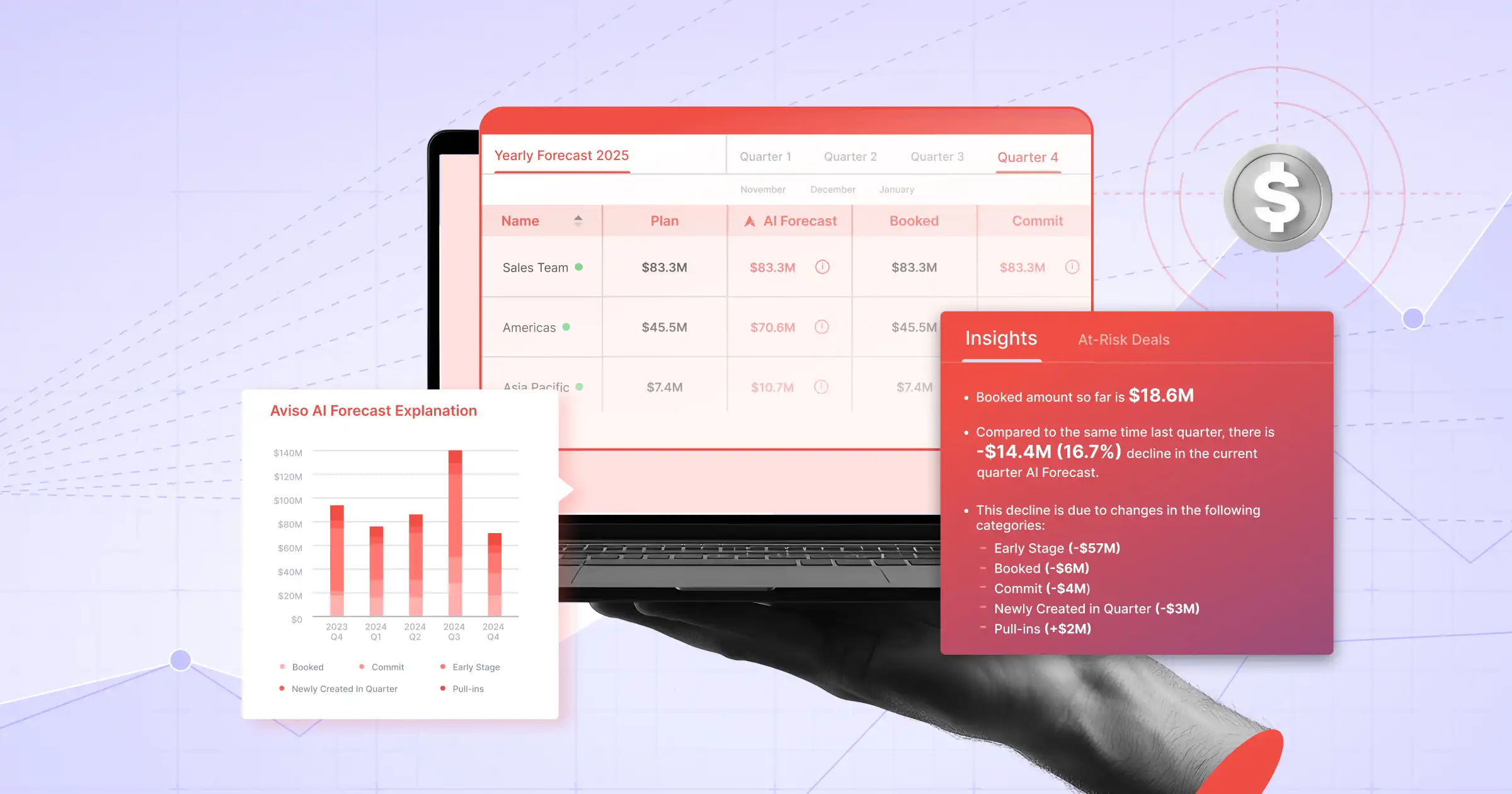
The plain truth: Most revenue intelligence platforms are CRM dashboards with prediction skinned on top.
A real one compounds the signal into a forecast that updates itself and explains itself when you ask why.
There are two kinds of revenue intelligence platforms. The kind that reports what already happened in slightly better visuals. And the kind that predicts what will happen, decomposes the prediction into the deals and signals behind it, and updates the number the moment new evidence arrives.
The first kind sells dashboards. The second kind sells conviction.
This is a guide to telling the two apart.
What a revenue intelligence platform actually is
A revenue intelligence platform is an AI layer that reads every system your go-to-market team already uses - CRM, calls, calendar, email, marketing automation and produces three things the CRM cannot:
A close-probability score for every open deal, updated continuously
A forecast at every level (deal, rep, segment, total) with a confidence interval
An explanation for each number that survives a sales manager's pushback
If a tool produces dashboards but not those three things, it's a CRM extension. Useful. Not revenue intelligence.
How a revenue intelligence platform works
Four layers. Each layer earns the next.
Ingestion. It connects to the systems where deals actually live - Salesforce, HubSpot, Microsoft Dynamics, the conversation tool you use, the calendar that holds the meetings, the email that holds the buying committee. Multi-CRM and multi-instance support is the differentiator. Most platforms fail this test the moment a customer has more than one Salesforce org.
Enrichment. Raw data is messy. Stages mean different things to different reps. Close dates lie. Enrichment standardizes the records, infers missing fields, and links the email thread to the right opportunity without a rep clicking log to Salesforce.
Modeling. Machine learning scores every open deal against the patterns of every closed deal in your history. The model is not a single global classifier. It's a stack of segment-aware models - enterprise vs SMB, new logo vs renewal, vertical-specific patterns - because a single global model fits no one well.
Action. The score lives in the workflow. In Slack when a deal slips. In the manager 1:1 with the call clip attached. In the rep's pipeline view with the next move suggested. A platform that produces beautiful predictions no one acts on is just an expensive PDF.
The work is in the connections between layers. Anyone can ship the boxes.
How revenue intelligence platforms drive sales
Forget the marketing version. Three things change when the platform is real:
Slipping deals surface four to six weeks earlier. Not the deals already lost. The deals that are about to be lost. Recovery rate on flagged deals is the cleanest ROI metric in the category.
The forecast call shifts from negotiation to evidence. Reps stop defending categories. Managers stop relitigating commits. The room argues the few deals the model is uncertain about - not all of them.
Coverage math becomes legible. You see, by segment, the pipeline-to-quota ratio that will actually produce the number - not the one your reps quote.
The compounding effect is the part most platforms don't deliver. A forecast that's slightly more accurate this quarter retrains a model that's meaningfully more accurate next quarter. The teams that internalize this build a structural advantage. The ones that don't keep buying clicks.
How to choose a revenue intelligence platform
One test does more work than any feature comparison: the backtest.
Hand the vendor four to eight quarters of your historical opportunity data. Ask them to score every deal as if the model had been live in real time, then produce the forecast they would have given you each week of those quarters. Compare to what actually closed.
Vendors that decline this test are telling you something. Vendors who run it and the model produces forecasts within two to three points of actual are telling you something different.
Three secondary tests that matter:
Explainability. Pick the lowest-scored open deal in your pipeline. Ask the platform why. The answer should be specific signals, not "the model says so."
Data-source breadth. Confirm it ingests every CRM, conversation tool, and email system you use today. Not the standard ones - the actual ones.
Time to first usable forecast. Four to eight weeks is the standard. Twenty-six weeks is a services contract dressed as software.
That's the entire evaluation. Everything else is parsley.
The trap most buyers walk into
The Dashboard Trap.
You spend nine months evaluating platforms on visual polish and demo flow. You pick the one with the most beautiful UI. Six months in, your reps have learned to ignore it because the predictions don't survive contact with the deal review. The platform becomes the Salesforce dashboard you already had with a new logo.
The fix is uncomfortable: evaluate on accuracy first, design second. A correct prediction in an ugly UI beats a beautiful prediction that's wrong.
How the best platforms reduce manual data entry
Auto-capture is table stakes, not a differentiator. Every email logged. Every meeting attached. Every contact identified from the call transcript and added to the buying committee.
What separates the best is field completion where the model reads the conversation and writes back the missing CRM fields the rep was going to enter eventually, if they remembered, which they wouldn't. Close date confidence. Next step. Competitive presence. Stakeholder coverage.
The rep gains five to ten hours a week. The CRM stops being a graveyard. The forecast inherits cleaner inputs. The compounding starts.
Frequently asked questions
What is a revenue intelligence platform? AI software that unifies CRM, conversation, and pipeline data to predict revenue, score deal risk, and recommend next actions. The CRM tells you what happened. A revenue intelligence platform tells you what will happen.
How does a revenue intelligence platform work? It ingests data from your operational systems, standardizes the records, scores every open deal continuously using machine learning, and surfaces the predictions in the workflows where decisions are made.
Do I need a data warehouse for a revenue intelligence platform? No. The platform ingests directly from operational systems. A warehouse is useful for downstream analytics, not a prerequisite for the forecast.
How long does implementation take? Four to eight weeks to a first usable forecast. Twelve to sixteen for full deployment. Anything longer is services billing, not platform complexity.
What's the best revenue intelligence platform? The one that produces the most accurate forecast on your historical data in a backtest. There is no other answer.
Is it worth switching mid-year? Yes if the incumbent is missing the forecast and the team has stopped trusting the number. Switches complete in a quarter. Waiting another nine months guarantees another nine months of the same problem.
The closing line
A platform that reports the past is a record-keeper. A platform that predicts the future and explains the prediction is the thing.
The teams that internalize the difference build a forecast they can stake the business on. The ones that don't keep relitigating commit categories every Friday.
Read More Like This
