Why 2026 GTM Belongs to Companies That Act on Real Buyer Signals, Not Guesswork

No time to lose? Summarize with AI
ChatGPT
Claude

For more than a decade, B2B go-to-market strategy has been built on categories like inbound versus outbound, product-led versus sales-led, and top-of-funnel versus mid-funnel. But the world has changed. The way buyers evaluate products, express intent, and move through a purchasing journey has completely transformed.
Buyers behave differently. They research silently. They evaluate without raising their hand. They form opinions long before they ever speak to a seller. In fact, only about 3 percent of B2B visitors fill out a form. This means roughly 97 percent of website traffic remains anonymous. They come, they explore, they compare, and then they leave.
Yet most GTM teams still operate with the same frameworks they adopted years ago. They plan in quarters even though buyer signals evolve in hours. They rely on form fills even though almost no buyer willingly fills a form unless they have no other choice. They build account lists once a year even though the attributes that define an ICP change every week.
True pipeline is created long before a form is filled. It is created through micro signals. It is created through intent behavior that sales teams rarely see. It is created inside the invisible funnel that exists between the first anonymous visit and the final purchase decision.
The reality is simple. Revenue growth in 2026 will not be won by teams with the loudest marketing engines or the most aggressive outbound motion. It will be won by teams that detect buyer intent before anyone else, that act on those signals with precision, and that remove the guesswork that slows down pipeline creation.
The Hidden Pipeline Every Business Already Has
Today, the most valuable insights in GTM come from micro-signals. A specific pricing page visit. A return visit from a company that previously went cold. A spike of activity from multiple personas in the same account. A CTO checking integration documentation. A VP of Sales comparing forecasting features. A head of revenue operations reading your trust documentation. These are signals that buyers have already begun their evaluation.They are deeper in the funnel than anyone realizes. Yet they remain invisible to most revenue teams because traditional GTM infrastructure was never built to detect them.
Why Traditional GTM Systems Broke in 2025
The biggest reason companies struggle with pipeline today is not lack of effort. It is lack of visibility. Legacy systems break because they depend on outdated assumptions about how buyers behave.
1. Website treated as a brochure, not a revenue engine
Most companies still see the website as a marketing asset. In reality, it is the most important source of buying intent. Website Intelligence transforms it into a pipeline machine.
2. Static ICP definitions
Markets evolve weekly. Traditional ICP lists built manually cannot keep up. Aviso’s Lead Intelligence continuously enriches and updates account profiles so segments remain accurate.
3. Broken handoff between sales and marketing
When buyers move quickly, context must travel with them. Aviso unifies website activity, emails, meetings, and signals into one account timeline so no insight is lost.
4. Outreach without intelligence
Cold outbound is becoming obsolete. High-performing teams only contact accounts showing real buying behaviour.
5. Forecasting that only reflects CRM stage data
CRM stages are lag indicators. Buyers can be mid-evaluation long before an opportunity is created. Aviso incorporates behavioural and intent signals into forecasting for a more accurate prediction of pipeline movement.
Together, these gaps show why traditional GTM systems fail, and why revenue teams now require a unified layer that reveals real buyer intent as it happens. Aviso’s Website Intelligence delivers that layer by unlocking deep intent from website behaviour so your team never misses a hot lead again.
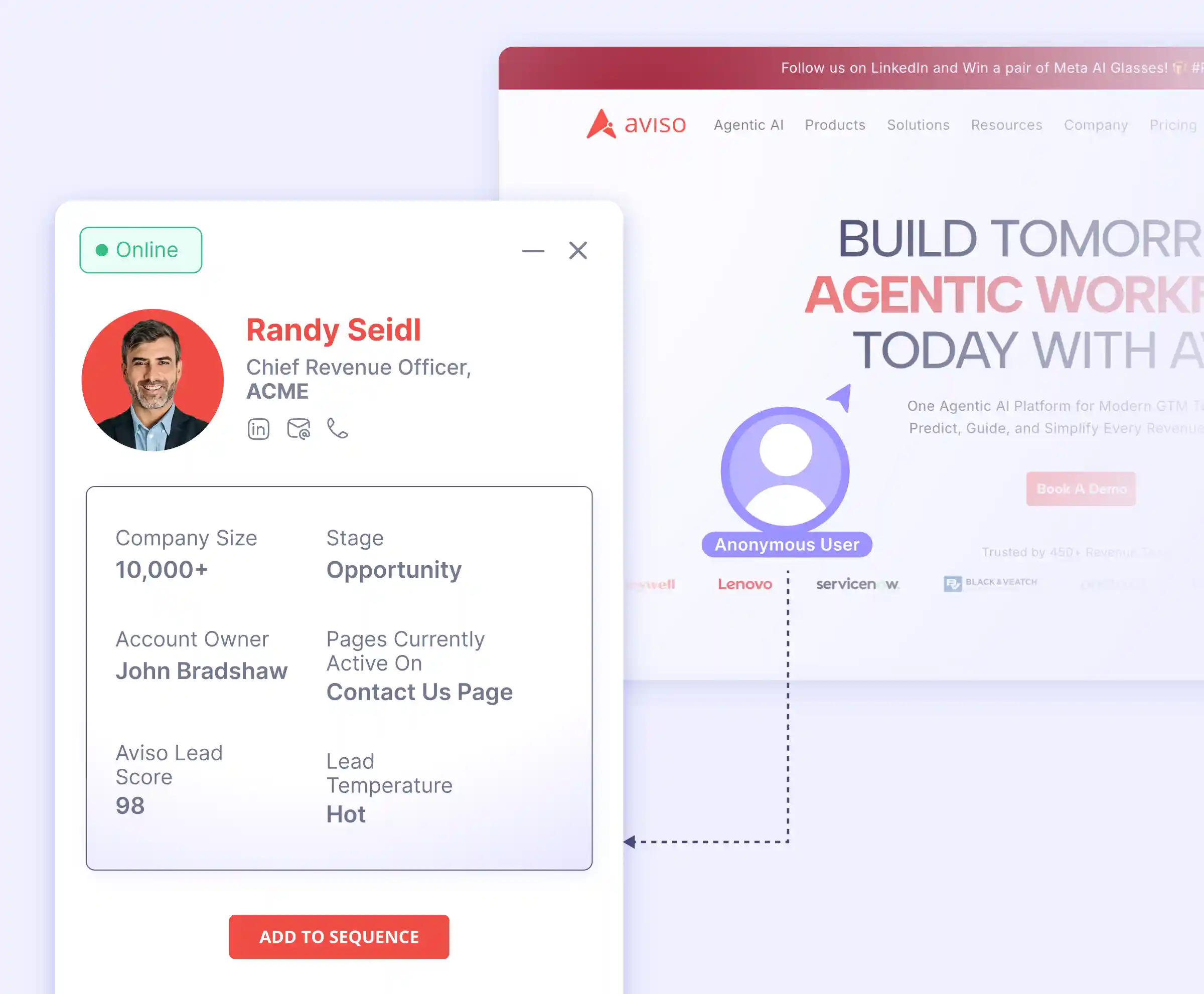
It identifies accounts visiting your site, their level of ICP match, their activity timeline, and the intent behind their behaviour. A high-intent pricing visitor becomes a high-priority lead. A sequence of visits from multiple stakeholders becomes a buying committee in formation. A sudden spike of activity from a closed-lost account signals re-entry into the market. Instead of guessing who might be interested, revenue teams now have complete visibility into who truly is.
The 3S Formula Redefining GTM: Signals, Sequences, Scale
Most companies still rely on funnels or stages. But funnels are linear and buyers are not. In 2026, revenue teams will need to operate using a simpler and more realistic model.
The model is Signals to Sequences to Sales.
Step 1. Signals
Every GTM motion begins with the detection of a signal. A lead visits a pricing page. An account shows a spike in activity. A champion reactivates after months of silence. A closed lost deal suddenly checks a new integration page.
Signals define intent. Signals define timing. Signals replace guesswork.
Step 2. Sequences
Once a signal is detected, the right response is triggered. This may be a tailored outbound message for a director persona, a retargeting campaign, a nurture track for existing customers, or a seller notification prompting them to send a specific case study.
Sequences become precise and timely because they are tied to behavior, not broad segments.
Step 3. Sales
Reps finally speak with accounts when the accounts are already educated and interested. They use activity timelines to understand context. They have insight into what pages were visited, which documents were viewed, and how many stakeholders have shown interest. This increases conversion rates and reduces sales cycle time.
The result is a revenue engine that operates with clarity, precision, and real time intelligence.
How Revenue Teams Use Aviso’s Intelligence Every Day
Signals are only useful when teams know how to execute on them. Here is how each GTM function benefits from the Revenue OS.
Revenue teams across marketing, sales, and CS can use Aviso as a daily workspace.
Marketing Teams
• Discover which ICP accounts are visiting the website
• Trigger campaigns for high-intent visitors
• Use intent data to run more targeted ads
• Improve MQL quality through signal-driven scoring
Sales Teams
• Receive prioritized lists of high-intent accounts every morning
• See unified activity timelines before every call
• Personalize outreach with real behavior data
• Close deals faster using predictive insights
RevOps Teams
• Monitor signal-based pipeline health
• Build automated routing and assignment logic
• Improve forecast accuracy using intent indicators
• Align sales and marketing with shared intelligence
Customer Success Teams
• Detect expansion intent for existing customers
• Identify renewal risks early
• Track account engagement trends
• Support upsell conversations with data
This creates a shared understanding of where revenue is moving and why.
The 2026 GTM Blueprint: A New Way to Operate
Instead of steps or linear frameworks, modern GTM is guided by a simple philosophy.
1. Make buyer behaviour the primary source of truth
Not forms. Not personas. Signals.
2. Collapse silos between sales, marketing, and RevOps
GTM succeeds only when all functions share one intelligence layer.
3. Convert your website into a revenue channel
Your website is your highest-intent surface. It should be the first place you mine for pipeline.
4. Replace outbound blasting with precision engagement
The highest win rates come from contacting buyers already in evaluation mode.
5. Operate in real-time, not in quarterly cycles
GTM speed is now a competitive advantage.
6. Forecast using both historical and behavioural indicators
Anything else is guesswork.
7. Treat every account as a dynamic, living profile
Signals change daily. ICP fit should too.
Companies that apply this blueprint do not just grow faster. They grow with consistency and predictability.
GTM Advantage Goes to Teams Who See What Others Miss
Most companies still fight over the same small percentage of buyers who make themselves known. But the real opportunity lies in the buyers who never fill a form, never request a demo, and rarely announce their intent until the very end. These are the accounts doing research silently. They represent the largest pool of future pipeline.
Instead of waiting for leads to surface, high-performing companies treat buyer signals as the source of truth. And Aviso is designed to reveal the signals most teams never see and turn them into revenue. It enables teams to act on intent, not assumptions. It removes the blind spots that slow down GTM. And it gives revenue leaders a way to run their business with clarity, precision, and intelligence.
Explore how Aviso can reveal your hidden pipeline and convert real buyer signals into revenue.
Read More Like This