Top 10 Gainsight Alternatives & Competitors in 2026 for Customer Success Teams

No time to lose? Summarize with AI
ChatGPT
Claude
Top 10 Gainsight Alternatives & Competitors in 2026 for Customer Success Teams
There are two kinds of customer success software.
The kind that surfaces risk. The kind that fixes it.
Gainsight built the first category. The market is moving to the second.
Most teams evaluating Gainsight alternatives in 2026 are not running away from the platform's capability. They are running away from the price of running the platform. The license is a line item. The Gainsight admin who configures the playbooks, builds the health scores, and maintains the workflows is the line item nobody put in the original budget.
Call it what it is. The Admin Tax.
Every dollar spent on Gainsight is a dollar that buys insights. Every additional dollar spent on the team required to operationalize those insights is the cost of doing business with a platform built for an era when humans configured the workflows.
That era is closing. This is the list of the alternatives that have figured it out.
Why Teams Are Leaving Gainsight in 2026
Three reasons surface across every Gainsight evaluation we hear.
The admin tax. Configuring health scores, building playbooks, modifying workflows, and updating hierarchies all require Gainsight admins. Most enterprises run two or three of them, which is the budget line that does not appear on the contract.
The insight-to-action gap. Gainsight surfaces risk. The execution still falls back on the CSM and a stack of Excel files. Staircase AI (Gainsight's own AI acquisition) classifies sentiment, but the play after the classification is manual.
The pricing pattern. Per-module licensing, per-seat licensing, mandatory implementation fees, and CS-specific contract lock-in. Most teams renew once and start looking the year after.
A CS platform that watches the customer is not the same product as a CS platform that works the customer. Most of the alternatives below are betting on the second one.
What to Look for in a Gainsight Alternative
Before evaluating tools, decide what the CS team actually owns end-to-end.
Agentic execution. Does the platform automate renewal briefs, write personalized emails, trigger plays, and update CRM, or does it surface a dashboard for the CSM to act on?
Health score grounding. Is the score updated live from CRM, conversation data, product usage, and support signals, or is it a weighted formula that depends on rep entry?
Revenue context. Does the platform see the deal, the forecast, and the pipeline next to the customer, or does it operate in a separate CS silo?
Time to value. Days to deploy, or months of admin configuration?
Total cost of ownership. License plus admins plus point tools plus integrations, not just the per-seat number.
If the platform fails on the first three, it is not a Gainsight alternative. It is a Gainsight clone.
The 10 Best Gainsight Alternatives in 2026
1. Aviso: Agentic Customer Success Intelligence
Aviso is the AI-native alternative to Gainsight, built for teams that want the customer success platform to do the work, not surface the work.
The contrast with Gainsight is structural. Gainsight is a customer success workspace. Aviso is a customer success agent.
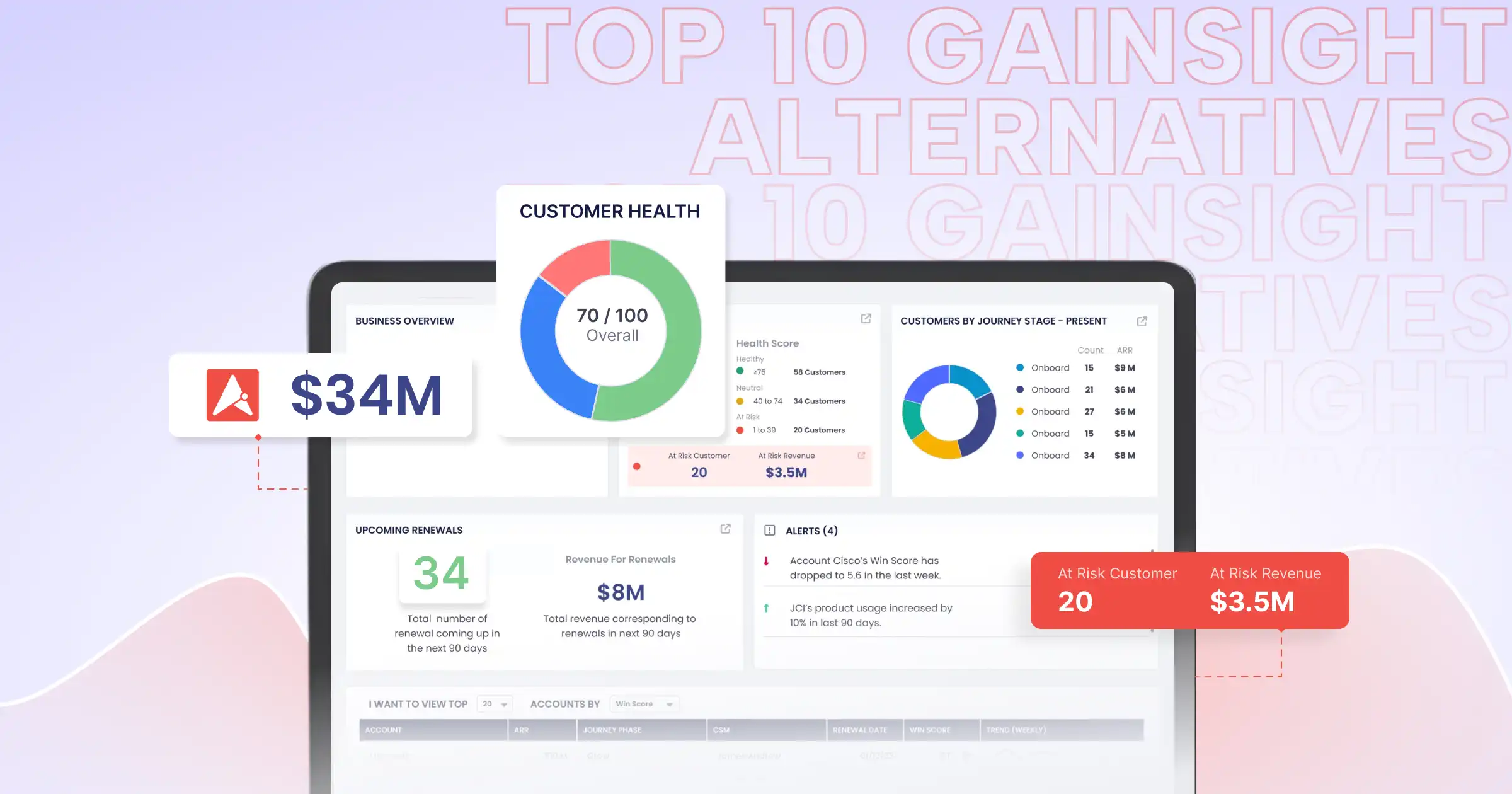
The Virtual CSM automatically writes renewal briefs, builds to-do lists, triggers plays, and crafts personalized emails. The Customer Success Avatar handles onboarding and adoption in real time. AI-based health scores update live from CRM, conversation intelligence, product usage, and forecast signals. MIKI, the AI Chief of Staff, answers questions about any account in natural language. The whole stack runs out of the box, no Gainsight admin required.
Best for: CS teams that want agentic execution, not another dashboard. Enterprises consolidating Gainsight plus point tools plus admins into a single revenue platform.
Limitations: Aviso is a consolidated Revenue AI platform, not a standalone CS point tool. Teams that only need a basic NPS dashboard will find the surface area larger than their use case requires.
Gainsight vs Aviso. Gainsight needs Gainsight admins. Aviso needs CSMs. That is the difference.
2. ChurnZero
Churnzero is the most-cited Gainsight alternative in 2026 evaluations. Strong customer health scoring, in-app communications, and lighter implementation than Gainsight.
Best for: Mid-market SaaS teams that want Gainsight's core capabilities at a lower configuration cost.
Limitation: Strong on health scoring and engagement, lighter on agentic execution. The CSM still does the work the system surfaces.
ChurnZero vs Gainsight. Same category, lower admin tax. ChurnZero is what teams pick when they want Gainsight's playbook without Gainsight's staffing model. The work itself still needs a CSM.
3. Totango
Totango focuses on composable customer success workflows. Modular by design, so teams build the pieces they need.
Best for: Mid-market and enterprise CS teams that want flexible workflows without Gainsight's full configuration weight.
Limitation: Composability cuts both ways. Teams without a clear CS ops function will struggle to assemble the workflows the platform supports.
Gainsight vs Totango. Both surface risk. Totango is faster to configure; Gainsight is deeper. Neither runs the play for the CSM.
4. Planhat
Planhat is account-centric. Strong on financial outcomes per account, renewals, and expansion math. Clean modern UX.
Best for: B2B SaaS CS teams that think in account economics and want a tool that mirrors that frame.
Limitation: Lighter on AI execution and adoption analytics than newer entrants.
Planhat vs Gainsight. Planhat is the choice when the CS team thinks like RevOps. Gainsight is the choice when the team thinks like product adoption.
5. Vitally
Vitally is the modern UX pick. Slack-native, fast to deploy, popular with smaller CS teams and PLG companies.
Best for: Mid-market PLG teams that want CS workflows next to where the team already works.
Limitation: Lighter on enterprise governance and multi-product account hierarchies.
6. Catalyst
Catalystis revenue-focused customer success. Strong on expansion plays, multi-threading, and tying CS activity to net revenue retention.
Best for: CS teams under a CRO or VP of Customer Revenue, where expansion is the primary metric.
Limitation: The expansion focus is the strength and the constraint. Teams that need adoption analytics or PLG signal capture look elsewhere.
7. Custify
Custify targets SMB and lower mid-market. Fast deployment, accessible pricing, simpler health scoring.
Best for: SMB SaaS teams that want a Gainsight-shaped tool without the Gainsight-shaped contract.
Limitation: Limited enterprise depth. Multi-product, multi-region, multi-tier CS organizations outgrow it.
8. ClientSuccess
ClientSuccess is the legacy alternative. Cleaner UX than Gainsight, simpler implementation, traditional CS workflows.
Best for: Mid-market CS teams replacing Gainsight without changing the shape of the CS motion.
Limitation: Traditional architecture. Newer AI-native entrants have moved past it on automation depth.
9. Velaris
Velaris is the AI-native lightweight pick. Strong on automation, faster to deploy than Gainsight, modern AI architecture.
Best for: Growth-stage SaaS companies that want AI-native CS without the Gainsight contract.
Limitation: Newer player; enterprise track record is still being built.
10. Salesforce Service Cloud (with CS Cloud)
Service Cloud becomes a Gainsight alternative when paired with the Salesforce CS Cloud add-on. Strong for Salesforce-locked enterprises.
Best for: Enterprises whose system of record is already Salesforce and want the CS layer in the same console.
Limitation: Salesforce-locked by design. Heavier admin lift. AI execution layer (Agentforce) is still maturing relative to AI-native platforms.
Gainsight vs the Alternatives: At a Glance
Tool | Best For | Standout Capability | Limitations |
|---|---|---|---|
Aviso | Agentic CS, revenue-grounded | Virtual CSM + CS Avatar + AI health scores | Consolidated platform, not a point tool |
ChurnZero | Mid-market SaaS | Lighter implementation than Gainsight | Still surfaces; CSM still executes |
Totango | Composable workflows | Modular flexibility | Requires CS ops capacity to assemble |
Planhat | Account economics | Revenue-shaped CS | Lighter AI |
Vitally | PLG, Slack-native | Modern UX | Lighter enterprise governance |
Catalyst | Expansion plays | NRR-focused workflows | Expansion-only frame |
Custify | SMB SaaS | Fast deployment | Limited enterprise depth |
ClientSuccess | Mid-market replacement | Cleaner UX than Gainsight | Traditional architecture |
Velaris | AI-native lightweight | Modern AI, fast to deploy | Newer; smaller enterprise track record |
Salesforce Service Cloud | Salesforce-locked enterprises | CRM-native CS | Heavy admin lift |
Final Verdict
The reason teams leave Gainsight is rarely Gainsight. It is the cost of the team required to make Gainsight worth the contract.
The next generation of customer success software does not need that team. The work is the agent.
Gainsight surfaces risk. Aviso fixes it.
→ [Take the NRR Challenge with Aviso: 5 NRR points or 50% off]
→ [Book a demo of Aviso's Agentic CS Intelligence]
FAQs
What is Gainsight? Gainsight is a customer success platform used by SaaS companies to manage customer health, drive product adoption, reduce churn, and identify expansion opportunities. It includes modules for customer success workflows (Gainsight CS), product analytics (Gainsight PX), and AI-based risk and sentiment detection (Staircase AI). Gainsight is the longest-running brand in the customer success software category.
What are the best alternatives to Gainsight? The strongest Gainsight alternatives in 2026 are Aviso (agentic CS intelligence with revenue grounding), ChurnZero (mid-market direct competitor), Totango (composable workflows), Planhat (account-centric CS), Vitally (modern PLG-focused UX), and Catalyst (expansion-focused CS). The right choice depends on whether the team needs analytics depth, composable workflows, or agentic execution.
Why are teams looking for Gainsight competitors? Three reasons surface most often: the configuration burden (Gainsight requires dedicated admins to maintain), the insight-to-action gap (Gainsight surfaces risk but execution still falls on the CSM), and the total cost of ownership (per-module licensing plus admin headcount plus point tools). Teams that want CS execution rather than CS analytics are moving to agentic alternatives.
What is the difference between Gainsight and ChurnZero? Gainsight is the enterprise category leader with deep configuration, multi-product support, and the longest customer reference list. ChurnZero is a mid-market focused alternative with lighter configuration, faster deployment, and a similar feature surface for teams that do not need Gainsight's full enterprise depth. Both surface customer health and risk; neither runs the playbook autonomously.
How does Aviso compare to Gainsight? Aviso is agentic by design. Gainsight is workflow-driven by design. Aviso's Virtual CSM automates renewal briefs, plays, and personalized emails. The Customer Success Avatar handles onboarding and adoption in real time. AI-based health scores update live from CRM, conversation intelligence, and product usage. Gainsight surfaces these signals but the CSM still does the work. Aviso also includes a contract buy-out for teams already locked in with Gainsight.
How much does Gainsight cost? Gainsight does not publish list pricing. Based on customer reports and procurement marketplaces, Gainsight contracts typically start in the mid-five figures annually for mid-market deployments and reach six figures for enterprise. Pricing varies by module (CS, PX, and Staircase AI are licensed separately), seat count, and implementation scope. Implementation services are charged separately.
Is there a cheaper alternative to Gainsight? Yes. Custify and ClientSuccess offer more accessible pricing for SMB and lower mid-market teams. Vitally is competitive on price for PLG and mid-market CS teams. For enterprises, the question is rarely about a cheaper alternative; it is about a more efficient one. Aviso's consolidated Revenue AI platform replaces Gainsight plus surrounding point tools, which is where the cost savings compound.
Is Aviso a true Gainsight replacement? Yes. Aviso covers the core customer success capabilities Gainsight delivers (health scoring, playbooks, renewals, expansion, customer dashboards) and adds agentic execution (Virtual CSM, CS Avatar, MIKI AI Chief of Staff,conversation intelligence with sentiment analysis). Aviso also offers a contract buy-out for teams currently under a Gainsight agreement.
Read More Like This