10 Best Gong Alternatives & Competitors in 2026 for Revenue Teams

No time to lose? Summarize with AI
ChatGPT
Claude
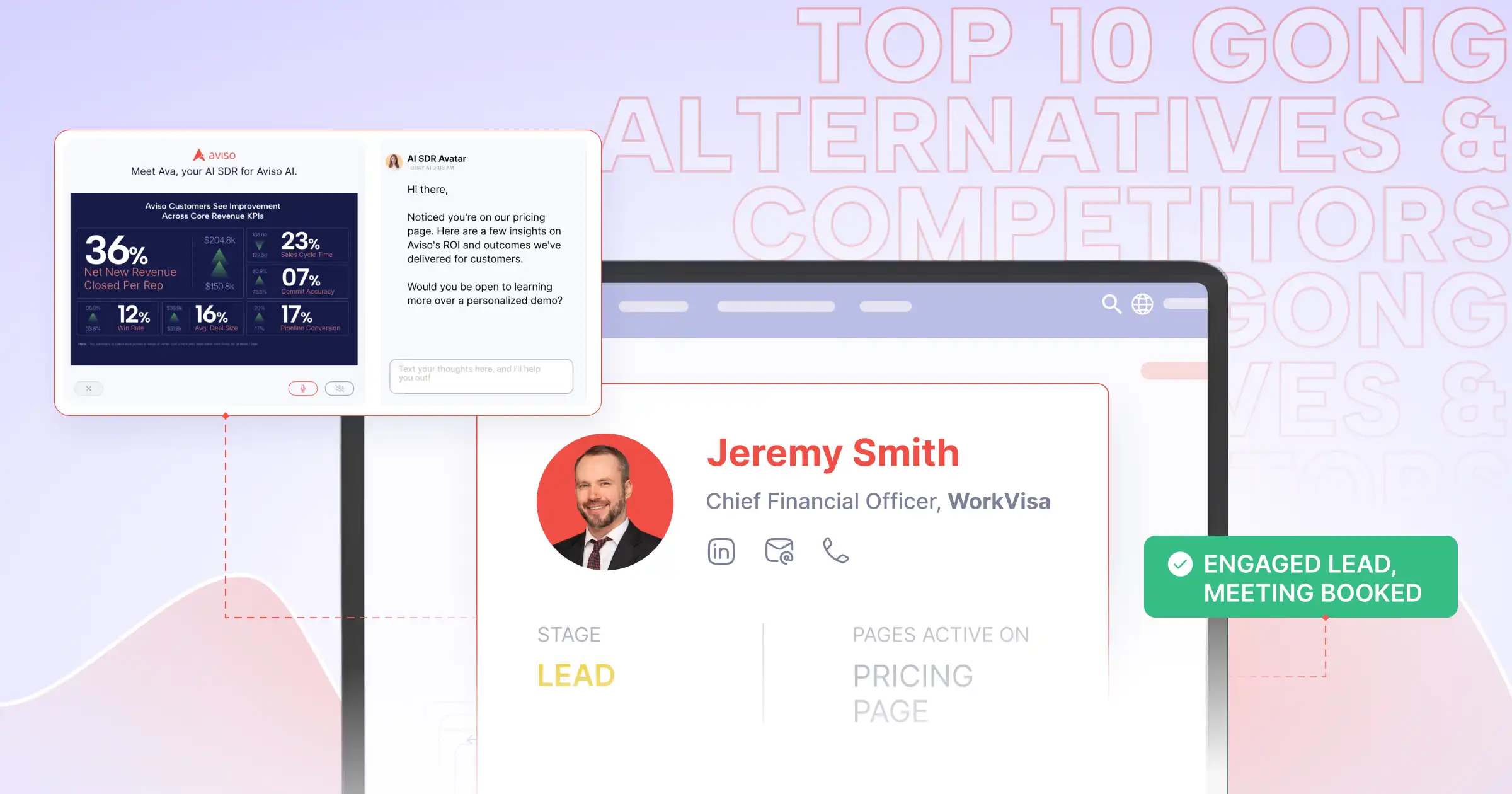
Gong defined the Conversation Intelligence (CI) category. By recording calls, transcribing them, and extracting keywords, it gave sales leaders unprecedented visibility into what was actually happening on the front lines. If you wanted post-call insights into why a deal stalled, Gong was the pioneer.
But B2B selling has changed. Buyers today expect more than a rearview mirror — and so do revenue teams. Modern GTM orgs need real-time coaching, accurate forecasting, AI-driven pipeline intelligence, and automated execution in one place. Standalone conversation intelligence software is excellent at analyzing conversations but often falls short at orchestrating the next revenue action.
The market is shifting from "What did the prospect say?" to "What should we do next to close the deal?"
If your stack feels fragmented, or you're paying enterprise prices for a tool that solves only one piece of the puzzle, it's time to evaluate Gong's competitors. Below are the 10 best Gong alternatives in 2026 — plus Fathom as an honorable mention — evaluated by capability, ideal customer, and where each one falls short.
Gong Alternatives & Competitors at a Glance
# | Tool | Best For | Standout Feature | Limitation |
|---|---|---|---|---|
1 | Aviso | End-to-end revenue orchestration | Unified CI + forecasting + execution | Heavier than a pure CI tool |
2 | Chorus (ZoomInfo) | ZoomInfo-native teams | Deep CI + B2B contact data | CI-only; limited execution |
3 | Clari | Top-down forecasting | Boardroom-grade pipeline visibility | CI depth (via Wingman) is lighter |
4 | Avoma | SMB / mid-market | Affordable AI meeting lifecycle | Light on enterprise pipeline modeling |
5 | Revenue.io | High-volume inside sales | Real-time call guidance | Narrow execution focu |
6 | Salesloft | Outbound SDR/AE workflows | CI inside the engagement layer | CI is an add-on, not the core |
7 | Outreach | Enterprise outbound at scale | Workflow + cadence depth | CI is a secondary feature |
8 | Momentum | Slack-native RevOps automation | Deal desk + CRM updates in Slack | Less CI history & benchmarking |
9 | Jiminny | Coaching-first cultures | Intuitive scorecards + libraries | Limited forecasting |
10 | Salesken | Live in-call copilot | Real-time objection handling | Lighter on enterprise depth |
11 | Fathom | AI meeting notes (free tier) | Free-forever recording + summaries | Limited CRM and pipeline depth |
How We Evaluated These Tools
We assessed each platform against five criteria that matter most to revenue leaders making a switch from Gong: conversation intelligence depth, coaching and enablement, pipeline and deal intelligence, forecasting accuracy, and AI-driven execution. We weighted real-world fit (ideal customer profile, pricing tier, integration footprint) alongside feature coverage, and cross-referenced public pricing pages, G2 and TrustRadius reviews, and customer conversations.
Conversation Intelligence Software: How Gong Compares to the Market
Conversation intelligence software is the broader category Gong helped create. The premise is simple: record sales calls, transcribe them with AI, then surface keywords, themes, and competitor mentions so managers can coach reps and leaders can spot deal risk.
In 2026, the conversation intelligence software market splits into three clear groups. Pure-play CI tools — Gong, Chorus, Avoma, Jiminny — focus on transcription quality, scorecards, and call libraries. Sales engagement platforms with embedded CI — Salesloft, Outreach — fold conversation insights into outbound workflows. And revenue intelligence platforms — Aviso, Clari — treat the conversation as one signal among many, blending it with CRM, marketing, and pipeline data to drive forecasting and execution.
Gong sits firmly in the first group. If you only need to record, transcribe, and review calls, almost any tool below will do the job. The question is whether call review alone solves your team's problem — or whether you need the conversation feeding a larger revenue engine.
What to Look for in a Gong Alternative
Before evaluating tools, decide whether you need a point solution or a unified revenue platform. The best fit depends on what your team actually owns end-to-end.
Core evaluation criteria:
Conversation intelligence: Recording, transcription accuracy, thematic insights.
Coaching & enablement: Scorecards, snippet sharing, onboarding workflows.
Deal intelligence: Pipeline visibility, risk detection, multi-threading signals.
Forecasting accuracy: Ability to predict revenue based on deal signals — not just rep-submitted commits.
Real-time vs. post-call: Does the tool coach reps live, or only after the call is over?
AI execution: Next-best-action recommendations and automated CRM updates.
The 3 Categories of Gong Competitors
To make evaluation easier, the market clusters into three buckets:
Conversation intelligence tools. Point solutions focused on call recording and coaching — Chorus, Avoma, Salesloft, Outreach.
Revenue intelligence and RevOps platforms. End-to-end systems that combine CI with forecasting and pipeline management — Aviso, Clari.
AI-first / real-time execution tools. Built for live guidance and workflow automation — Revenue.io, Momentum, Wingman.
The Best Gong Alternatives & Competitors in 2026
1. Aviso (Best for End-to-End Revenue Orchestration)
Aviso is a unified revenue AI platform built for teams ready to graduate from isolated conversation insights to end-to-end revenue orchestration.
Where Gong stops at post-call analysis, Aviso ingests conversational signals and fuses them with CRM data, marketing engagement, and relationship intelligence into a single source of truth. That foundation powers [predictive forecasting][link: forecasting page], AI deal inspection, and next-best-action execution. Aviso doesn't just flag a competitor mention on a call — it tells you how that mention shifts your quarter's forecast and surfaces the playbook to counter it.
Public customer references and G2 reviews highlight forecast accuracy improvements and meaningful CRM-hygiene gains as the most-cited outcomes after switching.
Best for: RevOps leaders, enterprise GTM teams, and forecast-driven organizations consolidating their tech stack.
Limitations: Aviso is a comprehensive RevOps engine, not a lightweight call-recording tool. Five-person startups will find it overkill, and the broader capability set means a longer initial rollout than dedicated point tools.
See how Aviso compares to Gong directly
2. Chorus (by ZoomInfo)
Chorus is Gong's most direct competitor. Acquired by ZoomInfo, it pairs deep call analytics with ZoomInfo's B2B contact database — strong on tracking competitor mentions and market trends across thousands of recorded hours.
Best for: Teams already invested in the ZoomInfo ecosystem who want a seamless data layer.
Limitation: Conversation-centric. Lacks the forecasting and end-to-end revenue orchestration of a full RevOps platform.
Gong vs. Chorus. The two tools are functionally similar — call recording, transcription, deal-risk flags, coaching libraries. Chorus pulls ahead if your team already lives in ZoomInfo and wants prospect data alongside call insights. Gong tends to win on UI maturity and benchmarking depth. Neither is a forecasting tool.
3. Clari (incl. Wingman)
Clari is a heavy hitter in revenue intelligence and forecasting. To add CI, Clari acquired Wingman, layering call recording and real-time coaching onto its forecasting suite. Strong on roll-up visibility for the CRO and board.
Best for: Teams where complex forecasting and top-down pipeline visibility are the highest priority.
Limitation: CI depth (via Wingman) is generally considered lighter than Gong's legacy engine. See Aviso vs. Clari
Gong vs. Clari. Different products solving different problems. Gong is conversation-first; Clari is forecast-first. Teams that want both end up running Clari + Gong, paying twice — which is exactly the consolidation pressure that pushes evaluators toward unified platforms like Aviso.
4. Avoma
Avoma is an AI meeting assistant and lifecycle CI tool. Highly collaborative, with strong automated meeting summaries, shared note-taking, and CRM sync.
Best for: SMB and mid-market teams looking for an affordable, efficient meeting-lifecycle tool.
Limitation: Lighter on enterprise-grade revenue intelligence and complex pipeline modeling.
Gong vs. Avoma. Avoma typically wins on price and time-to-value for smaller teams; Gong wins on enterprise-grade analytics, integration breadth, and benchmarking. If your team is under ~50 reps and you mostly want clean meeting notes plus light coaching, Avoma is often the better fit.
5. Revenue.io
Revenue.io focuses on the live moment of selling — real-time guidance, pop-up battle cards, and behavioral cues directly inside Salesforce.
Best for: High-volume dialing teams and inside sales orgs that need live coaching.
Limitation: Narrow scope. Strong on front-line execution; not a full-funnel RevOps engine.
6. Salesloft
Salesloft is a sales engagement platform with built-in conversation intelligence. Reps run cadences, send email, and record calls inside one interface.
Best for: Outbound SDRs and AEs who want a single-tab workflow.
Limitation: CI is an add-on to the engagement layer, so insights aren't as deep as on dedicated platforms.
7. Outreach
Outreach is an enterprise sales execution platform with integrated CI. Managers can see how calls map to active outbound sequences.
Best for: Large enterprise outbound teams prioritizing cadence adherence and activity tracking.
Limitation: CI is a secondary capability — the platform was built for execution first, conversation analytics second.
8. Momentum
Momentum is an AI-first RevOps execution platform that lives in Slack. Strong on automating deal-desk approvals, CRM updates via chat, and quick deal summaries.
Best for: RevOps teams that want to cut CRM busywork through Slack-native automation.
Limitation: Newer player; less historical CI depth and benchmarking than the incumbents.
9. Jiminny
Jiminny is a coaching-first CI platform. Intuitive scorecards, call libraries, and peer-review systems help managers level up reps.
Best for: Teams with a heavy coaching and enablement culture.
Limitation: Targeted coaching tool — limited broader GTM intelligence or forecasting.
10. Salesken
Salesken is an AI conversation intelligence tool focused on real-time cues. It coaches reps live based on the prospect's in-the-moment objections.
Best for: Inside sales and call-heavy teams that need immediate guidance.
Limitation: Lacks the enterprise depth required for multi-threading, complex deal intelligence, and board-level forecasting.
11. Fathom (Honorable Mention)
Fathomis a fast-growing AI meeting notetaker with an aggressive free tier — unlimited recording and AI summaries at no cost, paid plans only when you need team features and CRM sync. Heavy adoption among individual reps and small teams.
Best for: Solo founders, small teams, and reps who want free AI meeting notes that don't require a full CI rollout.
Limitation: Built as a meeting notetaker, not a revenue intelligence platform. Limited deal intelligence, pipeline analytics, and forecasting.
Gong vs. Fathom. Different price points, different buyers. Fathom wins on accessibility and free-tier generosity. Gong wins on the analytics, coaching depth, and managerial visibility that mature sales orgs need. Fathom is a credible starting point; teams typically graduate from it once formal coaching and pipeline reporting become priorities.
Other Tools Worth Knowing
A handful of newer entrants are worth tracking even if they didn't make the top list: Sybill and MeetGeek for AI-generated meeting summaries, tl;dv for free recording with strong searchability, Balto for real-time agent assist in contact centers, and Claap for asynchronous video selling. None match the breadth of the platforms above, but each has a specific use case where it's the right tool.
Gong vs. the Alternatives: Where Gong Still Wins
Gong didn't become category leader by accident, and a fair evaluation has to acknowledge what it still does well.
Maturity. One of the most battle-tested CI engines on the market.
Data and benchmarking. Years of recording history give it solid industry benchmarks.
Adoption. Reps know the UI; ramp time on a new Gong rollout is short.
Where Gong Falls ShortLimited execution. Gong tells you what happened. It struggles to automate complex RevOps execution in real time.
Forecasting gaps. Compared to purpose-built engines like Clari or Aviso, Gong's forecasting is widely viewed as a secondary capability.
Fragmented intelligence. Marketing, relationship, and CRM context require integrations to assemble a full picture.
Pricing. Gong's premium, often rigid pricing is a common trigger for teams to evaluate alternatives.
When NOT to Switch from Gong
Gong is still the right answer in a few cases. If your team's only GTM gap today is call coaching and you have a separate forecasting and pipeline tool you're happy with, the switching cost rarely pays back. If your reps are mid-onboarding on Gong's UI, finishing the rollout typically beats restarting on a new platform. And if your sales motion is high-volume transactional with no complex multi-threaded deals, the broader RevOps capabilities of platforms like Aviso are likely overkill.The case for switching is strongest when you're consolidating multiple tools, when forecasting accuracy matters more to leadership than call review, or when your team needs real-time AI execution rather than post-call analysis.
Why Teams Are Moving Away from Gong
The 2026 narrative is tech consolidation. Revenue leaders are tired of paying high per-seat costs for a tool that only delivers insights. SMBs find standalone CI overkill; enterprises want AI-driven execution that ties directly to revenue outcomes. Both are pushing the market toward unified platforms.
Which Gong Alternative Should You Choose?
Use this decision framework based on your team's primary goal:
Choose Chorus or Avoma if your sole priority is call recording and basic CI without overcomplicating the stack.
Choose Revenue.io or Momentum if your priority is real-time execution, live call pop-ups, and automating busywork.
Choose Clari if top-down pipeline visibility and boardroom forecasting are the primary mandates.
Choose Aviso if you want the complete package — moving past conversation insights into full revenue orchestration that blends CI, accurate forecasting, and AI-driven execution in a single platform.
Final Verdict
Gong pioneered the category and forced the industry to listen to the voice of the customer. The market has moved on. The future of GTM tech is AI agents, revenue orchestration, and real-time execution — not just better recordings.
Aviso represents that next step. It's the strongest Gong alternative for teams ready to stop analyzing past conversations and start driving future revenue outcomes.
See Aviso in action — book a demo
FAQs
What is the best alternative to Gong? The best alternative depends on your GTM maturity. Aviso is the strongest fit for teams wanting end-to-end revenue orchestration and forecasting. Chorus and Avoma are better fits if you only need dedicated call recording and transcription.
Is there a cheaper alternative to Gong? Yes. Avoma, Jiminny, and Salesken offer more accessible pricing for SMBs and teams that want core conversation intelligence without an enterprise contract.
Is there a free alternative to Gong? Yes. Fathom offers unlimited free AI meeting recording and summaries; tl;dv and Avoma's free tier are also widely used. None match Gong's analytics, coaching, or pipeline intelligence — but for reps who need basic notes, they're a credible no-cost starting point.
What's the difference between Gong and Fathom? Gong is enterprise-grade conversation intelligence: deep analytics, manager coaching, and benchmarking, priced for full sales orgs. Fathom is an AI meeting notetaker with a generous free tier built for individuals and small teams. Different buyers, different price points.
What tools compete with Gong? Gong's competitors fall into three buckets: dedicated CI tools (Chorus, Avoma), revenue intelligence and forecasting platforms (Aviso, Clari), and real-time sales execution software (Revenue.io, Salesloft).
What's the difference between Gong and Clari? Gong is conversation intelligence first — call recording, transcription, and post-call analysis. Clari is forecasting first — top-down pipeline visibility for CROs and the board. Clari added CI by acquiring Wingman, but its CI depth remains lighter than Gong's.
Gong vs. Clari vs. Aviso — what's the difference? Gong focuses on extracting insights from recorded conversations. Clari focuses on top-down forecasting and pipeline visibility. Aviso bridges both — combining deep CI with predictive forecasting and AI-driven workflow execution in a single platform.
Do I need conversation intelligence or revenue intelligence? If your goal is coaching reps and reviewing call tape, conversation intelligence is enough. If your goal is predicting whether a deal will close, forecasting your quarter, and automating the next steps to win revenue, you need a unified revenue intelligence platform.
Read More Like This
