Aviso’s Ontology Layer: The Semantic Foundation That Governs How AI Understands, Reasons, and Acts Across the Revenue Cycle

No time to lose? Summarize with AI
ChatGPT
Claude
Sales data lives everywhere. CRM records, emails, calls, Slack messages, notes, spreadsheets, and forecasts all contain signals that matter. Enterprises have already solved the access problem. The harder problem is meaning.
Most AI systems can retrieve data. Very few understand how that data fits together, what it represents in your business, or how it should be used safely. When AI lacks this understanding, it guesses. Guessing leads to hallucinations, inconsistent reasoning, and fragile execution, especially in revenue-critical workflows.
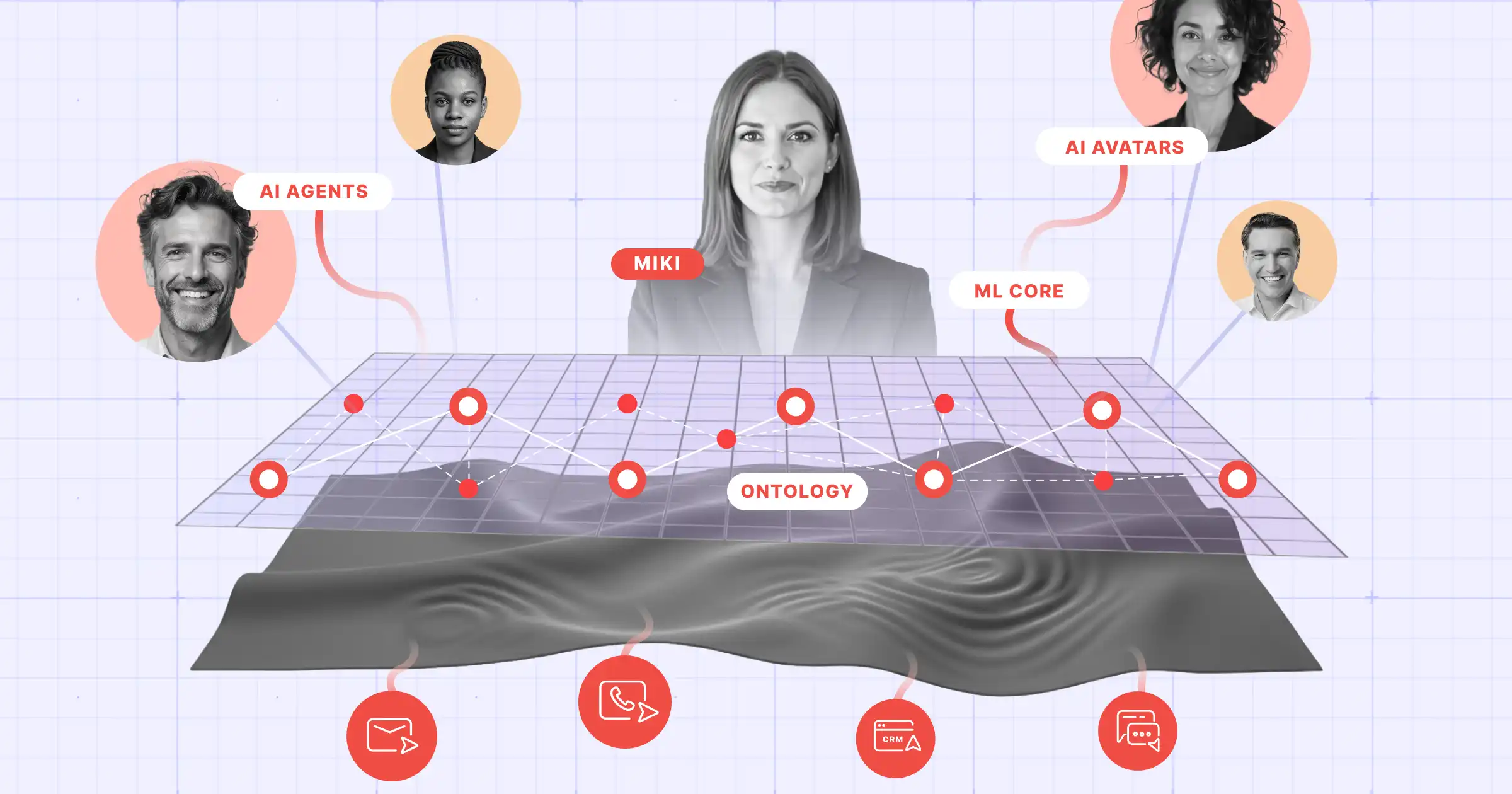
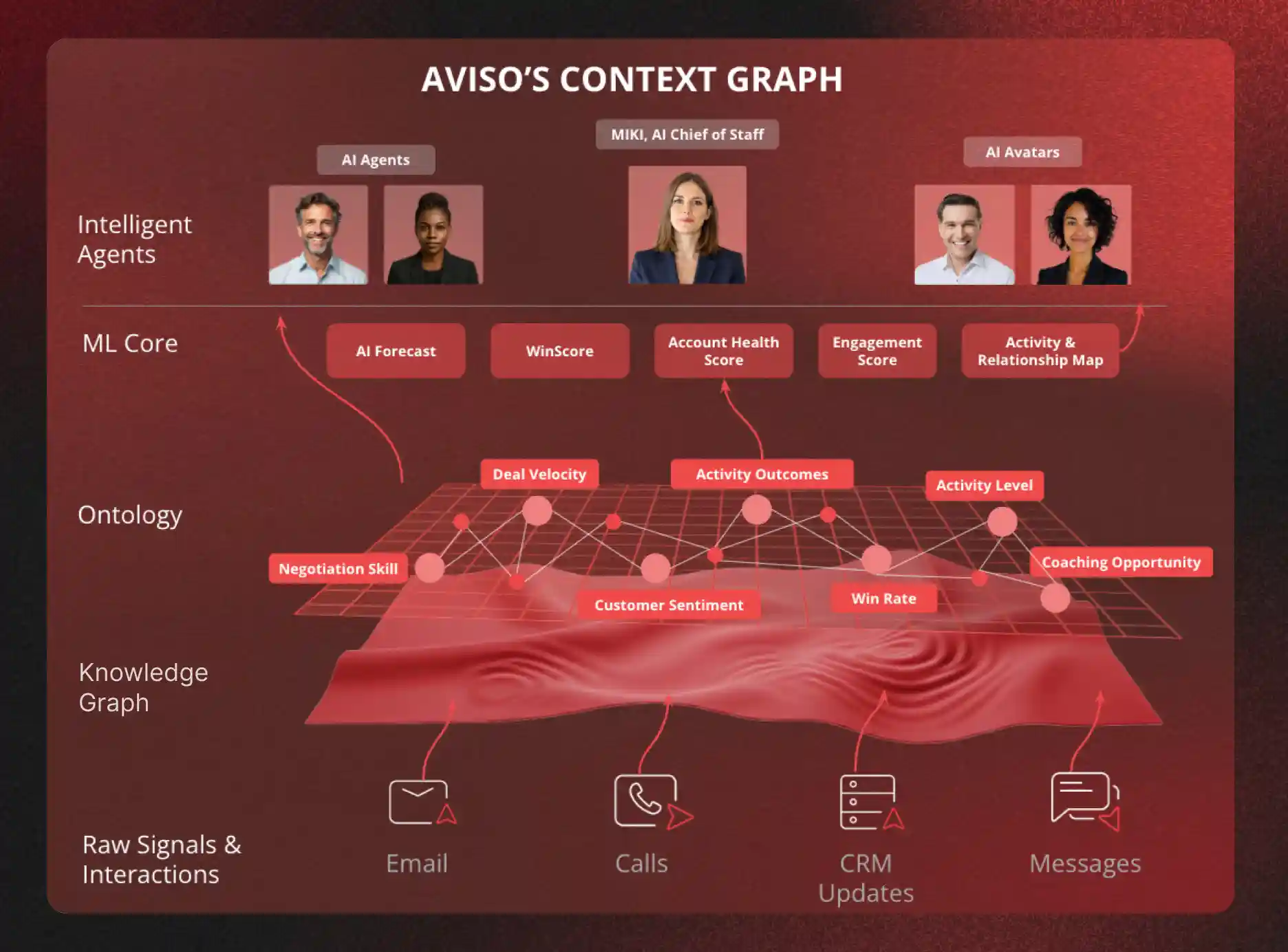
Aviso was built to eliminate that risk. At the core of the platform is an enterprise Knowledge Graph paired with a first-class Ontology Layer. Together, they form Aviso’s Context Graph: a unified semantic foundation that gives AI a shared, governed understanding of how your revenue engine actually works. Not just what data exists, but what it means, how it connects, and how AI is allowed to reason and act on it.
This is what turns AI from a chat interface into production-grade infrastructure.
Aviso’s AI-Native Enterprise Knowledge Graph
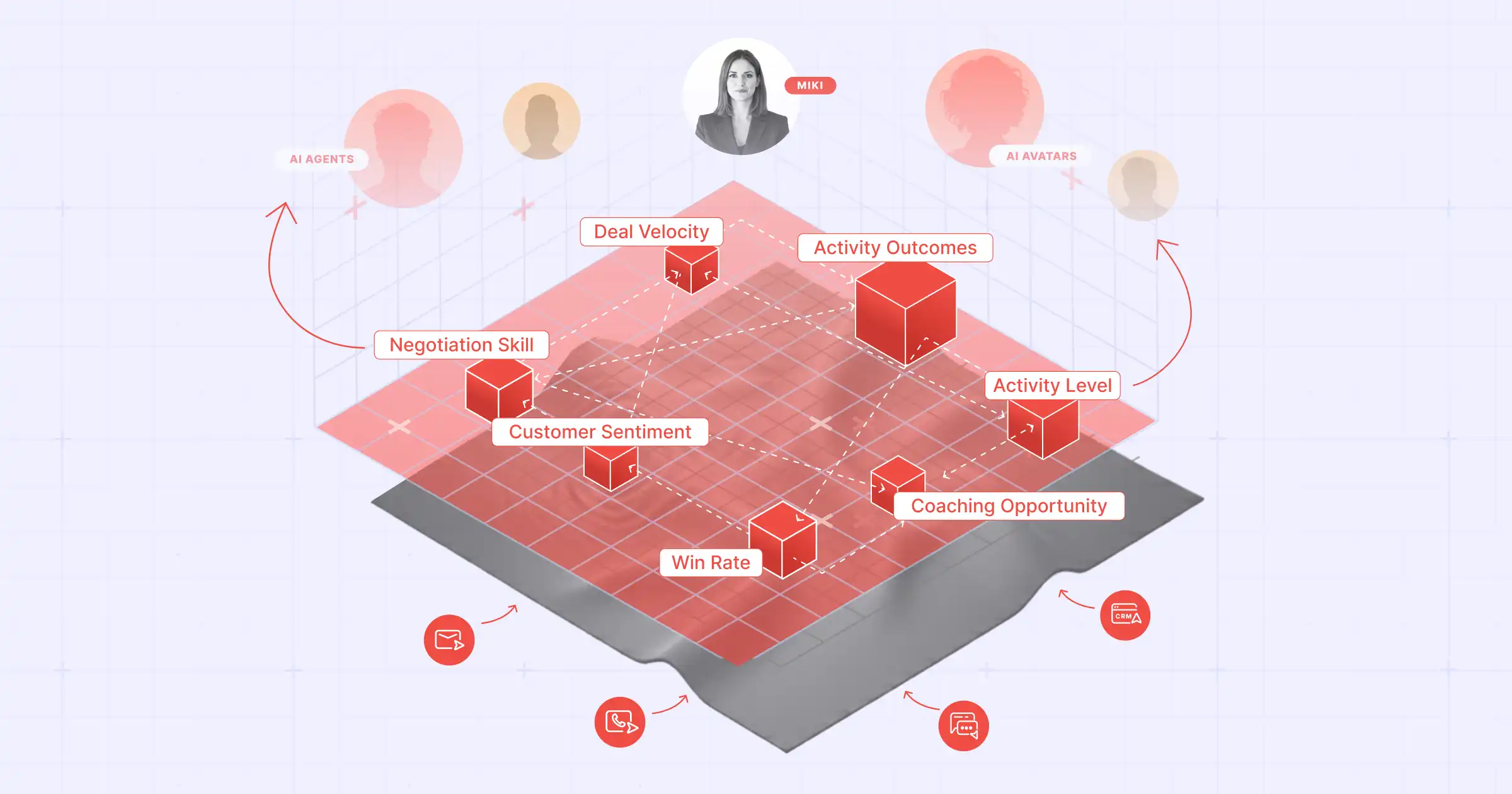
The Knowledge Graph is responsible for connection. It links people, accounts, opportunities, activities, conversations, and outcomes into a single connected model. Instead of treating emails, calls, CRM updates, and forecasts as isolated records, knowledge graph shows how they relate over time.
Who said what.
Which activity influenced which deal.
How engagement patterns changed.
Which behaviors preceded success or failure.
This allows AI to see the full picture of a deal rather than fragmented snapshots. When a deal slows, the Knowledge Graph can trace which stakeholders disengaged, which activities dropped, and how that pattern compares to thousands of historical outcomes.
But connection alone is not enough.
A Knowledge Graph can tell you what changed. It cannot tell you what it means unless the system understands your business logic. That is the role of the Ontology Layer.
The Ontology Layer: Business Meaning as Infrastructure
The Ontology Layer is the system’s source of business truth. It defines what entities exist, how metrics are calculated, what relationships are valid, and how concepts should be interpreted across the revenue lifecycle.
Think of the Ontology as both a dictionary and a rulebook for your business.
If your organization defines a deal as “late” only after the close date has moved twice, the Ontology enforces that rule. AI cannot label a deal as late after a single date change, regardless of how confident the model sounds. The meaning is encoded, not inferred.
This shifts AI from prompt-based guessing to rule-governed reasoning.
Every AI agent in the Aviso platform reasons within this shared semantic foundation. Metrics are not reinterpreted per query. Definitions do not drift over time. Agents cannot misuse data or invent logic because the Ontology constrains what is valid.
This is how Aviso prevents hallucinations at the system level, not just at the response level.
When someone asks MIKI, Aviso’s Agentic AI Chief of Staff, “Why is this deal at risk?”, the system does not start by generating text.
It starts by reasoning.
First, the Ontology is used to interpret what “at risk” means in that specific organization. Which signals qualify? Which metrics are valid at that stage? Which time-based patterns matter?
Only then does MIKI reason over the Knowledge Graph, examining stakeholder engagement, activity decay, historical comparisons, and outcome patterns. If the conditions defined by the Ontology are met, MIKI explains the risk with evidence. If they are not, MIKI explains why the deal does not qualify as at risk rather than fabricating an answer.
This ability to say “no” is critical. It is what makes the system trustworthy.
Ontology Layer: A Control Plane for Grounded Reasoning
A dense, unstructured Knowledge Graph, for all its richness, is inherently dangerous for autonomous agents. Without a guiding framework, it risks becoming "noisy, hard to reason about, difficult to maintain, and prone to hallucination." The Ontology is the architectural control plane engineered specifically to mitigate these risks. It serves as an essential anchor that makes the Knowledge Graph navigable, safe, and intelligible, imposing order on the complexity that the Graph captures.
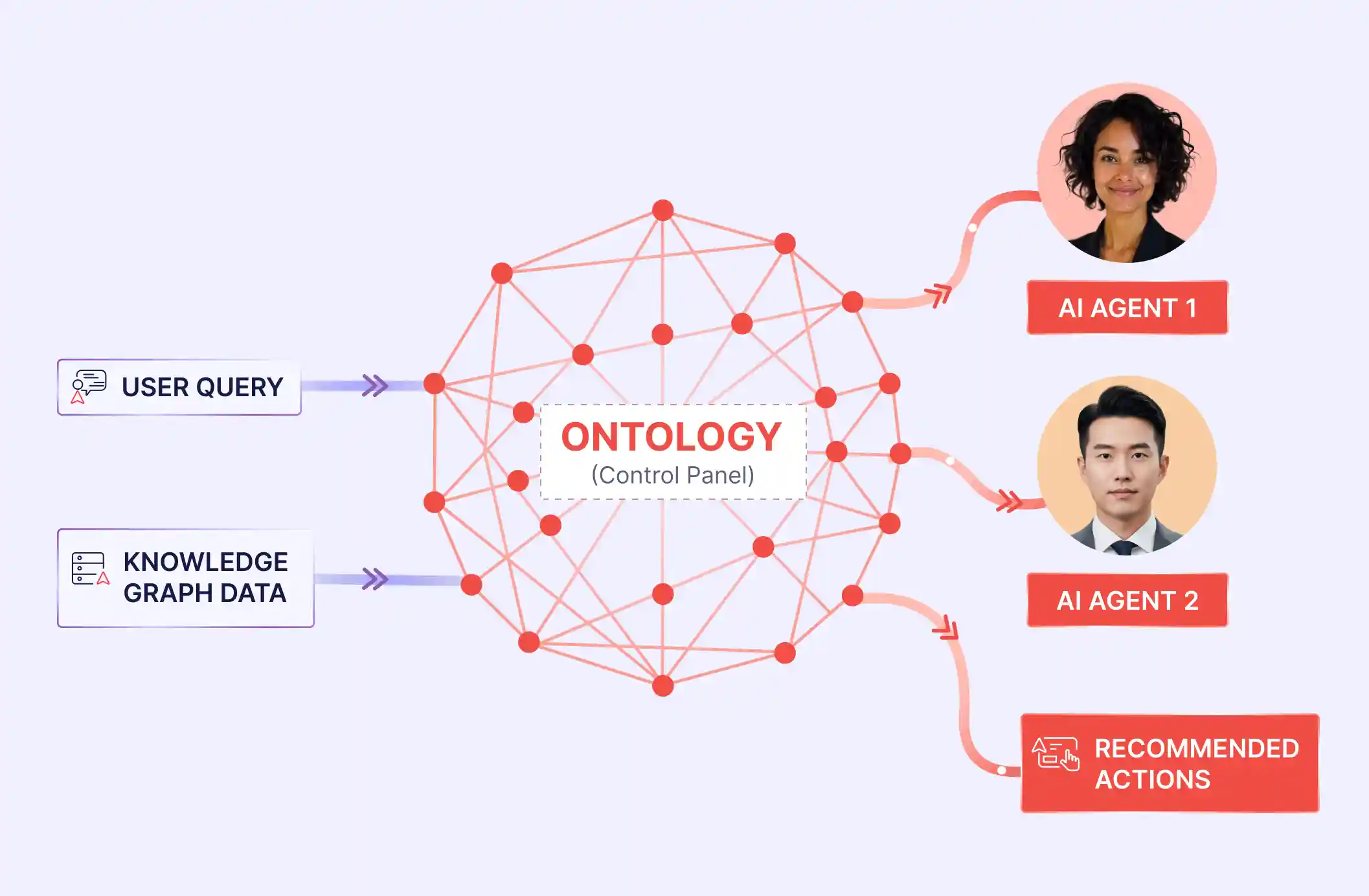
In the Agentic AI architecture, the Ontology functions as a critical abstraction layer. Agents do not interact with the raw Knowledge Graph directly; instead, they operate through the clear, structured lens of the Ontology. Its function can be understood as:
An indexed tree: Providing a hierarchical structure to complex data.
A semantic control plane: Giving meaning and context to raw signals.
A routing layer for intelligence: Directing queries and actions to the appropriate agents and processes.
The Ontology models and encodes the core concepts of the business domain. Its primary functions are to:
Define deal behavior
Encode representative behavior
Model account dynamics
Capture feature taxonomy
Embed qualitative data like complaints, feedback, and risks
This structure is inherently hierarchical, with its subtrees operating at different levels of granularity (e.g., deal-level, account-level, rep-level). This multi-grained hierarchy is what enables Aviso’s AI Aegnts to deterministically parse user queries, invoke the correct agents for a given task, and, most importantly, keep all AI-driven reasoning firmly grounded in a structured representation of reality. This disciplined approach sets the stage for a powerful synergy between the system's two core components.
Why Ontology Is Essential for Agentic AI at Scale
Most agentic AI systems fail not because models are weak, but because meaning is ungoverned.
Without a shared ontology:
Agents interpret metrics differently
Context drifts across steps
Reports contradict actions
Automations trigger on weak or incorrect assumptions
Aviso’s Ontology Layer eliminates these failure modes by acting as a semantic control plane across all agents. Every plan, query, action, and explanation is grounded in the same business logic.
Agents do not contradict each other because they share the same semantic foundation.
Over time, this creates institutional memory. Decisions are not just made. They are understood, audited, and improved.
Because the Ontology sits below planning and execution, it allows Aviso’s agents to act safely at scale. Actions are not taken because a model is confident. They are taken because conditions defined by the business have been met.
This is also why Aviso sequences ontology before automation. Velocity without semantic grounding is dangerous. Governance must come first.
Intelligence That Holds Up in Production
The Ontology Layer is not a feature. It is infrastructure.
The Knowledge Graph captures reality as it unfolds.
The Ontology defines how that reality should be interpreted.
Together, they allow AI to understand not just what happened, but why it happened and what should happen next.
Without the Knowledge Graph, the Ontology would be abstract.
Without the Ontology, the Knowledge Graph would be unsafe.
It is their combination that enables contextual, explainable, production-grade reasoning.
This is the difference between AI that sounds smart and AI that can be trusted to run the revenue engine.
And it is why ontology is not optional for enterprise-grade agentic AI.
If you want to see how Aviso’s Context Graph and Ontology work together to power trustworthy, enterprise-grade AI for revenue teams, book a demo with Aviso and experience what it means to move from AI experiments to AI infrastructure.
Read More Like This