From Forecasting Opinions to Forecasting Reality: Why CROs Need More Than “AI Rollups” to Run Revenue

No time to lose? Summarize with AI
ChatGPT
Claude

For decades, sales forecasting has been treated as a leadership discipline problem. If CROs just ran tighter calls, enforced better CRM hygiene, and challenged their teams harder, the thinking went, the numbers would take care of themselves.
They didn’t.
What we called forecasting was often a structured debate built on opinion, optimism, and compromise. By the time a number reached the board, it reflected alignment, not reality. And when it missed, the cost showed up everywhere: frozen hiring plans, delayed investments, missed market windows, and credibility lost.
Forecasting has not been broken because leaders lacked rigor. It has been broken because the systems behind them were never designed to predict outcomes.
That is what has finally changed.
But not all “AI forecasting” changes the game.
The Real Problem With Traditional Forecasting
It Aggregates Beliefs, Not Evidence
Most forecasting systems, even modern ones, still operate on the same flawed premise:
start with rep judgment, adjust with manager opinion, and roll it up.
That approach fails for three structural reasons:
Human bias compounds as forecasts move up the org
Optimism, sandbagging, and risk avoidance do not cancel out. They amplify.Critical signals live outside stage and amount
Buyer behavior, deal momentum, stakeholder changes, competitive pressure, and execution gaps are rarely reflected in CRM fields.Static snapshots miss how deals evolve
Forecasts are often based on current state, not trajectory. But revenue outcomes are driven by change over time.
This is why forecast variance of 20–30% became “normal” in enterprise sales. And why CROs learned to manage expectations instead of managing outcomes.
Why Forecasting Fails Without Time-Series Intelligence and Reasoning
AI does not magically fix forecasting.
It only works when it is grounded in the right data foundation and reasoning system.
Revenue is not static. Deals do not fail or succeed because of a single moment in time. They evolve. Momentum builds or decays. Risk compounds. Signals emerge long before outcomes become visible. Any forecasting system that relies on snapshots of CRM data is, by design, late.
Aviso learned this early. You cannot predict revenue by layering machine learning on top of point-in-time records. Forecasting requires understanding how reality changes over time:
How deal momentum shifts week over week
Which sequences of signals historically precede slippage or acceleration
How rep behavior influences outcomes across cycles
How risk accumulates across portfolios, not just individual deals
That is why Aviso’s forecasting engine is built on time-series intelligence, not static rollups. Every change in the business is captured, preserved, and analyzed in sequence, allowing the system to reason over trajectories, not just states.
But time-series data alone is not enough.
Forecasting requires reasoning.
From “AI Narratives” to Forecast Reasoning You Can Trust
Most AI forecasting tools today are language-first. They summarize pipeline, explain risk, and generate narratives. That is useful for reporting. It is insufficient for prediction.
Forecasting requires reasoning.
Aviso’s AI is built on an LQM architecture that combines:
Language intelligence to understand conversations, activities, and deal context
Logical reasoning to determine which changes actually matter and why
Quantitative models to assess how similar patterns resolved historically
LQMs at Aviso act as a cohesive reasoning engine, fusing outputs from task-specific AI/ML models and enriching them with context from our Context Graph.
So instead of insights operating in isolation, LQMs connect the dots. This ensures every AI decision understands what is happening, why it matters, and how success should be evaluated.
For instance, they recognize when a high-commit deal with no recent meetings, weak engagement, and repeated stage slippage signals systemic risk. The LQM quantifies the forecast impact and recommends exactly what to do next — whether that’s escalating internally or re-engaging the buyer, so your actions are always grounded in connected, data-driven reasoning.
LQMs form the central reasoning layer across all of Aviso's modules: forecasting, pipeline inspection, deal execution, activity intelligence, and coaching. They synthesize signals from diverse sources—CRM data, engagement platforms, financial forecasts, and even outputs from other specialized AI models (like sentiment analysis). This allows LQMs to, for example, precisely quantify deal-level risk, forecast revenue with high accuracy, or identify the subtle behavioral patterns that correlate with sales success.
Forecast Explanations, Not Just Forecast Outputs
We do not ask, “What does the rep think will close?”
We ask, “What is actually happening, how is it changing, and what does history say comes next?”
Every Aviso forecast comes with clear, evidence-backed explanations:
Why a deal is at risk
Which signals changed the forecast
What patterns from history it resembles
What action would most likely improve the outcome
CROs do not just see what will happen.
They see why—and what to do next.
This is the difference between describing the forecast and controlling it.
With Aviso’s AI-powered Forecast Explanations, sales teams understand the "why" behind their sales forecasts and WinScores. These explanations go beyond basic CRM data, using AI/ML to analyze various factors—including deal progression, conversation sentiment, and historical trends—to explain why a deal is likely to close, slip, or be at risk.
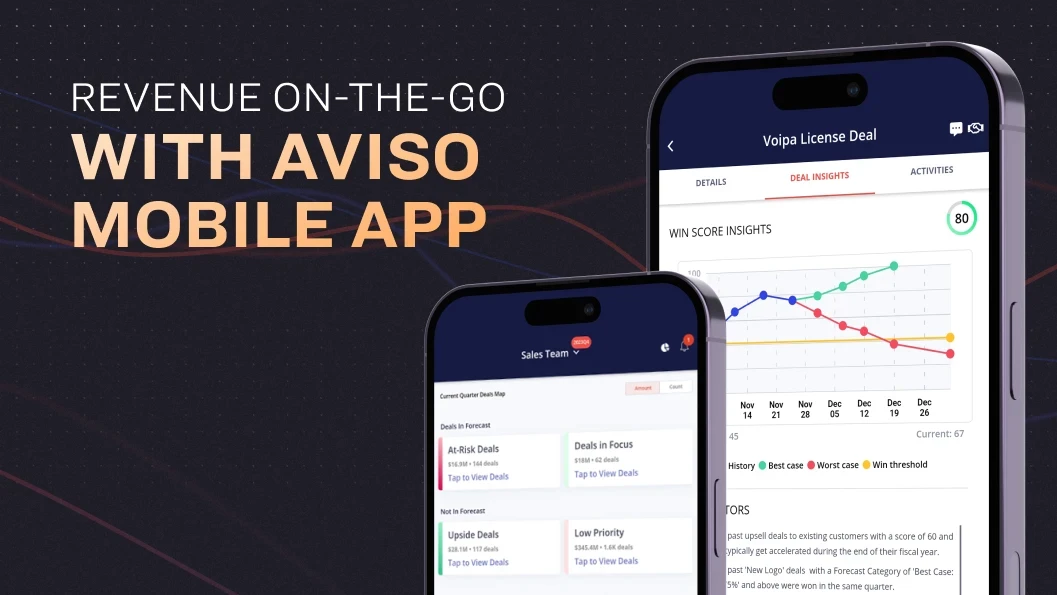
WinScore Explanations: Provides a 0-100% score for each deal, indicating the likelihood of closing. It explains the contributing factors to this score.
Pipeline Insights & Risk Reporting: Identifies why a forecast changed from a previous period, detailing which deals increased or decreased in value. It highlights deals that are "stuck" or at risk.
Pull-In Analysis: Identifies deals in future quarters that can be accelerated into the current quarter.
Conversation & Activity Intelligence: Analyzes emails, calls, and meetings to determine buyer engagement, sentiment, and objections, and how these affect the forecast.
Actionable Nudges: Offers AI-driven recommendations on the next best actions to take for a specific deal
Check out this HBR article to know more about how Aviso's advanced AI capabilities effectively support companies like Honeywell in overhauling their sales forecasting and pipeline management systems.
Accuracy Depends on Data Integrity
Forecast accuracy is impossible without trust in the underlying data.
Aviso eliminates data drift through bi-directional sync with CRM systems. Updates flow both ways automatically, ensuring forecasts are always grounded in the latest reality, not stale snapshots, shadow spreadsheets, or delayed updates.
This matters because forecasting is not a quarterly exercise.
It is a continuously evolving system.
With Aviso:
Changes made in CRM instantly impact forecasts
Forecast insights can be pushed back into CRM workflows
Sales teams work in their native systems without extra overhead
Accuracy improves not because reps are forced to behave differently, but because the system reflects reality as it changes.
Forecast Accuracy Comes From Eliminating Noise, Not Adding More Inputs
The most valuable thing AI can do for a CRO is not generate another number.
It is to remove uncertainty.
Aviso continuously analyzes thousands of signals across your revenue operation: deal changes, activity patterns, engagement shifts, execution gaps, and historical outcomes. These signals are not treated independently. They are interpreted in context, over time.
The result is not a forecast that feels smarter.
It is a forecast that behaves differently:
Variance tightens early in the quarter, not at the end
Risk is surfaced weeks before it becomes visible in pipeline reviews
Commit confidence is based on evidence, not negotiation
Leaders stop reacting and start reallocating resources with intent
This is how forecasting moves from reporting to control.
Real-Time Visibility Is Not About Speed
It Is About Runway
Most CROs do not miss the number because they find out too late.
They miss because they find out when it is no longer fixable.
Aviso’s real-time forecasting intelligence gives leaders runway.
Runway to intervene.
Runway to rebalance coverage.
Runway to change outcomes.
When risk is identified early, coaching becomes targeted. When acceleration is real, leadership can remove friction. Teams stop chasing deals that look good in slides but are structurally broken.
This is the difference between knowing what happened and knowing what will happen.
MIKI, Aviso’s Agentic AI Chief of Staff, continuously ingests signals from CRM updates, calls, emails, meetings, and seller activity. This ensures forecasts reflect what is actually happening in the field, not just what reps report during forecast calls. When execution slows, engagement drops, or buyer sentiment turns negative, MIKI adjusts its outlook automatically.
Unlike black-box models that output a single probability, MIKI focuses on reasoning about risk. It explains why a deal or forecast is at risk by identifying concrete drivers such as missing decision-makers, stalled next steps, competitive pressure, or historical patterns that commonly lead to push-outs. This makes forecasts understandable and defensible for CROs and frontline leaders.
MIKI also adapts as conditions change. Forecasts are recalculated continuously as new signals arrive, eliminating the need for manual re-forecasting cycles. When buyer behavior shifts or execution improves, the forecast updates in real time.
What Happens When Forecasts Become Trustworthy
When forecasting accuracy improves, the impact extends far beyond sales.
Finance plans with confidence instead of buffers.
Marketing invests with precision instead of overgeneration.
Product aligns capacity to real demand signals.
Boards stop discounting the number.
At Honeywell, a global enterprise, Aviso helped transform forecasting from a reactive exercise into a strategic operating system. With materially improved accuracy and early risk visibility, leadership was able to make faster, better decisions across capacity planning, execution focus, and revenue strategy. The outcome was measurable ROI driven not by incremental reporting, but by prevented surprises and improved execution discipline.
The result was not just better accuracy, but over $150 million in incremental revenue driven by improved execution and predictability.
That is what forecasting is supposed to do.
Forecasting Is Not a Sales Problem
It Is a Systems Problem
Many organizations still treat forecasting as a political process. Sales has one view. Finance has another. Operations reconciles after the fact.
AI-driven forecasting, done correctly, changes the power dynamics.
There is one number because there is one system of record for reality.
When everyone sees the same evidence, debates shift from “whose number is right” to “what are we going to do about it.”
That is when forecasting stops being a source of friction and becomes a source of alignment.
Scaling What Actually Works
One of the most underappreciated benefits of accurate forecasting is what it reveals about execution.
When you understand why deals close or slip, patterns emerge. Not anecdotes. Not rep stories. Actual behaviors that correlate with outcomes.
Aviso surfaces these patterns automatically, allowing leaders to codify best practices and scale them across teams. Forecast accuracy improves not just because predictions are better, but because execution improves.
In high-performing organizations, forecasting becomes a performance lever, not a reporting artifact.
The Future of Revenue Is Predictable
And That Is a Good Thing
The best revenue teams are no longer surprised.
They forecast within single-digit variance.
They plan growth with confidence.
They act early and decisively.
This is not because they hired better forecasters.
It is because they built better systems.
Aviso’s AI-driven revenue forecasting is not about replacing human judgment. It is about grounding judgment in reality, at scale, continuously. This leads to Clarity. Foresight. And a 98%+ forecast accuracy for 100% of our customers.
And once you experience a world with no surprises, you do not go back.
Are you stuck with a rearview mirror? It’s time to switch. Let’s talk.
Read More Like This