Why Bolt-On AI Agents Fall Short in Enterprise Revenue Systems

No time to lose? Summarize with AI
ChatGPT
Claude
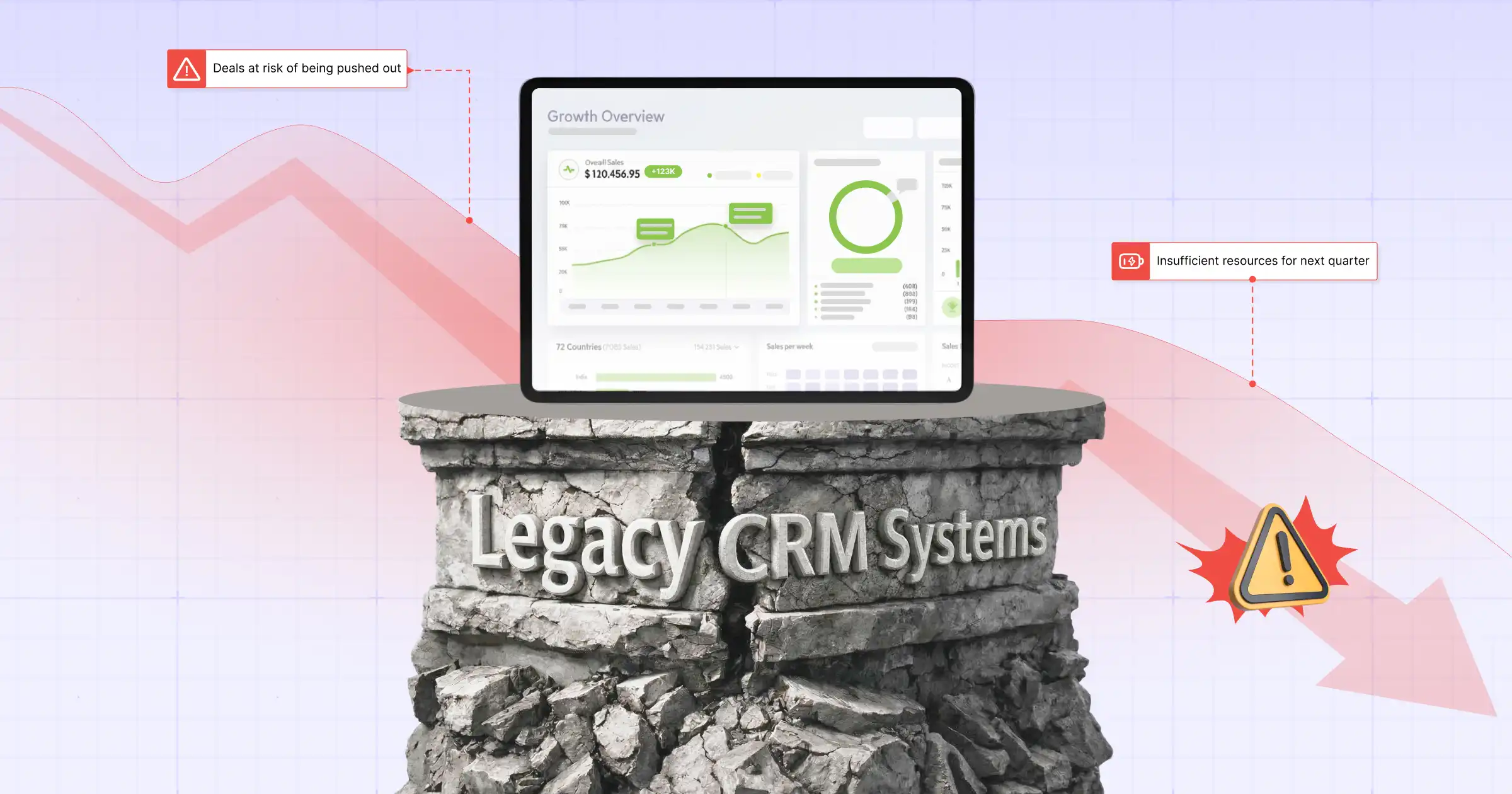
AI agents are quickly becoming the centerpiece of modern enterprise software. Vendors are announcing copilots that promise to answer questions, automate workflows, and guide decisions across sales, customer success, and revenue operations.
But many organizations are discovering a gap between promise and reality.
Most enterprise revenue teams still operate on traditional CRM platforms such as Salesforce, Microsoft Dynamics 365, SAP CRM, or HubSpot CRM. These legacy revenue systems were built primarily as systems of record. Their role was to store information about accounts, contacts, opportunities, and activities. They were not designed to continuously interpret signals or predict outcomes.
When AI agents are layered on top of these systems, they inherit the same limitations.
Bolting AI agents onto legacy platforms often produces surface-level automation without structural intelligence. The result is confident outputs built on unstable foundations. In revenue organizations, that translates into missed forecasts, misallocated coverage, and erosion of trust in AI initiatives.
AI agents are not features. They are reasoning systems. And reasoning systems require an architecture that was never designed into most legacy platforms.
Challenges: The Structural Mismatch Between Agents and Legacy Systems
When an AI agent is bolted onto a legacy CRM like Salesforce or Dynamics 365, it does not gain intelligence. It inherits constraints. The platform was designed for humans entering data, not for machines reasoning over it. This creates five compounding structural problems.
1. Legacy CRMs Store States, Not Signals
A CRM like Salesforce records what happened: a deal moved to Stage 4, a call was logged, a contact was added. AI agents need to reason about what is happening: continuous, real-time streams of engagement signal that reveal momentum, intent, and change.
When you bolt an agent onto a state-store, it can only reason about snapshots. It has no visibility into whether a deal is accelerating or stalling, whether a stakeholder is warming or pulling back, or whether the competitive situation shifted since the last field update. It is like asking a navigator to plot a course using only photographs instead of GPS.
The result: AI outputs that reflect where a deal was at the time of last entry, not where it actually stands today. Recommendations are always slightly out of date, and in fast-moving deals, slightly out of date is wrong.
2. The Data Model Was Designed for Human Interpretation, Not Machine Reasoning
Fields like Close Date, Stage, and Amount carry implicit human context. An experienced rep knows that close dates slip, stages get updated to satisfy forecast calls rather than reflect reality, and amounts are often aspirational. Humans apply that judgment automatically. AI agents do not.
When an agent reads a Salesforce record showing a deal at Stage 4 with a close date of next Friday, it treats that as ground truth. It does not know the rep advanced the stage during a pipeline review, or that the close date has rolled forward three times. The data model was never designed to carry the semantic weight that AI reasoning requires.
The result: Confident AI outputs built on manipulated inputs. The agent does not detect the distortion. It scales it across the entire pipeline, producing forecast calls and risk scores that appear precise but are grounded in fiction.
3. No Relationship Graph, Only Objects and Attributes
Legacy CRMs model things: accounts, contacts, opportunities, each with a set of properties. What they do not model is the relationships between those things. Who influences whom. How engagement between a champion and an economic buyer correlates with deal progression. How a key contact going dark affects renewal likelihood.
AI agents need a graph, not a table. Reasoning about revenue outcomes requires understanding the network of relationships across stakeholders, influence paths, communication flows, and historical engagement patterns. A flat object model in HubSpot or Oracle CX Sales cannot provide that.
The result: An agent that can tell you a deal has low activity, but cannot tell you that the economic buyer specifically went quiet while a technical stakeholder stayed engaged. The nuance that drives real deal insight is invisible to the model.
4. Activity Data Is Sparse and Unverified
CRMs depend on reps self-reporting their activities. Calls that happen over a personal phone, meetings arranged through a personal calendar, emails sent from outside the tracked account are all invisible to the system. The CRM does not know what it does not know.
An AI agent cannot distinguish between "nothing is happening on this deal" and "things are happening but they are not being logged." It interprets silence in the data as silence in the deal. That is a dangerous assumption in enterprise sales, where the most important conversations often happen outside the system.
The result: Risk flags and engagement scores built on incomplete evidence. Deals that look cold in Salesforce may be actively advancing. Deals that look active may be running on stale logged activities from weeks ago.
5. No Feedback Loop for the AI to Learn From
Legacy CRMs were not built to track whether any given recommendation or prediction led to an outcome. When an AI agent flags a deal as at risk, there is no mechanism in Salesforce or SAP Sales Cloud to record whether that flag was accurate, whether the suggested action was taken, and whether the outcome improved as a result.
Without a closed feedback loop, the agent cannot improve. It keeps generating outputs into a void, with no way to calibrate against reality. Over time, confidence does not increase. It just accumulates without accountability.
The result: AI that does not get smarter with use. Every quarter looks like the first quarter. The system has no memory of what it got right or wrong, and no mechanism to adjust. That is not intelligence. It is automation with an AI label on it.
The Business Risks of Cosmetic AI
Forecast Instability
Forecast accuracy depends on interpreting multiple signals simultaneously: deal progression, stakeholder engagement, historical win patterns, seasonality, and rep behavior.
If an AI agent relies primarily on CRM fields or isolated activity metrics, its predictions lack depth. Leaders may see improved dashboard aesthetics without improved forecast reliability.
When forecast variance persists despite AI deployment, executive trust declines.
Reinforced Technical Debt
Adding AI connectors, middleware layers, and API bridges increases complexity. Each integration introduces latency, synchronization challenges, and security considerations.
Instead of simplifying the revenue stack, bolt-on AI often compounds technical debt. Data pipelines become more fragile. Debugging insight discrepancies becomes more difficult.
Over time, the cost of maintaining integrations outweighs incremental productivity gains.
Governance and Compliance Exposure
AI agents that operate across systems must adhere to data governance standards. When multiple agents access overlapping datasets with different permission schemas, compliance risks increase. Without a centralized intelligence layer that understands data lineage and access controls, enterprises expose themselves to audit vulnerabilities.
The Solution: Build AI Into the Foundation, Not On Top of It
The core shift: from system of record to system of intelligence. Instead of a CRM that stores data and an AI that sits on top of it, the platform itself needs to be designed around continuous signal ingestion, relationship modeling, and multi-model reasoning from the ground up. The intelligence layer is not a plugin. It is the architecture.
Agents deliver meaningful business impact only when they are embedded into how revenue data is structured, connected, and continuously interpreted.
Instead of treating agents as add-ons to legacy platforms, organizations need to rethink the architecture that supports decision-making.
It is to move from interface-level AI to foundation-level intelligence.
This shift typically involves four strategic moves.
1. Continuous Signal Ingestion Replaces Snapshot Storage
Instead of relying on what reps log into the CRM, the platform ingests signals continuously from email, calendar, product usage, support, marketing engagement, and external sources. It does not wait for a human to update a field. It reads activity as it happens and updates its understanding of each deal, account, and relationship in real time.
This directly solves the states-vs-signals problem. The AI is no longer reasoning from a photograph. It is reasoning from a live feed.
2. A Semantic Layer Interprets Data in Context, Not at Face Value
A purpose-built revenue AI platform does not treat CRM fields as ground truth. It applies a semantic layer that understands what those fields mean given the surrounding context. A Stage 4 label means nothing on its own. Paired with declining stakeholder engagement, a slipping close date, and no recent activity from the economic buyer, it signals a deal in trouble.
This solves the human-interpretation problem. The platform encodes the judgment that experienced reps apply implicitly, and applies it consistently across every deal in the pipeline.
3. A Relationship Graph Models the Revenue Network, Not Just Its Objects
Aviso’s Context Graph combines an Ontology Layer with a Knowledge Graph to model the full network of relationships across stakeholders, influence paths, communication flows, and engagement trajectories. The ontology defines the entities and permissible relationships in the revenue domain. The knowledge graph instantiates those relationships dynamically as real-world signals arrive.
The practical difference is significant. Without a Context Graph, an agent identifies that an opportunity has low activity. With a Context Graph, it identifies that the economic buyer went quiet while secondary stakeholders increased engagement, which is a specific signal of internal deliberation, not disengagement.
This solves the flat object model problem. The AI reasons over a living network, not a table of attributes.
4. Multi-Source Signal Fusion Closes the Activity Blind Spot
By ingesting signals from email servers, calendar systems, communication tools, and product telemetry directly, the platform does not depend on rep self-reporting. Conversations that never touch Salesforce are still visible. Engagement that happens outside the CRM is still captured.
This solves the sparse activity data problem. The platform can distinguish between a deal where nothing is happening and a deal where things are happening outside the logged record.
5. Outcome Tracking Creates a Closed Feedback Loop
Every prediction and recommendation the AI makes is tracked against what actually happened. Did the deal close? Did the flagged risk materialize? Did the suggested action improve the outcome? That closed loop feeds back into the models continuously, allowing them to calibrate and improve with every quarter.
This solves the no-feedback problem. The AI gets smarter with use. Confidence is earned through accuracy, not just asserted.
Multi-Model Orchestration Ties All Five Layers Together
None of these five capabilities can be served by a single model type. Large language models handle unstructured signal interpretation. Large quantitative models handle statistical forecasting and scenario modeling. Smaller specialized models handle targeted tasks like churn detection and sentiment classification. Machine learning algorithms handle continuous pattern learning across historical outcomes.
Aviso’s platform orchestrates all of these model classes against a shared, structured context. Each model operates on the same unified signal layer. Outputs are reconciled before surfacing recommendations. The result is predictions that combine generative language capability with quantitative rigor, rather than substituting one for the other.
Bolt-on agents default to whichever model type their vendor ships. Purpose-built intelligence platforms route each problem to the model best suited to solve it.
Enterprise AI Success Depends on What You Build Beneath It
AI agents represent a meaningful evolution in enterprise software. They can monitor signals at scale, identify risk patterns beyond human perception, and recommend actions with speed.
However, intelligence is an architectural decision. It cannot be retrofitted through superficial integrations.
Before deploying another AI agent, enterprises should evaluate three structural questions:
Is our revenue data unified and continuously reconciled across systems?
Do we model relationships and influence networks, or only objects and fields?
Is our AI stack orchestrated across multiple model types with governance embedded?
If the answer to these questions is no, bolt-on agents will likely deliver incremental productivity gains but limited strategic advantage.
The next generation of revenue platforms will not differentiate on the number of AI features they expose. They will differentiate on the integrity of their intelligence foundation.
Enterprises that treat AI agents as plugins will experience fragmented insights and limited trust. Enterprises that invest in contextual intelligence, structured relationship modeling, and multi-model orchestration will build durable competitive advantage.
The future of revenue performance will not be defined by who deploys agents first. It will be defined by who builds the right foundation for those agents to reason effectively.
AI does not replace systems. It transforms them. The transformation begins at the core.
This is the design principle behind Aviso.
Instead of bolting AI onto static records, Aviso enables AI to reason over the full context of the revenue engine.
Learn how Aviso helps revenue teams turn fragmented signals into predictive intelligence. Book a Demo now.
Read More Like This
