Why First-Gen Automation Is Holding GTM Teams Back

No time to lose? Summarize with AI
ChatGPT
Claude
Spend time with any RevOps or sales operations team, and you will hear a version of the same complaint. The automation is unreliable. We spend more time fixing the workflow than running it. Every time something changes, someone has to go in and manually patch it.
First-generation automation tools optimize for known paths. When the path is known, they are fast, reliable, and easy to maintain.
The workflows where GTM teams are struggling are not the known-path ones. They are the ones where the right steps depend on what you find along the way. Where an enrichment result changes what you do next. Where a missing input should pause the workflow rather than break it. Where the orchestration needs to reason about what to do, not just execute what it was told.
This is the difference between traditional AI workflow automation and agentic AI. This is why a new category of AI agent builders, purpose-built for GTM, is replacing tools like n8n, Zapier, and first-generation RPA that revenue teams have outgrown.
Why Traditional AI Workflow Automation Breaks on GTM Workflows
Visual workflow builders were designed around a reasonable premise: if you can map out a process, you can automate it. Define the steps, connect them, configure the conditions, ship it. For stable, well-understood processes, this works extremely well.
The problem is that a large and growing portion of GTM work does not fit that description. Prospecting research, deal qualification, account intelligence, and meeting preparation are all workflows where the path is not fully known before you start. The steps you need depend on what you find along the way. First-gen tools handle this badly.
What first-generation automation actually looks like in practice:
Static, hand-built flows Break when requirements change. Every new edge case becomes a manual rewrite | Runtime-only failures No validation layer. Issues are discovered after execution, when it is most expensive to fix. |
UI-dependent execution Hard to run headless in CI/CD and server environments. Automation becomes click-ops. | Limited reasoning loops Hard to orchestrate research, code, QA, and retry workflows without brittle glue code connecting them. |
The business impact: These failure modes compound. Slower delivery because every edge case needs a manual fix. Higher mean time to resolution because failures are discovered late, after partial execution. Inconsistent output quality because the workflow behaves differently depending on who last patched it. Hidden costs accumulate due to retries, rework, and context loss, especially when the workflow path is not known up front.
The teams that feel this most acutely are not the ones running simple SaaS-to-SaaS integrations. They are the ones trying to orchestrate research across multiple sources, sequence outreach based on enrichment outputs, or chain together meeting prep, call intelligence, and CRM updates into a single reliable workflow.
For those teams, the core issue is not that their current tool has bugs. It is that their current tool was built for known paths. They are running unknown-path workflows through a known-path tool, and paying for it in maintenance overhead every week.
The Current Tool Landscape for GTM Automation
Platform | Where It Wins | Where It Falls Short |
|---|---|---|
n8n / ZapierGeneric Workflow Builders | Connecting SaaS tools via fixed triggers and actions | No revenue context. Flows break when deals change. No GTM knowledge baked in. |
ClayEnrichment & Outbound Ops | Data enrichment and waterfall prospecting from multiple sources | Top-of-funnel only. Cannot support mid-deal actions, coaching, or forecast management. |
Salesforce AgentforceCRM-Native Agents | CRM-embedded actions inside the Salesforce ecosystem | Locked to Salesforce data. No cross-platform revenue signal. Requires Salesforce to be the source of truth. |
RoxGTM Agent Workflows | Prebuilt GTM playbooks and revenue productivity use cases | Vertical focus and cloud dependency; less flexible for orchestration across arbitrary systems. |
What Revenue Teams Actually Need
The missing ingredient isn't more templates or more integrations. It's orchestration that can plan, validate, and adapt, not just connect nodes.
Think about what a top-performing AE actually does before a major meeting. They don't follow a script. They pull relevant context from multiple sources, synthesize it, identify risks, and build a plan, then adjust that plan as new information comes in. When a deal signal changes the day before a call, they adapt.
That kind of reasoning isn't something a trigger-action workflow can replicate. It requires an agent that can adapt to changing business needs.
Introducing Aviso Agent Studio: The AI Agentic Builder for GTM
Aviso's Agent Studio was designed from the ground up for this problem. It's not a visual workflow tool with an AI wrapper. It's an enterprise agent builder built specifically for go-to-market teams, one that treats revenue intelligence as the core context, not an afterthought.
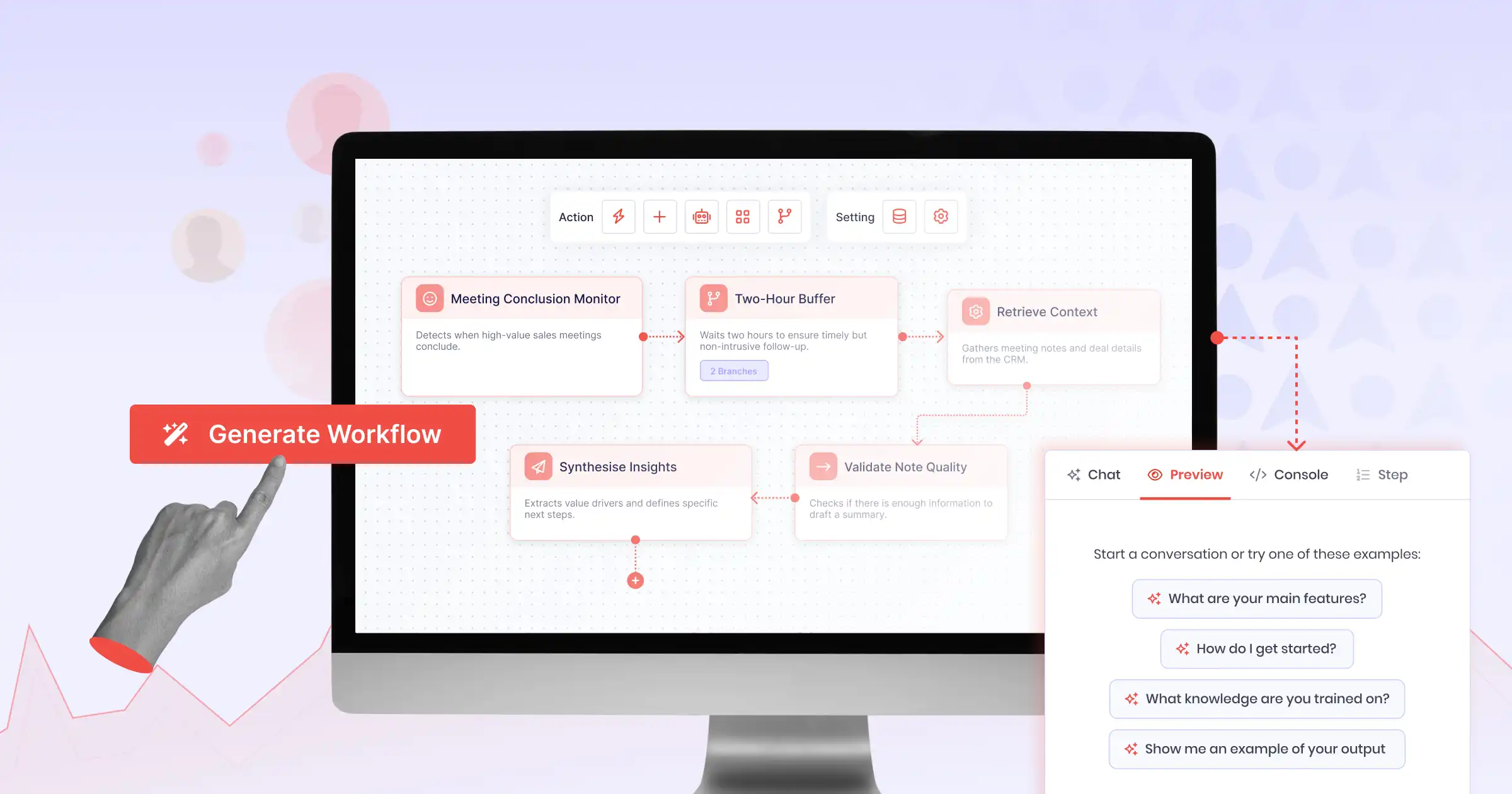
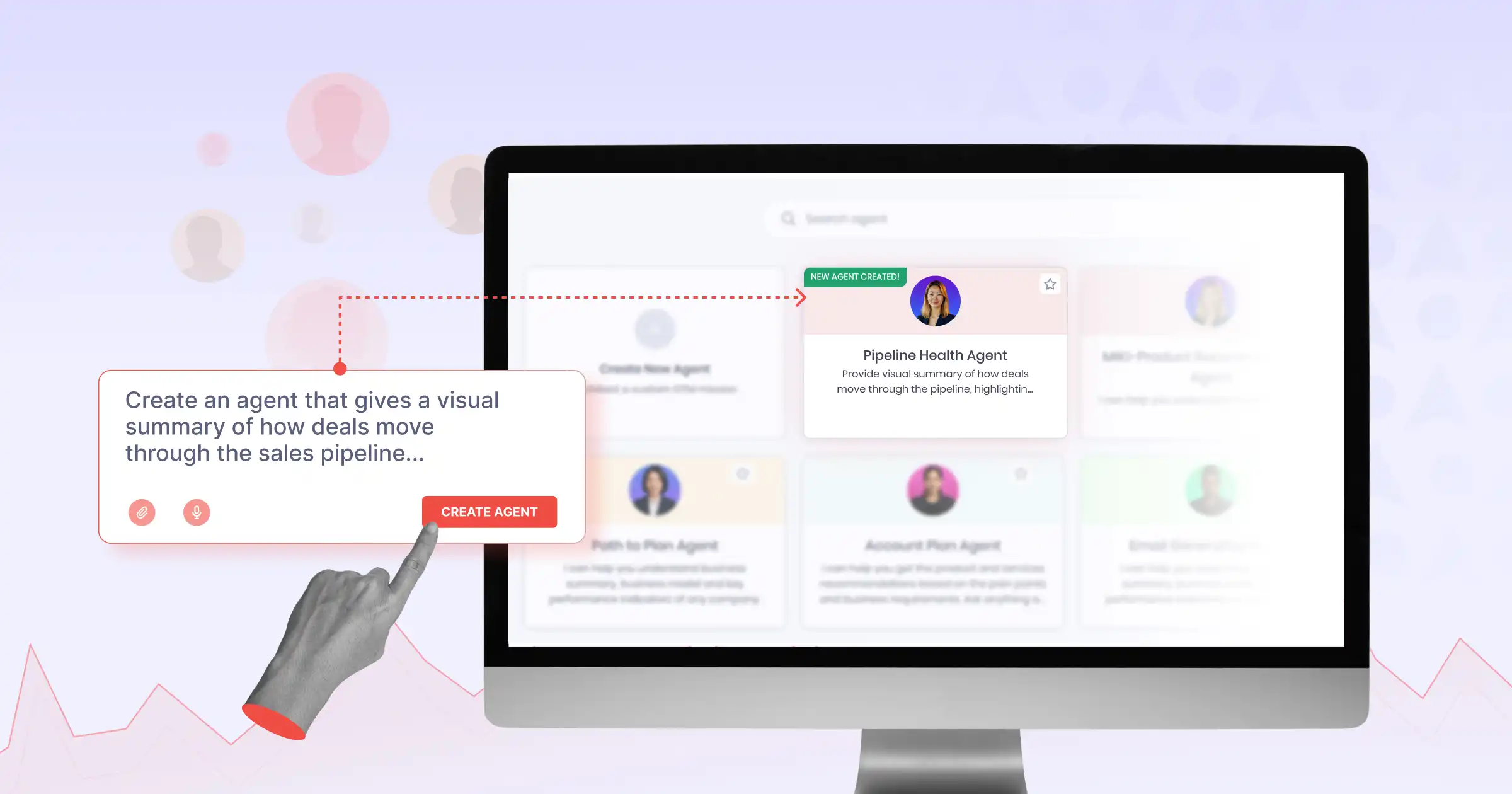
The core idea is simple but powerful: describe what you want in plain language, and Agent Studio builds the workflow for you instantly.
No drag-and-drop canvas. No code. No complex setup. Just describe the GTM outcome you're trying to achieve, and the AI planner generates the workflow, validates it before execution, and self-corrects when something changes mid-run.
Traditional Agent Builder | Aviso Agent Studio |
|---|---|
⚠️ Static dashboards, insights only | ✅ Autonomous agents, actions embedded |
⚠️ Weeks to configure, siloed AI features | ✅ Natural language, unified platform |
⚠️ Hard to govern, prone to hallucinations | ✅ Enterprise controls, knowledge-grounded |
⚠️ Tribal knowledge | ✅ Institutional knowledge |
Feature Comparison: Aviso’s Agent Studio vs The Market
Capability | Aviso | n8n / Zapier | Clay | Agentforce | Gong / Clari |
|---|---|---|---|---|---|
Build agents without code | ✔ Full | ⚠ Partial | ✘ No | ✘ No | ✘ No |
Revenue data grounding (CRM, CI, forecast) | ✔ Full | ✘ No | ✘ No | ⚠ Partial | ⚠ Partial |
Role-specific pre-built agents (CRO, AE, FLM) | ✔ Full | ✘ No | ✘ No | ⚠ Partial | ✘ No |
Agents that adapt when deals change mid-flight | ✔ Full | ✘ No | ✘ No | ✘ No | ✘ No |
Enterprise governance + RBAC + audit logs | ✔ Full | ⚠ Partial | ✘ No | ⚠ Partial | ⚠ Partial |
Dynamic plan generation | ✔ Full | ✘ No | ✘ No | ✘ No | ⚠ Partial |
Pre-execution validation | ✔ Full | ✘ No | ✘ No | ✘ No | ✘ No |
Runtime clarification / mid-flight adaptation | ✔ Full | ✘ No | ✘ No | ✘ No | ✘ No |
Why Revenue-Grounded Agentic AI Outperforms Generic AI Agents
What makes Aviso’s approach different is not just the natural language interface. It is what the agents are grounded in and how they operate across your organization. Every agent is built on your live CRM data, conversation intelligence, forecast signals, playbooks, and historical deal patterns. This ensures outputs are specific to your business, not generic AI responses.
When deal context changes, such as a champion leaving, a competitor entering, or a timeline shifting, Aviso agents adjust in real time and continue execution without disruption.
These agents are designed for every role across GTM teams. Sales leaders, operations teams, and SDRs can all use tailored agents directly within their existing workflows. This creates consistency in execution while making it easy to scale proven processes across the organization.
The platform is enterprise-ready from day one. With over 200 integrations, built-in governance, audit logs, and enterprise-grade security, it supports large organizations that require control, compliance, and reliability at scale.
Why Aviso’s Agents Outperform
Revenue-Grounded Context Every agent is grounded in live CRM data, call intelligence, and forecast signals via MIKI. No generic outputs. Unlike tools that know nothing about your deals, Aviso agents are built on the revenue context that actually drives decisions. |
Agents That Adapt Mid-Deal When inputs are missing mid-run, Aviso automatically asks for clarification, requests what it needs, and resumes from exactly where it paused. When a deal changes or new information surfaces, agents adjust their plan and keep moving, not rigid flows that break. |
Enterprise Controls Built In RBAC permissions, human-in-the-loop approvals, and full audit logs. IT and RevOps stay in control from day one. Not shadow AI tools with zero visibility or oversight. |
Institutional Knowledge, Not Tribal Agents are grounded in playbooks, past deals, and your team’s winning patterns. not just the last conversation. Build once, deploy across your whole team. Scale your best rep’s process to the entire team instantly. |
Benefits Across GTM Teams
Sales Operations: Reduce manual workflows and minimize escalations by automating repetitive tasks such as data updates, reporting, and pipeline tracking. With continuous monitoring of deal activity and risk signals, issues are identified early, allowing teams to address them before they turn into escalations.
Sales Leaders: Scale high-performing processes across the entire team by turning successful sales motions into repeatable, agent-driven workflows. This ensures that best practices are consistently applied, enabling every rep to operate with the same level of effectiveness as top performers.
IT Admins: Manage all GTM tools through a single orchestration layer by centralizing integrations, workflows, and controls. This simplifies system management, reduces fragmentation across tools, and provides better visibility and governance across the entire GTM tech stack.
Is Your Automation Ready for What Changes Mid-Deal?
Most automation tools were built for the deals that go exactly as planned. But you know as well as anyone: those aren't the deals that matter most.
The deals that matter are the ones with complexity, ambiguity, and moving parts. The ones where the path changes three times before close. The ones where the right next action depends on context that no static workflow can anticipate.
That's where Agent Studio was designed to operate. Instead of a human configuring the path in advance, a planning agent generates the path at runtime from the stated intent and available context. The workflow adapts to what it finds rather than failing when it finds something unexpected.
If your current automation stack is still asking your team to do the thinking and just handling the clicking, it might be time to see what an agent built for revenue looks like. Book a Demo now.
FAQs
What is agentic AI? Agentic AI is a category of AI systems that can plan, reason, and adapt to take autonomous action across multi-step workflows — rather than executing pre-defined steps. Where traditional AI workflow automation follows a fixed trigger-action path, agentic AI generates the path at runtime based on the goal and the real-time state of the data.
What is agentic automation? Agentic automation applies agentic AI to business workflows. Instead of mapping every step in advance, you describe the goal in plain language and the AI agent plans, validates, and executes the workflow — adapting in real time when inputs change.
What is an AI agent builder? An AI agent builder is a platform for creating, deploying, and governing autonomous AI agents. The 2026 market splits into general-purpose agent builders (OpenAI, Google, Lindy), vertical GTM-grounded platforms (Aviso Agent Studio, Rox, Clay), and CRM-native agent layers (Salesforce Agentforce).
How is agentic automation different from Zapier or n8n? Zapier and n8n are first-generation workflow tools — fast and reliable for known-path workflows but brittle when the path isn't fully knowable in advance. Agentic automation generates the workflow at runtime based on the goal and context, so it adapts to new information instead of breaking on it.
How do I build an AI agent for sales? The fastest path is to use a GTM-grounded AI agent builder like Aviso Agent Studio. Describe the outcome you want in plain language; the platform generates the agentic workflow, grounds it in your live CRM and forecast data, validates it before execution, and adapts in real time. No code or visual canvas required.
What is Aviso Agent Studio? Aviso Agent Studio is an enterprise AI agent builder purpose-built for GTM teams. It generates agentic workflows from natural-language descriptions, grounds every agent in live revenue data (CRM, conversation intelligence, forecast signals), and includes enterprise controls — RBAC, audit logs, human-in-the-loop approvals — out of the box.
Read More Like This