Conversation Intelligence Software in 2026: Why One-Size-Fits-All CI Is Broken

No time to lose? Summarize with AI
ChatGPT
Claude
Conversation intelligence (CI) tools promise to make every sales call more productive. Record, transcribe, summarize, and your reps should have everything they need to follow up, coach, and close. In theory.
In practice, most teams have a different experience: the summaries are technically accurate and almost completely useless.
Not because the AI isn't working. Because it's applying the same template to every call, regardless of who's on it, what stage the deal is in, or what the conversation was actually about.
What Is Conversation Intelligence Software?
Conversation intelligence (CI) software uses AI to record, transcribe, and analyze sales conversations. The standard outputs are call summaries, action items, buyer sentiment signals, talk-time ratios, and (in better systems) coaching recommendations and deal risk flags. Gong, Chorus, Salesloft, Avoma, and Aviso are all common platforms in the category.
What Is Context-Aware Conversation Intelligence?
Context-aware conversation intelligence is CI that adapts its output to the type of call, the stage of the deal, and the roles of the participants. Instead of applying one fixed template to every conversation, the system classifies the call first (discovery call, QBR, SDR cold call, implementation review, and so on), then routes the transcript to an analysis engine purpose-built for that call type.
The result: a sales rep gets discovery questions and qualification signals on a discovery call. A CSM gets account health and renewal risk on a QBR. An SDR gets a single line on whether the call booked a meeting. An engineer gets blockers and action items on an internal standup, not "Seller Coaching."
The Problem: One Template, Four Broken Use Cases
Modern revenue teams run very different types of calls. An AE closing a deal sounds nothing like an SDR qualifying a lead. A QBR with a long-term customer has different stakes than a cold call. An engineering standup operates in a completely different universe from a sales discovery.
Generic CI doesn't know the difference. It produces the same structured output for all of them, and in doing so, it fails all of them.
Here's what that looks like in practice:
Team | What Generic CI Actually Produced |
|---|---|
AE / Sales | A rep walks into a pricing negotiation with a summary structured for discovery: pain questions, qualification signals, no deal risk analysis. |
CSM / Post-Sale | A QBR summary surfaces Buyer Interest Score: 72 and recommends seller follow-up for a call with no buyers on it. |
SDR / Outbound | A 6-minute cold call produces a 7-section report with Competitive Landscape and MEDDPICC. Meeting Booked: not mentioned. |
Internal / Implementation | A deployment standup labels 3 engineers as Buyers and 2 as Sellers — Seller coaching included, action items and blockers absent. |
The pattern is the same across every team: the output is technically present, but it doesn't reflect what the call actually was. Over time, reps stop reading it. Managers stop trusting it. CI becomes shelfware, adopted by no one, used by no one.
The Core issue: Generic CI is built for one call type. Your team runs four.
Aviso’s Context-Aware CI: The Shift From Recording to Understanding
Most conversation intelligence platforms were designed around a simple idea: record calls, transcribe them, and generate summaries. While this improves visibility into customer conversations, it often fails to capture the actual context behind the interaction.
A discovery call, a renewal discussion, and an implementation review are fundamentally different conversations. Yet many CI tools process them using the same structure, the same metrics, and the same insight framework.
Aviso’s Context-aware CI takes a different approach. Instead of treating every call identically, it adapts intelligence based on the specific type, stage, and objective of the conversation.
As a result, the system moves from generic transcription to contextual understanding.
Dimension | Generic CI | Context-Aware CI |
|---|---|---|
Call Classification | One template for all calls | 2-level: call type → deal stage |
Summary Structure | Fixed template, always | 8 templates — adapts to call type & sub-type |
Participant Roles | Buyer / Seller, universally applied | Context-appropriate per persona across 4 role sets |
Metrics | Same for every call | Relevant metrics per call type and sub-type |
Insight Layers | Buyer & Seller insights always shown | Per-type: Health · Project · Engagement · Expansion |
The result isn't a better version of the same summary. It's a completely different output, shaped by who was on the call, why they were there, and what success looks like for that specific conversation.
For an AE, that means deal-stage-aware intelligence that shifts as opportunities move through the funnel. For a CSM, it means health signals, churn risk, and expansion indicators; not Buyer Interest Scores. For an SDR, it means one north-star metric: did this call book a meeting? For internal teams, it means blockers, decisions, and action items with owners; not seller coaching for engineers.
Key Differentiator: Other CI tools record your calls. Context-aware CI understands them.
How Aviso’s Context-Aware CI Works
Instead of applying one static workflow to every transcript, the system first identifies the purpose of the call and then routes it to specialized AI engines trained for that specific context. The system uses a multi-layered approach to ensure that the insights generated are actually relevant to the specific conversation.
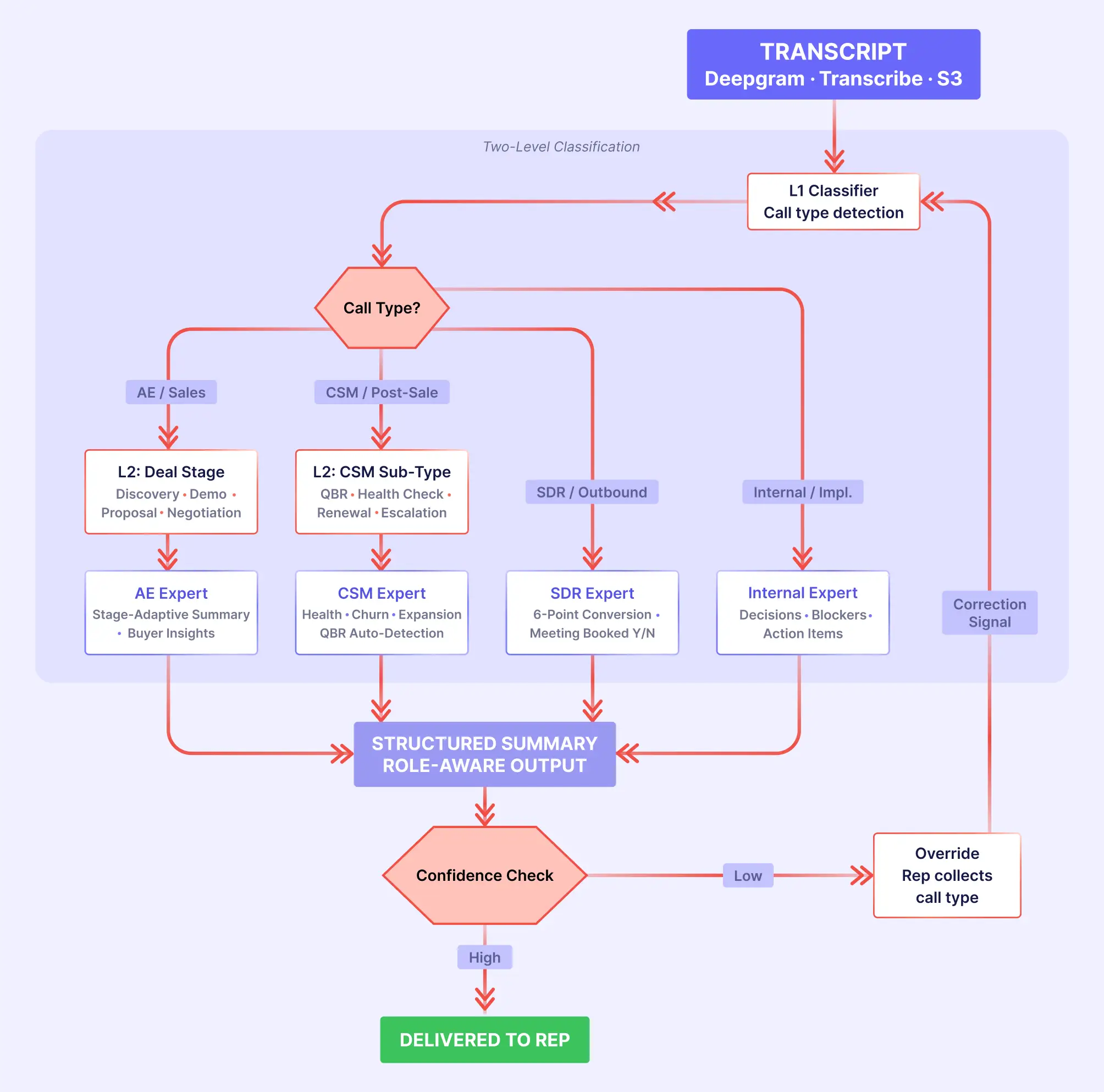
1. Transcript Ingestion
The process begins by ingesting transcripts from any major transcription or recording platform. Whether the source is Deepgram, Gong, Zoom, or another provider, transcripts are normalized and prepared for downstream analysis.
This creates a unified input layer, ensuring that no matter where your meetings happen, the audio is converted into text and fed into the intelligence engine immediately.
2. Two-Level Classification
Once the transcript is ingested, the system performs layered classification.
L1 Classifier: The first layer identifies the broad category of the call, such as Sales, Customer Success (CSM), SDR Outbound, or Internal meetings.
L2 Classifier: The second layer adds finer-grained understanding based on the role and context.
For example, AE calls may be classified into discovery, demo, proposal, or negotiation stages; CSM calls may be classified into QBRs, renewals, escalations, or health checks.
This two-level structure allows the platform to understand not just who is speaking, but what business objective the conversation serves.
3. Expert Routing
After classification, the transcript is routed to specialized AI engines built for that specific call type.
An AE discovery call requires different intelligence than a customer renewal conversation. Similarly, an SDR outbound call benefits from different scoring logic than an implementation review.
Each expert model focuses on role-specific outcomes:
AE intelligence surfaces buyer signals, objections, and stage progression
CSM intelligence identifies churn risk, expansion opportunities, and renewal indicators
SDR intelligence evaluates qualification quality, conversion likelihood, and meeting outcomes
Internal meeting intelligence extracts blockers, decisions, and action items
4. Structured, Role-Aware Output
The outputs are then assembled into structured summaries tailored to the user consuming them.
Sales reps may receive: Buyer intent signals, Competitive mentions, Deal risks, Next-step recommendations.
Customer success teams may receive: Account health indicators, Escalation risks, Renewal likelihood, Expansion opportunities.
This role-aware structure ensures that every stakeholder receives actionable intelligence instead of long transcript recaps.
5. Confidence Scoring and Override Loops
Not every call can be classified perfectly. To improve reliability, the system performs a confidence check before delivering outputs.
High Confidence: The summary is delivered directly to the representative.
Low Confidence: The system flags the call for human review. If a representative corrects the call type, that Correction Signal is fed back into the L1 Classifier, allowing the AI to learn and improve its accuracy over time.
Stage | What Happens |
|---|---|
| Ingests transcripts from any major transcription or recording service. |
| L1 detects call type. L2 refines deal stage (AE) or sub-type (CSM). |
| Each call type routes to a dedicated AI engine with purpose-built output logic. |
| Role-aware output delivered to the rep — sections, metrics, and insights tailored per persona. |
| Low-confidence calls surface a score for rep review. Overrides improve accuracy over time. |
Why This Architecture Matters
The problem with generic CI is the assumption that every call deserves the same summary, which is like assuming every email should get the same response.
The core advantage of context-aware CI is precision. Generic AI summaries flatten every conversation into the same output format, which limits usefulness at scale.
By understanding call context first and applying specialized reasoning second, context-aware systems generate outputs that are:
More relevant to the user
Better aligned to business workflows
Easier to operationalize across teams
More accurate over time through feedback loops
When CI understands context, including deal stage, call type, participant roles, and team function, it stops being a transcript processor and starts becoming an intelligence layer.
Reps get summaries they can act on. Managers get signals they can coach from. Revenue teams stop ignoring the output because the insights finally match the reality of the conversation.
This is where Aviso’s Context-Aware CI stands apart.
Instead of forcing every interaction into a single generic template, Aviso dynamically adapts intelligence based on the purpose of the conversation, the role of the participants, and the outcomes that matter for that specific workflow.
The result is conversation intelligence that moves beyond transcription and summarization into role-aware decision support that helps revenue teams drive better execution, coaching, forecasting, retention, and expansion outcomes at scale.
FAQs
What is conversation intelligence? Conversation intelligence (CI) is the use of AI to record, transcribe, and analyze sales conversations. The standard outputs include call summaries, action items, buyer sentiment, talk-time ratios, deal risk flags, and coaching recommendations. CI is most often used by revenue teams to improve rep coaching, deal forecasting, and customer engagement.
What is conversation intelligence software? Conversation intelligence software is the platform layer that captures, processes, and surfaces insights from sales calls and meetings. Common platforms include Gong, Chorus, Salesloft, Avoma, and Aviso. Most platforms record and transcribe; the better ones add deal-stage analysis, coaching signals, and integration with the forecast and pipeline.
What is context-aware conversation intelligence? Context-aware conversation intelligence is CI software that adapts its output based on the type of call, the stage of the deal, and the roles of the participants. Instead of applying one fixed template to every conversation, the system classifies the call first (discovery, QBR, SDR cold call, internal review, and so on), then routes the transcript to an analysis engine purpose-built for that call type. The result is a different output shape for each call type, which generic CI cannot produce.
How does conversation intelligence software work? Conversation intelligence software ingests audio or transcripts from calls and meetings, runs the content through AI models to extract structured signals (sentiment, action items, talk-time, competitive mentions, deal stage indicators), and produces summaries and dashboards for revenue leaders. Better CI systems also classify the call type and apply different reasoning depending on whether the call was a discovery, a demo, a QBR, or a renewal.
How is Aviso's CI different from Gong or Chorus? Generic CI platforms apply a single AI workflow to every call. Aviso's Context-Aware CI classifies the call type first (AE discovery, CSM QBR, SDR outbound, internal review) and routes the transcript to a specialized AI engine for that specific call type. That changes the output structure, the metrics surfaced, and the recommendations produced. The downstream effect: reps and managers stop ignoring the output because the insights match what the call actually was.
How can managers use conversation intelligence to coach reps? Managers use conversation intelligence to identify the calls where reps are struggling (objection handling, pricing conversations, multi-threaded deals), surface the moments inside those calls that matter, and turn them into reusable coaching tape. Context-aware CI is especially useful here because the coaching signals are scoped to the call type. Discovery coaching looks different from negotiation coaching, and the system tailors the output accordingly.
What types of calls can context-aware CI classify? Context-aware CI typically classifies calls into four broad categories with deal-stage sub-types: AE sales calls (discovery, demo, proposal, negotiation), CSM calls (QBR, renewal, escalation, health check), SDR outbound calls, and internal meetings (implementation, standup, kickoff). The first classifier (L1) identifies the category; the second (L2) refines the sub-type or deal stage.
Is Aviso's CI a Gong alternative? Yes. Aviso is a Gong alternative for teams that want CI to do more than record and summarize. Aviso captures 1,000+ signals per call (vs Gong's 300+), updates the deal's WinScore in real time from those signals, and adapts its output to call type and participant role via Context-Aware CI. See the full Aviso vs Gong CI comparison.