Memory Without Bias: The Next Challenge for Enterprise AI

No time to lose? Summarize with AI
ChatGPT
Claude
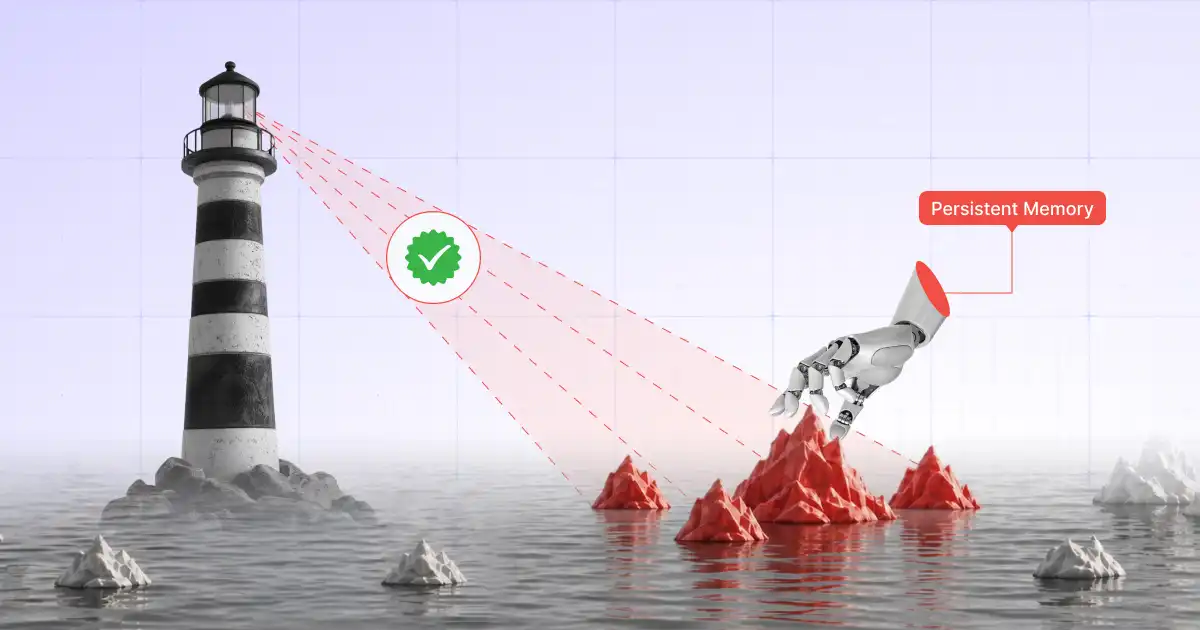
The debate isn't whether AI should remember. It's what it should remember.
Every enterprise software vendor is racing to add memory to its products. Agents that recall past conversations, past interactions, past decisions. It sounds like the obvious next step for AI in revenue teams. But memory by itself does not make an agent better. It makes an agent more confident, and confidence without accuracy is a liability, not an advantage.
When memory is built carelessly, it treats belief as fact. If a rep tells an assistant a deal is closing this quarter, and the system stores that as ground truth, every future recommendation inherits that error. The agent stops reasoning from evidence and starts reasoning from what it was told. In a consumer setting, that produces an awkward conversation. In a revenue setting, it produces a forecast nobody can trust.
Personalization Is Not Context
Personalization answers one question: what does this user prefer? Context answers a different one entirely: what is actually happening in this business?
A personalized system might learn that a rep writes short emails or prefers bullet points over paragraphs. A contextual system knows that a $400,000 opportunity has been stalled for 42 days since procurement got involved. Those are not variations on the same capability. They require different reasoning, and only one of them changes a forecast.
This is the distinction enterprise AI keeps skipping past. Teaching an assistant to sound like you is a formatting exercise. Teaching it to understand your pipeline is a business capability. Conflating the two is how vendors end up shipping agents that feel personal but stay useless.
What Enterprise Memory Should Actually Hold
If personalization is not the goal, the question becomes what enterprise memory is actually for. The honest answer is narrower than most product teams want to admit. Enterprise memory should hold:
Account and opportunity history, not a rep's read on either
Verified activity: calls logged, emails sent, meetings held
Deal stage changes and the evidence behind each one
Stakeholder mapping and buying committee shifts
Outcomes that were confirmed, not outcomes that were predicted
None of this is exotic. It is the data GTM teams already generate every day. The failure is not a lack of memory infrastructure. It is a willingness to let unverified claims sit next to verified records as if they carried the same weight.
Personalization Should Never Override
There is a boundary every enterprise AI system needs, and it should be explicit rather than implied. Personalization can shape tone, format, and delivery. It can decide how a summary is written or how a dashboard is laid out. But it should never override:
Factual evidence
Retrieval from trusted sources
Grounded reasoning
Enterprise governance
Cross that line, even with good intentions, and the system starts optimizing for agreement instead of accuracy. Otherwise, the AI gradually becomes more loyal to the user than to reality.
Persistent Doesn't Mean Agreeable
There is a second risk hiding inside the memory conversation, and it is closely related: agreeableness. Systems that personalize aggressively tend to drift toward telling users what they already believe, because that is what keeps the interaction smooth. In a revenue context, smooth is not the goal. Accurate is.
A persistent sales agent should not simply agree with a rep's read on a deal. It should challenge assumptions when the data disagrees, verify claims against the CRM and activity history, surface risks the rep has not flagged, and explain the reasoning behind every recommendation it makes.
Persistence should make an agent more accountable, not more compliant.
This is the difference between an assistant that makes a rep feel good in the moment and one that makes the forecast defensible in front of leadership. GTM teams need the second kind, even when it is the less comfortable one.
The Deeper AI Architecture Point
Underneath all of this is really a discussion about context engineering. Not all context is equally valuable, and treating it as if it were is where most memory systems go wrong.
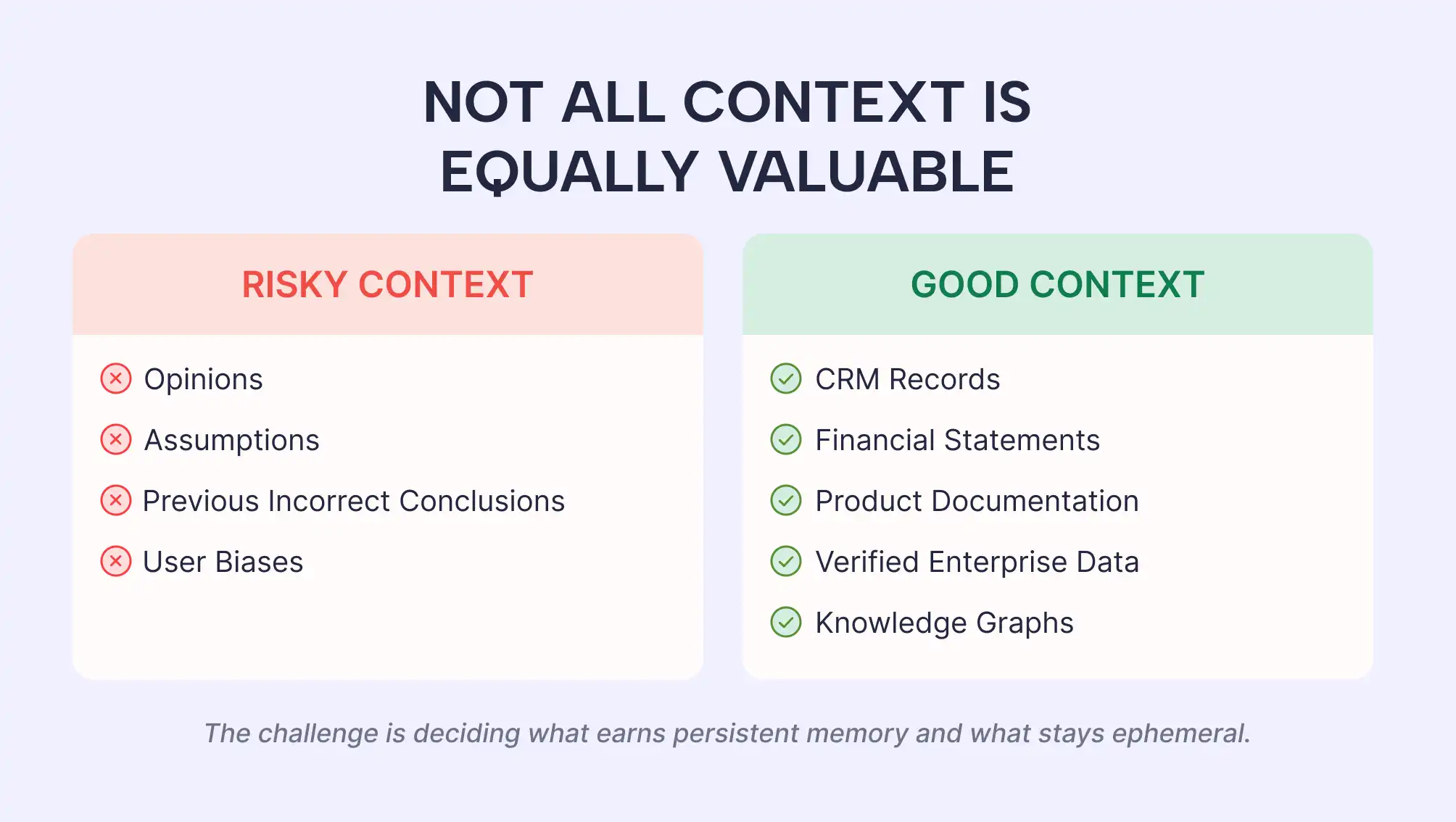
Good context includes CRM records, financial statements, product documentation, verified enterprise data, and knowledge graphs. It is information that has already been checked against something external to the model. Risky context includes opinions, assumptions, previous incorrect conclusions, and user biases. It feels like information because it is phrased like information, but nothing has verified it.
The challenge for enterprise AI is not whether to build memory. It is deciding what deserves to become persistent memory and what should remain ephemeral conversation history that fades once the session ends. A rep's hunch about why a deal stalled is worth hearing in the moment. It is not worth carrying forward as an input to next quarter's forecast.
The problem isn't persistent memory. It's persisting the wrong memory.
Memory Needs an Architecture, Not a Database
Most teams picture enterprise memory as a large language model bolted onto a vector database. That is not architecture. It is storage, and storage alone cannot tell the difference between a verified fact and a confident guess.
Real enterprise memory is layered. Structured CRM data feeds a knowledge graph. The knowledge graph is organized by an ontology that defines what accounts, contacts, and opportunities actually mean to the business. Activity timelines and semantic memory sit on top of that, and grounded reasoning happens across all of it before a persistent agent ever takes an action or makes a recommendation.
This is the model behind Aviso's Persistent Agents and Context Graph: memory grounded in verified business data, organized by a business ontology, and governed by explicit policy on what enters memory, when it expires, who can access it, and what evidence is allowed to override it. Without that governance layer, memory is not an asset. It is an accumulated liability waiting to surface in a board review.
Why This Distinction Shows Up on Forecast Calls
This is not an abstract architecture debate. It shows up directly in the way revenue teams operate every week. Picture a forecast call where a rep says a deal is on track, and a personalized assistant echoes that confidence back because it has learned to align with what the rep usually says. Leadership hears agreement and assumes the pipeline is healthy. Nobody in the room notices that the last verified activity on the account was three weeks ago, or that the champion who was driving the deal changed roles.
An agent built on grounded memory catches that gap immediately, because it is not weighing what the rep believes. It is weighing what the CRM, the activity log, and the meeting history actually show. That single difference, reasoning from verified records instead of from a rep's narrative, is what separates a forecast that survives scrutiny from one that collapses the moment someone asks a follow-up question.
The same pattern repeats across renewals, expansion motions, and territory handoffs. Wherever a system relies on what someone said instead of what the data confirms, errors compound quietly until they surface at the worst possible moment, usually in front of a board or a CRO.
What This Means for How Agents Should Reason
An enterprise agent should not remember what a salesperson believes about an account as if that belief were truth. It should remember what actually happened: the calls, the emails, the changes in deal stage, the customer interactions, and the verified business facts behind them. At the same time, it should stay willing to challenge those facts and its own prior conclusions the moment new evidence appears.
That is a more nuanced position than simply saying that memory is good or bad. Memory is neither. It is a design decision, and the decision that matters is what earns the right to persist.
Vendors that skip this distinction end up building agents that are pleasant to talk to and unreliable to act on. Vendors that get it right build something closer to a colleague who has read every file, remembers every commitment, and still asks for evidence before drawing a conclusion. That is the standard enterprise AI should be held to, and it is a materially higher bar than remembering someone's preferences.
The future of enterprise AI isn't about building agents that know you better. It's about building agents that understand your business better. Book a demo with Aviso to learn more.
Read More Like This