The Memory Gap: Why Revenue AI Misses Buying Intent

No time to lose? Summarize with AI
ChatGPT
Claude

Revenue teams do not struggle because information is missing. They struggle because critical business context is scattered across conversations, CRM records, customer interactions, and internal systems.
AI can tell you that someone visited your pricing page. But that information alone doesn't tell you whether it matters.
Was the visitor from one of your target accounts? Is this their first visit, or have they returned multiple times over the past month? Did they attend a recent webinar or download a buyer's guide? Is there an open opportunity in the CRM, or a closed-lost deal that's showing renewed interest? Are multiple stakeholders from the same company researching your solution together? Has the account's product usage increased, indicating expansion potential?
These questions determine whether a website visit is just another page view or the start of a meaningful buying journey.
The challenge is that the answers rarely exist in one place. Website analytics captures browsing behavior. CRM stores account history. Marketing platforms track engagement. Customer Success monitors adoption. Sales teams hold valuable relationship knowledge in meetings, emails, and notes.
Most AI can retrieve information from these systems, but it struggles to connect them into a coherent business narrative. It recognizes an event, but not its significance.
Context is what transforms a website visit into buying intent. It connects anonymous activity to a real account, places it within the broader customer journey, and reveals what should happen next. Without that context, AI can surface signals. With it, AI can make informed revenue decisions.
The Four Context Gaps in Revenue AI
A buyer visits your pricing page three times in a week. Downloads a guide. Returns after a product announcement. Shares the site with two colleagues.
None of them fills out a form.
Marketing sees anonymous traffic. Sales sees nothing. AI sees only isolated website sessions.
The buying journey has already begun, but your revenue organization has no understanding of it.
Revenue work depends on understanding how events connect over time, what has changed, and what should happen next.
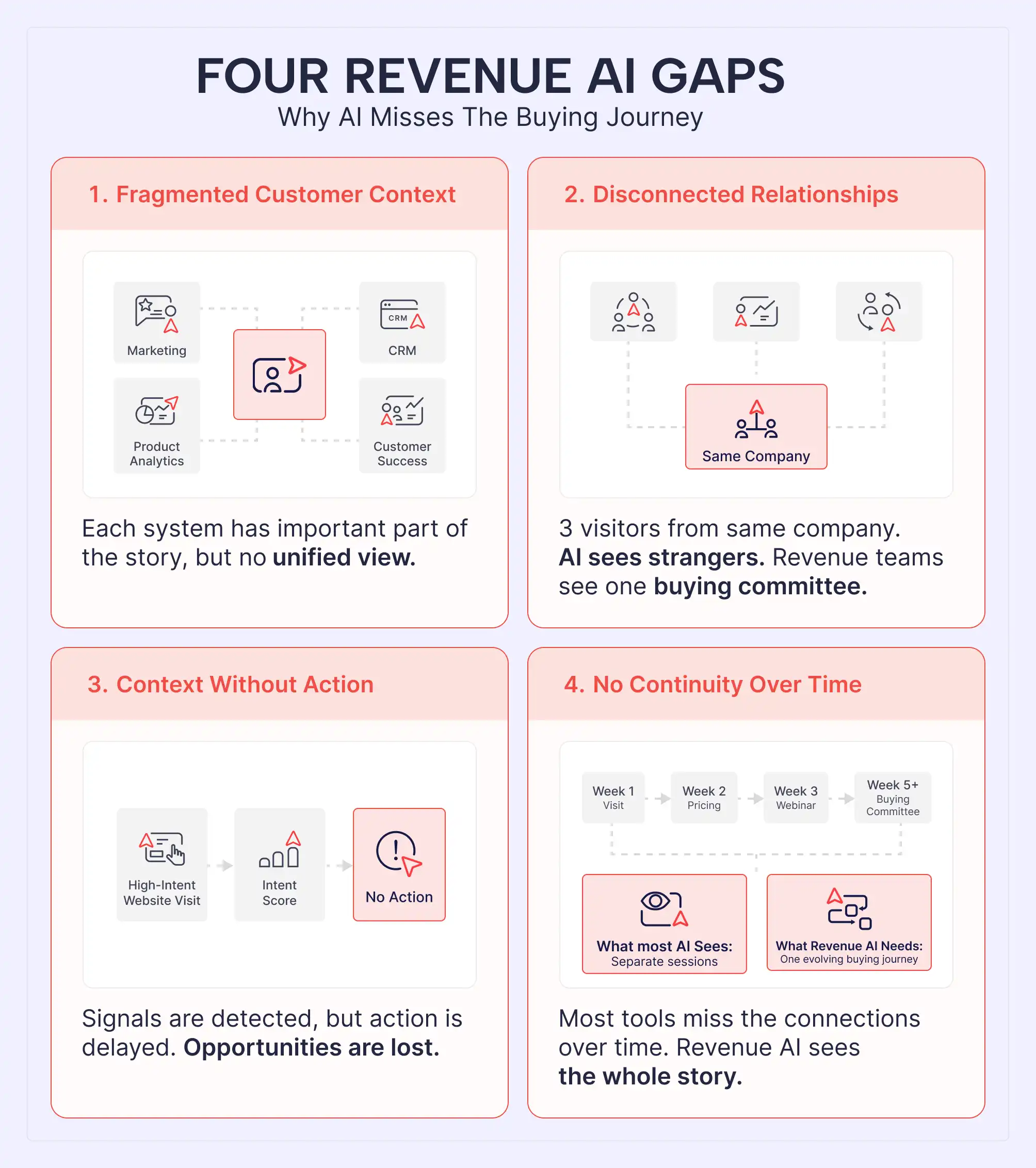
Four gaps consistently prevent AI from operating with the continuity that revenue teams need.
1. Fragmented Customer Context
A prospect visits your pricing page.
Your marketing platform knows they downloaded two whitepapers last month. CRM shows the account was an opportunity a year ago. Customer Success knows another business unit is already using your product. Product analytics shows adoption has recently increased.
Each system holds an important piece of the story, but none brings it together automatically. AI may retrieve information from individual systems, yet without a unified view, it cannot understand what this latest website visit actually means for the business.
2. Disconnected Business Relationships
Enterprise buying rarely involves one person.
Over two weeks, three employees from the same company visit your website. One explores pricing, another reads technical documentation, and a third downloads a case study. Traditional analytics records three anonymous sessions. Revenue teams, however, recognize the emergence of a buying committee.
Without understanding the relationships between people, accounts, opportunities, and previous engagements, AI cannot distinguish isolated website traffic from coordinated buying behavior.
3. Context Without Execution
A high-intent account returns to your website after weeks of inactivity.
The signals are there. Website analytics detects the visit. Intent scores increase. Marketing captures the activity.
But nothing happens.
The SDR reviews the alert the next day. CRM updates after another sync. Outreach is delayed while someone researches the account and decides who should engage. By then, the buying window may have narrowed.
AI surfaced the context. It didn't translate that context into timely execution.
4. No Continuity Over Time
Buying journeys rarely unfold in a single session.
A prospect visits your website today. They return the following week to compare solutions, attend a webinar, revisit the pricing page, and come back a month later after involving additional stakeholders.
Most systems record these as separate website sessions. Revenue teams should see something very different: one account moving steadily through a buying journey.
Without continuity, AI treats every interaction as another event to analyze. With continuity, every interaction strengthens its understanding of the customer, making future recommendations and actions more informed than the last.
Why More AI Tools Won't Fix It
The typical response to revenue challenges is to add another AI tool.
One identifies anonymous website visitors. Another tracks buying intent. AI SDRs automate outreach. Meeting assistants summarize conversations. CRM copilots answer questions about opportunities. Each promises to improve a specific part of the revenue workflow.
Individually, these solutions deliver value. Collectively, they create another layer of fragmentation.
Revenue teams don't need another assistant to complete individual tasks.
This is the limitation of point solutions. They optimize individual tasks but rarely share a persistent understanding of the customer or coordinate actions across the entire revenue lifecycle.
What revenue teams need is not another AI assistant. They need a unified intelligence layer that connects every signal, preserves business context, and enables AI to act with continuity from the first website visit to closed-won and beyond.
What Revenue AI Should Actually Do
The next generation of revenue AI should do more than retrieve information or respond to prompts. It should operate with an understanding of the business that grows richer over time.
That begins with memory. AI should retain the context behind customer interactions, business decisions, account history, and team activity instead of treating every request as a new starting point.
It also requires reasoning. Revenue work is driven by relationships, not isolated records. AI should understand how people, accounts, opportunities, meetings, signals, and outcomes influence one another, allowing it to identify risks, uncover opportunities, and recommend actions with greater accuracy.
Finally, AI must be able to act. Instead of stopping at insights or recommendations, it should execute workflows, coordinate tasks across systems, update records, engage the right stakeholders, and follow through until the work is complete.
When AI can remember, reason, and act as part of a continuous business process, it stops functioning as a collection of productivity features and starts becoming a true execution partner for revenue teams.
The Architecture Behind Context-Aware Revenue AI
A buying journey is constantly evolving. Every website visit, webinar registration, product interaction, sales conversation, and support request changes what your business knows about a customer.
The challenge is not capturing these events. Modern GTM teams already have tools that do that. The challenge is ensuring every new signal updates AI's understanding of the account instead of becoming another isolated data point.
That requires an architecture where context is continuously built, refined, and carried forward.
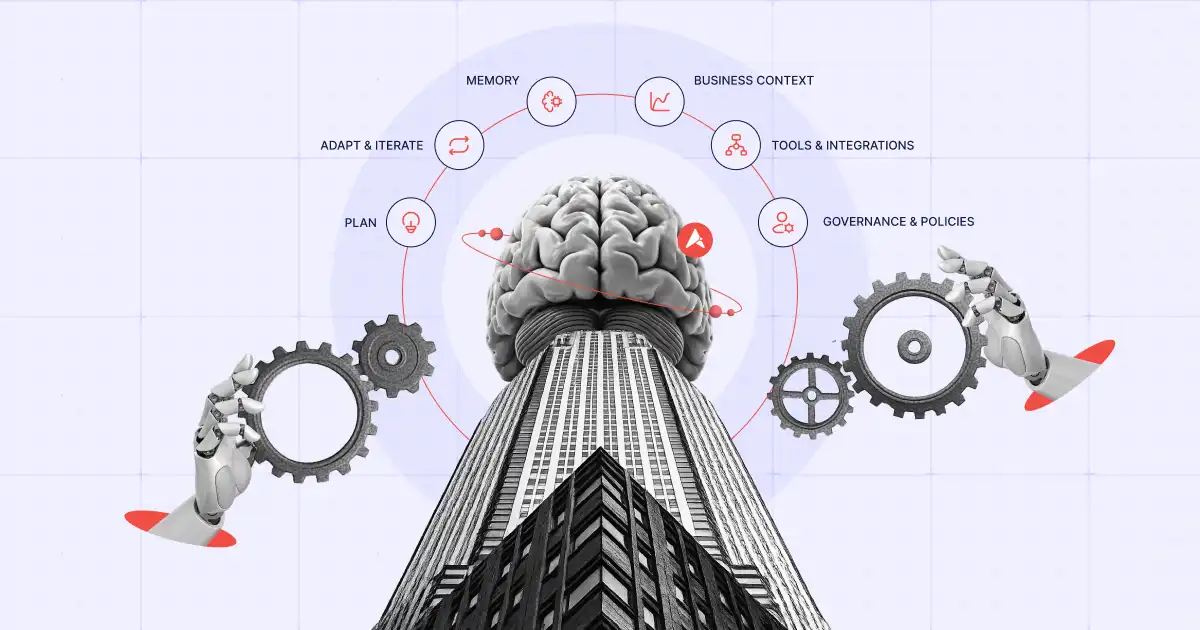
At the foundation is an Ontology that gives business meaning to enterprise data. It defines how accounts, contacts, buying committees, opportunities, products, meetings, customer health, and revenue outcomes relate to one another. Instead of treating a pricing page visit as another web event, AI understands it as buying behavior associated with an account, a stage in the customer journey, and a potential trigger for downstream action.
Built on this foundation is the Context Graph, a living representation of every customer relationship. As new signals arrive from your website, CRM, meetings, emails, product usage, and other enterprise systems, the graph evolves continuously. A returning website visitor is no longer viewed as another anonymous session. Their activity strengthens AI's understanding of the account, updates stakeholder relationships, reshapes buying intent, and influences revenue priorities across the business.
The Memory Layer preserves this evolving context over time. It remembers commitments made during discovery calls, objections raised during evaluations, previous website engagement, expansion opportunities, and historical buying patterns. Instead of reconstructing the customer journey every time someone asks a question, AI starts from what it already knows and builds from there.
This foundation enables Persistent AI Agents. Rather than reacting to individual prompts, they operate with a continuously updated understanding of the business. They recognize when a high-intent website visitor should be matched to an existing opportunity, when new buying committee activity changes engagement strategy, or when product adoption and website behavior together indicate an expansion opportunity. Every action they take is informed not by a single signal, but by the complete business context accumulated over time.
This is the shift from AI that responds to events to AI that understands how the business is evolving and acts accordingly.
A Day in the Life of a Website Visitor
A potential buyer lands on your website. They explore a product page, compare pricing, download a guide, and leave without filling out a form.
For most organizations, this is where the story ends.
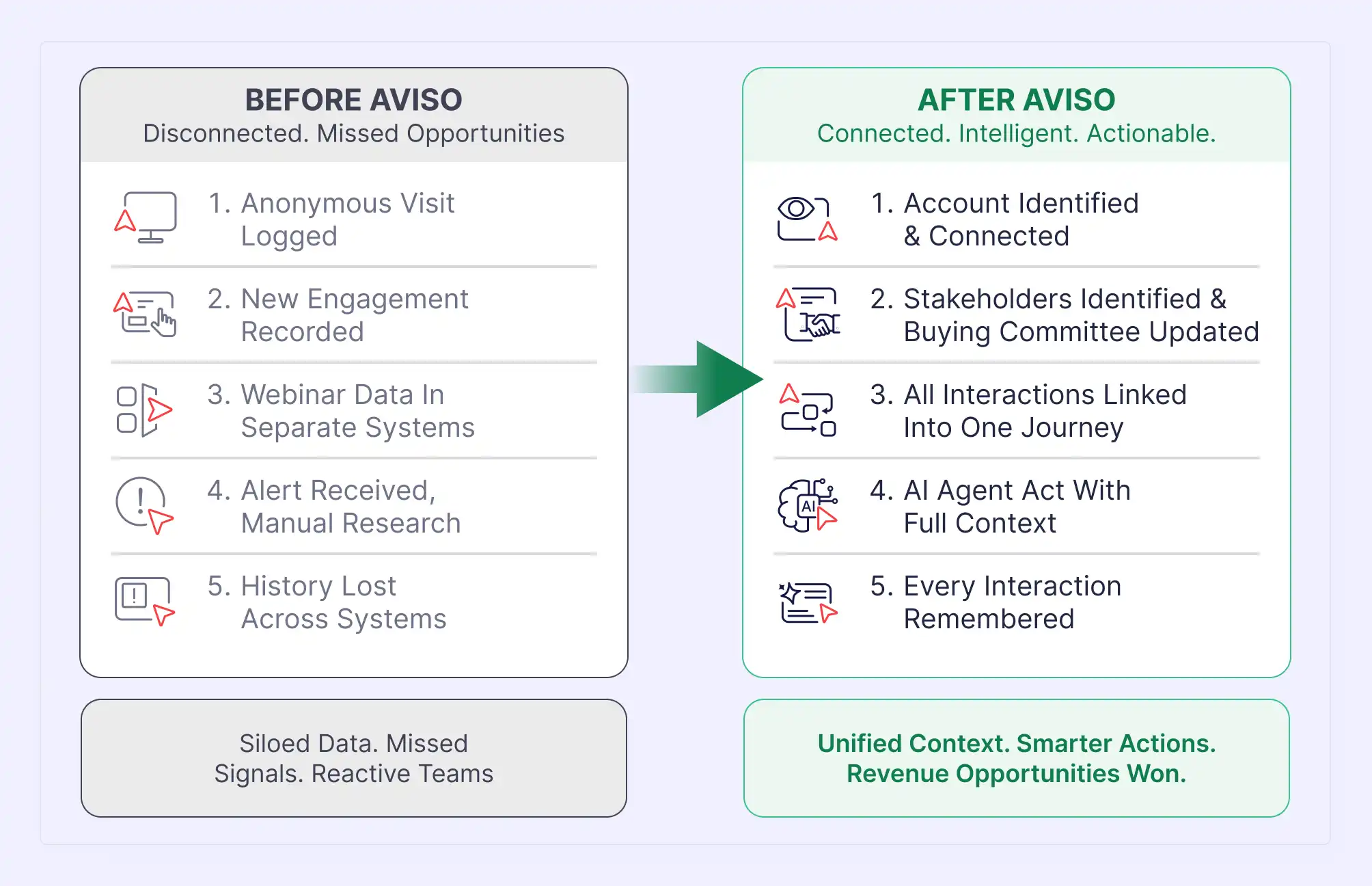
Marketing records another anonymous website session. Sales never knows the visitor existed. By the time someone identifies the account, enriches the contact, syncs the data into CRM, and reaches out, the buyer has already moved on. The website generated interest, but not action.
Now imagine a different experience.
As soon as the visitor arrives, AI identifies the account, uncovers the relevant decision-makers, enriches the lead with CRM history and relationship context, and evaluates both ICP fit and buying intent. It recognizes that the same account attended a webinar last month, opened recent campaign emails, and has an inactive opportunity from six months ago. The latest website activity is not treated as an isolated signal. It becomes another piece of the customer's evolving journey.
Instead of waiting for manual handoffs, AI determines the appropriate next step. A high-intent visitor can be greeted in real time, enrolled in a personalized outreach sequence, routed to the right seller, or invited to schedule a meeting while they are still evaluating solutions. Lower-intent visitors can be nurtured until stronger buying signals emerge.
This is the difference between collecting website data and understanding buyer context. Every visit adds to a continuously evolving picture of the account, enabling AI to make better decisions with every interaction. Your website stops being a passive marketing asset and becomes an active part of your revenue execution engine, turning anonymous interest into qualified pipeline through context, continuity, and timely action.
Building Revenue AI That Remembers
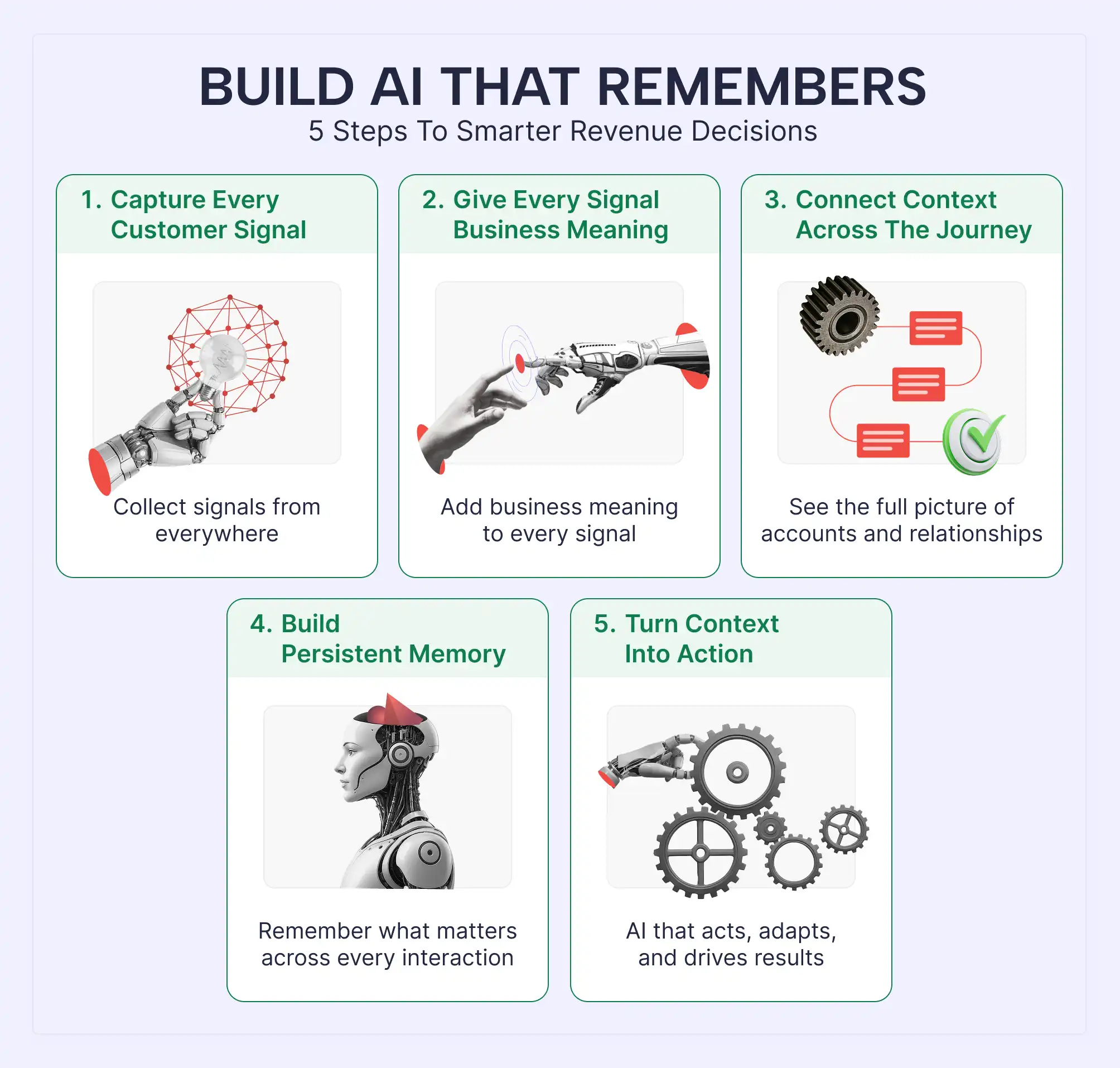
Creating context-aware revenue AI isn't about adding another point solution. It's about ensuring every customer interaction strengthens AI's understanding of the business. Here's where to start.
1. Capture Every Customer Signal
Context begins long before a demo request.
Website visits, content engagement, meetings, CRM updates, product usage, support interactions, and emails all reveal something about buyer intent. The first step is ensuring these signals are captured, not lost in disconnected systems.
2. Give Every Signal Business Meaning
Not every interaction deserves the same response.
A pricing page visit from an existing customer is different from one by a first-time visitor. Three stakeholders from the same account researching your product signal something very different than three unrelated visitors.
An Ontology transforms raw activity into business context by defining what every signal means within your revenue model.
3. Connect Context Across the Customer Journey
Revenue teams don't think in website sessions, CRM records, or meeting transcripts.
They think in accounts, buying committees, opportunities, customer health, and expansion potential.
A Context Graph brings these relationships together, so AI understands how every interaction influences the broader customer journey.
4. Build Persistent Memory
Customer relationships don't reset after every conversation.
AI shouldn't either.
A Memory Layer preserves stakeholder relationships, previous objections, buying history, product adoption, and business outcomes so every interaction starts with accumulated knowledge instead of rediscovery.
5. Turn Context Into Autonomous Execution
Context has no value if it never changes what happens next.
Persistent AI Agents continuously reason over the latest business context, determine the next best action, route opportunities, personalize engagement, and adapt as the buying journey evolves.
The goal isn't to build AI that answers more questions. It's to build AI that remembers enough to make better decisions every time.
Closing Thought
The next phase of revenue AI will not be defined by larger models or more AI applications. It will be defined by how well AI understands the business it is supporting.
Revenue execution is built on continuity. Every customer conversation, buying signal, forecast update, and business decision shapes what should happen next. AI that treats these events as isolated requests will always deliver fragmented outcomes, no matter how sophisticated the model behind it.
The opportunity is to build AI that continuously learns from the business, preserves context across every interaction, reasons through changing customer dynamics, and turns that understanding into meaningful action. When AI can do that, it becomes more than an assistant. It becomes a trusted execution partner for every revenue team.
At Aviso, this vision powers our approach to Context-Aware Revenue Intelligence. By combining business context, persistent memory, and intelligent agents, we're helping revenue teams move beyond isolated AI interactions to continuous, context-driven execution that accelerates growth and improves every customer engagement.
Read More Like This