AI Is Changing the Buyer. Is Your Revenue Team Ready?

No time to lose? Summarize with AI
ChatGPT
Claude

The Buying Journey Has Moved Before You Enter It
The first buyer in your next deal may not be a person.
Forrester’s 2026 research, based on nearly 18,000 global business buyers, found that 94% now use AI in their purchase process, up from 89% in 2025. More strikingly, twice as many buyers named generative AI or conversational search as their single most meaningful research source than any other source, including vendor websites, product experts, and sales representatives.
That changes where the B2B buying journey begins.
By the time a seller sees an account signal, a website visit, or a form fill, the buyer may already have researched the category, compared vendors, formed opinions, and narrowed their options with the help of an AI engine.
The first stage of the buying journey is increasingly happening outside the seller’s funnel.
For revenue teams, that is more than a shift in buyer behavior. It is a shift in where competition is won.
Your Website Is No Longer the Starting Line
For decades, revenue teams built their go-to-market engines around a familiar sequence: create demand, drive prospects to your website, capture intent, engage the account, and move the buyer through the funnel.
AI is disrupting that sequence.
Buyers can now ask an AI engine to explain a category, identify vendors, compare capabilities, summarize customer sentiment, or recommend a shortlist without ever visiting a vendor website. The research layer of the buying process can happen without a click, a form fill, or a conversation with sales.
That creates a visibility problem for revenue teams.
You cannot influence a buying journey you cannot see.
Traditional intent signals often tell you what a buyer did after they entered your ecosystem. AI-mediated research can happen long before that.
This means revenue teams need to rethink what “intent” looks like. The absence of a website visit does not necessarily mean the absence of demand. A buyer could be deeply engaged in researching a problem while remaining completely invisible to conventional demand signals.
The competitive question is no longer simply, “How do we get buyers to our website?”
It is becoming, “How do we remain relevant when buyers are making decisions before they reach us?”
But AI Doesn’t Close the Trust Gap
Yet there is an important counterpoint.
AI may increasingly shape how buyers discover and evaluate vendors, but buyers are not ready to let AI make the entire decision for them.
Gartner’s 2026 research found that 69% of B2B buyers still turn to sales representatives to validate AI-generated insights at key decision points. Buyers use sellers to reduce uncertainty, build internal support, and increase confidence before committing to a decision.
That distinction matters.
AI is becoming the source of discovery. Sales is becoming the source of validation.
The seller is entering the journey later, but that does not make the role less important. It makes the role different.
The rep no longer needs to win by being the fastest source of information. AI has fundamentally changed that equation. Instead, the rep needs to help the buyer answer harder questions:
Does this actually apply to our business?
What are we missing?
Is this recommendation right for our specific situation?
How do we defend this decision internally?
What happens if we get it wrong?
Those are not information retrieval problems. They are judgment and confidence problems.
The Rep’s Job Is Changing: From Information to Confidence
The data makes this shift measurable.
Gartner found buyers were 32 percentage points more likely to say a sales representative made them feel confident in their decision, and 39 points more likely to say the rep understood their needs.
That is where the human advantage remains.
A great seller does not simply tell a buyer what a product does. They interpret the situation, connect the dots across stakeholders, challenge assumptions, anticipate objections, and help the buyer build confidence around a decision.
In other words, the value of the rep is moving up the decision stack.
The best sellers will spend less time answering questions AI can answer instantly and more time addressing the questions AI cannot fully resolve.
That also changes what sellers need from their revenue technology. If AI is generating insights for buyers, sellers need equally strong intelligence about the buyer’s context. They need to know what changed, why it matters, who is affected, what has already been discussed, where the deal is vulnerable, and what action will actually move it forward.
The winning model is not AI versus the rep.
It is AI expanding what the rep can understand, so the rep can contribute where human judgment matters most.
The New Revenue Challenge: Win Both Machines and Humans
The shift in buyer behavior creates a new mandate for revenue teams: win the AI-mediated buying journey and the human decision journey.
These are not separate motions. They are increasingly connected.
Revenue teams need to understand what buyers are researching, what problems are emerging across accounts, and where demand may exist before traditional intent signals appear. At the same time, sellers need the context to turn those signals into relevant conversations and credible recommendations.
That requires more than another layer of AI-generated insights. It requires intelligence that connects signals across the entire revenue workflow, from what is happening in the market and account to what is happening in conversations, opportunities, and customer relationships.
The goal is not simply to give sellers more information. It is to help them know what matters, understand why it matters, and act while it still matters.
Trust Becomes the New Competitive Advantage
There is another reason this matters: buyers do not automatically trust either AI or sales.
Gartner found that 51% of buyers said they were likely to encounter misleading information from generative AI, compared with 49% who said the same about a sales representative.
That near-even split is telling.
The competitive advantage is no longer simply access to information. It is the ability to establish confidence in the information and the decision that follows.
For revenue teams, that means every recommendation needs context. Every insight needs evidence. Every seller interaction needs to demonstrate an understanding of the buyer's specific situation.
AI can surface the signal. Sellers need to turn that signal into confidence.
What Revenue Teams Should Do Now
The shift in buyer behavior calls for more than adding AI to existing GTM workflows. Revenue teams need to rethink how they create visibility, build trust, and execute across a buying journey they increasingly cannot see.

1. Become AI-discoverable.
Understand that buyers may form opinions about your category and company before they ever reach your owned channels. Your content, expertise, customer proof, and market presence need to show up wherever AI-driven research is shaping buyer decisions.
2. Detect demand before traditional intent appears.
A website visit or form fill is no longer the only meaningful signal. Revenue teams need to connect account, market, relationship, conversation, and behavioral signals to identify emerging demand before it becomes an obvious opportunity.
3. Equip sellers to validate, not just inform.
Give reps the account context, buyer signals, conversation history, and intelligence they need to challenge assumptions, personalize recommendations, and build confidence. The best sellers should enter conversations with a point of view, not a product pitch.
4. Turn every interaction into intelligence.
If buyers are using AI to synthesize information, revenue teams need to do the same with their own data. Conversations, emails, CRM activity, meetings, customer interactions, and account signals should continuously improve the team's understanding of what is happening and what it means.
5. Orchestrate across the revenue workflow.
The next action rarely belongs to one person or one system. A deal risk might require a rep follow-up, manager intervention, executive engagement, updated messaging, and a customer action. Revenue AI needs to connect these actions rather than simply recommend them.
Aviso’s AI Agents are designed to move beyond recommendations and help execute complex, end-to-end revenue workflows. An agent can connect signals and context, reason about what needs to happen, coordinate actions, and drive the workflow forward without requiring constant manual orchestration.
6. Measure completion, not just insight.
Insight has limited value if it stops at a recommendation. Revenue teams should ask a harder question of every AI system: Did it actually move the workflow forward? The real measure is not how many insights AI produces, but how effectively it helps teams detect, decide, act, and verify outcomes.
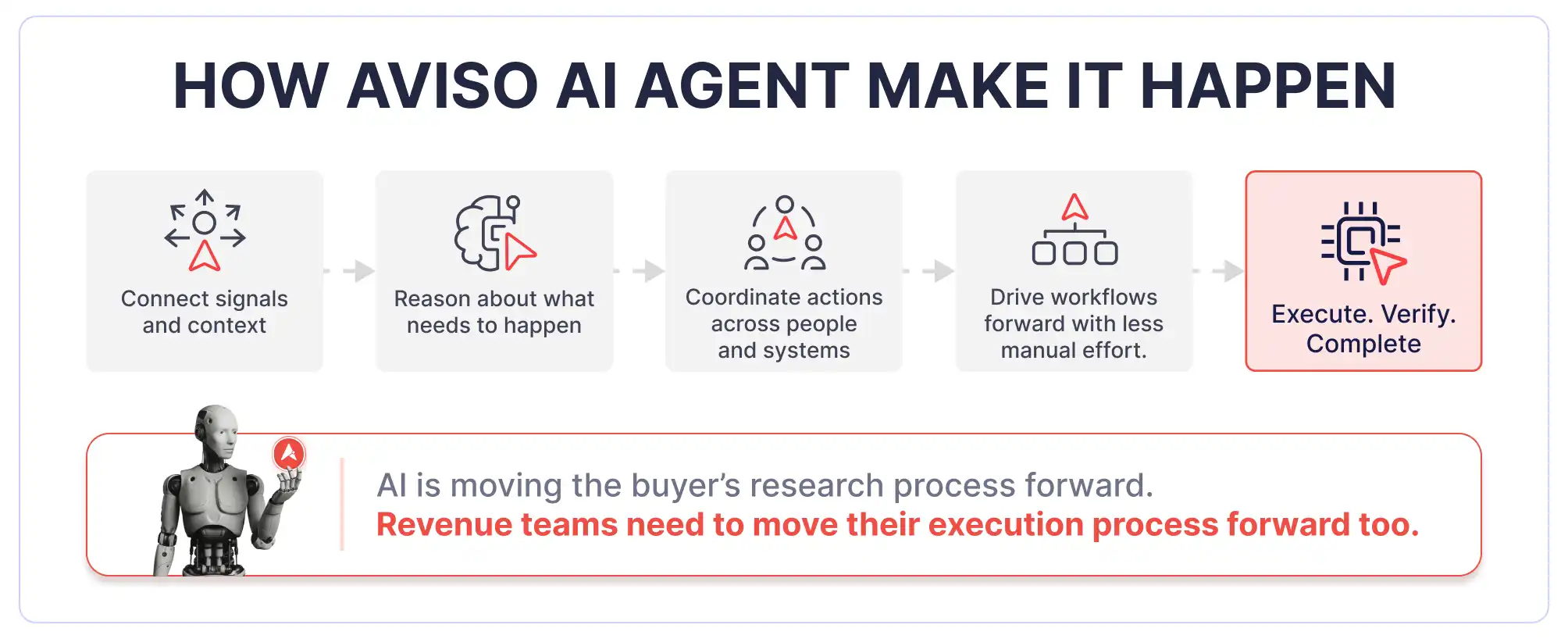
The underlying shift is simple: AI is moving the buyer's research process forward. Revenue teams need to move their execution process forward too.
The revenue teams that win will connect both.
That is the opportunity for AI in revenue: not simply making sellers faster, but giving them the intelligence, context, and execution power to show up at the moments that matter most.
Aviso brings these capabilities together with AI agents that connect revenue signals, buyer context, seller judgment, and execution across the GTM lifecycle. From detecting emerging demand to understanding deal risk and orchestrating next actions, Aviso helps revenue teams move from knowing what is happening to acting on it.
See how Aviso AI Agents can turn revenue intelligence into execution. Book a demo.
Read More Like This