The Agentic AI Buyer's Test: 7 Questions to Ask Before You Buy an AI Agent

No time to lose? Summarize with AI
ChatGPT
Claude

AI agents are everywhere. But for enterprise buyers, the harder question is not whether a vendor has an agent. It is whether that agent can actually do the work it claims to do.
A polished demo can show an AI system finding information, summarizing a deal, identifying a risk, or recommending a next step. But revenue work rarely ends there. Someone still has to interpret the signal, decide what matters, take action, coordinate with others, and make sure the job gets done.
That is the gap buyers need to examine. A real revenue workflow asks a system to move through a much longer chain:
detect → understand → reason → decide → act → coordinate → verify
A truly agentic system should move beyond generating intelligence to executing work. It should know what triggered the task, understand the context, reason about what should happen next, take action across the systems where work happens, coordinate with other agents, and know when the workflow is complete.
It should also operate within clear permissions, approvals, and audit controls.
So instead of asking, “Does your product have AI agents?” ask a harder question:
“Show me what happens between the signal and the completed outcome.”
The answer reveals far more about an agent’s real capabilities than a product demo ever will.
Agent Demo Is Easy. Execution Is The Difficult Part.
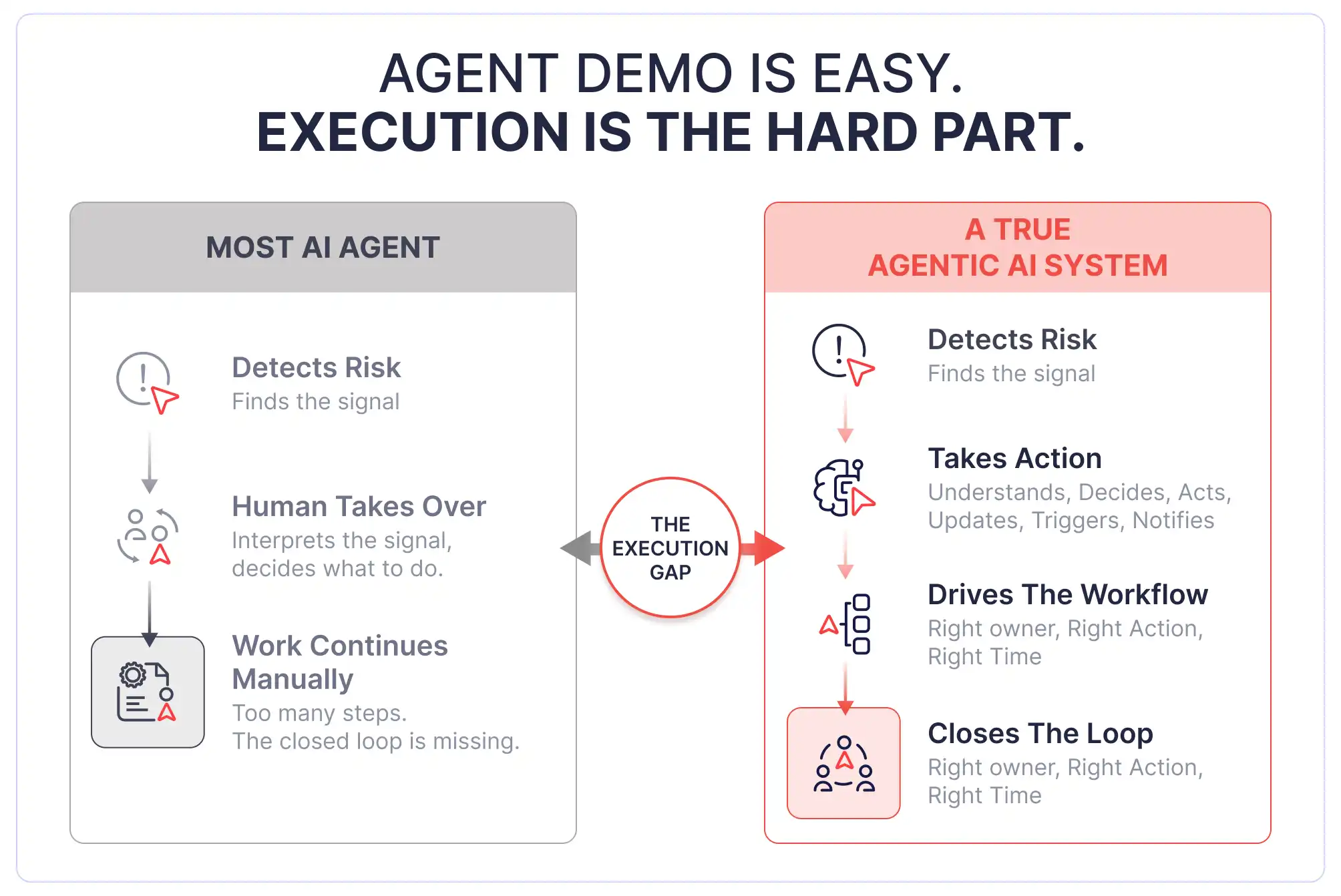
The problem with most “AI agent” pitches in revenue tech is not that the agents are fake. It is that a polished demo can hide the execution gap.
Consider a simple prompt: “Show me an agent that identifies a risky deal.” That is easy. Pattern recognition across CRM and conversation data has been solved for years.
The more revealing question is what happens after the risk is identified. Can the system:
Understand why the deal is at risk?
Determine what should happen next?
Identify the right owner?
Update the CRM with the new state?
Trigger the appropriate workflow?
Notify the right person?
Escalate if nobody acts?
Verify that the issue was resolved?
That is a more useful distinction than “assistant vs. agent.” Buyers should evaluate agents by the work they complete, not the intelligence they demonstrate.
A conventional AI system might detect a change and tell a rep, “Deal engagement has declined.” Useful, but the human still has to interpret the signal and decide what to do.
An agentic system should take the workflow further. It detects the engagement drop, understands that the champion has gone quiet, a competitor surfaced in a recent call, and procurement has not engaged. It reasons that the opportunity needs executive attention, updates the risk state, assigns the next action, triggers the relevant workflow, alerts the manager when needed, and tracks the outcome.
Both systems use AI. The difference is how much work remains between the insight and the outcome.
The 7-Test Agentic Execution Framework
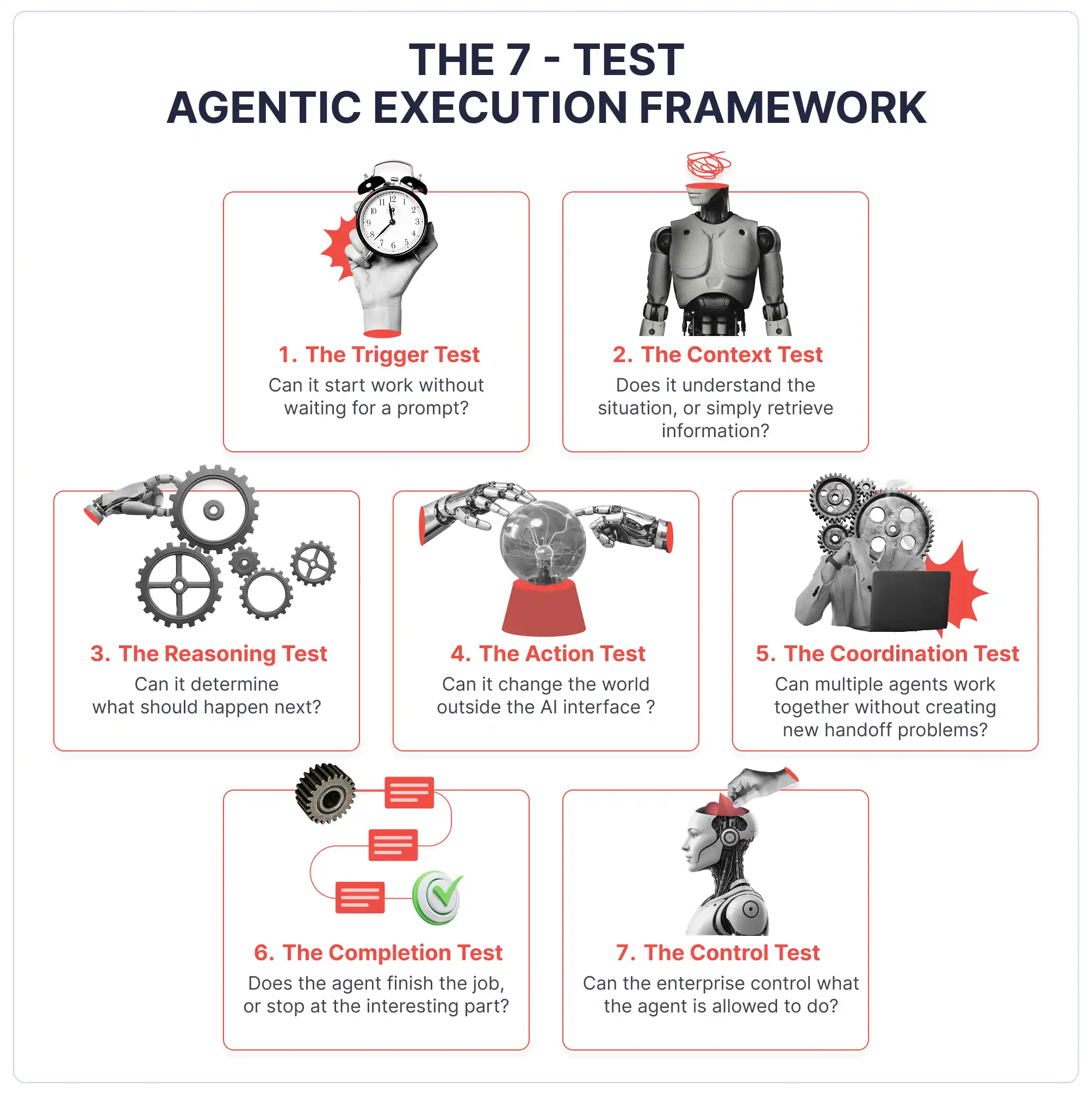
1. The Trigger Test
Can it start work without waiting for a prompt?
A genuinely operational agent should not always require a human to say, “Go do this.” In revenue environments, work can begin when a lead changes status, a customer signal shifts, an opportunity enters a risk state, a calendar event occurs, or another agent finishes a task. The trigger is part of the work.
Buyer question: Show me what causes the agent to start working when nobody asks it to.
Aviso’s Persistent Agents are designed to operate beyond a single user interaction. They can respond to changing business conditions, signals, workflow events, and the completion of other agent tasks rather than waiting for a user to issue a new instruction every time.
The agent retains the context it needs to continue pursuing a task or goal instead of resetting after each interaction. That turns an agent from something a user invokes into something that can participate in an ongoing business process.
2. The Context Test
Does it understand the situation, or simply retrieve information?
Retrieving information is not the same as understanding a business situation. An agent should be able to connect current signals with account history, deal stage, people, activity, prior interactions, and other relevant context. For example, it should distinguish between a quiet opportunity that is healthy and one where the champion has gone silent, a competitor has appeared, and the expected close date is approaching.
Buyer question: What context does the agent use to make its decision, and where does that context come from?
Aviso does not treat context as a collection of disconnected records. The Context Graph connects people, accounts, opportunities, activities, signals, relationships, and historical interactions so agents can reason about how those elements relate to one another.
The Ontology layer adds business meaning to that context. It helps agents understand what an opportunity, account, relationship, risk, or activity means within the revenue organization, rather than simply retrieving matching data.
Together, they give agents both the current business state and the history needed to interpret it.
3. The Reasoning Test
Can it determine what should happen next?
An agent should be able to move from signal to interpretation to decision, rather than simply summarize what it found. Revenue work is often ambiguous. Several actions may be possible, and the best action depends on the circumstances. Buyers should test whether the agent can explain why it selected a particular path and what conditions would cause it to choose another.
Buyer question: Give the agent an ambiguous situation. Can it explain why it chose this action over the alternatives?
Aviso Agents reason by combining business context, memory, and real-time signals before deciding what to do next. They understand relationships across accounts, contacts, opportunities, activities, and outcomes through the Context Graph.
The PlannerAgent breaks a goal into a structured sequence of actions and dependencies using a DAG.
The PlanValidator checks the plan for errors, dependencies, and execution risks before work begins.
Agents then execute, evaluate results, and adapt their next actions based on what they learn.
4. The Action Test
Can it change the world outside the AI interface?
The question is not simply whether an agent can update a field. Can it execute the work across the systems where that work actually happens? In revenue, that may include CRM, email, calendar, workflows, ownership, notifications, and escalation paths.
Buyer question: Show me the complete workflow, not just the agent’s recommendation.
Aviso's browser agent architecture extends execution into the applications where revenue work actually happens.
Because the browser agent can interact with web interfaces much like a human user, it can work across systems and surfaces that may not expose the APIs an agent would normally depend on.
This is particularly important in enterprise environments, where the workflow rarely lives in one system. The agent can move from understanding what needs to happen to actually performing the work across the browser-based tools involved.
5. The Coordination Test
Can multiple agents work together without creating new handoff problems?
Complex business processes rarely belong to one role. A prospecting agent may qualify an account, an AE agent may prepare the opportunity, a sales engineer agent may handle technical questions, and an orchestration agent may coordinate the handoff. The critical question is whether context survives those transitions. Multi-agent architecture should reduce handoff friction, not create another layer of it.
Buyer question: When Agent A finishes its work, what does Agent B know, and how does it know it?
Aviso's architecture supports coordination across agents and tools so that work can move between specialized capabilities without forcing the user to manually orchestrate every step.
The important distinction is that coordination is not simply about having multiple agents. It is about preserving the context and intent of the work as it moves between them.
An agent can hand work to another agent or invoke an external capability while maintaining the information needed to continue the workflow.
6. The Completion Test
Does the agent finish the job, or stop at the interesting part?
This may be the most revealing test of all. Many systems can detect a problem. Fewer can detect, diagnose, assign, act, escalate, and verify. Buyers should define what “done” means before evaluating the agent. If done means “the system produced a recommendation,” the workflow may still depend on a human. If done means “the business process reached its intended state,” the system is being evaluated on execution rather than output.
Buyer question: What event tells the agent that its job is actually complete?
Aviso Agents are built to take action, not just suggest what a human should do next.
They can interpret signals, determine the right workflow, and execute tasks across connected systems.
Instead of stopping at a recommendation, they can update records, trigger workflows, schedule meetings, or hand work to another agent.
7. The Control Test
Can the enterprise control what the agent is allowed to do?
Autonomy without control is not enterprise readiness. Buyers should understand how permissions, approvals, human-in-the-loop checkpoints, audit trails, escalation rules, and action history work. The goal is not to eliminate human oversight. It is to make autonomy predictable, bounded, and observable.
Buyer question: Can I define what this agent can do, what requires approval, and see exactly what it did?
Aviso's agent architecture is designed to combine autonomous execution with the controls enterprises need to govern it. Agent actions can be governed through permissions, policies, approvals, and human oversight, while execution history provides visibility into what happened and why.
The goal is not unrestricted autonomy. It is bounded autonomy: agents that can move work forward independently while operating within clearly defined enterprise rules.
The Buyer's Scorecard
Here's a simple way to score any vendor demo against the framework:
Test | Weak Agent | Strong Agent |
|---|---|---|
Trigger | Waits for a prompt | Responds to business signals |
Context | Retrieves data | Understands relationships and history |
Reasoning | Generates a recommendation | Chooses the next action |
Action | Drafts output | Changes systems / executes |
Coordination | Hands off manually | Coordinates across agents |
Completion | Produces an insight | Closes the workflow |
Control | Black-box autonomy | Governed, auditable execution |
The rule that follows is simple: if a vendor can't demonstrate all seven, don't evaluate the agent by the demo — evaluate the missing capability.
Why This Matters More Than Model Intelligence
It's tempting to let this conversation collapse into another "whose model is smarter" debate. That's the wrong fight.
The enterprise agent race isn't ultimately about who has the smartest underlying model. It's about who can reliably connect signals, context, reasoning, action, coordination, and control to a measurable business outcome. A brilliant model that stops at a recommendation still leaves a human holding the workflow. A modest model wired into the right systems, with the right memory and the right guardrails, can actually finish the job.
Aviso’s agentic AI architecture is designed around this execution model: agents grounded in real-time revenue context, triggered by business signals, capable of multi-step action, coordinated across roles, and governed through enterprise controls. The platform combines role-specific agents, prebuilt agentic workflows, Agent Studio for custom workflows, and MIKI as an orchestration layer across revenue teams.
The result is a different way to think about AI in revenue: not as another interface that helps people interpret information, but as an execution layer that can carry work forward across the revenue lifecycle.
Read More Like This