AI Sales Email Generator: How to Write Personalized Sales Emails From Real Deal Data

No time to lose? Summarize with AI
ChatGPT
Claude
Quick Answer
The short answer: Generic, template-based sales emails underperform because they lack real deal context, and writing genuinely personalized emails by hand takes more time than most AEs have. Aviso's Personalized Email Creation Agent solves this by synthesizing deal history, buyer signals, and engagement data into ready-to-send drafts built around a stated goal, tone, and buying-center persona. It generates multiple tonal variants for the same deal, so reps can multi-thread across stakeholders without writing each version from scratch.
Your AEs know a generic email gets ignored, so they spend real time trying to personalize outreach. The problem is that real personalization requires research most reps do not have time for. The result is a slow process that still produces average emails.
Why Personalized Sales Emails Are So Hard to Write at Scale
Every AE knows a generic email underperforms. The problem is not awareness. It is capacity.
Salesforce’s State of Sales research shows that rep capacity remains under pressure, with sellers balancing prospecting, CRM work, internal coordination, and administrative tasks alongside actual selling. The problem is simple: personalized outreach needs context, but reps rarely have unlimited time to gather that context for every deal, stakeholder, and follow-up.
Writing personalized email is one of the tasks competing for whatever time is left after admin and research. Here is why it consistently falls short:
Real personalization requires research. A genuinely relevant email references deal stage, recent company news, buyer role, and stated priorities. Pulling all of that together for a single email can take longer than the email itself.
One email rarely fits every stakeholder. A CFO, a VP of Sales, and a technical buyer on the same deal need different framing, different proof points, and a different tone. Writing three versions by hand is rarely realistic under time pressure.
Templates produce template-sounding emails. Merge tags fill in a name and company, but the substance of the message stays generic. Buyers can tell the difference.
Tone and length require constant recalibration. An executive-level email and a conversational follow-up are not the same task, and switching between them for different accounts adds friction.
Editing and iteration take time too. Even after a draft exists, refining subject lines, tightening the body, and adjusting the ask consumes additional minutes per email, multiplied across a full pipeline.
None of this is a motivation problem. It is a structural mismatch between what real personalization requires and how much time a rep actually has. This is where AI email generation changes the equation.
What AI Email Generation Actually Means
AI email generation means the system pulls the research and drafts the message. The AE supplies the goal, the tone, and the final judgment call before sending.
This is different from a merge-tag template or a generic AI writing assistant that has no visibility into the deal. An email generation agent connected to CRM and deal data can reference the actual stage, the actual buying center, and the actual context of the account, not placeholder fields.
The output a sales team needs from a tool like this includes:
A draft grounded in real deal context, not a generic template
Multiple tone options suited to different personas and relationship stages
Multiple drafts for the same deal when multi-threading across stakeholders
An editable starting point, not a finished email the AE cannot adjust
The AE's role shifts from first-draft writer to reviewer and closer. That is a better use of the time they have. Here is what that looks like in practice inside Aviso.
How Aviso's Personalized Email Creation Agent Works
Aviso's Personalized Email Creation Agent generates ready-to-send email drafts by synthesizing deal history, buyer signals, and engagement data tied to a specific account or deal. Here is the flow in practice.
Step 1: Start From the Email Generation Dashboard
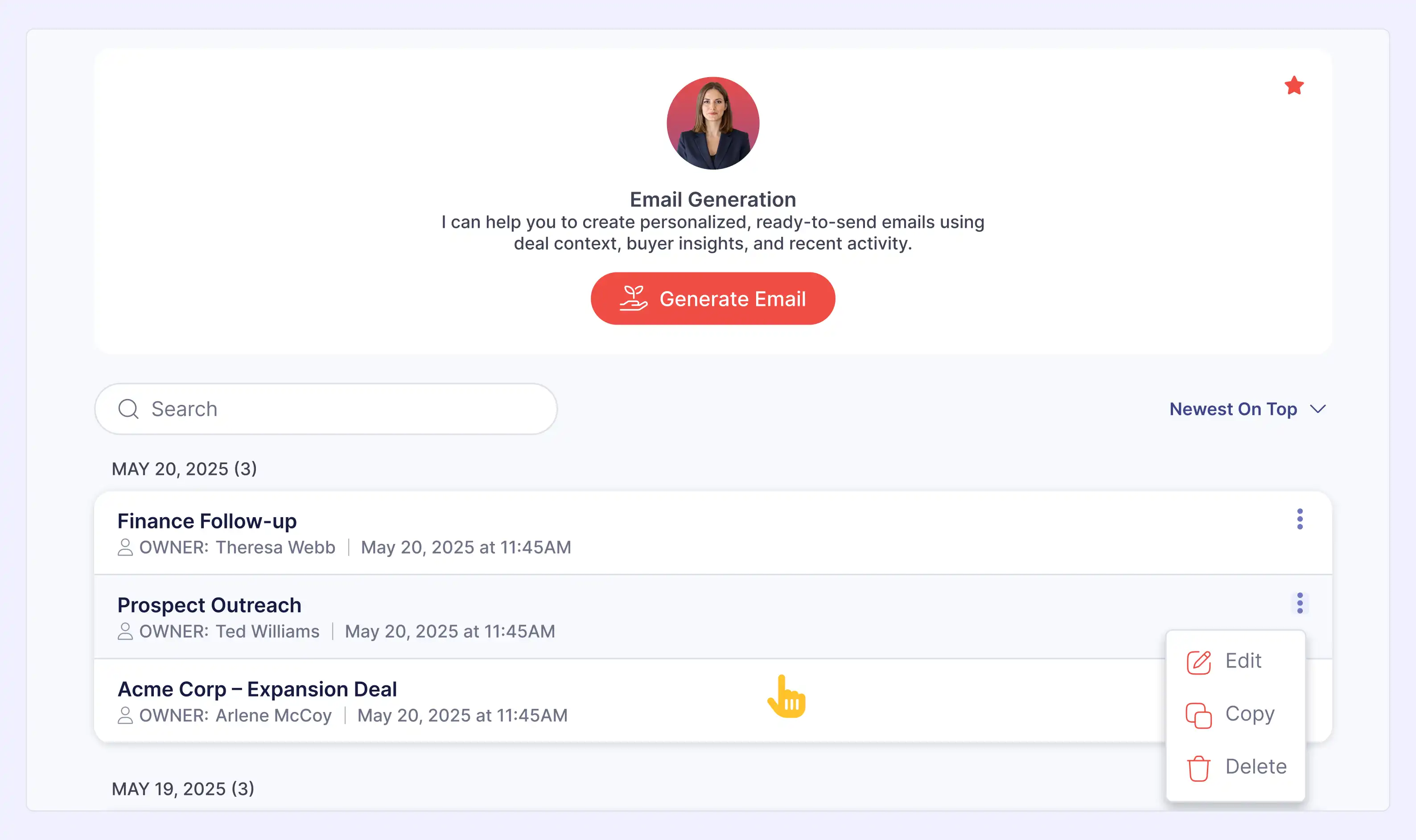
The AE opens Email Generation and sees prior drafts organized by date, along with a clear "Generate Email" entry point. Each past draft shows its title, owner, and timestamp, so nothing gets lost across a busy pipeline.
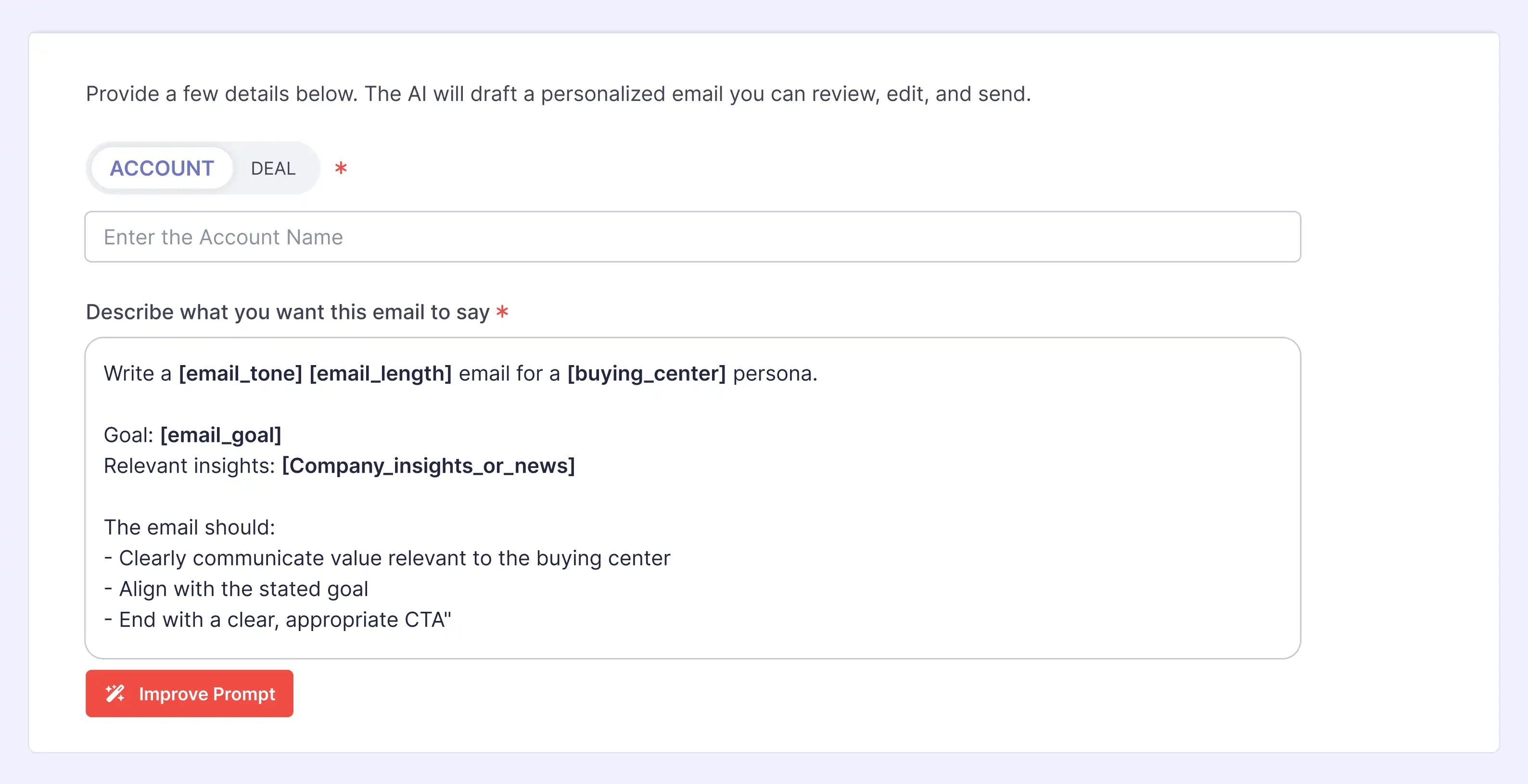
Step 2: Choose Account or Deal and Set the Prompt
The AE selects whether the email is tied to an account or a specific deal, enters the name, and works from a structured prompt template. The template already includes fields for tone, length, buying center persona, goal, and relevant company insights, so the AE is filling in a framework rather than writing from scratch.
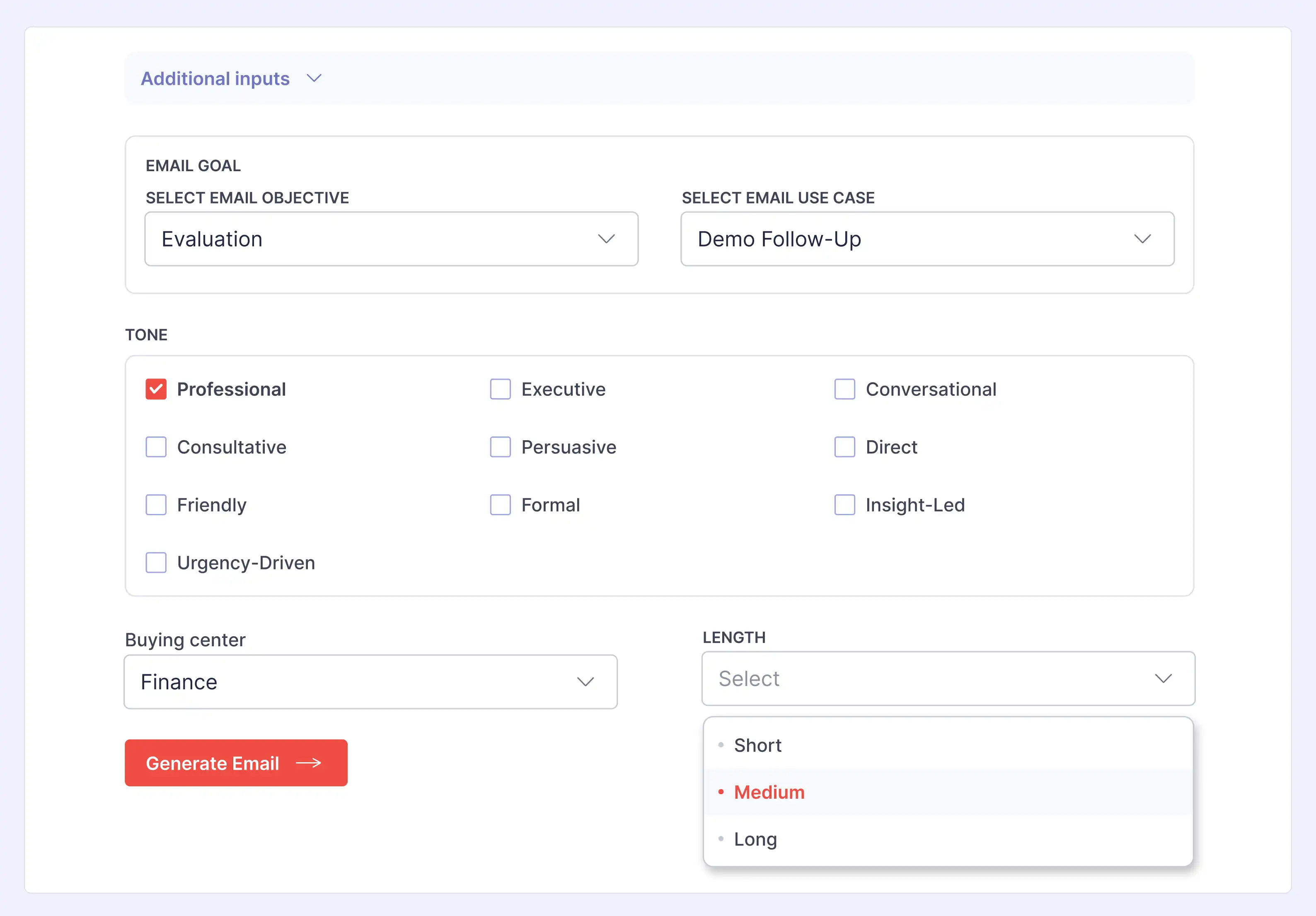
Step 3: Refine the Brief With Additional Inputs
Expanding Additional Inputs surfaces more precise controls: email objective, use case, a bank of tone options (including Professional, Executive, Conversational, Consultative, Persuasive, Insight-Led, and others), buying center selection, and length.
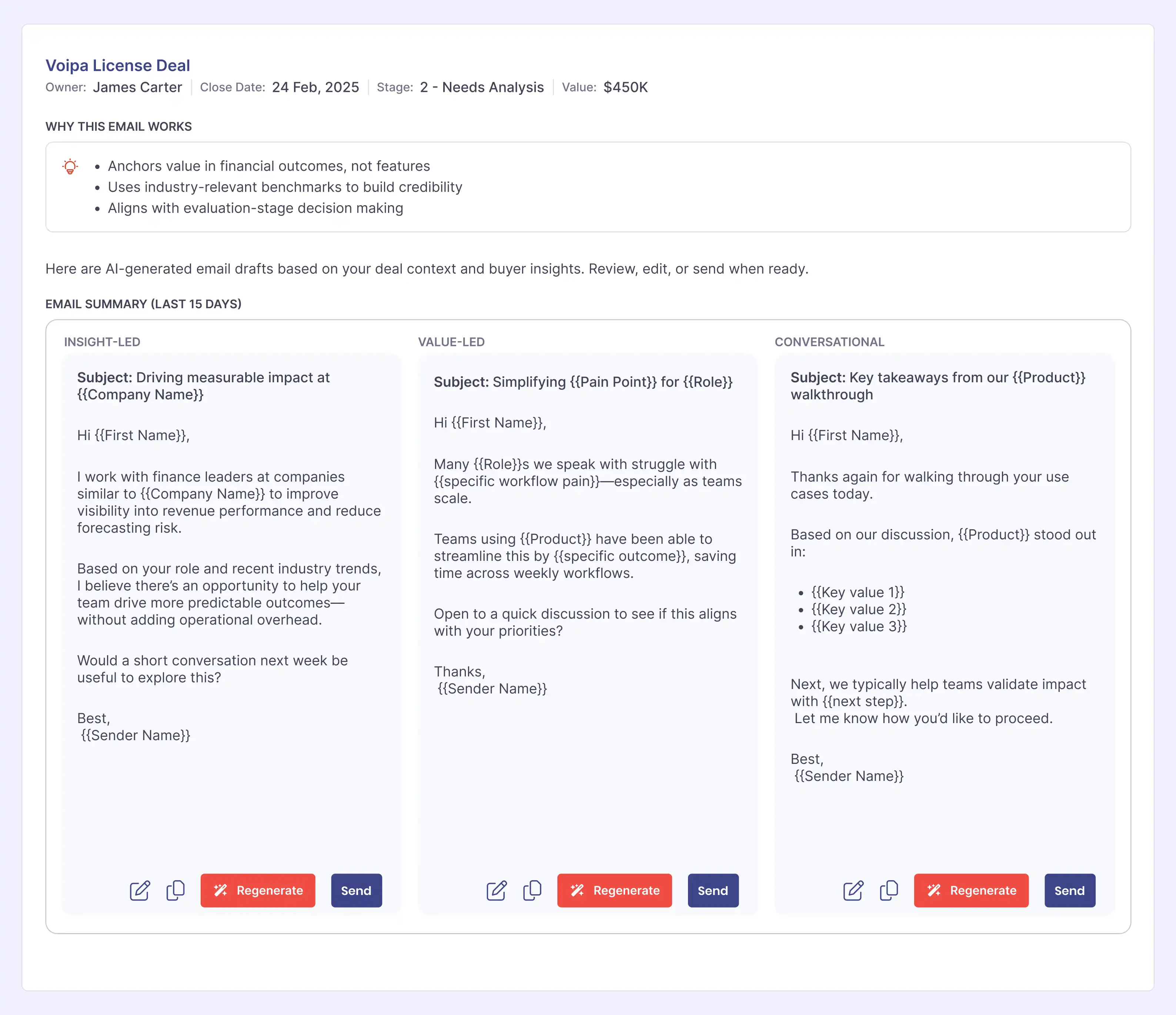
Step 4: Review Three Ready-to-Send Variants
The agent generates the email against the live deal record, showing the deal owner, close date, stage, and value alongside the drafts. A short "Why This Email Works" explanation accompanies the output, and three tonal variants (Insight-Led, Value-Led, Conversational) appear side by side, each fully personalized with buyer-specific tokens.
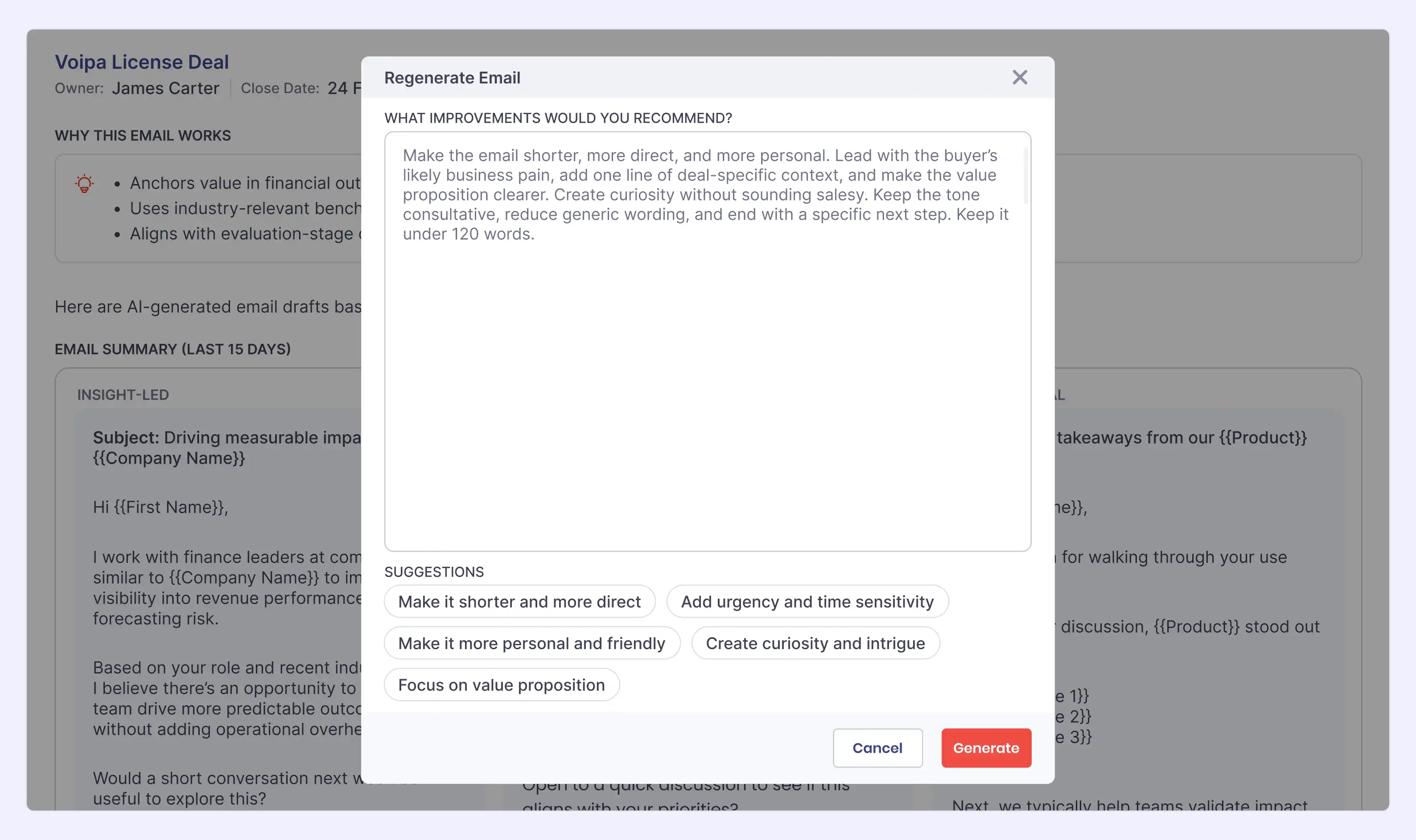
Step 5: Edit, Copy, Regenerate, or Send
Every draft supports in-line editing through a rich text editor, so the AE can adjust subject lines, tighten language, or personalize further before it goes out. Copy, regenerate, and send actions are available directly from each variant.
What Powers Every Draft
Behind these five steps, four capabilities are doing the actual work:
Deal-context synthesis pulls deal history, buyer signals, and engagement data together so the draft reflects where the deal actually stands, not a generic stage-agnostic pitch.
Hyper-personalization tailors content to the recipient's role, the deal stage, and recent interaction history, so the email reads as though it was written specifically for that person, because it was.
Tone and length controls let the AE match communication style to the buyer without manually rewriting the same core message for every persona.
Multi-persona variants generate different angles on the same account simultaneously, which supports multi-threading without requiring the AE to draft each version separately.
Available From Anywhere in Aviso
The Personalized Email Creation Agent lives within Aviso's AI Agents library, surfacing contextually wherever a rep or leader is already working. Reps don't navigate to a separate email tool. They open the AI Agents panel from the record in front of them, and the agent drafts around whatever context that record provides.
From the Deals grid, the agent drafts around a specific opportunity, its owner, stage, and value.

From the Accounts grid, the same agent drafts around the account's health score and engagement history, rather than a single opportunity.

The same library shows up on the Forecasts view, but for a different purpose entirely: internal, leader-to-rep communication instead of buyer-facing outreach.

Wherever the context lives, the agent is already there.
What Sales Leaders Actually Get
Zoom out from the individual workflow and the value shows up at the team level.
Faster time from deal insight to sent email. AEs are not staring at a blank draft trying to remember what happened on the last call. The agent starts from the real deal context.
More consistent quality across the team. Junior reps and senior reps produce emails grounded in the same intelligence layer, which narrows the gap between top performers and everyone else.
Better multi-threading coverage. Generating tonal variants for different personas in one pass makes it realistic to actually reach the full buying committee, not just the primary contact.
A searchable history of past outreach. The dashboard view means past drafts are not lost in someone's sent folder. Reps can copy, reuse, or build on prior messaging instead of starting over.
Less variance from rep bandwidth. When a rep is slammed, email quality usually drops first. An agent that generates the first draft removes bandwidth as the limiting factor on personalization quality.
Here is the same shift in a single view.
Traditional Email Drafting vs. AI-Assisted Email Generation
Traditional Email Drafting | AI-Assisted Email Generation |
AE researches and writes from scratch | Agent drafts from synthesized deal and buyer data |
One generic version sent to everyone | Multiple tonal variants for different personas |
Personalization limited to merge tags | Personalization grounded in real deal context |
Quality depends on rep time and skill | Quality baseline set by the underlying intelligence layer |
Past drafts scattered across inboxes | Drafts saved and searchable in one place |
The Bottom Line for Revenue Leaders
Sales emails should reflect real deal context, not a rushed template. When reps spend more time hunting for context than writing, quality suffers and pipeline slows down. AI email generation gives your team a grounded first draft, multiple persona-ready variants, and full editorial control before anything sends.
Book a demo to see the Personalized Email Creation Agent in action.
FAQs
Does AI email generation improve reply rates?
AI email generation improves reply rates when the generated content is grounded in real deal context rather than merge-tag templates. Personalization built from CRM data, deal stage, and buyer signals consistently outperforms generic outreach in third-party research. Aviso does not publish a single average reply-rate lift because the number depends heavily on the team's baseline and use case. Teams testing the Personalized Email Creation Agent should measure lift against their own template-based baseline over a 30-day window.
Can AI personalize sales emails at scale?
Yes. AI email agents that read from CRM data, deal history, and engagement signals can produce genuinely personalized emails for every account in a pipeline without asking a rep to write each one by hand. The key is grounding: the personalization has to come from real deal context, not from placeholder merge fields on a generic template. Aviso's Personalized Email Creation Agent generates multiple tonal variants for a single deal so reps can multi-thread across a buying committee without writing each version from scratch.
How does an AI email assistant help with sales follow-ups?
An AI email assistant helps with sales follow-ups by pulling deal history, prior conversations, and engagement signals into the draft, so the follow-up references what actually happened on the last touch rather than restarting from a template. The rep opens the agent, sets the goal (schedule a demo, respond to an objection, re-engage a dormant contact), picks a tone, and reviews a draft that already includes the context of the account. The rep edits and sends. What normally takes 15 minutes per follow-up compresses to under two.
What is the best AI sales email generator in 2026?
The best AI sales email generator in 2026 depends on where the tool reads its context from. Generic tools like Copy.ai, QuillBot, and HubSpot Campaign Assistant produce well-written but ungrounded drafts because they cannot see the deal. Sales-specific tools like Lavender.ai and Reply.io help with tone and coaching but still depend on the rep to bring the context. Aviso's Personalized Email Creation Agent is the option for revenue teams that want the personalization to come directly from CRM data, deal stage, buyer signals, and engagement history without asking the rep to gather any of it.
How does Aviso's Personalized Email Creation Agent compare to Lavender or Copy.ai?
Aviso's Personalized Email Creation Agent is grounded in the live deal record, so drafts include the deal owner, close date, stage, value, and stakeholder history automatically. Lavender.ai is a sales email coaching tool that scores and improves drafts the rep writes. Copy.ai is a horizontal AI writing tool without CRM context. The right question is not which tool writes better copy in isolation. It is which tool starts with the right context before writing anything.
Does AI email generation work for cold outreach?
AI email generation works for cold outreach when the tool has access to enrichment data on the prospect and account. Purely cold outreach (no CRM record, no engagement history) benefits less from an agent architected for grounded deal data. Aviso's Personalized Email Creation Agent is most valuable for active pipeline and account-based outreach where the account already has a record with signals attached. For fully cold, top-of-funnel outreach, Aviso's Cadence Agent handles the sequence orchestration alongside the email generation.
Can AI generate emails for multiple buyer personas on the same deal?
Yes. The Personalized Email Creation Agent generates three tonal variants (Insight-Led, Value-Led, Conversational) in a single pass, so an AE can reach a CFO, a VP of Sales, and a technical buyer on the same deal without writing three separate emails. Additional tone options include Professional, Executive, Consultative, and Persuasive. This is the multi-threading move that most teams know they should be running but rarely have time for.
Where can I access the Personalized Email Creation Agent inside Aviso?
The Personalized Email Creation Agent lives in Aviso's AI Agents library and surfaces contextually across the platform. From the Deals grid, it drafts around a specific opportunity. From the Accounts grid, it drafts around account health and engagement history. From the Forecasts view, the same library appears for internal leader-to-rep communication rather than buyer-facing outreach. Reps do not switch to a separate email tool. They open the AI Agents panel from whatever record they are already working on.
Read More Like This