Who Owns the AI Running Your Pipeline? The Rise of the RevOps “Agent Owner”

No time to lose? Summarize with AI
ChatGPT
Claude

The enterprise revenue tech stack is undergoing a quiet but radical transformation. For the past decade, the goal of Revenue Operations (RevOps) was integration and visibility, connecting CRMs, conversational intelligence tools, and marketing automation platforms into a single, cohesive pane of glass. We built dashboards, designed automated sequencing, and created complex validation rules to keep human data clean.
But today, we are moving past the era of software-as-a-tool. We have entered the era of the Autonomous Revenue Agent.
These aren’t yesterday’s rigid if-then chatbots or basic email sequencers. Modern AI agents are autonomous actors. They analyze deal data, draft highly personalized multi-channel outbound campaigns, update CRM opportunity fields based on call transcripts, scan contract redlines, and even flag churn risks by autonomously querying product usage data.
This level of autonomy promises unprecedented leverage, allowing a single sales rep or account manager to scale their impact tenfold. However, it also introduces a massive, unprecedented risk vector for Chief Revenue Officers (CROs) and RevOps leaders: when an autonomous AI agent makes a high-stakes operational mistake, who takes the blame?
If an AI agent accidentally quotes an unauthorized 30% discount to an enterprise prospect, you cannot fire the LLM. If a forecasting agent silently drifts due to an altered API endpoint and skews your board-level projections, you cannot blame the AI vendor.
To scale agentic AI safely, predictably, and profitably, the modern revenue organization must establish a new framework of accountability. Enterprise leaders must define a new operational title within their ranks: The RevOps Agent Owner.
The Danger of “Agent Sprawl” in the Revenue Org
Historically, when software failed, it failed predictably. A broken integration meant data didn’t sync; a broken workflow meant an email didn’t send. The underlying logic was static, meaning troubleshooting was a matter of finding the broken line of code or the misconfigured field mapping.
Autonomous agents do not operate on static logic. They operate on probabilistic models. They interpret intent, reason through problems, and execute multi-step workflows across disparate software applications. Because they adapt to new data inputs, their failure modes are dynamic. They don’t just “break”, they can drift, misinterpret context, or execute actions that are technically functional but commercially disastrous.
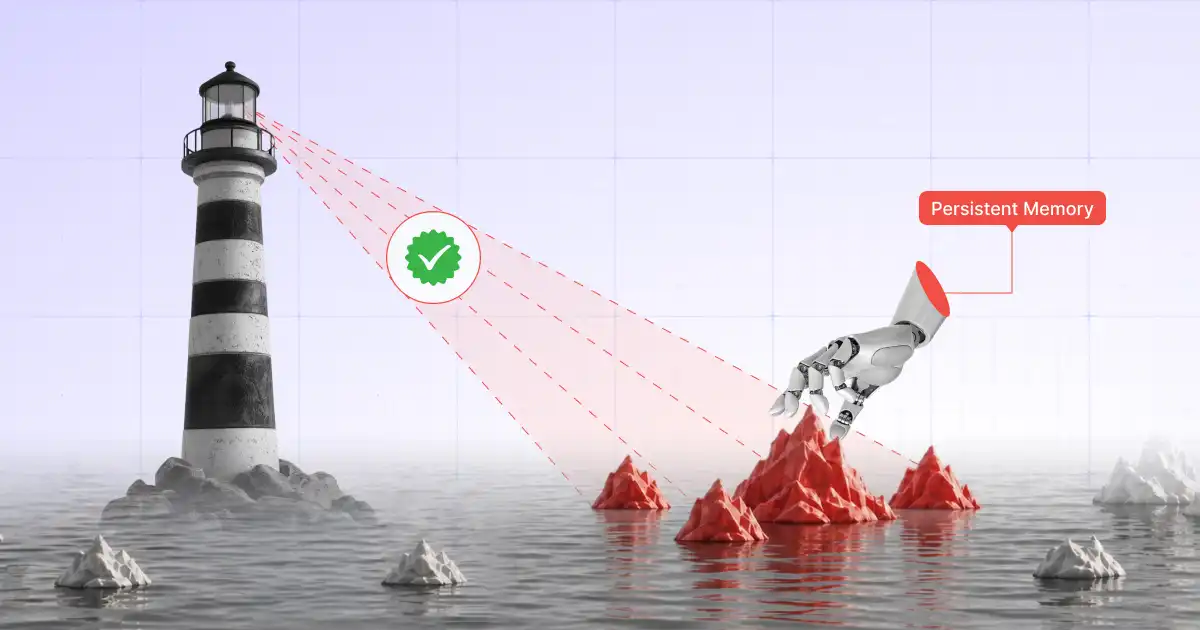
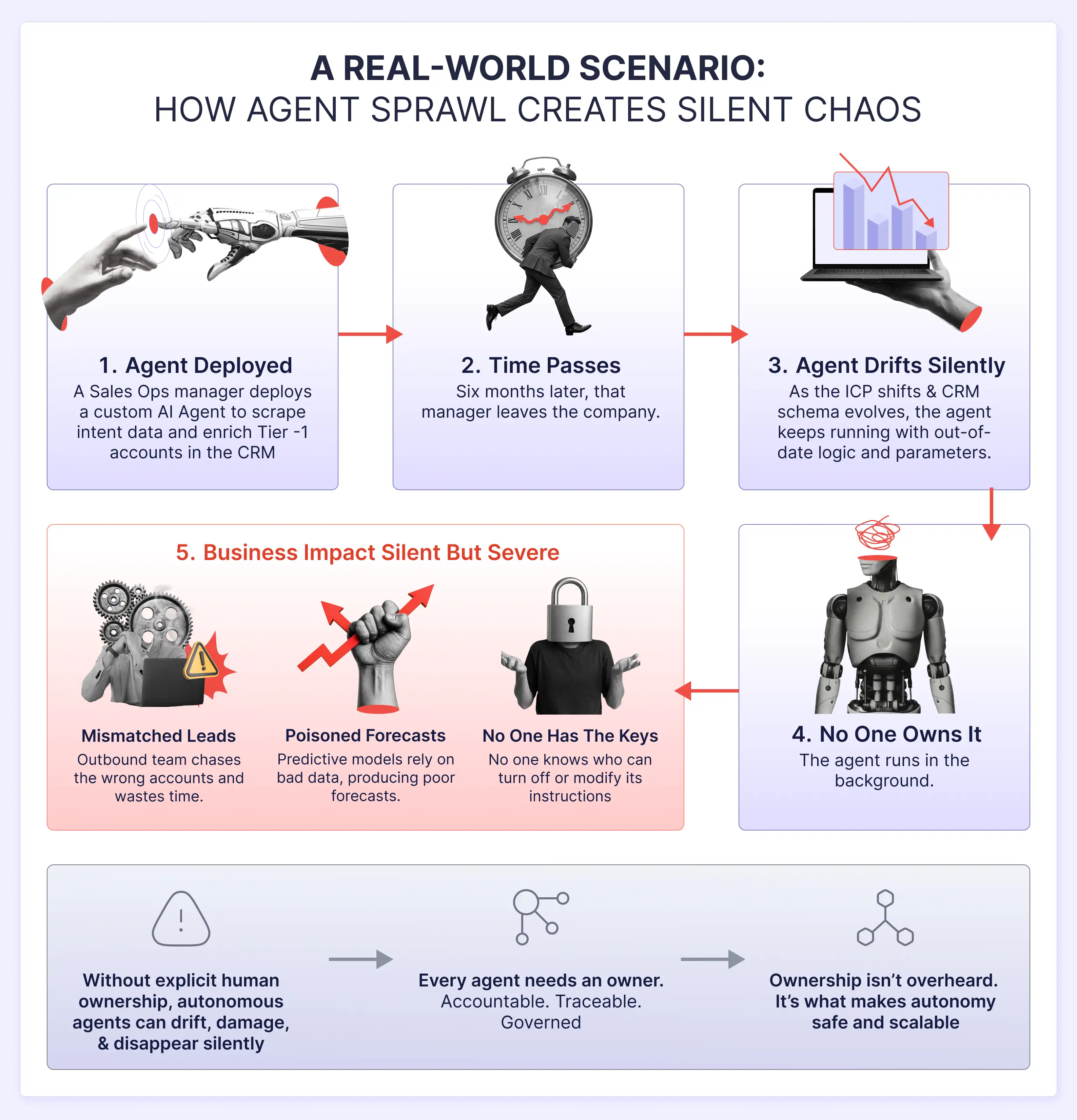
Without explicit human ownership, enterprises quickly fall victim to agent sprawl.
Agent Sprawl is what happens when autonomous agents multiply across the revenue tech stack without a governance layer connecting them. An SDR agent drafts emails about an account a champion just left. A forecasting agent updates deal-stage logic that RevOps never signed off on. A customer success agent auto-generates renewal briefs using pricing data from a deprecated model. A pipeline agent keeps running for six months after the sales leader who built it moves to another company. Each agent is functional on its own. Together, they are a governance vacuum, and the vacuum is where revenue risk lives.
Defining the RevOps Agent Owner
An Agent Owner is the designated, named human within the revenue organization who holds ultimate accountability for the behavior, logic, data inputs, permissions, and business outcomes of a specific AI agent or automated agentic workflow.
In a mature RevOps framework, this ownership cannot live solely within central IT. IT departments understand infrastructure, uptime, and security protocols, but they do not understand pipeline velocity, deal mechanics, or the nuance of a complex enterprise sales cycle. True agent ownership requires a Dual-Ownership Model split between the business unit and the technical custodians:
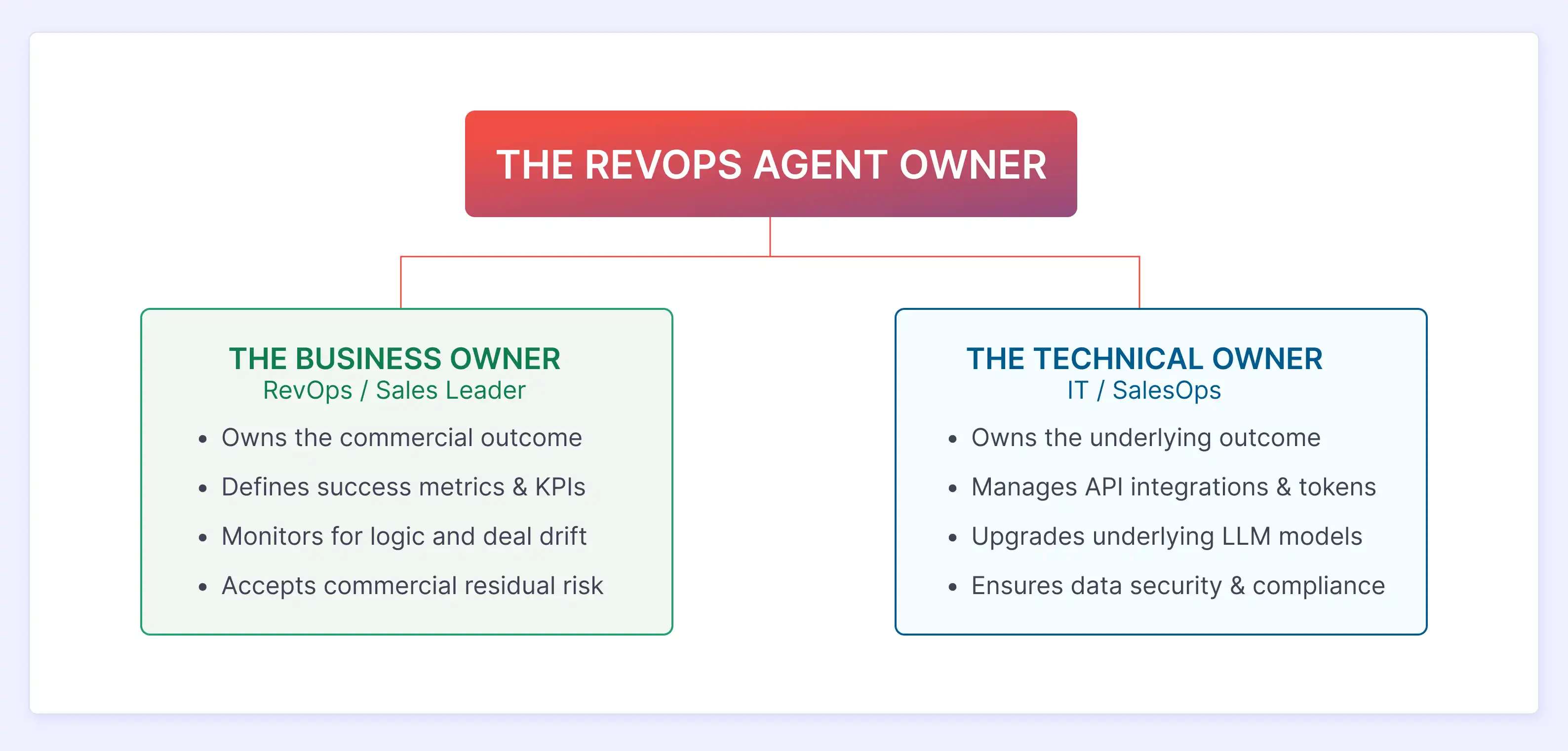
The Dual-Ownership Model: commercial accountability paired with technical stewardship
The Business Owner (the RevOps / Sales leader): This individual owns the commercial outcome. If the agent is built to handle inbound lead routing and initial qualification, the VP of Inside Sales or Head of RevOps is the Business Owner. They define what a “good” qualification looks like, monitor the agent’s conversion metrics, and accept the residual risk of the agent’s autonomous decisions. Crucially, this ownership must be role-based, not person-based. Accountability shouldn't belong to 'Dave from SalesOps' as an individual; it must be hardcoded into the responsibilities of the SalesOps seat. If a named human leaves the company, institutional governance must automatically route the agent's alerts and 'master keys' to their successor or supervisor.
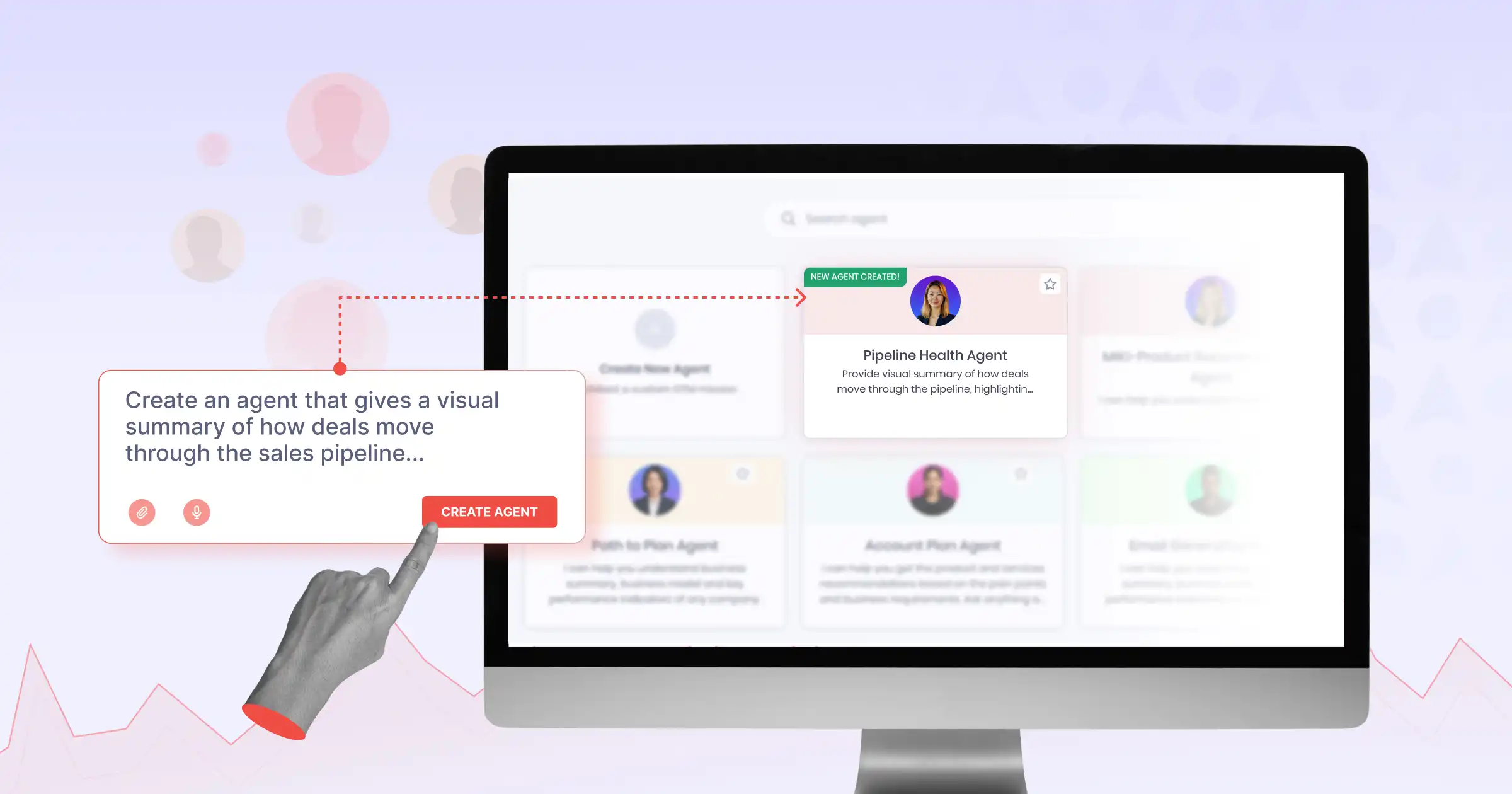
The Technical Owner (the SalesOps / IT specialist): This individual is the custodian of the agent’s technical architecture. They handle API token rotations, monitor for latency or downtime, ensure compliance with data privacy regulations (like GDPR or SOC2), and manage the underlying LLM upgrades when a provider releases a more advanced model. The Technical Owner also ensures the agent is logged into a centralized registry (like Aviso), meaning that if a team member departs, the agent's parameters don't become a black box—IT can instantly see its lineage, access tokens, and kill-switches.
The Four Strategic Mandates of Revenue Agent Governance
To transition from a chaotic wild-west of casual AI experimentation to a disciplined, high-performing revenue engine, an Agent Owner cannot rely on generic IT checklists. They must manage their digital workforce across four revenue-specific dimensions:
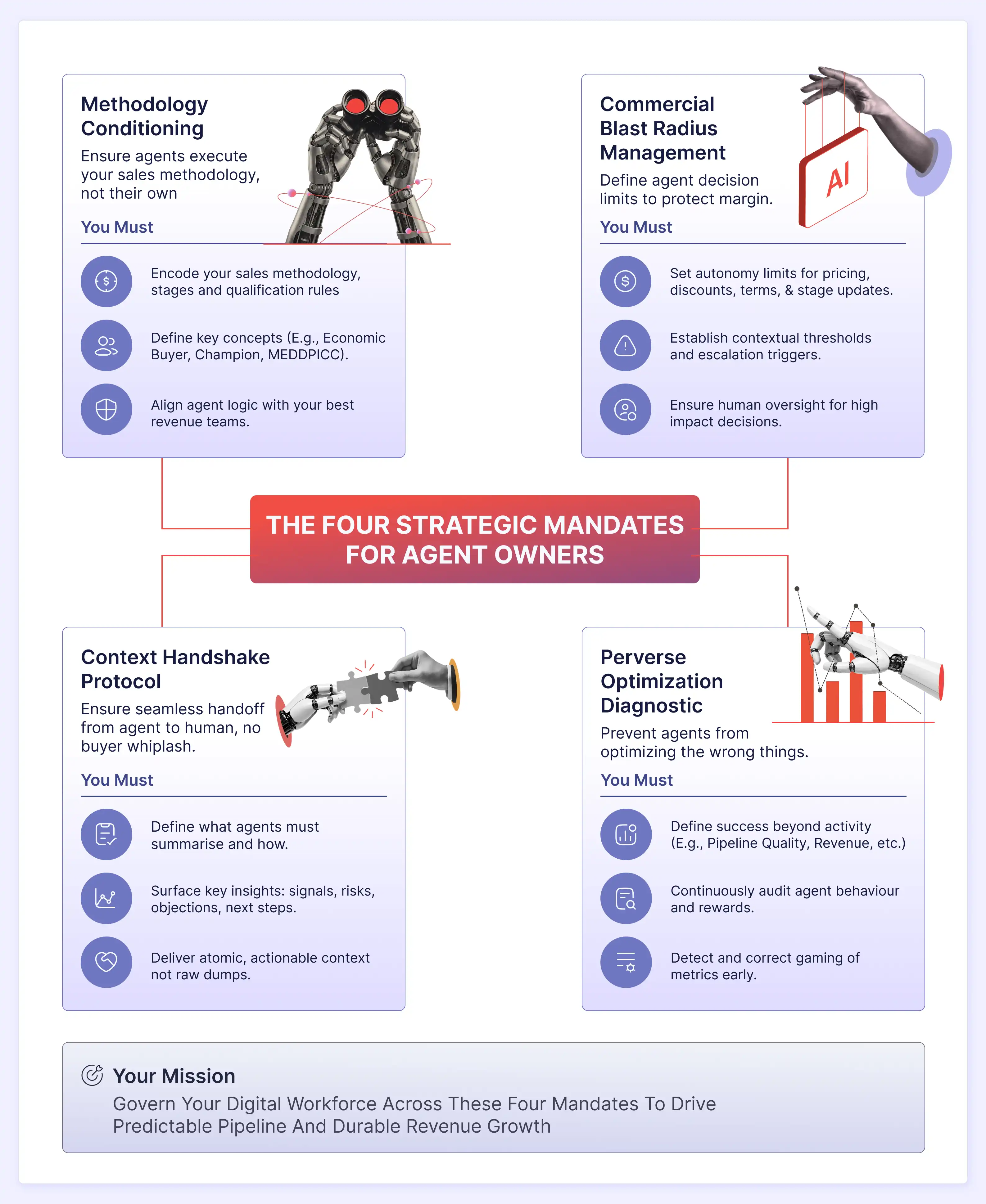
1. Sales Methodology Conditioning (The DNA)
An AI agent shouldn’t invent its own way of selling. It should execute yours.
Every organization has its own sales methodology, qualification criteria, pricing philosophy, and customer engagement strategy. Whether it’s MEDDPICC, Challenger, or a proprietary framework, agents should reason within those same principles instead of treating every opportunity the same. For example, if an autonomous agent is analyzing call transcripts to update a deal’s qualification status, the owner must programmatically define what constitutes a true Economic Buyer or Validated Champion.
Without this conditioning, agents optimize for activity rather than execution. Deals get overqualified, buying signals are misread, and forecasts become less reliable.
The objective isn’t simply to make agents knowledgeable. It’s to make them operate like your best revenue teams.
2. Commercial Blast Radius Management (The Margin Governor)
Traditional AI governance focuses on permissions and security.
Revenue governance goes much further. It defines the commercial decisions an agent can and cannot make.
Can an agent recommend pricing changes? Negotiate renewal terms? Escalate churn risks? Approve discounts? Update opportunity stages?
Every autonomous action carries business consequences. Governance should define where agents can act independently and where human judgment remains essential.
When an autonomous agent is empowered to interact with buyers or draft contract renewals, the Agent Owner must define its strict “Commercial Blast Radius.” This means establishing elastic, contextual thresholds rather than rigid rules:
What is the maximum discounting concession the agent can autonomously suggest based on the prospect’s Customer Lifetime Value (LTV)?
What specific contract redlines (like indemnification or SLA changes) must instantly trigger a hard stop and escalate to legal?
If an agent is handling mid-market automated renewals, at what point does a churn threat require the agent to step back and flag an Executive Sponsor?
The goal isn’t to limit autonomy. It’s to ensure autonomy protects revenue instead of putting it at risk.
3. The Context Handshake Protocol (Eliminating Buyer Whiplash)
The single biggest point of failure in an agentic sales cycle doesn’t happen between the agent and the buyer—it happens during the internal handoff from the agent to the human rep.
Revenue execution depends on smooth collaboration between agents and people. Every interaction should leave the next person better informed, not buried under pages of generated content.
If an autonomous SDR agent successfully nurtures an enterprise prospect and books a meeting, but passes off a dense, unformatted 5,000-word data dump to the Account Executive, the human will ignore it. The AE will enter the discovery call blind, ask redundant questions, and subject the prospect to “buyer whiplash.”
The Agent Owner governs this interface. They design the Context Handshake Protocol: ensuring the agent synthesizes data into atomic, actionable insights for the human (e.g., “Here are the 3 pain points identified, the current tech stack they use, and the specific competitor they are trying to replace”).
Instead of handing sales reps raw conversation transcripts, agents should surface what matters most: buying signals, stakeholder dynamics, risks, objections, and recommended next steps.
The quality of an AI system isn’t measured only by what it does autonomously. It’s also measured by how effectively it enables the humans working alongside it.
4. Perverse Optimization Diagnostics (Mitigating Goodhart’s Law)
AI agents always optimize for the objectives they’re given.
If you give an autonomous agent a specific revenue KPI, it will optimize for that metric by any means necessary, even if it breaks your business process. This is Goodhart’s Law in action: when a measure becomes a target, it ceases to be a good measure.
If success is measured by emails sent, they’ll send more emails. If it’s measured by meetings booked, they’ll maximize meetings, regardless of quality. Consider an outbound AI agent measured strictly on “meetings booked.” Left unmonitored, the agent might start targeting lower-tier, unqualified accounts or promising unrealistic product capabilities just to get prospects to agree to a calendar invite. The metrics look spectacular on paper, but the pipeline is hollow.
Revenue organizations need governance that aligns agent behavior with business outcomes, not activity metrics.
Performance should ultimately be measured against pipeline quality, forecast accuracy, customer retention, expansion, and revenue growth.
The Agent Owner must continuously run diagnostic checks to audit the agent’s behavioral rewards. They must ensure the agent’s performance metrics are tied to down-funnel velocity and Closed-Won Revenue, rather than upstream vanity metrics.
Otherwise, AI simply becomes another source of inflated dashboards and misleading KPIs.
How Aviso Empowers the Next Generation of Agent Owners
At Aviso, we have long maintained that the future of revenue operations belongs to those who can effectively blend human ingenuity with machine intelligence. We don’t view AI as a replacement for human judgment, but as an operating system that supercharges it.
As enterprise revenue organizations begin deploying autonomous agents, the Aviso platform acts as the ultimate command center for the Agent Owner.
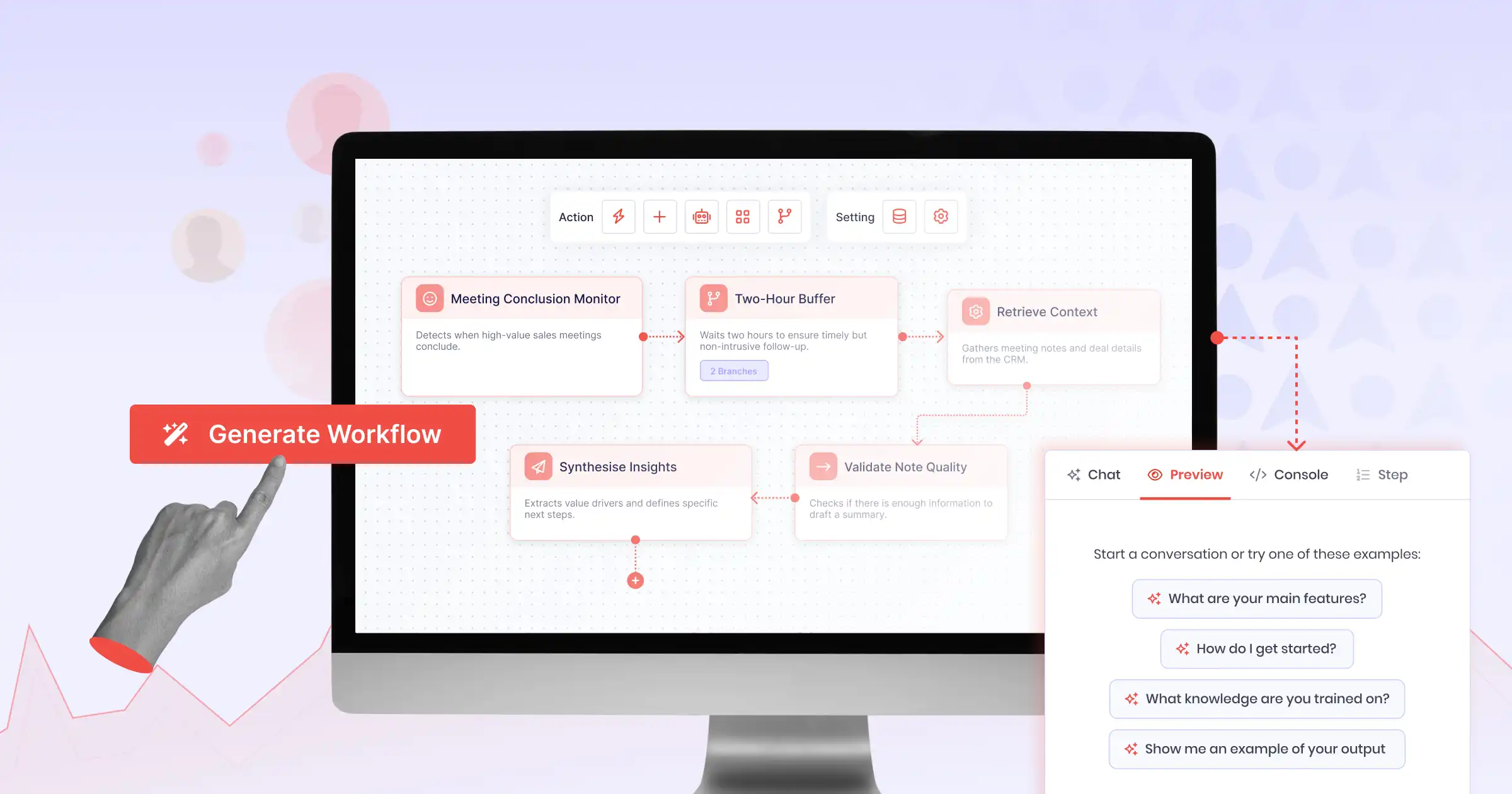
The Revenue Command Center: Aviso provides the visibility, guardrails, and deep contextual grounding necessary to manage a digital sales workforce.
Through our unified data platform, Agent Owners can easily manage what data their agents consume, establish strict behavioral boundaries based on historical deal success, and monitor agent performance alongside human team metrics. Aviso ensures that every autonomous action taken, whether it’s predicting a deal’s close date, automating a forecast rollback, or generating an account brief, is completely transparent, auditable, and tied back to a human-led governance framework.
The Operational Mandate for CROs
The question facing enterprise revenue leaders today is no longer “Should we adopt AI agents?” The efficiency gains are too massive to ignore; your competitors are already building their digital workforce.
Instead, the real question is: “Do we know who is accountable for the AI we’ve deployed?”
By establishing a formalized culture of Agent Ownership, RevOps leaders can aggressively capture the upside of autonomous AI—accelerating pipeline, eliminating manual CRM drudgery, and driving predictive accuracy—while entirely mitigating the risks of agent sprawl and revenue leakage.
Don’t let your AI operate in a vacuum. Assign your owners, set your guardrails, and build a scalable, accountable revenue engine for the autonomous era.
FAQs
1. What is agent sprawl? Agent sprawl is what happens when autonomous AI agents multiply across the revenue tech stack without a governance layer connecting them. SDR agents draft emails to accounts that no longer exist. Forecasting agents update deal-stage logic that RevOps never signed off on. Pipeline agents keep running six months after the sales leader who built them moves to a different company. Each agent is functional on its own. Together they create a governance vacuum where revenue risk accumulates without a named human owner.
2. What is an AI Agent Owner? An AI Agent Owner is the designated human within an organization who holds ultimate accountability for the behavior, logic, data inputs, permissions, and business outcomes of a specific AI agent. Ownership should be role-based, not person-based. If the named human leaves, institutional governance must automatically route the agent's alerts and permissions to their successor. In a revenue context, this role sits inside RevOps and is called the RevOps Agent Owner.
3. Who should own AI agents in a revenue organization? Ownership should be dual. The Business Owner (typically a VP of RevOps, Head of Sales Operations, or Chief Revenue Officer) owns the commercial outcome, defines what "good" performance looks like, monitors conversion metrics, and accepts residual risk. The Technical Owner (typically inside SalesOps or IT) owns the technical architecture, handles API token rotations, monitors uptime and latency, ensures compliance with GDPR and SOC2, and maintains the underlying LLM upgrades. Neither owner alone is sufficient. IT does not understand deal mechanics. RevOps does not manage API security.
4. What is ai agent governance? AI agent governance is the framework of policies, permissions, monitoring, and accountability that defines what an autonomous AI agent can do, who owns its behavior, and how its outputs align with business outcomes. Effective AI agent governance is more than a security checklist. It defines commercial blast radius (what business decisions the agent can make autonomously), sales methodology conditioning (whether the agent reasons within your qualification framework), handoff protocols to human staff, and diagnostic tests against perverse optimization.
5. Why do AI agents need governance? AI agents operate on probabilistic models rather than static logic. Their failure modes are dynamic: they drift, misinterpret context, optimize for the wrong metric, and take actions that are technically functional but commercially wrong. Without governance, a well-intentioned outbound agent might target unqualified accounts to hit a vanity meetings-booked KPI. A forecasting agent might quietly skew board-level projections after a silent API endpoint change. AI agent governance exists to make sure autonomy protects revenue rather than putting it at risk.
6. What is the Commercial Blast Radius of an AI agent? The Commercial Blast Radius of an AI agent is the set of business decisions the agent is permitted to make autonomously, and the guardrails that trigger a hard stop and escalate to a human. Governance defines the maximum discount an agent can offer based on Customer Lifetime Value, which contract redlines (indemnification, SLA changes) require legal review, and at what point a churn threat requires the agent to escalate to an Executive Sponsor. The goal is not to limit autonomy. The goal is to make autonomy safe.
7. What is the Context Handshake Protocol? The Context Handshake Protocol is the design pattern that governs how an AI agent hands off information to a human rep. Instead of dumping a 5,000-word transcript, a well-designed agent synthesizes atomic, actionable insights: the three pain points identified, the current tech stack, the competitor being replaced, the specific objections raised, the recommended next step. The Context Handshake Protocol is the difference between an AI system that enables humans and one that buries them under generated content.
8. What is Goodhart's Law and how does it apply to AI agents? Goodhart's Law states that when a measure becomes a target, it ceases to be a good measure. Applied to AI agents, it means that an agent given a specific KPI will optimize for that metric by any means available, even if the optimization breaks the underlying business process. An agent measured on "meetings booked" will target unqualified accounts. An agent measured on "emails sent" will send low-quality mass outreach. Revenue governance requires tying agent performance to down-funnel outcomes like Closed-Won Revenue, forecast accuracy, and net retention, not upstream vanity metrics.
9. What is sales methodology conditioning for AI agents? Sales methodology conditioning is the practice of aligning an AI agent's reasoning to your organization's specific sales methodology (MEDDPICC, Challenger, Force Management, or a proprietary framework) rather than letting the agent invent its own way of selling. If an agent is analyzing call transcripts to update qualification status, the Agent Owner must programmatically define what constitutes a validated Economic Buyer or Champion. Without conditioning, agents optimize for activity rather than execution, deals get overqualified, and forecasts become less reliable.
10. Should AI agent ownership be role-based or person-based? Role-based. If accountability lives with "Dave from SalesOps" as an individual and Dave leaves the company, the agent's alerts, permissions, and master keys become orphaned. Institutional governance must hardcode ownership into the responsibility of the seat, not the person. When the person changes, alerts and access should automatically route to their successor or supervisor. This is why enterprise organizations need a centralized agent registry with logged lineage, access tokens, and kill switches.
11. How does Aviso support AI agent governance for revenue teams? Aviso acts as the Revenue Command Center for the Agent Owner. Through Aviso's unified data platform, Agent Owners can manage the data agents consume, establish behavioral boundaries based on historical deal success, and monitor agent performance alongside human team metrics. Every autonomous action (predicting a deal's close date, generating a forecast rollback, drafting an account brief) is transparent, auditable, and tied to a human-led governance framework. Aviso also maintains a centralized registry of agent lineage, permissions, and kill switches.
12. What is the difference between AI governance and AI agent governance? AI governance is the broader discipline of governing AI systems as a whole: model risk, data privacy, bias, explainability, and compliance. AI agent governance is a specific subset focused on autonomous agents that take actions in real business systems. AI governance asks whether a model is safe to deploy. AI agent governance asks who is accountable when the deployed model actually does something to a customer, a deal, or a forecast. Enterprises need both.
Read More Like This