Why Persistent Agents Are the Only Architecture That Matters for Revenue Teams

No time to lose? Summarize with AI
ChatGPT
Claude

Every point solution in the market has suddenly rebranded its chatbots and automated workflows as AI Agents. But let us be candid: if an agent requires a human to explicitly prompt it, logs out when you close your browser tab, and operates in isolation inside a single dashboard, it is not an agent. It is just a script with a newer LLM API wrapped around it.
For enterprise revenue operations, these single-task bots are a liability. They create more digital noise, more fragmented data handoffs, and more manual coordination. They treat revenue operations as a series of disconnected, static events rather than a continuous, dynamic system.
A genuine agent, the kind that actually changes how revenue teams work, needs three things that most architectures do not provide: the ability to remember across time, the ability to pursue a goal without being re-prompted, and the ability to take action, not just generate output.
The Illusion of Point-in-Time Intelligence
Most "agents" deployed in enterprise software today are fundamentally stateless, even if they use clever engineering tricks to hide it.
Stateless agents are ephemeral bots that only wake up when a human asks a question or a rigid CRM rule triggers them. They look at a deal, evaluate a single transaction, and disappear. They view your business through a series of disconnected snapshots. No memory of the last call, no awareness of prior pipeline data, no context from the meeting that happened on Monday. Fast, cheap, and completely blind. The flaws of this model are stark:
The State vs. Signal Problem: A traditional bot reads a CRM field like "Stage 4 - Evaluation" and assumes everything is fine. It lacks the systemic persistence to know that three key stakeholders stopped opening emails two weeks ago, and the economic buyer just changed roles.
The Prompting Bottleneck: If an account executive has to actively remember to prompt an AI to check for deal risk, look up a competitor, or draft a follow-up, the AI will fail. High-performing reps do not have time to act as prompt engineers.
Contextual Blindness: Isolated bots cannot pass context across the revenue lifecycle. The bot qualifying a lead does not share a continuous memory system with the bot tracking the pipeline or the bot managing customer onboarding.
A stateful agent is better. It maintains context within a session or across a short window using external storage. You can have a coherent conversation with it. But statefulness has a ceiling. When the session closes or the defined memory window expires, the agent effectively resets. It has memory, but it has no persistent mission. It cannot wake up tomorrow and continue working toward a goal you set three weeks ago without being explicitly re-engaged.
Persistent agents completely invert this dynamic. They do not wait for instructions, and they never sleep. They operate as a continuous, background infrastructure that lives inside your data streams, autonomously monitoring the entire Go-To-Market lifecycle. They maintain durable identity, long-horizon goal continuity, cross-session memory, and the ability to resume mid-execution after interruptions.
The practical implication for a revenue team is significant. A stateful agent can help a rep prepare for a call. A persistent agent tracks that deal from discovery through negotiation, monitors signals across CRM, email, and call recordings, fires actions when risk thresholds are crossed, and updates the forecast without being asked.
What True Persistence Demands
Building an architecture capable of true agentic persistence requires moving away from flat relational databases and superficial wrappers. It requires three fundamental architectural pillars:
Continuous Signal Ingestion: The architecture must bypass manual CRM logging entirely. It needs to ingest live telemetry from email servers, calendars, conversational intelligence, support queues, and product usage in real time. It reasons from a live feed, not a photograph.
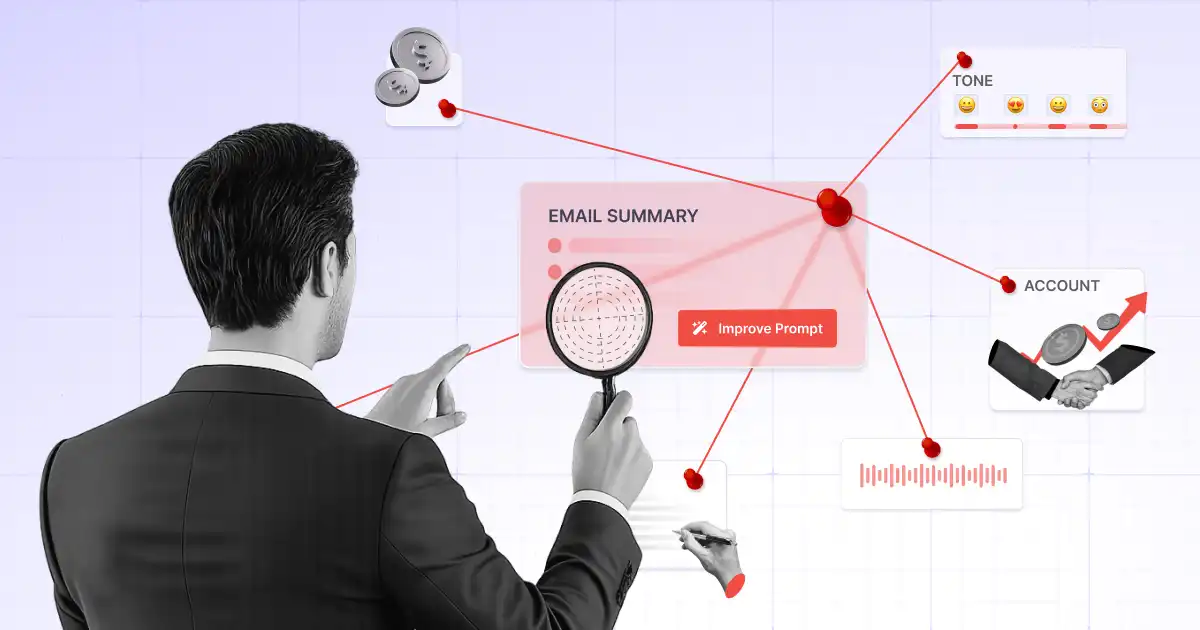
A Living Relationship Graph: Enterprise deals are won or lost based on the hidden network of human interactions. A persistent agent requires a dynamic Context Graph (combining an Ontology Layer with a Knowledge Graph) to model how influence flows between buyers, champions, and detractors over time.
Cross-Agent Coordination: True persistence means agents reason together instead of working in siloes. This means multiple specialized agents working together seamlessly across forecasting, deals, and execution.
Under the Hood: Memory as Infrastructure
Most AI systems are built to respond. Aviso's persistent agents are built to remember, adapt, and pursue goals.
Here's what's happening under the hood.
Long-Term Memory Modules: Most legacy bots operate with the short-term working memory of a simple prompt window, losing track of details the moment a session closes. Aviso integrates enterprise-grade memory modules anchored by an optimized Vector Database alongside a dedicated Time-Series Database. While the vector database converts emails, transcripts, and proposals into high-dimensional vector embeddings for deep semantic and episodic memory, the time-series database meticulously logs timestamps, activity frequencies, and event intervals. This dual-memory approach ensures our persistent agents don't just remember what was said, but exactly when and how often it occurred. If a prospect mentions a specific technical bottleneck in Q1, and a related issue spikes within support tickets and email frequencies in Q4, the agent pairs semantic memory with time-series history to instantly surface the pattern, pulling the full historic context into its active reasoning loop without requiring a human to remind it.
Feedback Loops: A persistent agent must be capable of evolutionary learning; otherwise, it remains a rigid automation script. Every time an Aviso agent predicts deal volatility, generates an automated outreach sequence, or surfaces an expansion play, the outcome is systematically tracked. The system closes the loop by comparing its internal reasoning and recommendations with real-world revenue results (e.g., Did the deal close? Did the champion churn? Did the sequence convert?). This continuous feedback dynamically optimizes our AI Brain, tuning the underlying models and reinforcement frameworks to recognize patterns, behavioral nuances, and buying triggers unique to your specific enterprise sales cycle and industry vertical.
Goal-Based Models: Ephemeral workflows are task-oriented; they execute a rigid, pre-defined rule and stop, regardless of whether that action made strategic sense. Aviso’s persistent agents are strictly goal-oriented. Driven by advanced multi-step inferences, our agents are given a high-level objective—such as "mitigate churn risk on Account X" or "accelerate contract signing on Opportunity Y." The agents then utilize Directed Acyclic Graphs (DAGs) to orchestrate and adjust their own sub-tasks autonomously. If a chosen path hits a dead end—for instance, if an automated executive outreach attempt goes unanswered—the goal-based model pivots, shifting tactics based on how the environment reacts to achieve the desired business outcome rather than just generating superficial output.
Contextual Reasoning: Context is established through Aviso’s Context Graph, built on a Knowledge Graph and an Ontology layer that define business meaning, metrics, and relationships. Together, they define not just what data exists, but what it means, how it connects, and how AI is allowed to reason and act on it. The Knowledge Graph connects everything that matters in selling. It links people, accounts, deals, activities, and outcomes into one connected model. This allows AI to see the full picture of a deal, not just isolated data points. Instead of treating emails, calls, and CRM updates as separate records, the Knowledge Graph shows how they relate. Who said what. Which activity influenced which deal. How engagement changed over time. This allows AI to understand who is involved in a deal, what actions have occurred, and how those actions influence outcomes over time.
For instance, when a deal starts to slow, the Knowledge Graph allows AI to trace which stakeholders disengaged, which activities dropped, and how that pattern compares to past outcomes.
The Ontology Layer defines business meaning and governs AI reasoning by acting as the system’s source of business truth. Instead of letting AI guess from prompts, the ontology defines what metrics, entities, and relationships actually mean in your business. Every AI agent reasons within this shared logic, which prevents hallucinations and misuse of data. Because all agents plan and act from the same semantic foundation, results stay consistent and do not drift over time.
The Unfair Advantage for Your GTM Team
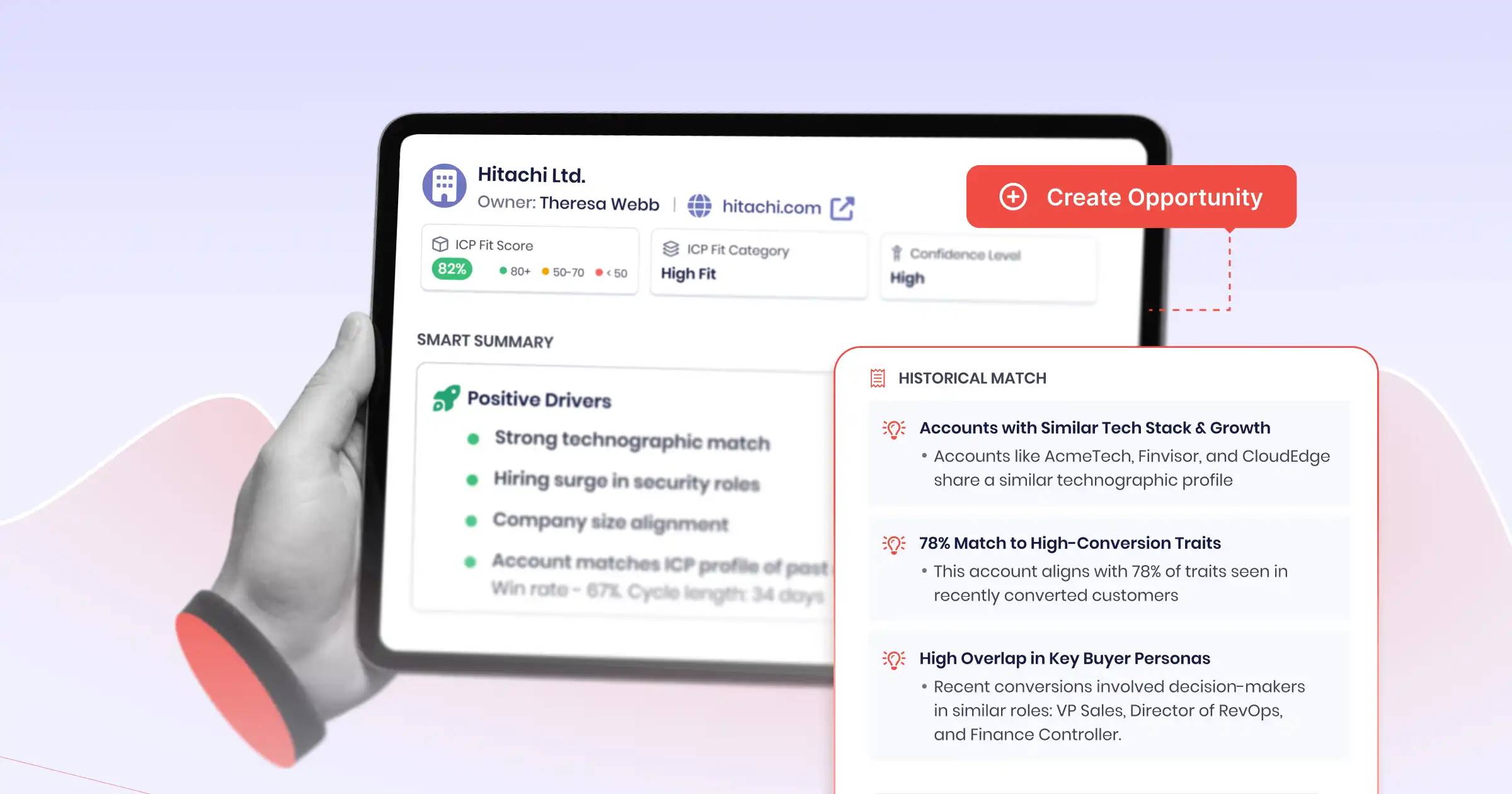
Persistent memory becomes tangible in Halo, Aviso’s AI-powered single pane of glass for revenue teams. Every signal from CRM activity, emails, calendars, call recordings, and marketing engagement is continuously ingested, embedded, and connected within the revenue knowledge graph.
When a rep opens a deal, Halo surfaces the most relevant context automatically. Not just the latest activity, but the information most semantically tied to the current deal state and next action.
Before a negotiation call, Halo can surface objection patterns from prior conversations, competitor mentions from recent touchpoints, and intelligence from similar closed-won deals in the same vertical. It understands where the opportunity sits within the 13-week GTM execution cadence, which actions are overdue, and which stakeholders have disengaged. The system is continuously tracking, reasoning, and updating context in the background.
Persistent agents extend this advantage across the entire revenue workflow.
Cross-agent orchestration
MIKI acts as a persistent agent by continuously retaining business context, conversation history, user feedback, and operational knowledge across sessions, enabling it to learn, reason, and execute tasks as an ongoing AI teammate rather than a stateless chatbot.
Because it maintains a persistent understanding of entities, relationships, ownership, deal stages, risks, and account history, it can reason across multiple data sources instead of treating each request independently. For example, when a manager asks, "Why is this deal slipping?" MIKI can combine previous deal history, recent call sentiment, buyer engagement patterns, forecast changes, and Rep activity to generate an explanation grounded in accumulated context rather than a single snapshot.
Result: The whole GTM system executes as one coordinated unit
Always-on AI Companion
Halo acts as the AI operating layer for the entire GTM stack, observing what reps see across every app, recommending next-best actions in the moment, and executing on their behalf without app switching. Every interaction sharpens the persistent context model for that rep and deal.
Result: One unified AI layer replacing fragmented point tools
Memory-powered cold outreach
Aviso’s AI SDR avatar retains engagement history across every prospect interaction, including opens, replies, objections, and timing patterns. Outreach evolves continuously based on what each buyer responds to over time.
Result: More qualified meetings with zero dropped follow-ups.
Inbound lead qualification
Aviso’s AI SDR Avatar manages inbound qualification across multiple conversations while retaining full account and interaction context until handoff.
Result: Reps engage only sales-ready, fully researched leads.
Objection handling
Aviso’s Sales Engineer Avatar remembers account-specific technical concerns, prior objections, and competitor discussions throughout the deal cycle.
Result: Faster ramp-up, stronger execution consistency, and higher win rates.
Continuous win/loss learning
Aviso’s Sales Coach Avatar continuously learns from every won and lost deal across the organization, updating guidance dynamically.
Result: Best practices spread across the organization automatically.
Market and competitive intelligence
Aviso’s Company Research Agent continuously tracks market shifts, analyst commentary, and competitive pressure across target accounts.
Result: Sellers lead with relevant market insight instead of generic pitches.
Toward AI Systems With Institutional Memory
The right question to ask of any AI agent you are evaluating is not whether it can answer a question well. It is whether it is still working on your goals when you are not in the room. Whether it remembers what happened three weeks ago without being told. Whether it fires an action the moment a risk signal crosses a threshold, not the morning after you notice it in a report.
If the answer to any of those questions is no, you do not have a persistent agent. You have a very capable tool that still requires a human to operate it. That is a meaningful distinction, and it is the one that will separate the platforms that transform revenue execution from the ones that simply participate in the conversation about it.
This is the future Aviso is building toward: AI agents with institutional memory that continuously learn from your business, monitor critical signals, and take action when it matters most. If you're evaluating what comes next for revenue execution, it's worth seeing what persistent AI looks like in practice. Book a demo with Aviso to know more.