Account Planning for Enterprise Sales Teams Is Broken. Here’s How AI Agent Fixes It

No time to lose? Summarize with AI
ChatGPT
Claude

Quick Answer
The short answer: Enterprise account planning fails when AEs rely on static documents, stale CRM data, and scattered research. Aviso’s Account Plan Agent turns account planning into an AI-assisted process by generating structured, source-backed account plans from CRM activity, company research, earnings calls, SEC filings, news, and engagement signals. It helps revenue teams identify account priorities, stakeholder relationships, risks, next steps, and owner-assigned actions before the next meeting.
Your AEs are spending hours building account plans that go stale before the first meeting.
The research is scattered. The insights are shallow. The plan often sits untouched until the next QBR. This is not an effort problem. It is a systems problem.
What Is Account Planning and Why Does It Keep Failing
Account planning is the process of building a structured, intelligence-backed strategy for a key customer or prospect. Done well, it tells your team who the buyers are, what the business is trying to achieve, where the risks and opportunities sit, and what actions to take next.
Done poorly, which is most of the time, it is a static document that lives in a folder and reflects the state of the account three months ago rather than today.
The failure is structural. Here is why account planning consistently breaks down:
Research is manual and fragmented. Building a credible account plan requires pulling from earnings calls, 10-K filings, CRM records, email threads, call transcripts, and news feeds. Most AEs do some of it poorly because none of them have time to do all of it well.
Plans go stale faster than teams can update them. A company's strategic priorities, leadership, and financial health can shift in weeks. Most tools have no mechanism for keeping plans current without manual intervention.
Templates drive compliance, not thinking. Most account planning software gives AEs a form to fill in. AEs learn to complete the template, not to use the plan.
Plans are documents, not workflows. The best account plan has no value if it does not translate into owner-assigned actions, tracked milestones, and visible stakeholder coverage. Most plans end as PDFs.
Adoption collapses under quota pressure. When time is scarce, account planning is the first thing AEs deprioritize. If the tool requires significant manual effort, it will not get used consistently.
These problems have persisted because the underlying approach, asking humans to do research-heavy work inside rigid templates, has not changed much even as the tooling has evolved.
What Autonomous Account Planning Actually Means
Autonomous account planning means the system does the research, synthesis, and structuring work. The AE provides direction and judgment. The agent handles the information gathering.
This is meaningfully different from workflow-based tools that automate parts of the process but still require significant human input. An account planning agent operates more like a research analyst than a template. You tell it which company you are focused on, and it builds the briefing.
The output covers everything a sales team needs before a strategic meeting:
Business overview and financial health
Strategic objectives and executive priorities
Pain points categorized by type and source
Stakeholder map with engagement history
Competitive landscape and whitespace analysis
Recommended actions with named owners
The AE's job shifts from researcher to reviewer and strategist. That is a better use of their time and a better use of the intelligence the system surfaces.
Account Planning Best Practices Before You Automate Anything
Before looking at tools, it is worth being clear on what a good account plan actually needs to contain. The structure below reflects what high-performing enterprise sales teams consistently use, regardless of tooling.
Business overview and financial health are the foundation on which everything else sits. This means understanding who the company is, what they sell, and what their financial trajectory looks like, including revenue trends, profitability, guidance changes, and budget signals.
Strategic objectives tell the AE what leadership is actually measured on. This comes from earnings calls, investor materials, and annual reports. AEs who know this can align their pitch to what matters at the executive level rather than guessing.
Pain points by category give a more nuanced picture than a flat list of challenges. Internal pain points come from CRM and communication data. External pain points come from filings and market analysis. Contextual pain points come from industry trends. Separating them matters because the response to each is different.
Stakeholder map with engagement data answers the coverage question directly:
Who are the economic buyers, champions, influencers, and potential blockers?
What is their organizational relationship to each other?
How engaged have they been, and through which channels?
Where single-thread risk exists before it stalls the deal?
Competitive landscape and whitespace signals are the intelligence most AEs lack going into renewal or expansion conversations. This includes which vendors are already in the account, what decisions have been made previously, which products have been won or lost, and where unaddressed opportunities sit.
Owner-assigned next actions are what separate a plan that gets used from one that gets filed. Every strategic priority should map to a specific action, a named owner, a timeline, and a visible status.
Getting all of this right manually, for every strategic account, at the frequency required to stay current, is not feasible at scale. This is the problem autonomous account planning is designed to solve.
How the Aviso Account Plan Agent Works
Aviso's Account Plan Agent takes a company name as its input and autonomously generates a structured account plan across all sections above, pulling from both public data sources and internal CRM and communication data.
Here is how it works in practice.
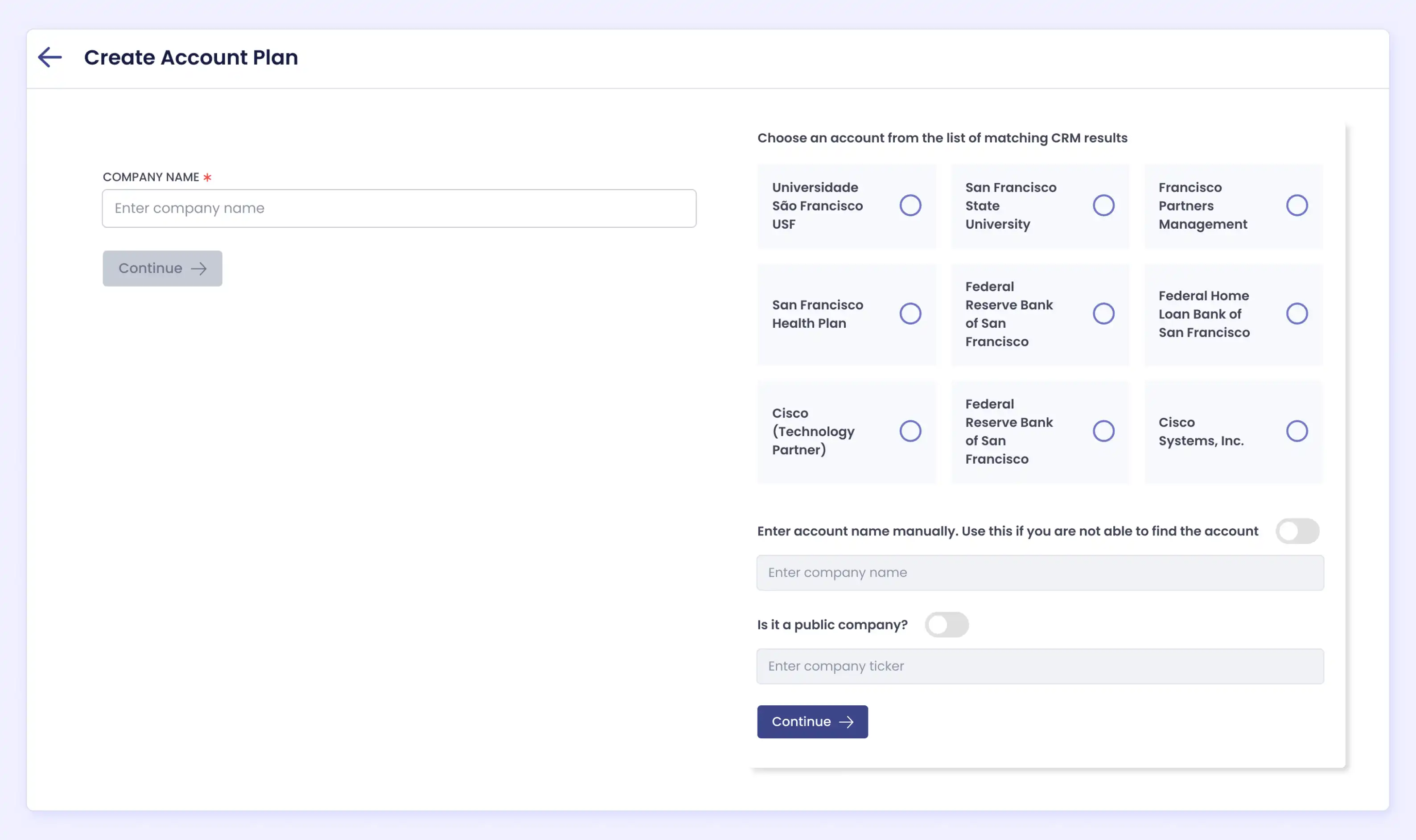
Step 1: Enter the Company Name
The AE opens the Account Plan workflow and types the target company name. The agent matches it against CRM records, confirms the right account, and determines whether the company is public or private to activate the appropriate data sources.
Step 2: The Agent Builds the Plan
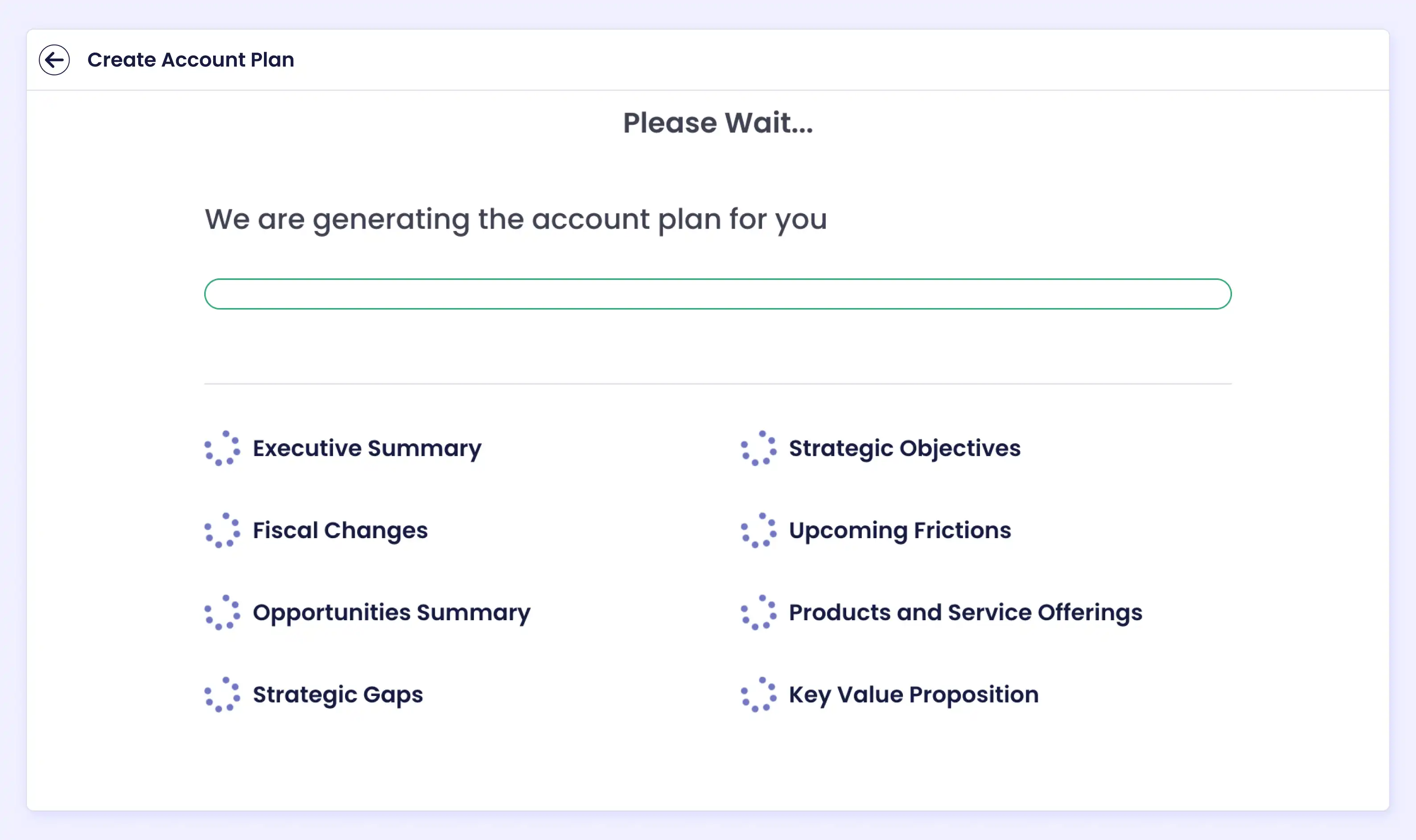
The agent works across all sections simultaneously. A live progress screen shows what is being generated in real-time. The AE does not need to stay on the screen. Sections generated include Executive Summary, Strategic Objectives, Products and Services, Fiscal Changes, Upcoming Frictions, Opportunities Summary, Strategic Gaps, and Key Value Proposition.
Step 3: Review, Refine, and Use
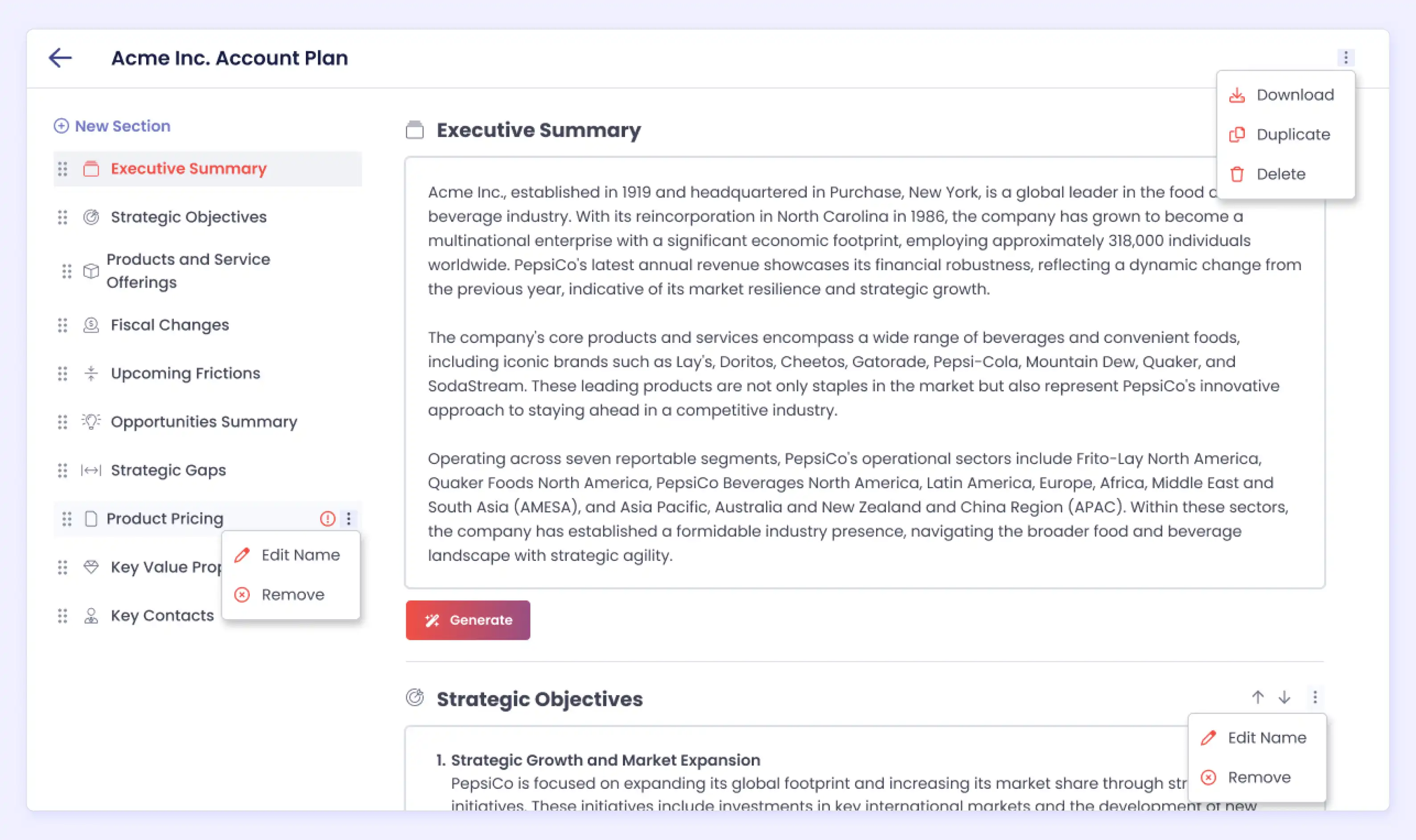
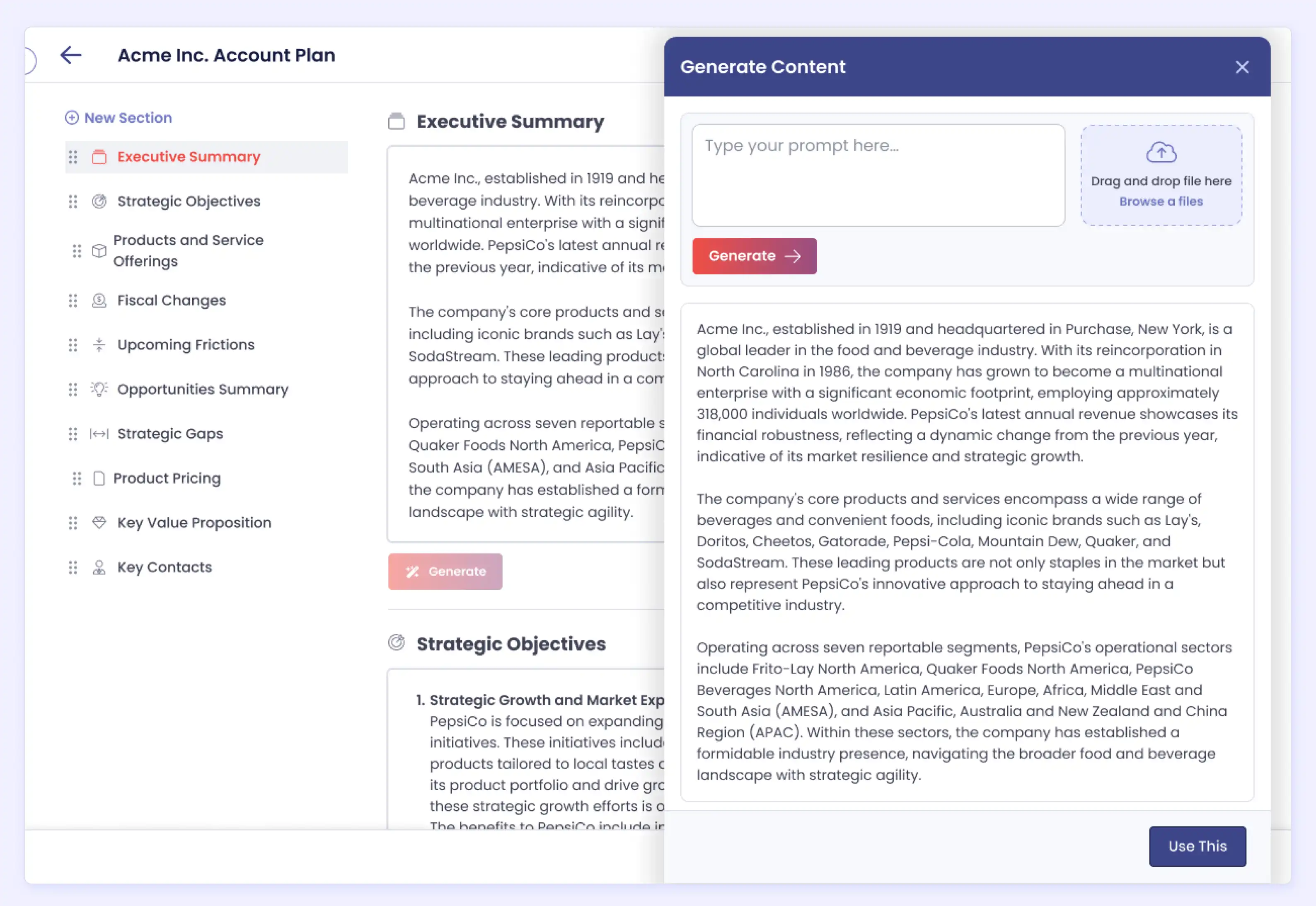
The output is a structured, section-by-section plan that the AE can review, edit, or regenerate. A Generate Content panel allows custom prompts, document uploads, and section-level refinement. The AE controls the final output.
The Intelligence Layers Inside the Plan
Strategic Customer Intelligence
The agent builds a comprehensive business overview, a financial intelligence summary, and a market strategy analysis. Every data point is cited with a source and paired with an Implication callout that connects the insight directly to the seller's opportunity. This is the difference between a research dump and a briefing.
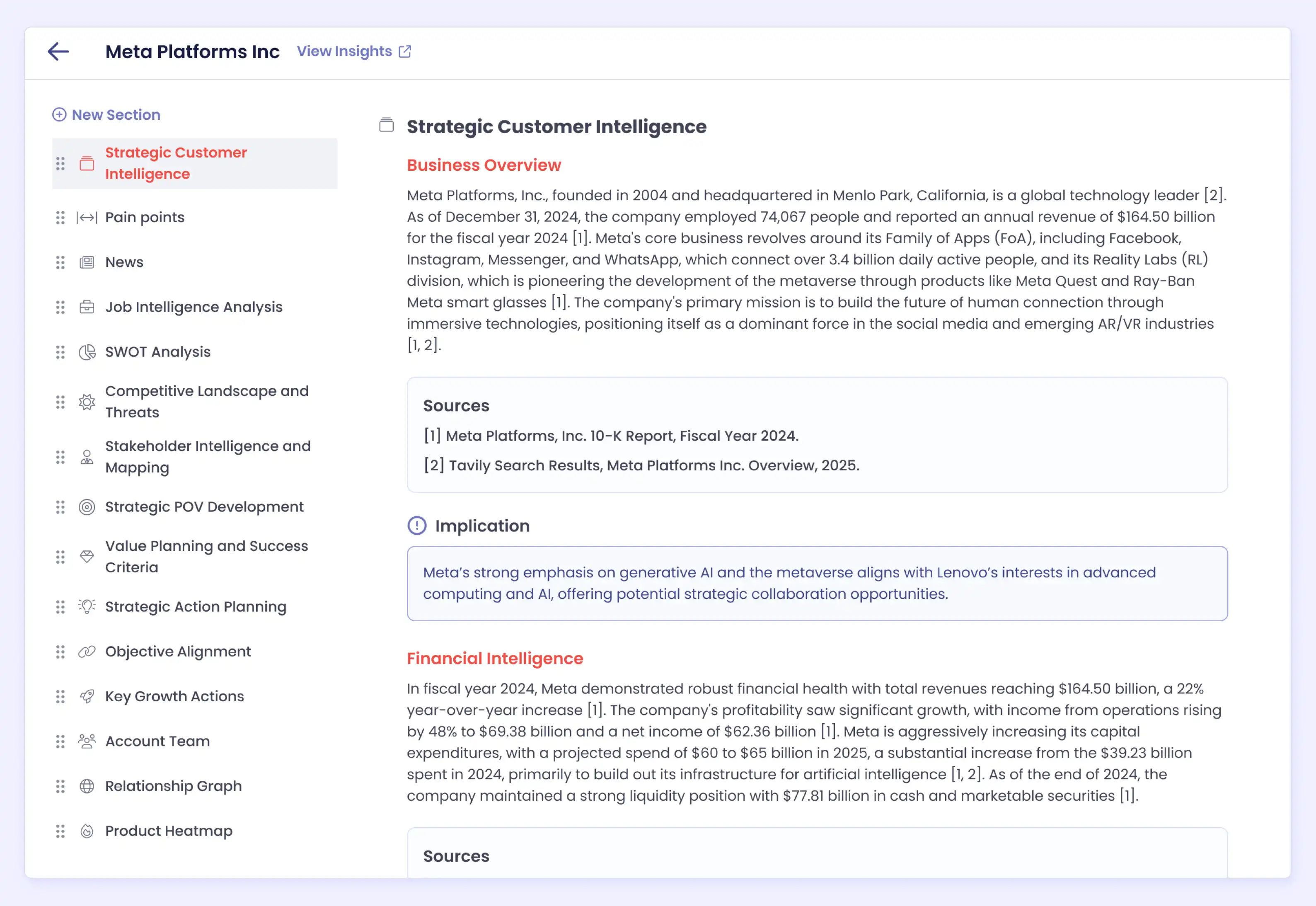
Financial intelligence covers revenue figures, year-over-year changes, margin trends, capex shifts, and guidance revisions, pulled from 10-K filings, earnings transcripts, and investor materials.
Pain Points
The agent separates pain points into three evidence-backed layers:
Internal pain points drawn from emails, call transcripts, and meeting notes
External pain points drawn from filings, market analysis, and earnings call commentary
Contextual pain points drawn from industry trends and competitive dynamics
Each insight includes a source citation, so the AE knows exactly where it came from before walking into the meeting.
Stakeholder Intelligence and Relationship Mapping
The relationship graph surfaces the full buying committee with organizational hierarchy, sentiment indicators, and engagement history for every contact.
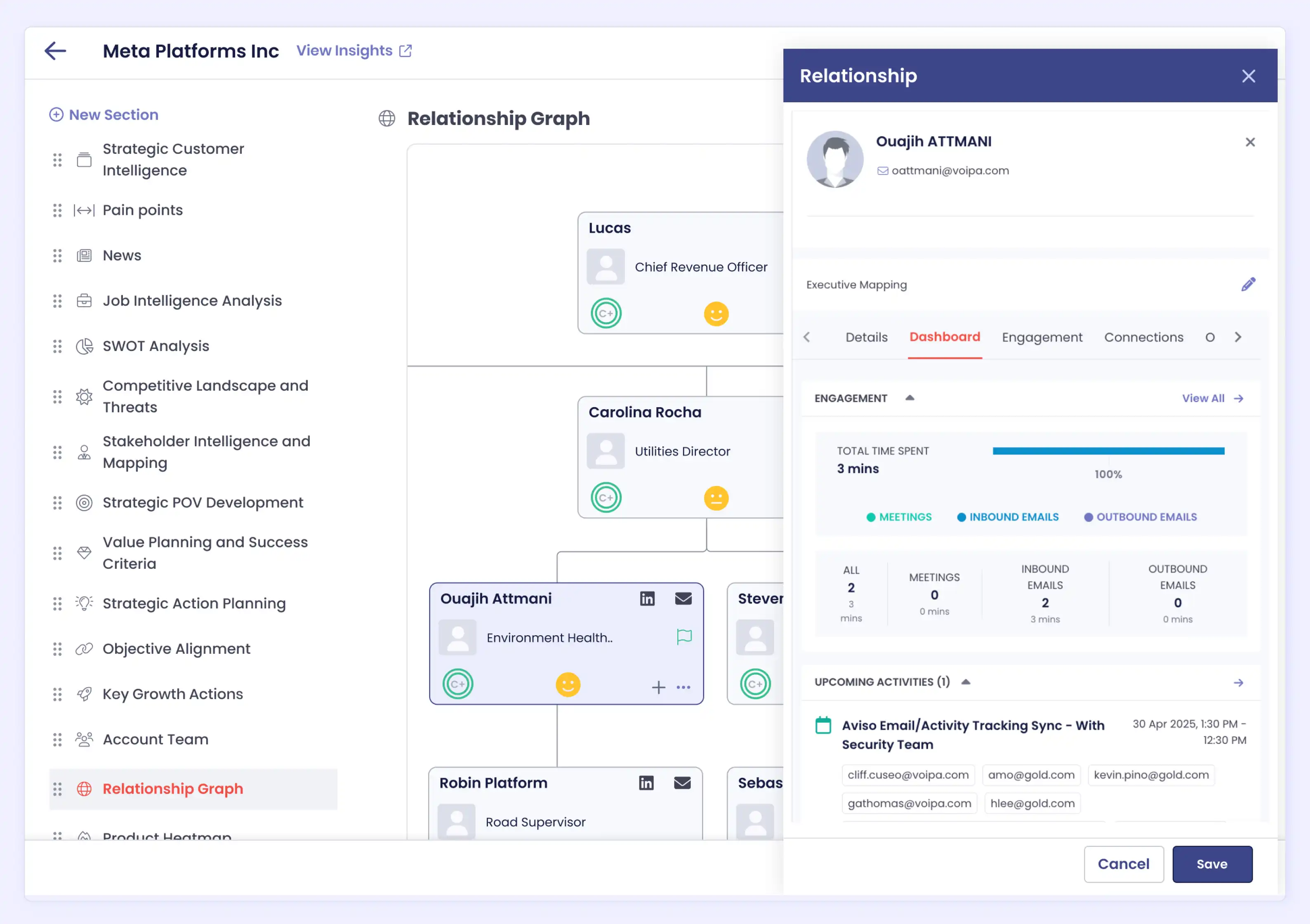
For each stakeholder, the agent surfaces role, engagement data across meetings and emails, sentiment indicators, upcoming activities, and executive mapping notes. Single-thread risk becomes visible before it becomes a problem.
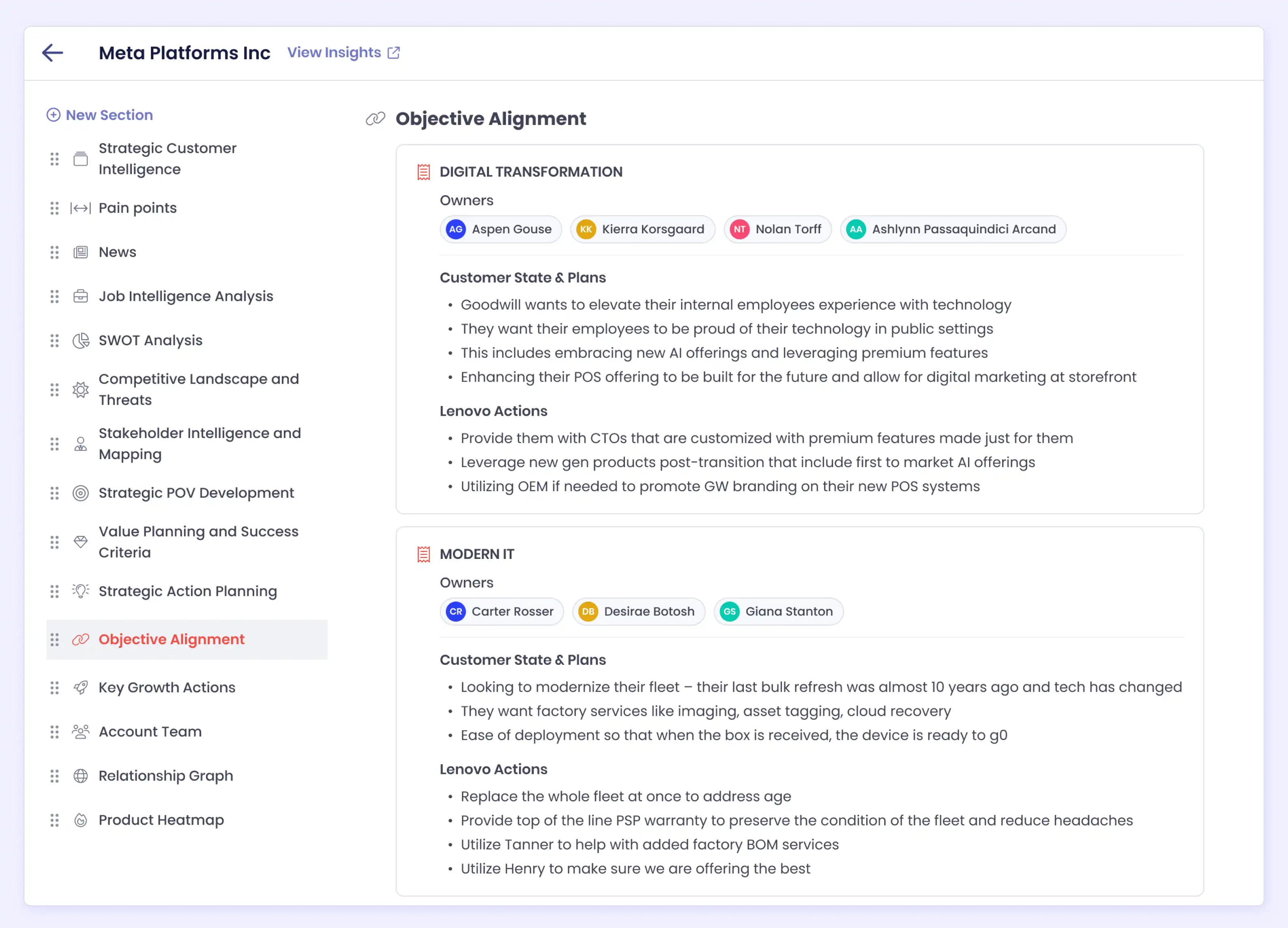
Objective Alignment
Buyer strategic priorities are mapped directly to seller actions, with named owners and built-in accountability. This is what makes account plans operational rather than decorative.
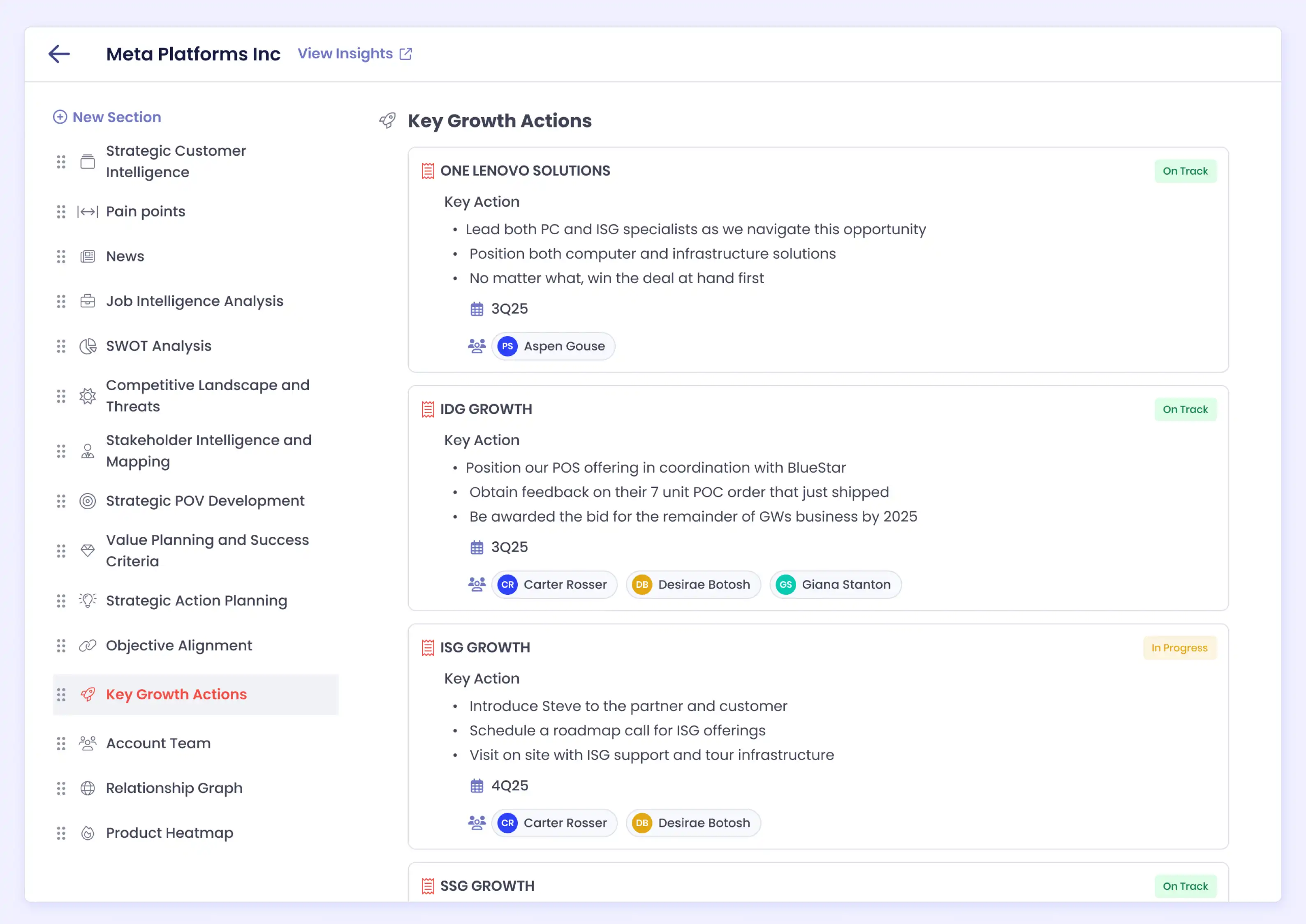
Key Growth Actions
Active strategic plays are tracked with status tags (On Track, In Progress), timelines, named owners, and specific next steps. Sales managers get a live view of account health without asking AEs for updates.
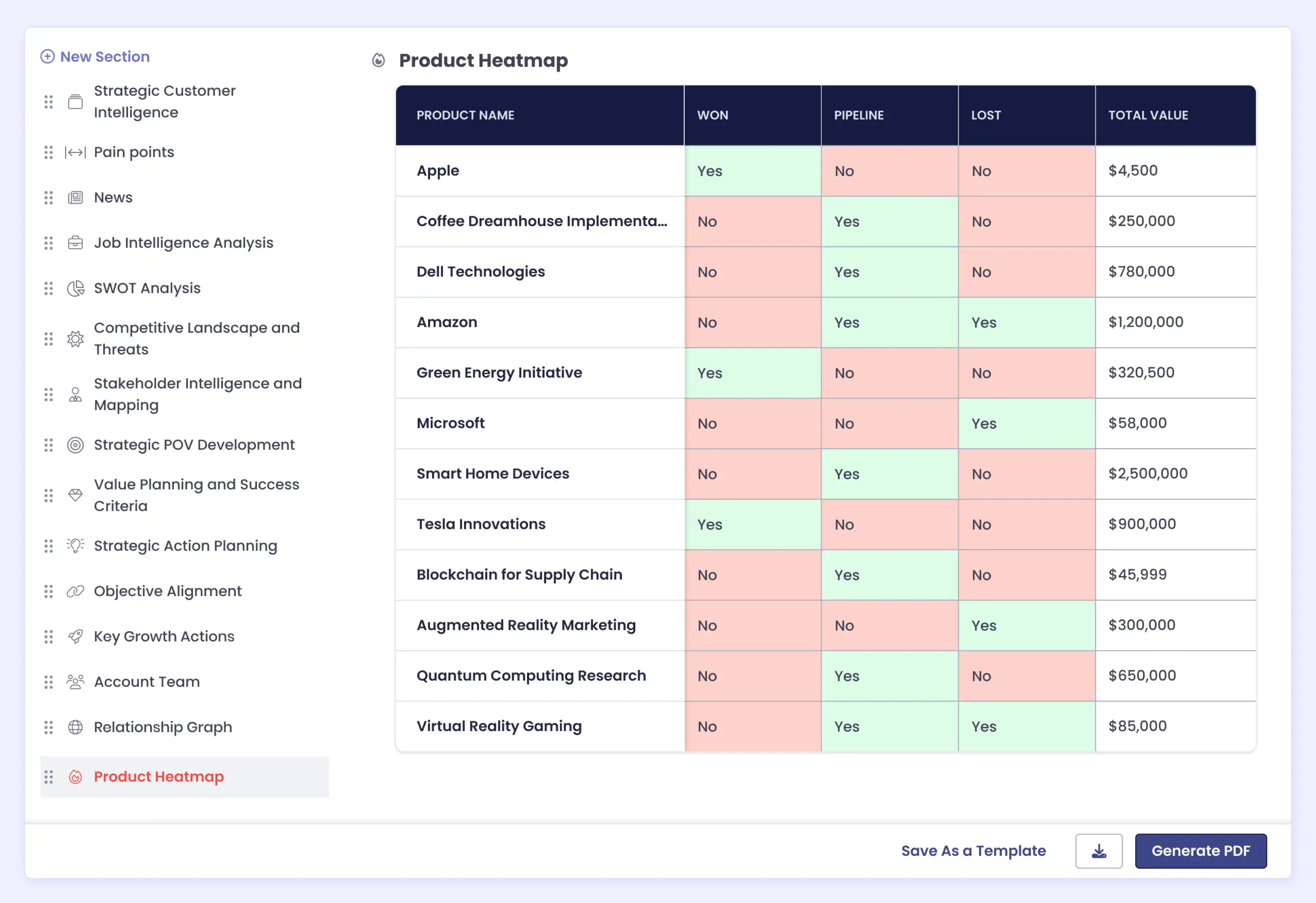
Product Heatmap
A cross-product view of what has been won, what is in the pipeline, and what has been lost surfaces whitespace and competitive displacement opportunities at a glance. Revenue leaders can spot expansion potential without digging through individual opportunity records.
What Sales Leaders Actually Get
The Account Plan Agent delivers outcomes at the team level, not just the individual AE level. Here is what changes in practice.
QBR-ready documentation in minutes, not hours. Plans reflect the latest earnings call, the most recent news, and the current relationship state. AEs show up to executive meetings prepared, not apologizing for a document last updated three months ago.
Consistent planning standards across the account team. Every plan follows the same structure and covers the same intelligence categories. This means:
RevOps stops chasing AEs for plan updates
Template compliance stops being a manual audit
Planning quality no longer varies by rep seniority or available time
Multi-threaded stakeholder coverage. The relationship graph and stakeholder intelligence sections make single-thread risk visible before it becomes a lost deal or a surprise churn. Sales managers can act on coverage gaps proactively rather than reactively.
Expansion and upsell signals surfaced early. Pain points, strategic gaps, and the product heatmap combine to surface expansion opportunities before the customer has to ask. This matters most in post-sale motions where revenue leakage tends to happen silently and late.
Export-ready output for customer-facing presentations. Plans export to PDF or map directly into customer-specific Google Slides templates. The manual copy-paste layer that typically precedes QBRs and executive reviews is removed entirely.
Traditional Account Planning vs. Autonomous Account Planning
Traditional Account Planning | Autonomous Account Planning |
AE manually researches and writes the plan | Agent autonomously researches and generates the plan |
Plan is built from static CRM data | Plan synthesizes CRM, news, earnings, emails, and calls |
Updated quarterly, if at all | Regenerable on demand with the latest signals |
Single document with no tracking | Live sections with owner-assigned actions and status |
Org chart lives on a whiteboard | Dynamic relationship graph with engagement data |
One-size-fits-all template for all accounts | Configurable sections tailored to account type |
A Note on Data Sources
The agent pulls from public and private data depending on the company type. All content is source-cited within the plan, so AEs know exactly where every claim came from, which matters when they are sitting across from a CFO who questions the data.
For public companies, sources include:
10-K and 10-Q SEC filings
Earnings call transcripts and DEF 14A proxy statements
News feeds, press releases, and job listings
Internal CRM and Aviso data
For private companies, sources include:
Company website and newsroom
Industry news, press releases, and job listings
Internal CRM and Aviso data
FAQs
What is the account planning process?
The account planning process is a structured workflow for building a strategy for a key customer or prospect. It includes researching the company's business and financial health, identifying strategic objectives, mapping the buying committee, surfacing pain points, analyzing the competitive landscape, and assigning owner-tracked actions. The process should be repeatable, source-cited, and revisited at least quarterly. AI account planning tools like the Aviso Account Plan Agent automate the research and synthesis steps so AEs focus on judgment and execution.
What goes into a QBR account plan template?
A QBR-ready account plan template covers eight sections: business overview and financial health, strategic objectives and executive priorities, pain points categorized by source, stakeholder map with engagement history, competitive landscape and whitespace, product heatmap, owner-assigned next actions with status tags, and source citations for every data point. The Aviso Account Plan Agent generates all eight sections from a single company name input, exportable to PDF or customer-specific Google Slides templates.
What is strategic account planning vs. transactional account planning?
Strategic account planning focuses on long-term value creation, multi-stakeholder coverage, and account-wide whitespace across an entire customer relationship. Transactional account planning focuses on the next deal in the pipeline. Strategic plans cover the full buying committee, multi-quarter expansion opportunities, and retention signals. Transactional plans focus on a single opportunity. Most enterprise revenue teams need both, but strategic account planning is the higher-leverage practice for renewal and expansion motion. AI account planning agents are well-suited to strategic plans because they handle the research depth strategic planning requires.
The Bottom Line for Revenue Leaders
Account planning should be a strategic asset, not an administrative burden. When AEs spend hours building plans that go stale in a week, the system is the problem. Autonomous account planning gives your team automatic research, current and cited intelligence, and actions that are tracked and owned.
Book a demo to see the Aviso Account Plan Agent in action.