Aviso vs Gong: An Honest Comparison for Enterprise Revenue Teams
No time to lose? Summarize with AI
ChatGPT
Claude
If you are evaluating Aviso vs Gong, start with the right question. It is not which platform has better call transcription. It is what happens after the call ends, where the insight goes, and whether a CI-first platform is the right foundation for an enterprise revenue stack.
This comparison answers that question directly.
TL;DR
Aviso bundles CI, forecasting, pipeline intelligence, and AI agents in one platform powered by MIKI's Context Graph
In Aviso, every conversation signal immediately updates your forecast, deal score, and rep's next action automatically
Gong is a CI platform but forecasting, engagement, and enablement are all separately licensed modules
In Gong, call signals stay in a coaching dashboard and do not connect to forecast or execution
MIKI's Context Graph minimizes token consumption enabling transparent pricing where Gong's LLM costs compound into opaque seat bills
Enterprises consolidating onto Aviso from a Gong stack report 40%+ reduction in sales technology costs
Aviso CI is free to start with no procurement process required
Gong's 2025 pricing restructure is pushing mid-market teams to evaluate alternatives at renewal
What You Are Actually Buying With Each Platform
Most buyers enter the Aviso vs Gong comparison thinking they are choosing between two CI tools. They are not.
They are choosing between two different philosophies about where revenue intelligence should stop.
Aviso | Gong | |
Core product | End-to-end revenue execution platform | Conversation intelligence platform |
Forecasting | Included in core platform | Separate licensed module |
Sales engagement | Included in core platform | Separate licensed module |
Enablement | Included in core platform | Separate licensed module |
AI brain | MIKI Context Graph | LLMs plus ~40 proprietary small models |
Pricing model | Single unified quote | Modular, negotiated per module |
Best use case | Enterprise consolidation, multi-quarter forecasting | CI-led coaching, standalone call analytics |
Aviso's unified structure:
Aviso bundles Conversation Intelligence with Lead Intelligence, Sales Engagement, AI Forecasting, Activity and Relationship Intelligence, Pipeline Inspection, and Customer Success Intelligence in one quote.
One platform. One AI brain. No module math required.
Gong's modular structure since 2025:
Foundation covers call recording, transcription, CI, and basic coaching dashboards
Forecast covers AI revenue forecasting and deal risk scoring, sold separately
Engage covers AI email sequences and sales engagement, sold separately
Enable covers AI call reviewer and rep training, launched April 2026
What most buyers think of as "Gong" is only the Foundation layer. Every capability beyond call recording is an additional line item on a separate invoice.
Conversation Intelligence Head-to-Head
Aviso's Conversation Intelligence is built differently from the ground up. Every signal it captures connects directly to your forecast, pipeline, and rep's next action. That connection is what separates it from every standalone CI tool on the market, including Gong.
Where Aviso CI leads:
Captures 1,000+ signals per call, including acoustic emotion detection and Computer Vision, vs. Gong's 300+ signals via NLP only
Mehrabian's insights that read vocal tone and non-verbal cues to detect buyer hesitation before it becomes a lost deal
Pinocchio Effect Detection that identifies misalignment between what a rep says and what deal data actually shows
DISC-guided live talk tracks surfacing real-time coaching based on that specific buyer's communication style
WinScore integration, where every coaching action connects back to the deal trajectory, so managers see which interventions actually changed outcomes
Every CI signal immediately updates the forecast, adjusts deal risk scores, and surfaces the rep's next best action without switching tabs
Where Gong stands:
A 4.7 out of 5 rating on G2 from over 6,000 reviews, with call analysis cited as its primary use case
A large proprietary call data set has been built into its transcription and NLP models over a decade
MEDDIC, BANT, and SPIN scorecards that are widely deployed across enterprise sales teams
Smart Trackers for competitive mention detection across the call library
AI Builder in Agent Studio lets enablement and RevOps teams generate content assets like battlecards, scorecards, and call scripts from real Gong call data via a prompt interface
Where Gong stops:
Gong captures the conversation. What it cannot do is connect that conversation to what happens next in your pipeline.
Gong's keyword-based Smart Trackers can struggle with contextual understanding, for example, mistaking a rep saying "we are looking at Salesforce internally" as a signal that the prospect is actively evaluating Salesforce as a competitor.
Beyond signal accuracy, the structural gap is more significant:
Coaching metrics surface inside the CI module and do not feed back into deal health or the forecast
There is no automatic WinScore update, no pipeline risk flag, and no rep action triggered after a call ends
A manager who spots a risk signal in Gong still has to manually act on it across a separate forecasting tool, a separate CRM, and a separate sequencing platform
Every step in that chain is a delay, and in enterprise deals, delays cost pipeline
The real-world post-call sequence with Gong looks like this:
Rep finishes a call, and a Gong summary appears inside Gong
Manager reviews the coaching signal, but it stays inside the CI module
Rep manually updates the CRM stage in Salesforce if they remember
Rep opens a sequencing tool separately to pick the next outreach step
Forecast gets updated later, based on what the rep logged and not what the call revealed
The insight was captured. What happened next was entirely human. That is the structural limit of a CI-first architecture.
After the Call: Where the Platforms Diverge
This is the section most comparison guides skip. It is also the most consequential one for any revenue leader evaluating at scale.
The Gong multi-tool reality:
The typical revenue tech stack built around Gong follows a predictable pattern: Gong for conversation intelligence, Clari for forecasting, Outreach or Salesloft for sales engagement, and Salesforce as the CRM foundation.
Every handoff between those tools is a signal decay point. Here is what that looks like in practice:
A rep finishes a Monday call, and a summary appears inside Gong
The coaching signal stays inside the CI module and does not travel anywhere automatically
The rep manually updates the CRM stage in Salesforce later in the day
The rep opens a sequencing tool separately to pick the next outreach step
The forecast gets updated based on what the rep remembered to log, not what the call actually revealed
By the time that Monday insight reaches Thursday's forecast, three systems have touched it, and the context has already degraded.
This multi-tool architecture emerged because no single platform delivered enterprise-grade capabilities across all revenue functions, but the operational and financial burden of maintaining it has become untenable.
The moment to act on that signal has usually passed before anyone acts on it.
The Aviso integrated execution layer:
In Aviso, the call ends, and MIKI already knows what changed.
Here is what happens automatically, without a human routing data between tools:
WinScore updates in real time from CI signals, with no manual CRM entry required
AI Cadences surfaces the rep's next best action based on what was actually said on that specific call
Pipeline Inspection flags, which deal with shifted risk posture based on live conversation patterns
Relationship Intelligence tracks stakeholder engagement, so no relationship gap slips through undetected
Customer Success Intelligence picks up post-sale signals from the same CI layer, so churn risk detection starts at the right moment
The insight does not travel between tools. It propagates through one connected revenue intelligence platform.
Enterprises like Lenovo, NetApp, BMC Software, and LogicMonitor chose Aviso over Gong specifically to close this gap, replacing a fragmented multi-tool stack with a single revenue execution layer.
The AI Architecture Behind the Difference
The gap between Aviso and Gong is not a feature list gap. It is an architectural one worth understanding before making a seven-figure platform decision.
How Gong processes intelligence:
Gong's architecture combines large language models with approximately 40 proprietary small language models, sitting on top of a revenue graph that aggregates data from CRM, emails, calls, and web signals.
That architecture produces CI output. But it carries a structural cost problem that compounds at enterprise scale:
A single agentic workflow may trigger 10 to 20 LLM inference calls to complete one user-initiated task
At 1,000 reps running daily queries, that token volume becomes very significant
Those inference costs flow directly into Gong's per-seat pricing
Forecast accuracy depends heavily on CRM hygiene. If reps are not updating stages or logging activity, the model's inputs are compromised
Gong's Agent Studio includes AI Builder for generating content assets like battlecards and scorecards from call data, but this is a content generation tool and not an agent workflow builder
Gong does not offer a native builder for deploying custom AI agents that can trigger actions across forecasting, pipeline, CRM updates, or revenue execution workflows
Agent behavior within Gong remains scoped to the platform's own fixed-purpose agents and cannot be extended to execute cross-platform revenue actions
How MIKI is built differently:
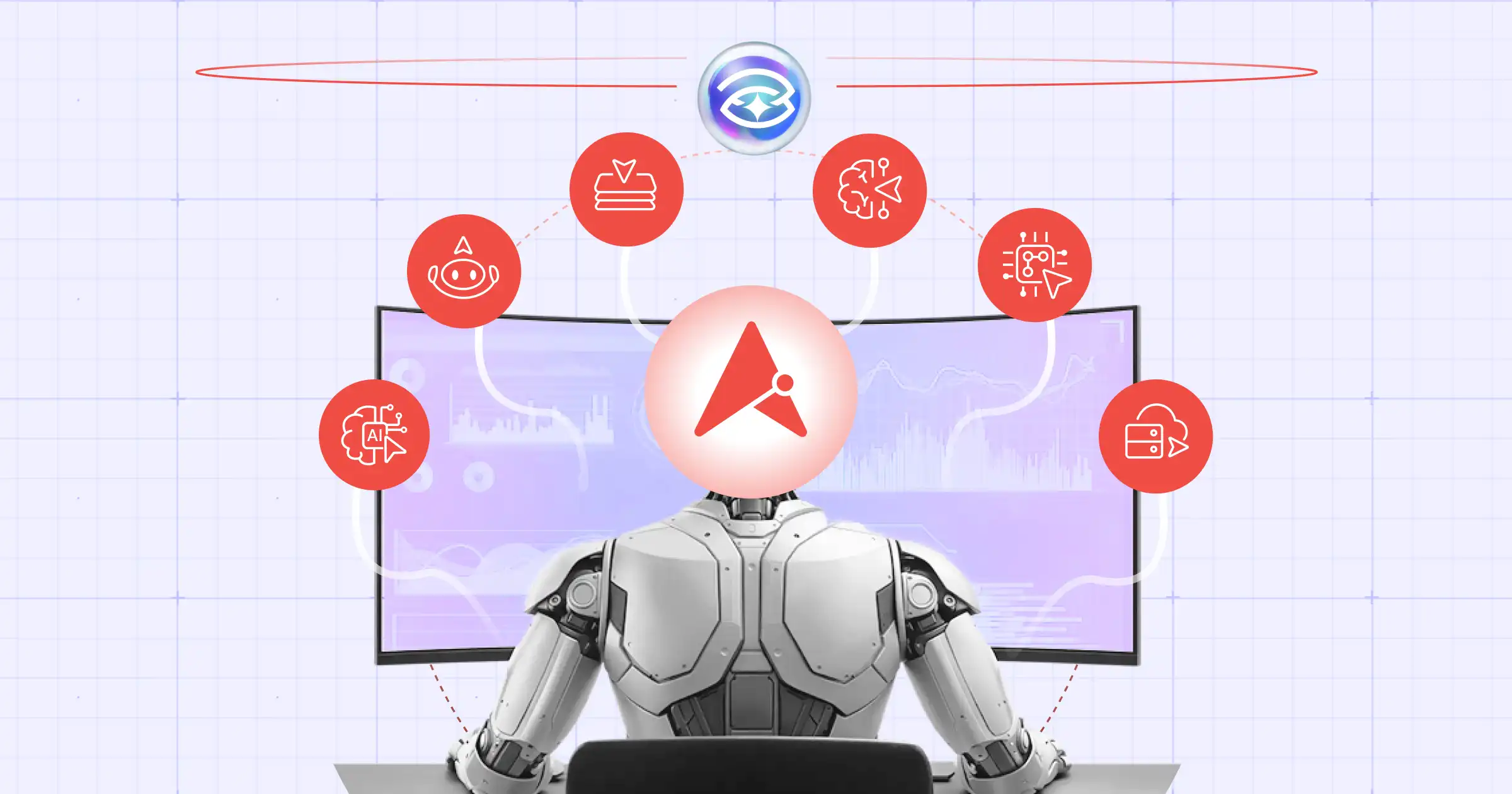
MIKI is not an LLM layer on top of CRM data. It is a purpose-built revenue intelligence platform optimized at the Context Graph level.
Here is what that means in practice:
Forecast concepts, CRM hierarchies, territory structures, and deal relationships are all pre-encoded into the architecture
MIKI navigates a pre-built graph rather than making repeated frontier model inference calls to derive the same context each time
Domain intelligence is pre-encoded at the graph level, so token consumption drops significantly vs. cold-start LLM reasoning
Deterministic validation catches errors without LLM retry loops, maintaining accuracy without extra inference cost
MIKI combines LLM orchestration with Large Quantitative Models that run quantitative predictions, forecast reasoning, and risk identification natively, without requiring additional inference overhead
Custom AI agents can be built and extended across the full revenue workflow, triggering actions across forecasting, pipeline, CRM, and customer success in one connected system
The results, based on Aviso internal benchmarking data, June 2026:
90%+ answer correctness across production RevOps workflows covering CRM, Forecast, and Interaction data
2.3x query efficiency vs. standard MCP agents, with 57% fewer tokens than MCP and 21% fewer than Glean
300K+ queries per $1,000 at enterprise scale, vs. approximately 4,400 for frontier model deployments at comparable accuracy
Approximately $500K to $1.2M in annual inference savings vs. GPT 5.4-based deployments (based on Aviso internal benchmarking, June 2026; figures vary by team size)
The cost advantage is not incidental. It is a direct output of building intelligence into the graph rather than burning tokens to rediscover it on every query.
Forecasting Accuracy: The Number Your CRO Cares About
Forecasting is where the AI architecture difference becomes a measurable business outcome, and the numbers are not close.
Aviso's forecasting capability:
Aviso delivers 98%+ AI forecast accuracy. At Week 4 of a quarter, Aviso's AI identified 68% of winning deals while the human rep caught only 15%.
The Revenue Forecasting platform maintains an independent time-series data lake across 12+ quarters, giving revenue leaders:
An 8-quarter historical baseline grounded in your own conversion patterns, not generic benchmarks
A 4-quarter forward view so your CRO sees where you are likely to be in three quarters, not just this one
Stage-weighted probability scores adjusting predictions based on deal stage, time in stage, and historical rates
WinScore directional trends show which deals are accelerating and which are slipping, before managers have to ask
What enterprise peers say on G2:
Enterprise leaders rated Aviso higher than Gong across all 17 user satisfaction metrics tracked by G2, based on reviews collected as of February 2026.
What enterprise peers say on G2:
Enterprise leaders rated Aviso higher than Gong across all 17 user satisfaction metrics tracked by G2, based on reviews collected as of February 2026.
The categories where Aviso leads include:
Sales Forecasting: Aviso 91% vs. Gong 83%
Pipeline Management: Aviso 90% vs. Gong 86%
Opportunity and Pipeline Management: Aviso 94% vs. Gong 88%
Performance Tracking: Aviso 90% vs. Gong 88%
ROI Forecasting: Aviso 88% vs. Gong 81%
Predictive Forecasting: Aviso 85% vs. Gong 80%
Live Forecasting: Aviso 86% vs. Gong 83%
Dashboard Analytics: Aviso 88% vs. Gong 86%
Historical Win/Loss Patterns: Aviso 84% vs. Gong 80%
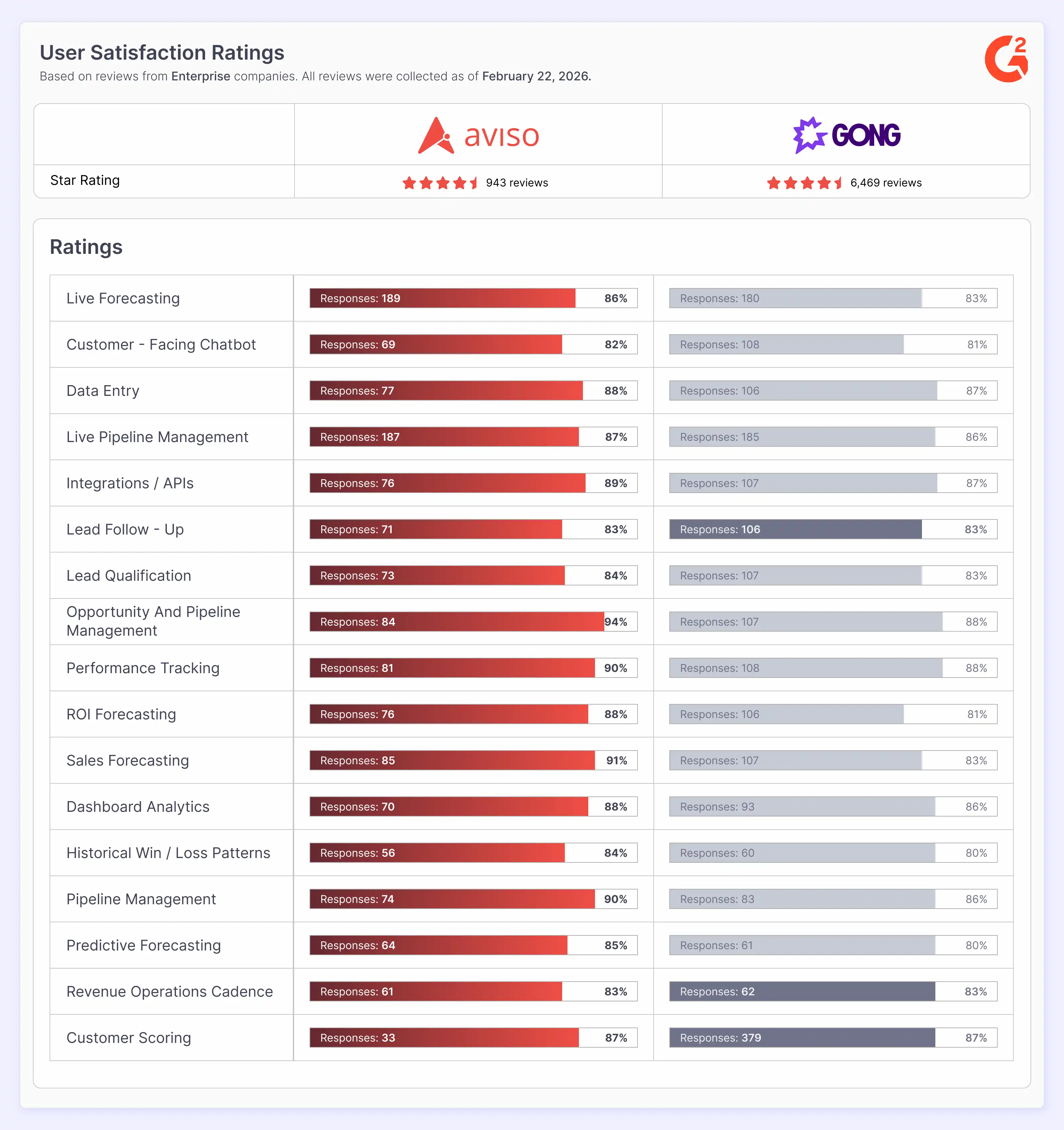
Lenovo, NetApp, LogicMonitor, BMC Software, and more did not swap vendors based on a single metric. They consolidated because the aggregate picture across forecasting, pipeline management, and revenue operations pointed consistently in one direction.
Gong's forecasting reality:
Organizations that fully adopt Gong report 25 to 30% less forecast variance. The caveat is that accuracy depends heavily on CRM hygiene.
Beyond the accuracy gap, consider the structural limitations:
Gong's forecast starts from current-quarter CRM snapshots, not a multi-quarter time-series baseline
The Forecast module is separately licensed and not included in Foundation pricing
Accuracy ceiling is determined by how consistently reps update Salesforce, not by AI model quality
Gong's forecast tells you where you are. Aviso's AI forecasting tells you where you are going and shows you which deals to act on today to change the outcome.
For a deeper breakdown, read the Aviso vs Gong AI Forecasting comparison.
Pricing: One Platform vs. a Growing Module Stack
Gong does not publish pricing anywhere on its website.
Here is what enterprise buyers are actually seeing, based on third-party procurement data from Vendr and verified G2 buyer reports:
Cost Component | Aviso | Gong |
Base platform fee | Included | ~$5,000/year flat |
Per-user license | Free tier available | ~$1,400 to $1,600/user/year |
Pro tier | $60/user/month | Not applicable |
Forecasting | Included | Separate module, additional cost |
Engagement | Included | Separate module, additional cost |
Enablement | Included | Separate module, additional cost |
50-person team Year 1 | Single unified quote | ~$85,000 before onboarding |
Pricing transparency | Published, transparent | Negotiated, opaque |
Gong's initial quotes are typically 20 to 40% above what buyers ultimately pay after negotiation, meaning the real cost is difficult to anchor before you are already deep in a sales cycle.
Buyers who went through Gong's 2025 pricing restructure saw mid-market teams pushed from legacy contract rates to significantly higher modular tiers at renewal. That restructure is a live reason many Gong customers are running competitive evaluations right now.
Aviso's pricing model works differently:
Conversation Intelligence is available free, at $60 per user per month for Pro, or custom for Enterprise
The full platform is quoted as one unified number with no module math required
Performance-based pricing options connect AI forecast accuracy directly to what you pay
Because MIKI's Context Graph minimizes token consumption at the architecture level, Aviso does not pass frontier model inference costs through to buyers via inflated seat pricing
Enterprises replacing Gong Forecast and surrounding point tools report a 40%+ reduction in sales technology costs after consolidating on Aviso.
Which Platform Is Right for Your Team?
Dimension | Aviso | Gong |
Primary strength | Full revenue execution, CI through forecast | Conversation intelligence and call coaching |
Best use case | Enterprise consolidation, multi-quarter forecasting, and AI-guided execution | CI-led coaching culture, standalone call analytics |
AI architecture | MIKI Context Graph, pre-encoded RevOps ontology | LLMs plus ~40 proprietary small language models |
Token efficiency | 2.3x more efficient than MCP, 300K+ queries per $1,000 | High inference volume, costs flow into seat pricing |
Forecasting | 98%+ accuracy, 8-quarter view, native to the platform | Current-quarter, CRM-dependent, separate module |
Post-call execution | Signals update WinScore, cadences, and pipeline in real time | Insight stays in the CI module |
Agent capability | Custom agents deployable across the full revenue workflow | Content generation via AI Builder, no cross-platform agent execution |
Pricing model | Transparent, bundled, performance-based options | Modular, negotiated, opaque |
Ideal team profile | 200+ reps, complex hierarchy, consolidation-focused | 50 to 200 reps, coaching-led, single CRM |
Choose Aviso if:
You need conversation signals to feed AI forecasting accuracy, not just populate coaching queues
Your CRO needs multi-quarter forward visibility and deal-level guidance, not current-quarter snapshots
You want to consolidate conversation intelligence, forecasting, pipeline management, and AI agents into one MIKI-powered revenue intelligence platform
You are approaching a Gong renewal and want to evaluate what a fully integrated, token-efficient alternative actually costs
Choose Gong if:
Call coaching is your only buying criterion, and you have no need for integrated forecasting or pipeline execution
You are already fully standardized on Gong Core, and a mid-contract migration is not feasible right now
Looking for Gong Alternatives? Here Is How to Evaluate Them
The "gong alternatives" search typically comes from one of three places:
A Gong renewal conversation where the pricing has shifted significantly
A RevOps leader consolidating a multi-tool stack onto fewer platforms
A CRO who needs forecasting depth that goes beyond current-quarter CRM snapshots
Not every alternative fits every situation. Here is a quick framework:
If your primary need is CI only at a lower price point:
Several tools cover call recording, transcription, and basic coaching at a lower cost. These fit if coaching is your only buying criterion and you have no need for integrated forecasting or pipeline execution.
If your primary need is CI plus forecasting in one platform:
This is where the evaluation narrows significantly. Most CI-first platforms add forecasting as a separate module, replicating the same fragmentation problem you are trying to solve. Aviso is purpose-built to avoid this. Conversation Intelligence, Revenue Forecasting, and pipeline execution are all native to the same platform.
If your primary need is full revenue execution consolidation:
CI that feeds forecasting natively, not via integration
Pipeline inspection that updates from conversation signals in real time
AI agents that can be customized to trigger actions across your revenue workflow
A single unified quote that replaces Gong plus the tools typically stacked alongside it
Aviso is the only platform in this category where all four requirements are met without a module purchase.
See how Aviso compares in a live demo
FAQs
1. What is conversation intelligence software?
Conversation intelligence software records, transcribes, and analyzes sales calls and meetings to extract signals about deal health, buyer sentiment, and rep performance. Advanced platforms like Aviso go beyond call analysis to connect those signals directly to revenue forecasting, pipeline updates, and rep next actions, all automatically and without switching tools.
2. What is a revenue intelligence platform?
A revenue intelligence platform aggregates signals from conversations, CRM activity, emails, and pipeline data to give revenue teams a unified view of deal health, forecast accuracy, and rep performance. Unlike standalone conversation intelligence software, a revenue intelligence platform like Aviso connects CI signals directly to forecasting, pipeline inspection, and sales engagement in one system.
3. Why is Gong so expensive?
Gong's cost compounds across a platform fee, per-user license, and separately priced modules for forecasting, engagement, and enablement. High LLM inference volume at enterprise scale flows into opaque seat pricing, making total cost difficult to anchor before renewal. Gong pricing is not published on its website, and initial quotes typically run 20 to 40% above the final negotiated price.
4. Does Gong forecasting actually work?
Gong's forecasting works, but its accuracy ceiling is set by CRM hygiene. If reps are not consistently updating deal stages, the model's inputs break down. It covers only the current quarter with no multi-quarter forward view built in, and the Forecast module is separately licensed and not included in Foundation pricing.
5. What happens at Gong renewal?
Gong's 2025 pricing restructure pushed many mid-market customers to higher modular tiers at renewal. Initial renewal quotes are typically 20 to 40% above the final negotiated price, according to Vendr procurement data. This restructure is a primary reason many teams are actively evaluating Gong alternatives right now.
6. Is there a Gong alternative that includes forecasting out of the box?
Yes. Aviso includes AI forecasting, conversation intelligence, pipeline inspection, and sales engagement in one platform with no separate module to license. The free CI tier lets you start without a procurement process, and the full revenue intelligence platform is quoted as a single unified number.
7. Does Gong update Salesforce automatically after a call?
Gong reads from Salesforce but relies on rep-updated CRM data as its forecasting input. Aviso's WinScore updates in real time from conversation signals and activity data, reducing dependence on manual rep entry and ensuring the forecast reflects what was actually said on the call.
8. What is a good Gong alternative for large enterprise sales teams?
For enterprise teams above 200 reps with complex hierarchies, multi-product pipelines, or multi-region operations, Aviso is the most complete revenue intelligence platform alternative to Gong. It replaces Gong plus the tools typically stacked alongside it, Clari for forecasting, Outreach, or Salesloft for engagement, with a single unified platform.
9. Can I try a Gong alternative for free?
Yes. Aviso's Conversation Intelligence is available on a free tier with no credit card required, including call recording, transcription, AI summaries, and coaching signals, with the option to upgrade to the full revenue intelligence platform when ready.
10. Why do revenue teams switch from Gong to Aviso?
The most common trigger is a Gong renewal, where forecasting, engagement, and CI arrive as three separate invoices. Teams switch to Aviso to connect conversation signals directly to AI forecasting accuracy and rep execution in one revenue intelligence platform, replacing a fragmented multi-tool stack with a single unified system.
The Bottom Line
Aviso is the only revenue intelligence platform where a conversation signal does not stop at a coaching dashboard. It updates your forecast, adjusts your pipeline, surfaces your rep's next action, and feeds your customer success layer automatically.
If your current stack cannot do that, you already know what to evaluate next. Start free today or see the full platform live with your own pipeline data.
Read More Like This