Aviso's Unified Revenue Platform: The #1 Gong Alternative That Drives Revenue Growth with Agentic AI

No time to lose? Summarize with AI
ChatGPT
Claude
Revenue leaders evaluating platforms like Aviso and Gong are not simply comparing feature lists. They are deciding how their go-to-market teams will forecast, execute, and grow in an environment where complexity continues to increase.
Gong built its reputation on conversation intelligence. Aviso was designed from the ground up as an AI-driven revenue operating system. That difference shapes how each platform supports forecasting accuracy, pipeline visibility, and enterprise scale execution.
Gong focuses primarily on analyzing conversations to generate insights about deals and rep performance. This helps teams understand what happened in calls and meetings.
But in 2026, conversation intelligence alone is no longer sufficient for the demands placed on revenue teams. Gong’s modular, add-on pricing model also means that building a full-stack revenue tech stack around it quickly becomes expensive and fragmented.
Aviso was built with a different philosophy: a unified AI Revenue Operating System that combines a patented time-series data engine, deep learning models, conversational intelligence, Agentic AI, and end-to-end pipeline management in a single platform.
This comparison explains where the platforms differ and why those differences matter for modern revenue organizations.
TL;DR:
Aviso is a unified AI Revenue OS; Gong is a conversation intelligence platform.
Gong focuses on analyzing calls and coaching reps; Aviso predicts and executes across the full revenue lifecycle.
Aviso uses time-series + quantitative + language models for forecasting and pipeline intelligence; Gong is centered on interaction data and NLP.
Aviso delivers end-to-end coverage (lead to expansion) in one platform; Gong requires multiple tools for full GTM execution.
Aviso enables autonomous execution with agentic AI; Gong remains assistive and insight-driven.
Company Overview: Aviso Vs Gong
Gong is a market-leading conversation intelligence platform best suited for large, data-rich enterprises with mature RevOps functions. Aviso is an end-to-end AI Revenue Operating System that unifies forecasting, pipeline management, coaching, and agentic AI into a single platform, making it a compelling Gong alternative for organizations seeking broader AI coverage, lower TCO, and faster time-to-value.
Capability | Aviso | Gong |
|---|---|---|
Founded | 2012 | 2015 |
Platform Type | Unified AI Revenue OS | Conversation Intelligence (CI-first) |
AI Architecture | Patented Time-Series DB + Deep Learning | NLP Models |
Multi-CRM Support | ✅ Independent multi-CRM hierarchies | ❌ Doesn’t support multiple CRM instances |
AI Agents Suite | ✅ Several task-based agents for end-to-end revenue execution | ✅ Siloed agents |
Forecasting | Complex multi-model (splits, overlays, run-rate, usage-based) | Basic + Gong Forecast module |
CRM Automation | Full replication + real-time writeback | Limited |
Pipeline Inspection | 360-degree with AI nudges + WinScores | Deal boards + conversation signals |
Customer Success Module | CS Intelligence with Virtual CSM Avatars | Account Boards (light CS) |
Platform Architecture Comparison: Aviso vs Gong
At the platform level, Aviso and Gong are built with very different objectives. Gong focuses on analyzing conversations and engagement signals. Aviso is designed as a unified revenue AI platform that predicts outcomes and drives execution across the full go-to-market lifecycle.
AI Foundation for Revenue Execution
The AI stack underneath a revenue platform determines what it can and cannot do across every downstream use case. The architectural choices made at this foundation level, including what models are used, how they are combined, and what data they reason over, ultimately define the ceiling of what a revenue platform can deliver.
|
Aviso is built on three coordinated layers: Large Language Models (LLMs) for natural language understanding and generation, Large Quantitative Models (LQMs) for numerical reasoning across structured revenue data, and a proprietary Time-Series Database that feeds both with historically grounded, temporally ordered signals. These three layers operate together as a unified intelligence layer, meaning the same foundational infrastructure powers forecasting, pipeline analysis, conversation intelligence, and execution planning.
Aviso leverages a mix of open-source and closed-source LLMs rather than being tied to a single provider. This approach enables continuous optimization across models, allowing the platform to combine the best of general-purpose language intelligence with domain-specific tuning, delivering both adaptability and performance as the LLM ecosystem evolves.
Gong applies AI primarily to conversational and engagement data. This produces strong visibility into deal discussions and surfaces useful coaching signals, but the platform does not offer the same depth of integrated modeling across pipeline dynamics, forecast reliability, and revenue execution planning.
Furthermore, Gong's AI layer is tightly coupled to Anthropic's models, meaning the platform's intelligence capabilities are bound to a single provider's ecosystem, limiting flexibility as the AI landscape continues to evolve. The absence of a quantitative modeling layer and a time-series data foundation further limits what the AI can reason about beyond the content of conversations.
AI Capability | Aviso | Gong |
|---|---|---|
LLMs for unstructured signals | ✅ Yes | ✅ Yes |
LQMs for pipeline and forecast reasoning | ✅ Yes | ❌ No |
Proprietary Time-Series Database | ✅ Yes | ❌ No |
Full Picture of Historical Revenue Trends
For teams that need to understand why deals are won or lost over time, static pipeline snapshots are not enough. They need clear visibility into how deals evolve week by week and quarter by quarter. Traditional CRM systems capture data as static snapshots. They can tell you what a deal looks like right now, but not how it got there.
This is where time-based data engineering becomes essential. A dedicated time series database captures every change in opportunity values, stage transitions, activity patterns, and rep behavior as timestamped events.
|
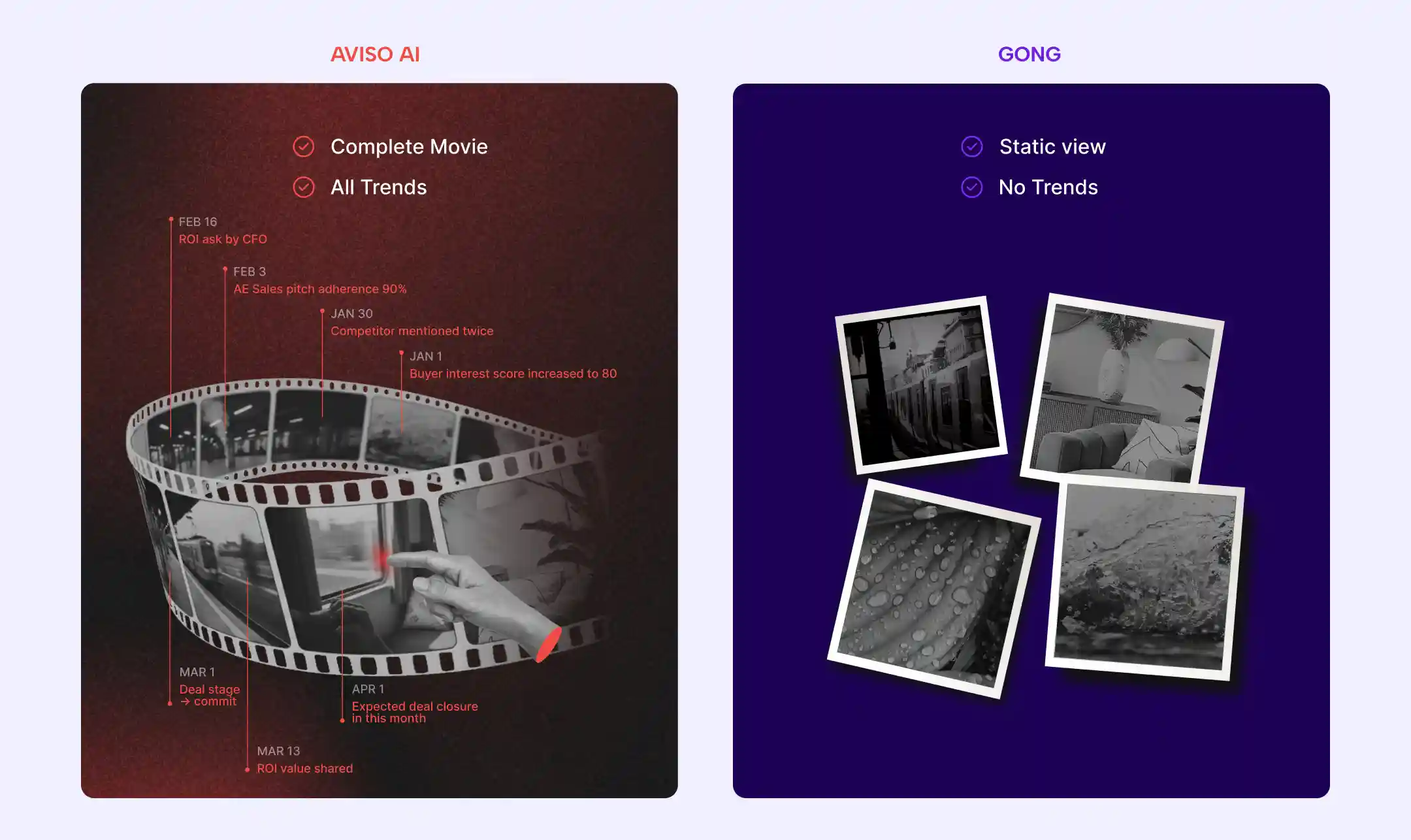
Aviso is built on a proprietary Time-Series Database that ingests over 8 quarters of signals from CRM, ERP, email, calendar, and engagement systems, recording every change as a timestamped event. This means AI models can compare live opportunities against historical deal trajectories with precise temporal context, not just CRM snapshots. This enables sequential modeling approaches such as trajectory comparison and pattern recognition across multiple quarters of historical data.
Gong captures conversational and engagement data effectively, but its data model is centered on interaction records rather than a continuously indexed, time-ordered signal store. The result is that pattern recognition is largely limited to what happened in calls and emails, rather than how deal dynamics evolved across the full revenue cycle.
Capability Area | Aviso | Gong |
|---|---|---|
Underlying data architecture | Proprietary Time-Series Database | Transactional DB |
Historical data ingestion | ✅ 8+ quarters of signals | ❌ Limited |
Signal recording method | Every change as timestamped event | Interaction logs (not time-ordered) |
Live vs. historical comparison | ✅ Yes (precise temporal context) | ❌ No (CRM snapshots only) |
Sequential / trajectory modeling | ✅ Yes (multi-quarter patterns) | ❌ No |
Pattern recognition scope | Full revenue cycle dynamics | Call & email content only |
Deal trajectory analysis | ✅ Yes (Compare live deals to historical paths) | ❌ Limited to conversation signal |
Why deals are won / lost over time | Deep temporal insight | ❌ Not supported (conversation-level only) |
Deal Intelligence and Relational Context
Enterprise deals rarely fail due to a single missed signal. They fail because revenue teams cannot connect relationships, activities, stakeholder dynamics, and historical patterns across the deal ecosystem. As buying groups expand and cycles lengthen, the challenge is not capturing data but making sense of how interactions, role changes, engagement gaps, and past outcomes shape the deal. Without a structured relational model, even data-rich platforms leave teams making critical decisions without clarity.
|
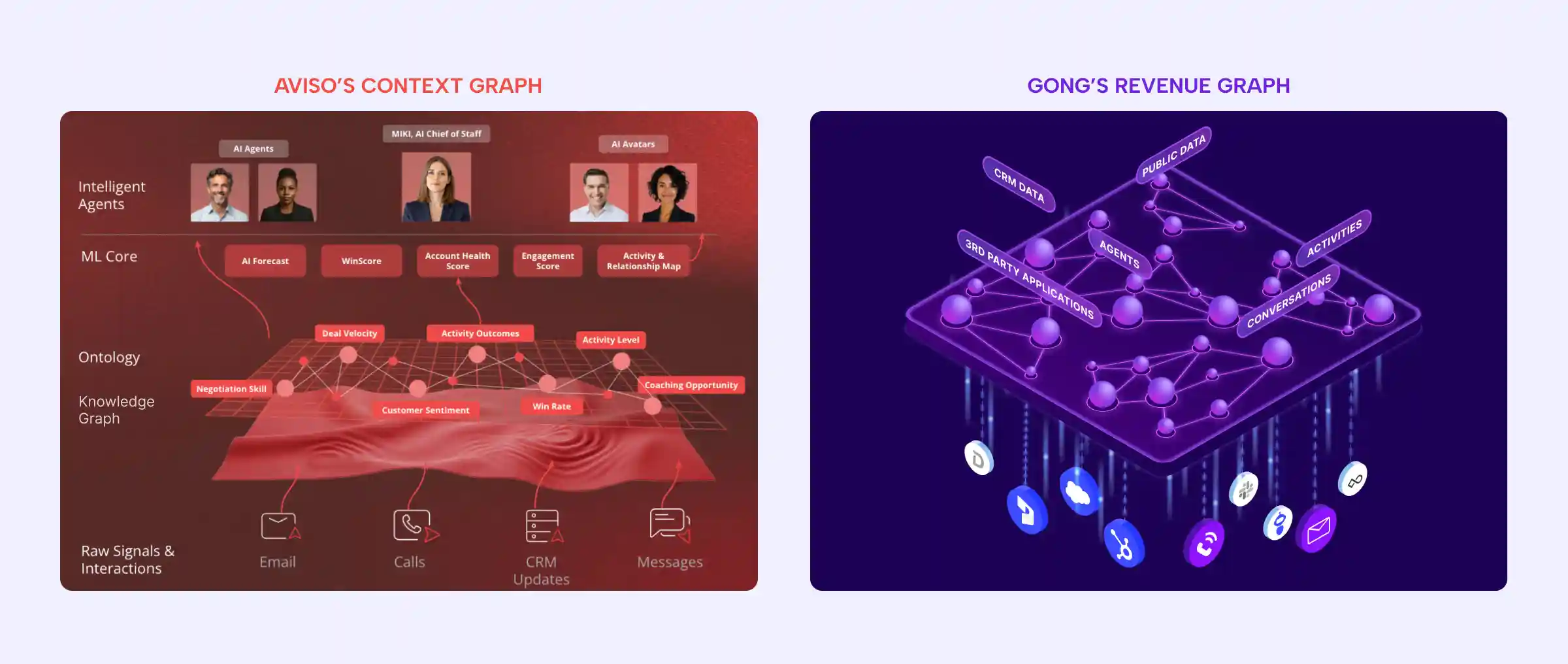
Aviso addresses this through its Context Graph, a layered intelligence architecture that connects raw signals to a Knowledge Graph, an Ontology Layer, and machine learning models. This structure enables transparent reasoning about risk, more precise next-best-action recommendations, and detection of multi-stakeholder risk patterns that isolated or loosely connected signal analysis would miss. It gives revenue teams the relational context required to act with confidence on complex deals.
Gong’s Revenue Graph maps relationships across deals, people, and interactions. However, the Revenue Graph lacks the architectural depth and definitional rigor needed to reason about complex deal ecosystems at scale. Without a dedicated ontology layer to formally define domain relationships and a purpose-built knowledge graph to connect signals to outcomes across multi-stakeholder environments, the relational intelligence remains relatively surface-level. It is better suited for pattern recognition within conversations than for decision-grade reasoning across the full arc of an enterprise deal.
Deal Intelligence | Aviso | Gong |
|---|---|---|
Context Graph architecture connecting all deal signals | ✅ Yes | ❌ No |
Knowledge Graph capturing relationships across buyers, activities, and outcomes | ✅ Yes | ❌ Only Revenue Graph |
Ontology layer structuring revenue concepts and decision logic | ✅ Yes | ❌ No |
Multi-stakeholder risk detection | ✅ Yes | ❌ Limited |
Cross-deal pattern reasoning | ✅ Yes (holistic model) | Conversations analyzed in isolation |
Transparent risk reasoning | ✅ Yes (decision-grade) | ❌ Limited |
Next-best-action recommendations | Contextually grounded | Coaching-focused |
Full Revenue Lifecycle Coverage
Revenue teams are now accountable for outcomes across the entire customer journey, from lead generation to retention and expansion. This requires technology that can operate on a single data foundation instead of disconnected point solutions.
|
Aviso is designed as a unified revenue AI platform that supports lead intelligence, pipeline and opportunity management, predictive forecasting, and customer success within one integrated architecture. The same models, signal sources, and data hierarchies power every workflow. This reduces dependency on fragmented tools, helps eliminate the traditional Frankenstack of revenue applications, and can lower overall technology costs by up to 50 percent through tech stack consolidation and simplified operations.
Gong delivers strong capabilities in conversation intelligence and sales engagement visibility. However, organizations that rely on it as a primary intelligence layer often introduce additional systems for lead prioritization, pipeline governance, and post-sale risk monitoring. Each added layer increases integration overhead, creates data silos, and makes it harder to maintain consistent modeling and reporting across the revenue lifecycle.
Capability Area | Aviso | Gong |
|---|---|---|
Platform type | Unified Revenue AI platform | Conversation intelligence platform |
Lead intelligence | ✅ Yes | ❌ No |
Sales Engagement | ✅ Yes | ❌ Limited |
Revenue Forecasting | ✅ Yes | ❌ Limited |
Conversation Intelligence | ✅ Yes | ✅ Yes |
Coaching and Enablement | ✅ Yes | ❌ Limited |
Relationship Intelligence | ✅ Yes | ❌ No |
Customer Success Intelligence | ✅ Yes | ❌ No |
Agentic AI Framework for Autonomous Execution
As revenue workflows become more complex and fragmented, the challenge is no longer insight; it is execution. Teams struggle to turn signals into coordinated action across the deal lifecycle. An Agentic AI framework solves this by closing the gap between knowing and doing.
Without it, AI remains reactive, surfacing insights while relying on humans to connect and execute across disconnected tools. This leads to delays, inconsistency, and missed opportunities.
Aviso addresses this with a fully orchestrated system of autonomous, role-specific agents powered by multi-step execution, persona-based avatars, no-code orchestration, and ambient intelligence. It not only identifies what needs to happen but proactively executes workflows in context and at scale.
Gong, by contrast, relies on siloed agents and point solutions for specific tasks. While it delivers insights and limited actions, it lacks a unified orchestration layer, leaving teams to manually bridge the gap between insight and execution.
|
Feature / Capability | Aviso | Gong |
|---|---|---|
AI Agents Suite | Several task-based agents for end-to-end revenue execution | Siloed Agents |
Autonomous AI Avatars | ✅ SDR, SE, CSM, Sales Coach avatars via audio/video/chat | ❌ No |
No-Code Agent Studio | ✅ GTM Agent Studio — no-code, self-serve for RevOps | ❌ No |
Halo — Desktop Ambient AI | ✅ Always-on desktop layer, first-mover advantage | ❌ No |
AI Chief of Staff | ✅ MIKI, Industry's first AI Chief of Staff (96%+ adoption) | ❌ No equivalent |
Multi-Agent Framework
The revenue technology landscape is shifting from AI that analyzes to AI that executes. Without a unified Agentic AI system, tasks remain siloed, handoffs break, and critical actions stall before they impact outcomes.
Aviso operates as a connected system of agents that drive continuous, end-to-end revenue execution across the entire GTM lifecycle, ensuring execution is continuous, accountable, and outcome-oriented.
Built on MCP (Model Context Protocol) and A2A (Agent-to-Agent Protocol), it enables seamless interoperability and coordinated action. MCP acts as a universal port for AI, letting core models plug into any system and share context instantly. A2A enables our agents to communicate and solve tasks collaboratively, working as a network of specialists rather than isolated bots.
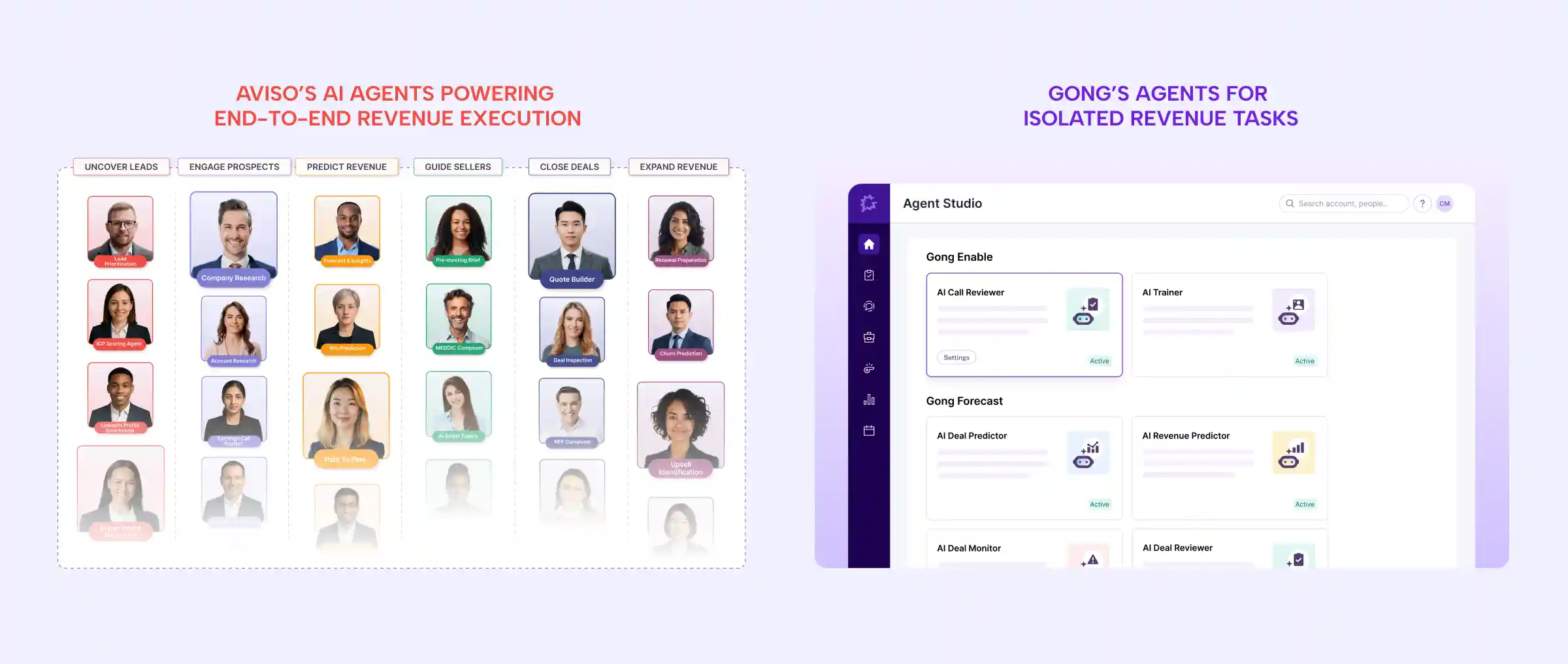
In contrast, Gong remains largely assistive. Its agents are fragmented and task-specific, focused on mid-funnel activities like transcription, note-taking, and call reviews. There is no agent coordination, no task ownership, and no execution continuity across stages. Insights surface risk, but without follow-through, leaving teams to interpret and act manually.
Feature / Capability | Aviso | Gong |
|---|---|---|
Context Continuity | Full deal context persists across interactions | Limited context carried between actions |
Built-in Governance | Operates within existing roles and data policies by default | Requires manual oversight and controls |
Time to Value | Enterprise-ready, live in days | Longer onboarding and time to impact |
Coordination | Coordinated intelligence; agents reason together across lifecycle | Siloed agent actions |
Autonomy | Truly autonomous; run continuously based on deal signals | Triggered by human action |
Orchestration | Central planning layer drives system-level outcomes | No central planning layer |
Adaptability | Adaptive via Agent Studio to match unique GTM motions | Fixed agent behavior |
Proactivity | Proactively anticipate risk before humans see it | Reactive to input |
Aviso vs Gong: AI Agent Coverage Across the Revenue Cycle
This comparison maps Aviso's agents stage by stage against Gong's catalog, revealing where the two platforms converge and, more tellingly, where Gong's conversation-first DNA leaves significant gaps,
Revenue Cycle Stage | Aviso Agents # | Gong Agents # | Gong — What’s Missing vs Aviso |
|---|---|---|---|
Uncover Leads | 3 | 0 | ⚠ ICP Fit Scoring ⚠ Buyer Behavior Profiling ⚠ Contact & Company Enrichment |
Engage Prospects | 3 | 2 | ⚠ Account Research ⚠ Strategic Outreach Planning |
Manage Deals | 5 | 5 | ⚠ MEDDIC / MEDDPICC Qualification ⚠ Contact 360 ⚠ Buying Committee Mapping ⚠ Asset Builder |
Close Deals | 5 | 5 | ⚠ Path to Plan ⚠ RFP Response ⚠ Contract Intelligence ⚠ Quote Generation |
Expand Revenue | 4 | 2 | ⚠ Account Plan ⚠ Account Health Scoring ⚠ Renewal Intelligence |
Predict & Forecast | 3 | 3 | ⚠ Opportunity Scoring ⚠ Pipeline Trend Analysis |
Persona-Based AI Avatars
CROs do not need more dashboards. They need execution built into everyday workflows. This requires technology that can apply expertise in real time, not just surface insights.
Gong does not currently provide role-based autonomous execution capabilities. Aviso addresses this gap through pre-trained, role-specific AI Avatars that replicate specialized go-to-market roles and take context-aware actions across revenue workflows using audio, video, and chat interfaces.
These avatars are designed to operate beyond conversational assistance. They can drive coordinated actions across pipeline management, forecasting discipline, and customer success interventions. Each avatar is trained on targeted playbooks grounded in real sales and revenue operations behavior rather than generic machine learning patterns. This helps reduce reliance on tribal knowledge, minimizes manual follow-ups, and improves consistency in how revenue processes are executed across teams.
Aviso’s AI Avatars | Core Function |
|---|---|
Qualifies inbound leads 24/7 based on web and CRM signals; queues precise next steps | |
Engages leads via email, answers objections, qualifies intent, and hands over warm leads | |
Joins live calls, brings relevant models and KPIs, ensures accurate technical messaging | |
Flags deal risks, surfaces gaps, and delivers board-level objection responses | |
Tracks usage, detects risk or expansion signals, triggers renewal or upsell actions |
Building Custom Agents
To make AI agents effective in real selling environments, teams need the ability to configure how agents behave, when they act, and which workflows they support. As go-to-market strategies evolve, organizations must be able to deploy new agent-driven actions, adjust decision logic, and operationalize playbooks quickly. Without this capability, AI agents remain generic assistants rather than embedded execution engines.
Aviso’s Agent Studio is a no-code environment that addresses this gap by enabling RevOps and enablement teams to design and deploy custom AI agents aligned to specific revenue workflows. Teams can define trigger conditions, configure multi-step action sequences, and set role-based deployment rules without engineering involvement. The platform separates the workflow orchestration layer from the model inference layer, allowing agent behavior to be updated rapidly without retraining underlying models.
Gong does not currently provide an equivalent framework for configuring and operationalizing custom AI agents, so deeper agent-level customization typically requires engineering effort and limits how quickly organizations can scale agent-driven execution.
Feature / Capability | Aviso | Gong |
|---|---|---|
No-Code Builder | ✅ Full No-Code Agent Studio for GTM workflows | ❌ Not available |
Custom Agent Creation | ✅ Build unlimited custom agents in plain English | ❌ 18 fixed agents — no custom build |
RevOps Self-Serve | ✅ RevOps teams self-serve — no engineering dependency | ❌ Engineering required for customization |
Pre-Built Templates | ✅ 100+ templates organized by role and outcome | ❌ Not available |
Agent Monitoring | ✅ Workspace to monitor all agents and track performance | ❌ Limited visibility |
Knowledge Grounding | ✅ Agents access CRM, docs, and playbooks — no hallucinations | ❌ Generic ML outputs |
Single Pane of Glass For Revenue Execution
Revenue teams use many tools, but still struggle with execution. Sales reps work across CRM, email, and outreach platforms. Managers rely on dashboards and reports. Operations manages forecasts and planning systems. Leaders depend on pipeline reviews and spreadsheets. Although each system holds important data, they rarely connect in real time. This creates fragmented insights, lost context, and slower decision-making.
Aviso offers Halo, an AI-powered single pane of glass that brings together every revenue motion, from prospecting to forecasting, within one adaptive interface. It serves as the primary execution surface where AI avatars and agent-driven workflows interact with end users. By consolidating signals, guidance, and actions into a single environment, Halo reduces context switching and helps teams operate with greater consistency and speed.
Gong does not currently provide a comparable agentic execution layer. Its product experience remains focused on conversation visibility and coaching insights rather than enabling autonomous, cross-workflow action through a unified operating interface.
Feature / Capability | Aviso | Gong |
|---|---|---|
Desktop Ambient AI | ✅ Halo; always-on desktop AI layer | ❌ Not available |
No App Switching | ✅ Halo overlays the entire workflow; zero switching | ❌ Requires navigating to Gong platform |
First-Mover Status | ✅ First ambient AI for GTM; pioneering category | ❌ No equivalent product |
Tool Fatigue Reduction | ✅ Reduces tool fatigue; major enterprise pain point solved | ❌ Adds another platform to manage |
Real-Time Context | ✅ Sees every deal, email, meeting in real-time | ❌ Delayed or manually triggered insights |
Customer Testimonials
G2 Feature Scores: Aviso vs Gong
Feature | Aviso Score | Gong Score |
|---|---|---|
Lead Scoring | 8.1 | 8.1 |
Predictive Forecasting | 8.3 | 8.0 |
Dashboard Analytics | 8.7 | 8.6 |
Pipeline Management | 8.8 | 8.6 |
Conversation Intelligence | 7.1 | 8.4 |
Generative AI | 8.6 | 8.6 |
Sales Forecasting | 9.1 | 7.9 |
AI Sales Assistant | 8.0 | 8.1 |
Tech Stack Consolidation With Aviso
Aviso was built to solve what decades of tool accumulation could not: a single AI-powered GTM operating system where autonomous agents, shared revenue memory, and unified intelligence replace the disconnected point solutions that have long fragmented revenue execution.
Rather than bolting AI onto an existing stack, Aviso collapses entire tool categories by unifying the context that made those tools necessary in the first place, delivering forecasting, conversation intelligence, engagement, and enablement natively through one shared data model.
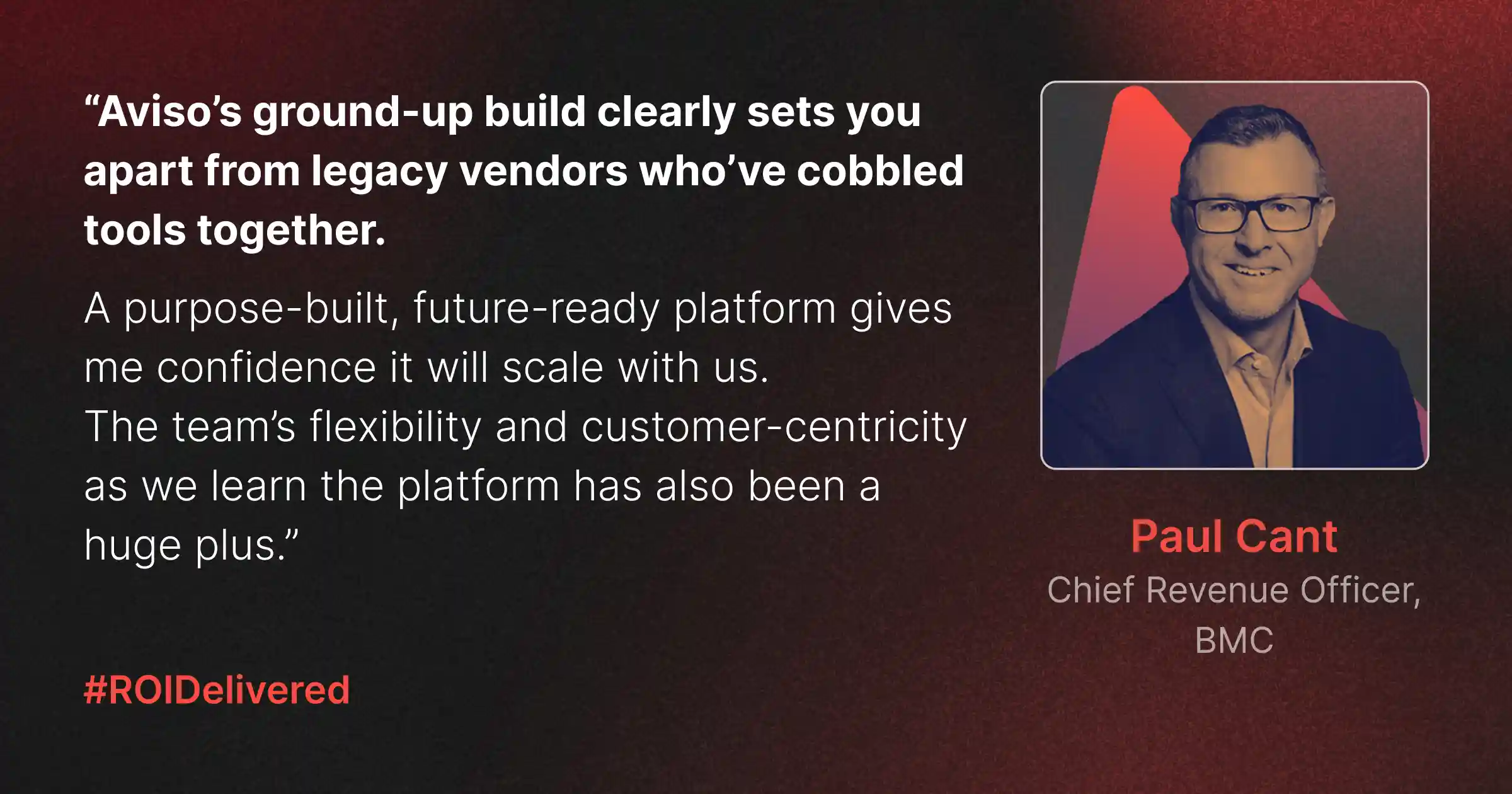
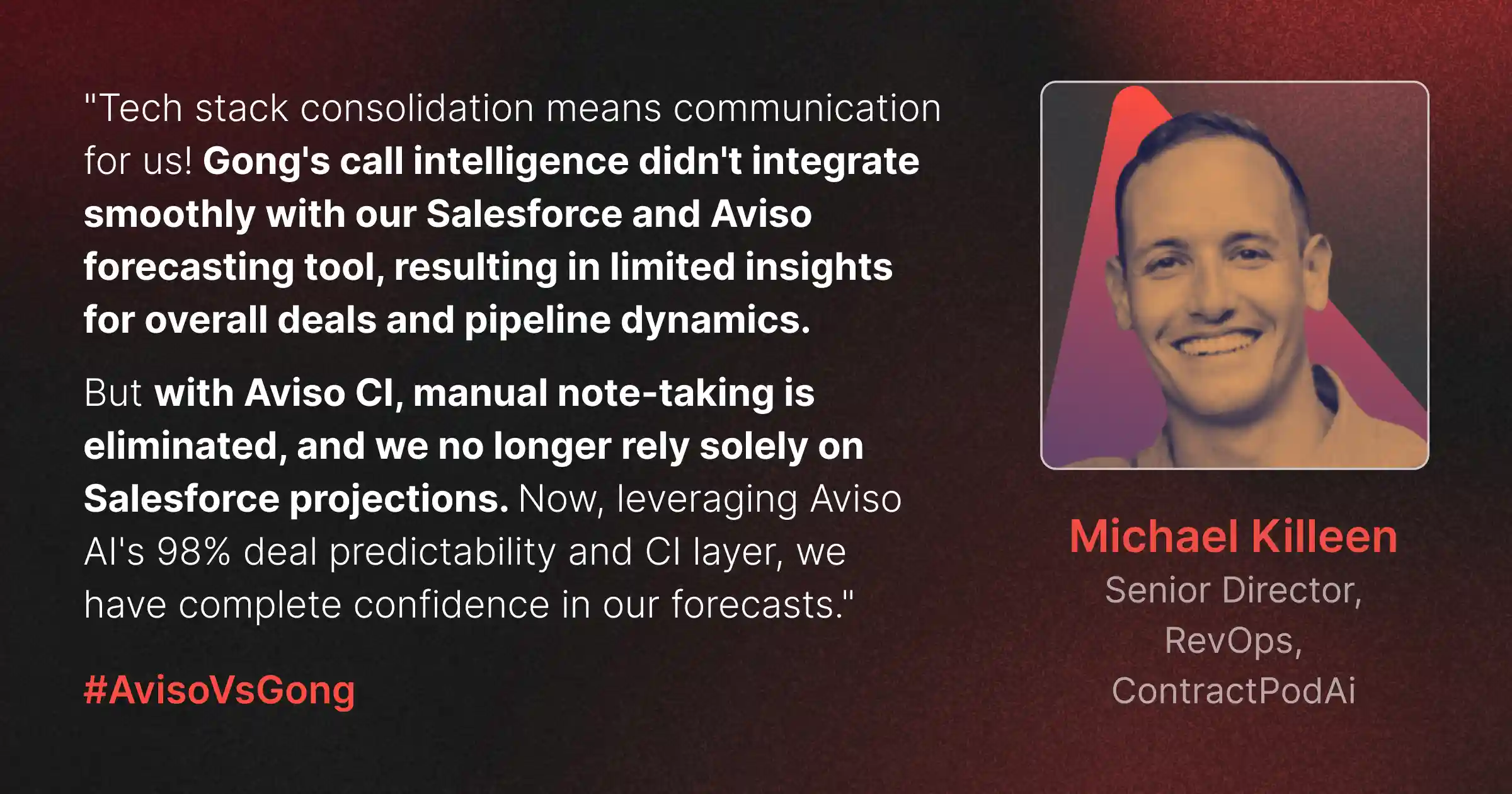
Leading enterprises including Druva, Nutanix, LogicMonitor, Lenovo, HPE, CDW, BMC, and NetApp have consolidated their GTM stacks with Aviso, choosing it over tools like Gong, cutting sales technology costs by 50% or more, and putting themselves on a clear path to AI-first, agent-driven revenue execution with Aviso as the foundation.
The Outcomes
Customers switching from legacy platforms to Aviso’s Sales Engagement see immediate, high-value ROI with Agentic AI:
50% Reduced Tech Stack Cost by consolidating disparate tools into one platform.
98%+ Forecast Accuracy
20% Increase in Win Rate
20 Rep Hours Saved Weekly by automating admin, research, and CRM updates.
36% Increase in Net New Revenue booked per rep.
Final Verdict: Aviso vs Gong
The choice between Aviso and Gong ultimately comes down to two questions:
1. Are you primarily solving a conversation intelligence and call coaching problem or a full-stack revenue execution problem?
2. Do you want to continue building a multi-tool stack or consolidate onto a single AI revenue operating system?
Choose Gong if:
Your team's top priority is best-in-class call recording, coaching, and conversation analysis. Gong remains the gold standard in CI, with unmatched market depth, the broadest integration ecosystem, and the strongest brand recognition among sales leaders. If your RevOps function is mature and your budget is healthy, Gong is a defensible choice.
Choose Aviso if:
You want a single platform that handles conversation intelligence, forecasting, pipeline management, agentic AI, sales engagement, relationship intelligence, and customer success, without the complexity and cost of assembling a multi-vendor stack. For enterprises with complex GTM motions, usage-based pricing models, or a strategic mandate to cut SaaS costs, Aviso's unified approach delivers a distinct competitive advantage.
If you are evaluating Gong alternatives and want to see how Aviso performs against your specific GTM structure and forecasting requirements, request a personalized demo at aviso.com.
FAQs
1. What is the main difference between Aviso and Gong?
Aviso is a unified AI Revenue Operating System designed for end-to-end execution across the revenue lifecycle. Gong is primarily a conversation intelligence platform focused on analyzing calls, emails, and rep interactions.
2. Is Gong enough for modern revenue teams?
Gong is strong for call analysis, coaching, and deal visibility. However, it does not cover forecasting, pipeline management, or customer success in a unified way, so teams often need multiple tools alongside it.
3. Why is Aviso considered a Gong alternative?
Aviso replaces multiple revenue tools by combining forecasting, pipeline inspection, conversation intelligence, and agentic AI in one platform. This reduces tool sprawl and improves execution consistency.
4. What is Agentic AI, and how does Aviso use it?
Agentic AI refers to autonomous systems that don’t just provide insights but also take action. Aviso uses coordinated AI agents to execute tasks like lead qualification, deal management, forecasting, and customer success workflows automatically.
5. Does Gong offer AI agents like Aviso?
Gong offers task-specific agents, but they are siloed and mostly assistive. Aviso provides a fully orchestrated multi-agent system that enables end-to-end execution across the revenue lifecycle.
6. Can Aviso replace multiple tools in a sales tech stack?
Yes. Aviso is designed to consolidate tools across forecasting, engagement, coaching, and customer success into a single platform, potentially reducing tech stack costs by up to 50% and a 36% increase in net new revenue per rep.