Your AI Agent Has a Model. What It Really Needs Is a Harness.

No time to lose? Summarize with AI
ChatGPT
Claude

Your AI Agent Has a Model. What It Really Needs Is a Harness.
Why the infrastructure wrapped around an LLM decides everything, and why Aviso built it first.
We’ve all seen the lifecycle of a tech hype-cycle play out before. First comes the foundational breakthrough, then the frantic gold rush of wrapper applications, and finally, the hard engineering reality check.
Right now, enterprise AI is hitting that reality check hard.
For the past couple of years, the collective tech world has treated Large Language Models (LLMs) like omnipotent digital minds. If an agent failed to close a sales opportunity, hallucinated a contract clause, or got stuck in an infinite loop, the standard response was simple: Wait for the next model version. GPT-5 or Claude 4 will fix it.
But the reason is not that the model is bad; it's probably remarkable. But a model, standing alone, is stateless, amnesiac, tool-blind, and unaware of your business context. It has no idea what happened on yesterday's call, cannot check your CRM, has no way to route a next-best action to the right rep, and certainly cannot enforce your pricing guardrails.
In 2026, the industry has finally woken up to a profound truth:
The model is rented. The harness is owned. And the harness is where competitive advantage actually lives.
Intelligence has become a commodity. You can swap out a reasoning model via a single API line change. But what you cannot rent is the operational environment that keeps that model from driving your enterprise workflows off a cliff.
At Aviso, we realized early on that an AI model is merely a central processing unit (CPU). To build a truly autonomous, multi-agent system that Fortune 500 enterprises can trust with revenue operations, you need a chassis, a transmission, and a steering wheel. You need an Agent Harness.
You can swap in a more powerful LLM and still fail at scale. Fix the harness, and the same model performs dramatically better.
So What Exactly is an Agent Harness?
An agent harness is the complete software architecture wrapped around an LLM that turns it from a simple text generator into an autonomous worker capable of completing multi-step tasks.
If the LLM is the "brain" that does the reasoning, the harness provides the "body": the tools, memory, hands, and safety constraints that allow that brain to interact reliably with the real world.
Since a raw LLM is stateless and isolated, if you paste code into a chat window and it gives you a buggy response, it cannot see its mistake, run a test, or fix it unless you prompt it again.
A harness changes this by wrapping the model in a continuous, deterministic loop: Sense ➔ Reason ➔ Act ➔ Verify.
Context Engineering is not The Same as Harness Engineering
One conflation worth clearing up: context engineering and harness engineering are related but distinct disciplines, and mixing them up leads to underbuilt systems.
Context engineering asks: what information should the model see right now? It is about the quality and composition of what gets loaded into the context window — retrieved documents, prior memory summaries, task state, tool outputs. It is genuinely hard work, and a lot of early agentic systems improved dramatically just by getting this right.
Harness engineering asks a bigger question: when does context get loaded, which tools are available, which actions are permitted, how do failures get handled, and what constitutes 'done'? The harness is the operating environment. Context engineering operates inside it.
You can have brilliant context engineering inside a broken harness. The agent will still drift, lose state, and fail at scale.
This distinction matters because it reveals where most vendors are actually competing. Most have invested in prompt engineering and retrieval quality. Fewer have built a real harness. Even fewer have done it for a specific, deeply complex domain like revenue operations.
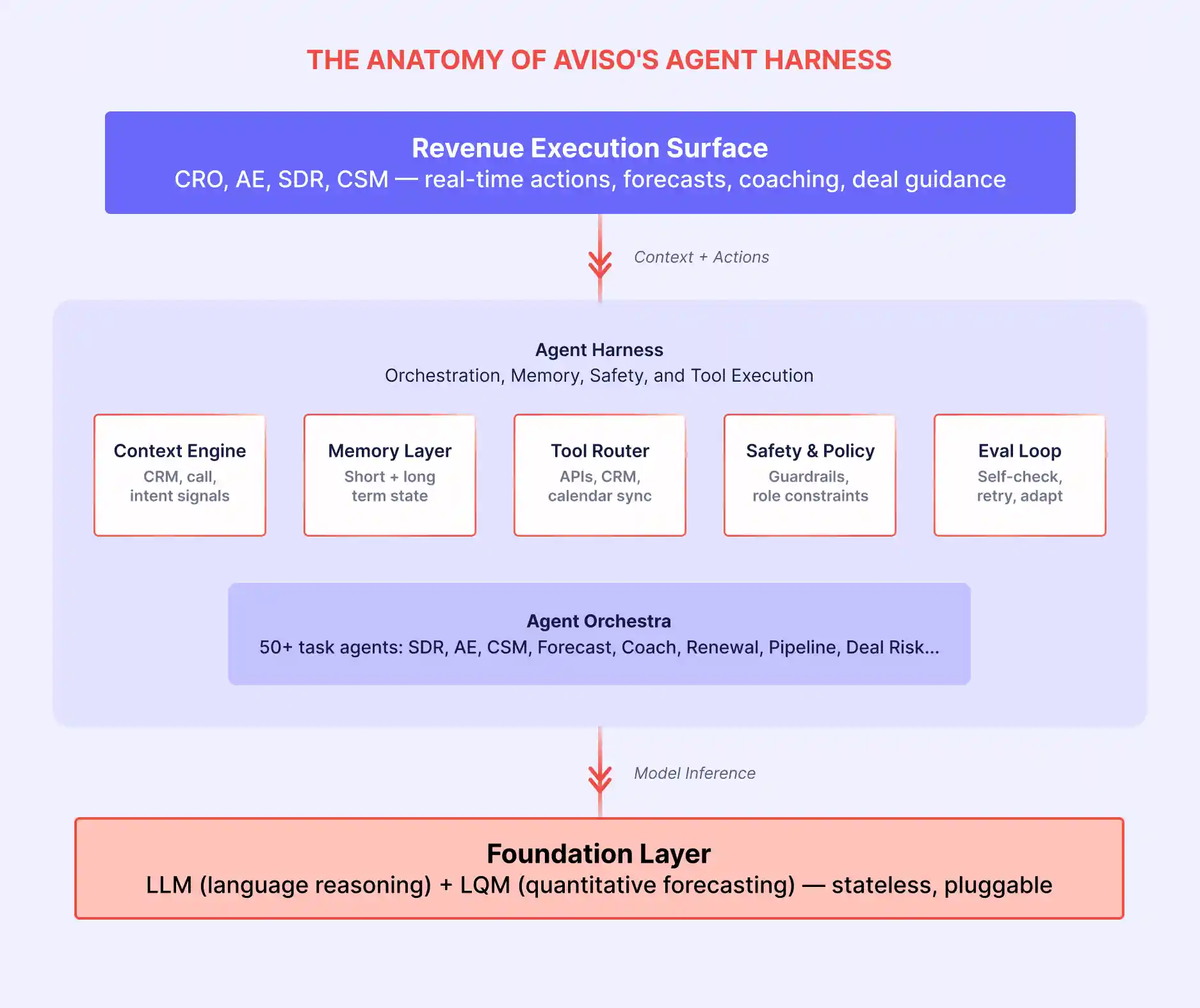
Aviso's Agent Harness
Aviso’s Agent Harness is the orchestration backbone that powers AI-driven revenue workflows. It coordinates five interdependent components: the Context Engine, Memory Layer, Tool Router, Safety & Policy, and Eval Loop, to ensure every agent action is informed, consistent, compliant, and continuously improving. Together, these components allow AI agents to handle complex, multi-step sales tasks autonomously while remaining aligned with business rules and human oversight.
Component | Key Capabilities | Purpose |
|---|---|---|
Context Engine | CRM, call, intent signals | Pulls live deal & buyer data to give the agent situational awareness before every action |
Memory Layer | Short + long-term state | Persists conversation history and past decisions so the agent learns and remains consistent across sessions |
Tool Router | APIs, CRM, calendar sync | Selects and invokes the right external tool (email, CRM write-back, calendar) at the right moment |
Safety & Policy | Guardrails, role constraints | Enforces guardrails, role constraints, approval rules, and compliance boundaries before any output is sent |
Eval Loop | Self-check, retry, adapt | Grades its own output against success criteria and retries or escalates if quality thresholds are not met |
1. Context Engine
CRM data • Call signals • Buyer intent
The Context Engine gives the agent situational awareness. It decides what information the model sees at any moment, including retrieved documents, CRM state, prior conversation, and intent signals. Too little and the agent guesses. Too much and it buries the signal.
It continuously pulls and interprets signals from systems like CRM records, call transcripts, emails, buyer interactions, meeting activity, and intent data. Instead of responding to isolated prompts, the agent operates with a full understanding of the account, opportunity stage, engagement history, and rep activity.
This allows the agent to:
Personalize outreach using real customer context
Understand deal progression and risk
Detect buying signals or inactivity
Maintain continuity across conversations and workflows
2. Memory Layer
Short-term session state • Long-term deal memory
Raw LLMs are inherently stateless; they forget everything once a session ends. The Memory Layer gives the agent continuity. Without it, every interaction would start from zero. With it, the agent builds an evolving understanding of each deal, each rep’s preferences, and each account’s history—making interactions feel intelligent and personalised rather than robotic and repetitive.
What It Does
Short-term memory: Retains context within a single session (e.g., remembers what was discussed earlier in the same call coaching interaction).
Long-term memory: Persists key facts across sessions—past objections, agreed next steps, stakeholder preferences, and previous agent decisions.
Memory retrieval: Surfaces the most relevant past context at the start of each new task through semantic search over stored records.
3. Tool Router
APIs • CRM write-back • Calendar sync
An agent cannot execute tasks in a vacuum. The Tool Router acts as the switchboard connecting the agent’s reasoning capability to the outside world via APIs and registries (like the Model Context Protocol, or MCP). It dynamically decides which tool to call, translates the model's intent into executable code/API commands, and returns the live system observations back to the agent.
The router abstracts complexity from the agent. Instead of manually orchestrating systems, the agent can autonomously execute multi-step business actions across the GTM stack. Examples include:
Updating CRM records
Scheduling meetings through calendar systems
Sending emails or Slack messages
Pulling forecasting data
Triggering workflows in sales platforms
4. Safety & Policy
Guardrails • Role constraints • Compliance
The Safety & Policy layer ensures the agent complies with business rules, data privacy rules (GDPR, SOC 2), permissions, and governance requirements at all times. It acts as a compliance and governance filter that sits between the agent’s intent and its output, preventing actions that violate brand guidelines, approval hierarchies, or regulatory requirements.
What It Does
Guardrails: Blocks outputs that include prohibited terms, competitive disparagement, or pricing commitments outside approved ranges.
Role Based Access Controls (RBAC): Defines what each agent persona can and cannot do—e.g., an SDR agent cannot approve a discount; a manager agent can.
Audit logging: Records every agent action and decision rationale for compliance review and model improvement.
This prevents agents from taking unauthorized actions, hallucinating risky outputs, or violating organizational processes. Human oversight can also be inserted at critical checkpoints when needed.
Human in the Loop (HITL) is an essential architectural principle within the Aviso Agent Harness architecture. The harness is designed to maximise automation for routine, low-risk tasks while surfacing human judgment precisely where it matters most.
5. Eval Loop (Evaluation Loop)
Self-check • Retry • Adapt
The Eval Loop transforms the agent from a one-shot executor into a self-improving system. After generating any output, the agent grades its own work against predefined success criteria. If the output falls short, it retries with a revised approach. Over time, patterns from these evaluations feed back into prompt refinement and model fine-tuning.
What It Does
Self-check: Scores generated outputs against rubrics such as tone adherence, factual accuracy, completeness, and relevance to the deal stage.
Retry logic: If the score falls below threshold, the agent rewrites the output up to N times before escalating to a human.
Adapt: Logs failure patterns and successful rewrites to continuously refine future agent behaviour.
Over time, the agent becomes more accurate, reliable, and aligned with desired business outcomes. Instead of remaining static, the system learns operational patterns and refines execution continuously.
The Eval Loop is what turns AI agents from simple automation scripts into evolving autonomous systems.
How Aviso Compares: Harness Depth at a Glance
Most AI vendors | Aviso Agent Harness | |
|---|---|---|
Harness architecture | Prompt wrappers | Full orchestration layer |
Memory | Session-only | Persistent + cross-agent |
Domain specialisation | Generic LLM | GTM-native LQM + LLM hybrid |
Context management | Flat retrieval | Agentic RAG with re-query |
Multi-agent coordination | Siloed | Orchestrated network |
Failure handling | Retry on error | Harness-level eval loop |
Safety & guardrails | Minimal | Role + policy-aware |
Table 1: Harness engineering capability across typical AI vendors versus Aviso's productionised architecture.
Why Harness is the Moat
While the rest of the industry is scrambling to patch open-source frameworks or waiting on cloud vendors to release experimental SDKs, Aviso has spent years perfecting this exact LLM orchestration layer.
Our core advantage stems from a fundamental product philosophy: We never built our platform to be dependent on a single model. Because the Aviso platform features a deeply integrated, proprietary data layer that synchronizes revenue signals across CRMs, emails, calendar events, and conversational intelligence, our Agent Harness didn't have to be retrofitted onto siloed systems. It was built directly on top of a unified data graph.
When a new, more efficient model hits the market, our harness allows us to swap it in seamlessly. The business logic, the memory graphs, the security guardrails, and the deep integrations stay perfectly intact. This architectural maturity means our agents don’t get stuck in hallucination loops; they execute predictable, highly contextual workflows that actually close pipeline gaps and drive sales execution forward.
What to Look for When Evaluating Any 'Agentic AI' Vendor
If you are evaluating agentic AI for sales, the questions that reveal harness depth are not the obvious ones. Do not ask 'which LLM do you use?' Ask:
How does the system maintain state across a multi-week deal cycle?
What happens when an agent encounters an unexpected input — how does the system recover?
How are guardrails enforced — in the prompt, or at the architecture level?
Can agents hand off context to each other, or does each interaction start cold?
How is domain-specific business logic encoded — in prompts, or in a shared ontology?
Vendors who can answer these with architectural specificity have a harness. Vendors who deflect to model capabilities or UI polish probably do not.
The Engineering Shift: From Prompting to Harnessing
The agent harness is not a feature. It is the engineering layer that determines whether an AI sales agent actually works in production, or looks good in a sandbox and fails in the field. It is where the real differentiation between agentic AI platforms is being built right now.
Aviso has been building this harness, deliberately and at depth, since long before 'agentic AI' became a category. The result is a platform where agents do not just assist, they execute, persist, adapt, and compound in value with every interaction. That is not a product pitch. It is what harness engineering, done seriously, actually looks like.
Want to see Aviso's Agent Harness in action? Book a demo at aviso.com
FAQs:
Q: What is an AI agent harness?
A: An AI agent harness is the complete software architecture wrapped around an LLM that transforms it from a simple text generator into an autonomous worker capable of completing multi-step tasks. It provides the tools, memory, safety constraints, and orchestration logic that allow an AI agent to interact reliably with real-world enterprise systems. Key components include a context engine, memory layer, tool router, safety and policy layer, and an evaluation loop.
Q: What is the difference between context engineering and harness engineering?
A: Context engineering determines what information the model sees at any given moment: retrieved documents, prior memory, task state, and tool outputs. Harness engineering governs the broader operating environment: when context gets loaded, which tools are available, which actions are permitted, how failures are handled, and what constitutes a successful outcome. Excellent context engineering inside a broken harness will still result in an agent that drifts, loses state, and fails at scale.
Q: What infrastructure is required to support agentic AI for sales?
A: Agentic AI for sales requires five core infrastructure layers: (1) a Context Engine for live CRM and intent data; (2) a Memory Layer that persists deal context across sessions; (3) a Tool Router that connects the agent to CRM, calendar, and email via APIs; (4) a Safety and Policy layer that enforces guardrails and RBAC; and (5) an Eval Loop that grades outputs and retries or escalates when quality thresholds are not met.
Q: What is LLM orchestration?
A: LLM orchestration is the process of coordinating a large language model with external tools, memory systems, and business logic so it can complete multi-step tasks autonomously. It manages context flow, tool selection, failure recovery, and output validation. In a sales context, it enables AI agents to update CRM records, send follow-up emails, schedule meetings, and guide deal progression without manual intervention.
Q: How does an AI sales agent maintain state across a multi-week deal cycle?
A: A well-built AI sales agent maintains state through a persistent Memory Layer storing both short-term session context and long-term deal memory. Short-term memory retains what was discussed in a single interaction; long-term memory persists past objections, agreed next steps, and stakeholder preferences across weeks or months. At the start of each new task, semantic search over stored records surfaces the most relevant past context.
Q: Why is the harness more important than the LLM model itself?
A: The LLM model on its own is stateless, tool-blind, and unaware of your business context. Models are now commodities. You can swap one in with a single API call. What you cannot rent is the operational environment: the memory graphs, guardrails, tool integrations, and eval logic that define how the agent behaves. The same model will perform dramatically better inside a strong harness than a weak one.
Q: What questions should I ask an agentic AI vendor to evaluate their harness?
A: Ask: (1) How does the system maintain state across a multi-week deal cycle? (2) What happens when an agent encounters an unexpected input: how does it recover? (3) Are guardrails enforced at the prompt level or the architecture level? (4) Can agents hand off context to each other? (5) Is domain-specific business logic encoded in prompts or in a shared ontology? Vendors with a real harness will answer these with architectural specificity.
Read More Like This