How AI Avatars Help Revenue Teams Sell, Coach, and Grow Revenue at Scale
No time to lose? Summarize with AI
ChatGPT
Claude
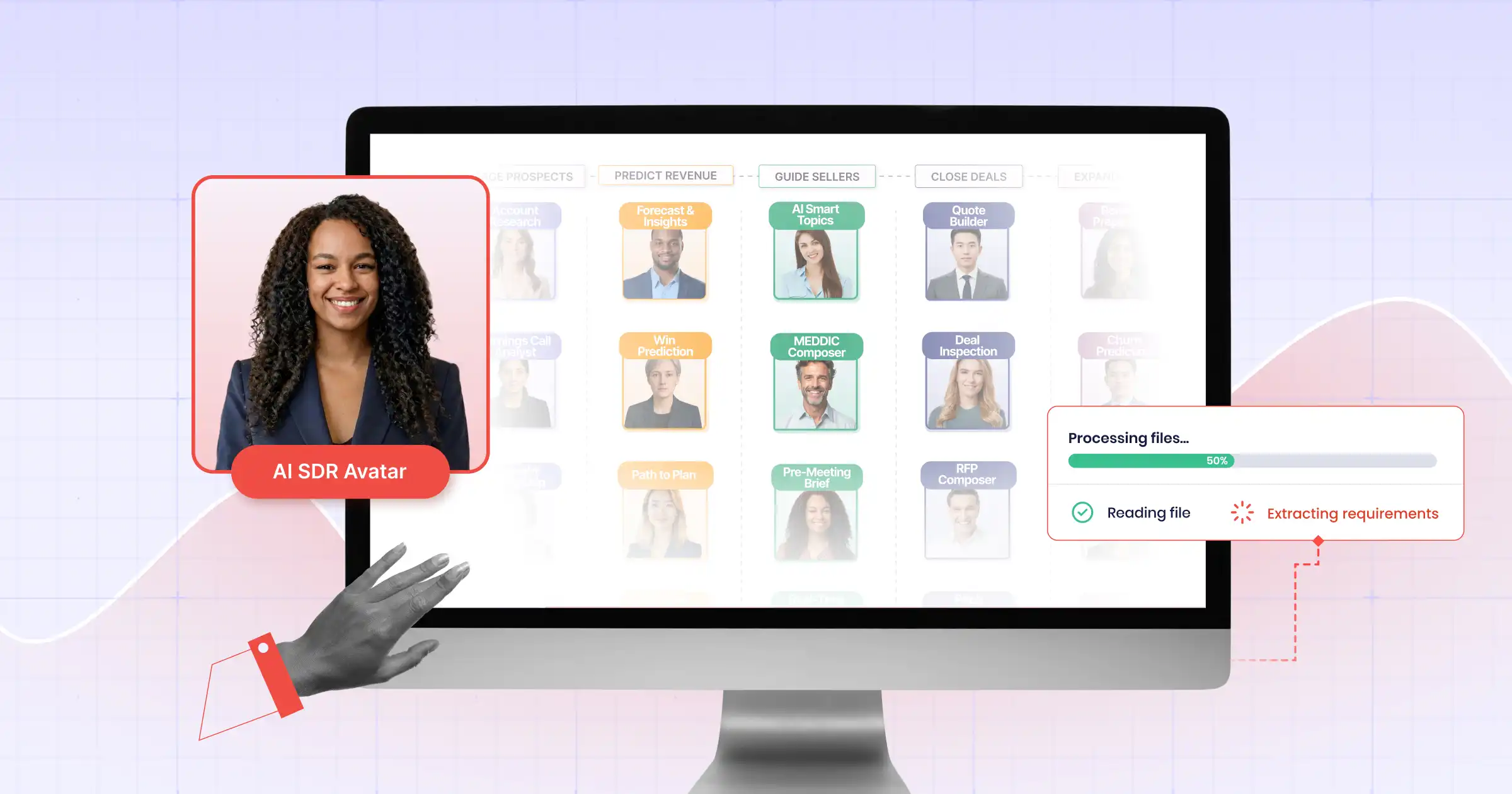
The future of GTM is not another app. It's an AI Agent.
Information was the edge. Then intelligence. Now, the application of intelligence separates quota-crushers from everyone else.
Only 17% of reps generate 81% of revenue, and sales teams juggling 8 disconnected tools are losing pipeline to teams where AI executes alongside every rep, on every call, every follow-up, every renewal. AI Avatars are how that gap closes.
What Are AI Avatars for Revenue Teams?
AI avatars for revenue teams are role-specific AI systems that engage directly in sales interactions across voice, video, and chat. They qualify inbound leads, engage prospects, assist reps during live calls, coach new hires, and guide customers through onboarding and renewals.
Before going further, it helps to separate two terms that often get confused: AI agents and AI avatars.
AI agents work behind the scenes. They continuously process signals across CRM data, conversations, product usage, and external sources to calculate deal risk, detect churn signals, enrich accounts, and trigger workflows automatically.
AI avatars operate where execution requires interaction. They engage prospects on your website, assist reps during live calls, run practice simulations for new hires, or guide customers through adoption.
Put simply: agents generate the intelligence, avatars deliver it in the moment.
Aviso deploys purpose-built avatars mapped to key stages of the revenue lifecycle:
• AI SDR Avatar for pipeline generation and prospect qualification
• Sales Engineer Avatar for live deal support and product discussions
• Sales Coach Avatar for rep readiness and onboarding
• Customer Success Avatar for onboarding, renewals, and retention
Each avatar is powered by underlying AI agents that continuously analyze signals and prepare the context needed for high-quality interactions.
AI SDR Avatar: Inbound Lead Qualification and Outbound Prospect Engagement
How Do You Convert More Website Visitors Into Qualified Meetings?
Every minute a lead waits costs you pipeline. Research consistently shows that responding within five minutes makes you dramatically more likely to connect and qualify a lead than waiting even thirty minutes. But when your SDR team is manually sorting form fills, webinar signups, and demo requests, speed-to-lead suffers. By the time a rep reaches out, the prospect has moved on.
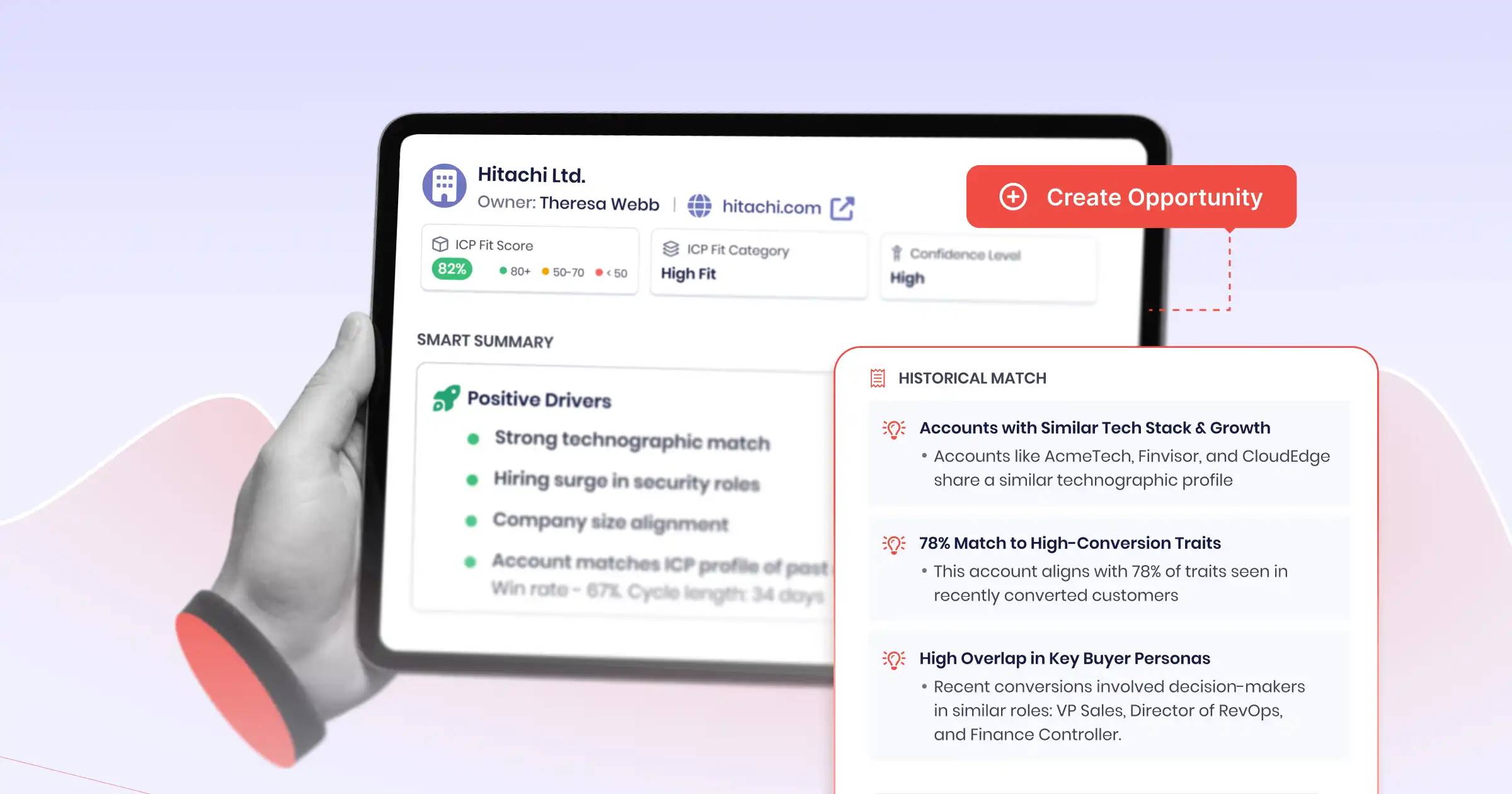
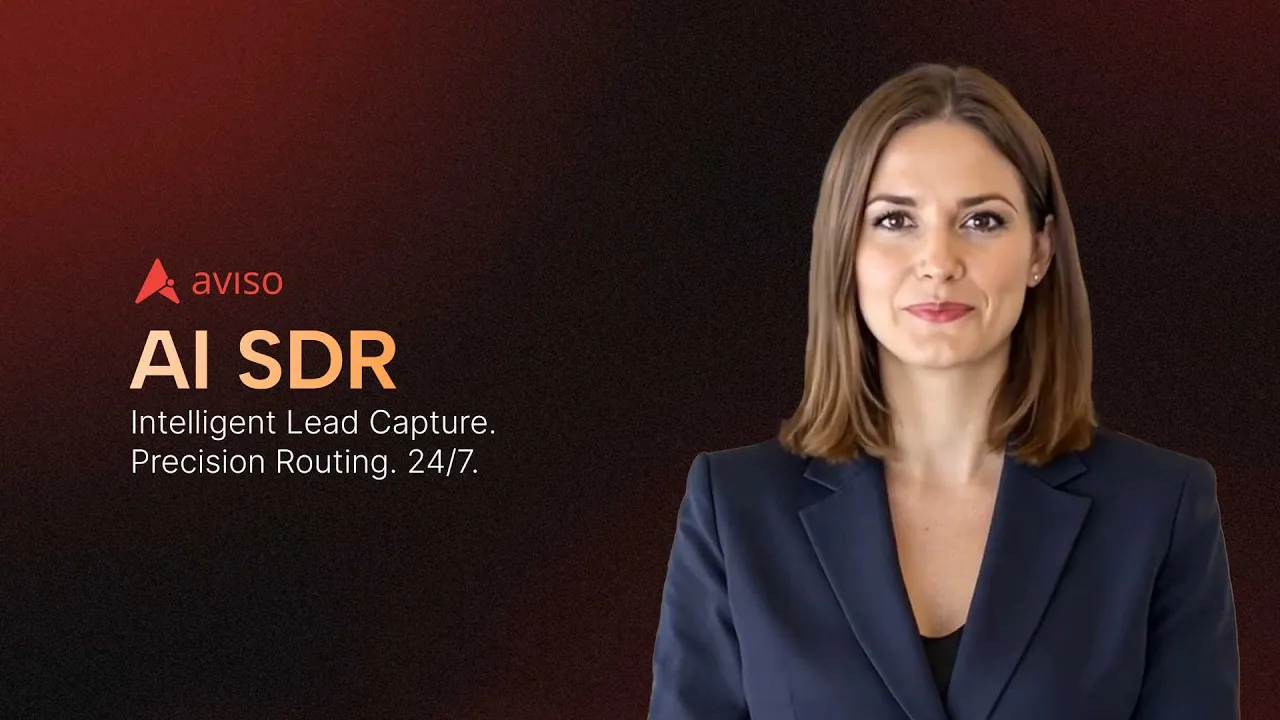
Aviso's AI SDR Avatar operates on your website as a photo-realistic, conversational agent that engages visitors the moment they show intent. It doesn't wait for a form fill. It identifies visitors through reverse IP lookup and CRM data, then initiates personalized conversations based on the page they're viewing, the campaign that brought them there, and their historical engagement with your company.
The avatar qualifies leads against your specific criteria through natural conversation - asking about challenges, timeline, and decision-making authority without sounding like a checkbox exercise. Qualified visitors are routed directly to the right rep's calendar with pooled team availability. The meeting is booked within the same conversation - no follow-up email, no three-day lag.
For visitors who engage but don't convert, the avatar triggers personalized email follow-up sequences that maintain full conversational context from the website interaction. Every conversation, buyer intent signal, and CRM update is logged automatically, so nothing falls through the cracks.
The result for sales managers: a predictable, scalable top-of-funnel that operates 24/7. For SDRs: meeting-ready leads with complete context so every first call starts warm. For marketing: visibility into which campaigns drive qualified conversations, not just form fills.
How Do You Improve Outbound Email Response Rates With AI?
Outbound prospecting has a friction problem that email sequences alone can't solve. A prospect receives your email, maybe they're intrigued - but they're not ready to commit 30 minutes to a call with a stranger. So they do nothing. Your carefully crafted cadence dies in their inbox.
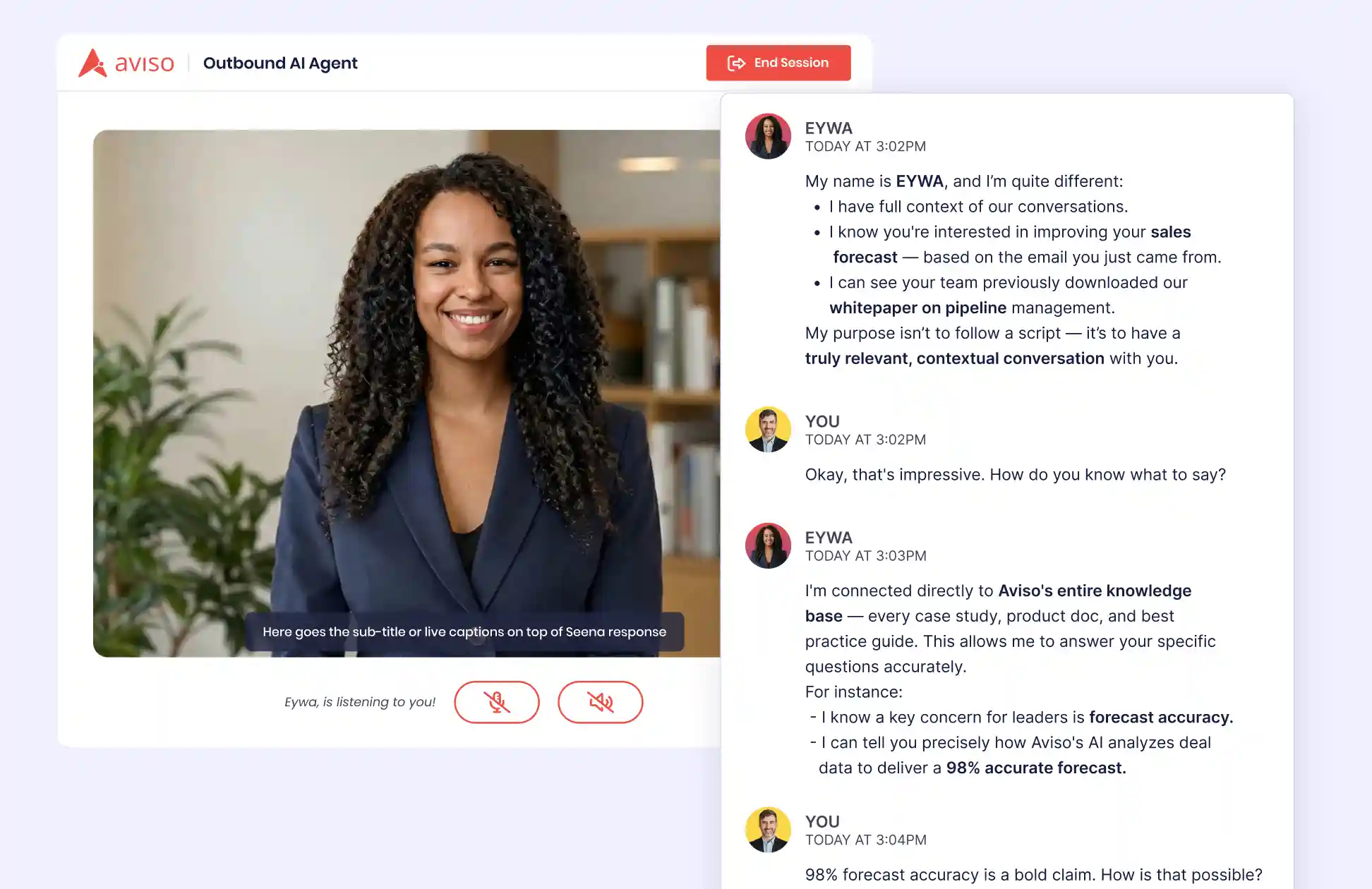
The same AI SDR Avatar solves this in outbound mode (Eywa). Instead of a static "Book a Demo" link, outbound emails include a link to have an instant conversation with the avatar. When a prospect clicks, they're greeted by name with full context - the email they received, their role and company, and any previous interactions logged in your CRM.
Eywa doesn't follow a rigid script. It answers the prospect's specific questions using your knowledge base - product documentation, case studies, pricing frameworks, competitive positioning - and can present slides, videos, and documents right within the conversation. It handles objections in real time, shares relevant content proactively, and reads intent signals throughout.
When the conversation signals genuine buying interest - questions about pricing, implementation timelines, or specific use cases - the avatar facilitates a seamless handoff by pulling up the appropriate rep's calendar and booking the meeting right there. If the prospect is clearly not a fit, the avatar identifies that too, saving your SDR team from wasting time on mismatched leads.
Every conversation is logged to CRM with a full transcript and context summary. The rep walks into the first call knowing exactly what the prospect cares about and what questions have already been answered.
What this changes: You've collapsed the typical multi-email, multi-day qualification cycle into a single interaction. The prospect gets immediate value without committing to a call. Your SDR gets a warm meeting with complete context. And your click-to-conversation rate goes up because you've removed the biggest friction point in outbound - asking someone to give you their time before you've given them anything useful.
Sales Engineer Avatar: Real-Time Support on Live Sales Calls
How Can AI Help Sales Reps Handle Objections During Live Calls?
Even well-prepared reps get thrown off by unexpected objections, technical questions outside their depth, or competitive positioning they haven't rehearsed. The traditional answer - "Let me get back to you on that" - kills deal momentum and signals uncertainty to the buyer.
Sales engineers solve this when they're available. But SE bandwidth is always a bottleneck. They can't sit on every call, and reps who need help the most are often the ones who don't have SE support scheduled.
Aviso's Sales Engineer Avatar joins live sales calls as an AI-powered co-pilot, providing real-time assistance that keeps conversations on track.
When a prospect raises a pricing objection, the avatar surfaces a response framework with relevant data points and competitive context. When a technical question comes up that's outside the rep's expertise, the avatar pulls the right answer from your knowledge base and feeds it to the rep in real time. When the conversation drifts, the avatar tracks where you are in your sales methodology and nudges the rep back to key pitch points that haven't been covered.
This isn't about replacing sales engineers on complex, highly technical deals - it's about giving every rep SE-level support on the calls where dedicated SE coverage isn't available. The avatar handles the real-time information retrieval and objection response so the rep can focus on building rapport and reading the room - the parts of selling that humans still do best.
What this means for your pipeline: Fewer "let me get back to you" moments that stall deals. More consistent execution of your sales methodology across every call, not just the ones with senior reps. And better utilization of your SE team, who can focus their limited bandwidth on the most complex, highest-value engagements.
Sales Coach Avatar: Onboarding, Certification, and Call Preparation
How Do You Reduce Sales Rep Ramp Time With AI?
The average new sales hire takes four months or more to become fully productive. During that time, managers spend hours on role-plays, call reviews, and one-on-one coaching, time taken directly from pipeline management and deal execution. Coaching quality also varies by manager bandwidth and priorities, leading to inconsistent outcomes across teams.
The result is predictable. Some reps ramp quickly under strong managers. Others learn by failing on real prospects. Both outcomes impact pipeline quality, forecast reliability, and rep retention.
Aviso’s Sales Coach Avatar standardizes onboarding, practice, and certification into a single AI-led system that scales coaching without consuming manager time.
Certification-Driven Onboarding
Managers and enablement leaders define structured onboarding paths across product knowledge, sales methodology, competitive positioning, and messaging. Each module includes curated call recordings tagged by skill and difficulty.
Reps complete assigned modules, then move into certification through live practice sessions with AI Sales Coach Avatar. Performance is evaluated against predefined benchmarks across messaging clarity, objection handling, and conversation flow. Reps who fall short retrain and retry. Reps who pass move forward with clear readiness signals.
Simulated Call Practice, Built on Real Deal Context
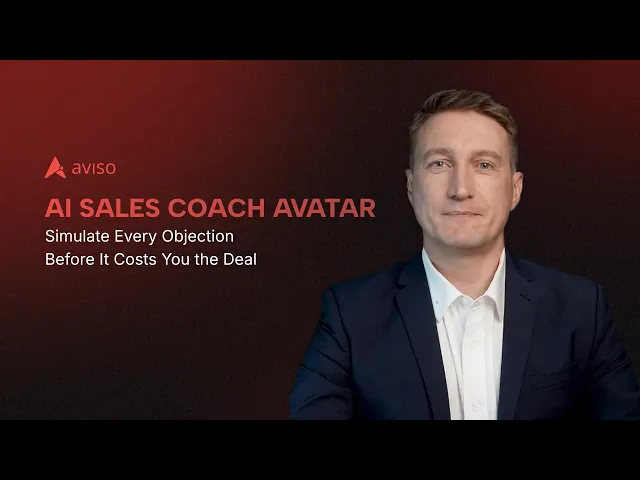
Reps preparing for upcoming calls can simulate the exact conversation using AI Sales Coach Avatar. The system pulls in deal context automatically, including account details, buyer role, deal stage, and meeting objectives. Simulations mirror real buyer behavior and surface objections relevant to that deal.
During practice, reps receive real-time guidance through an in-call coaching overlay. After the session, they receive a structured scorecard covering pitch quality, discovery depth, objection handling, talk-to-listen ratio, and closing strength, along with specific improvement actions.
Because each simulation is tied to live deal data, practice is not generic. It directly prepares reps for the next call that matters.
Manager Visibility Without Manual Oversight
Managers track onboarding progress, certification status, and performance trends across the team from a single dashboard. They can identify skill gaps, validate readiness, and ensure training aligns with pipeline priorities, without running manual coaching sessions.
The numbers: Early Aviso deployments indicate up to 60% reduction in ramp-up time, 26% increase in first-call success rates, and up to 40% improvement in win rates.
Customer Success Avatar: Post-Sale Onboarding, Adoption, and Retention
How Do You Reduce Customer Churn With AI?
Renewal management is one of the most consequential - and most manual - processes in recurring revenue businesses. Risks and signals (declining engagement, missing sponsors, dropped usage) are buried across CRM fields, support tickets, and activity logs. CSMs spend hours pulling together account context before every renewal conversation. By the time someone notices an account is at risk, the window to intervene has often closed.
The result: missed renewals, preventable churn, inaccurate forecasts, and excessive admin time that pulls CSMs away from relationship-building.
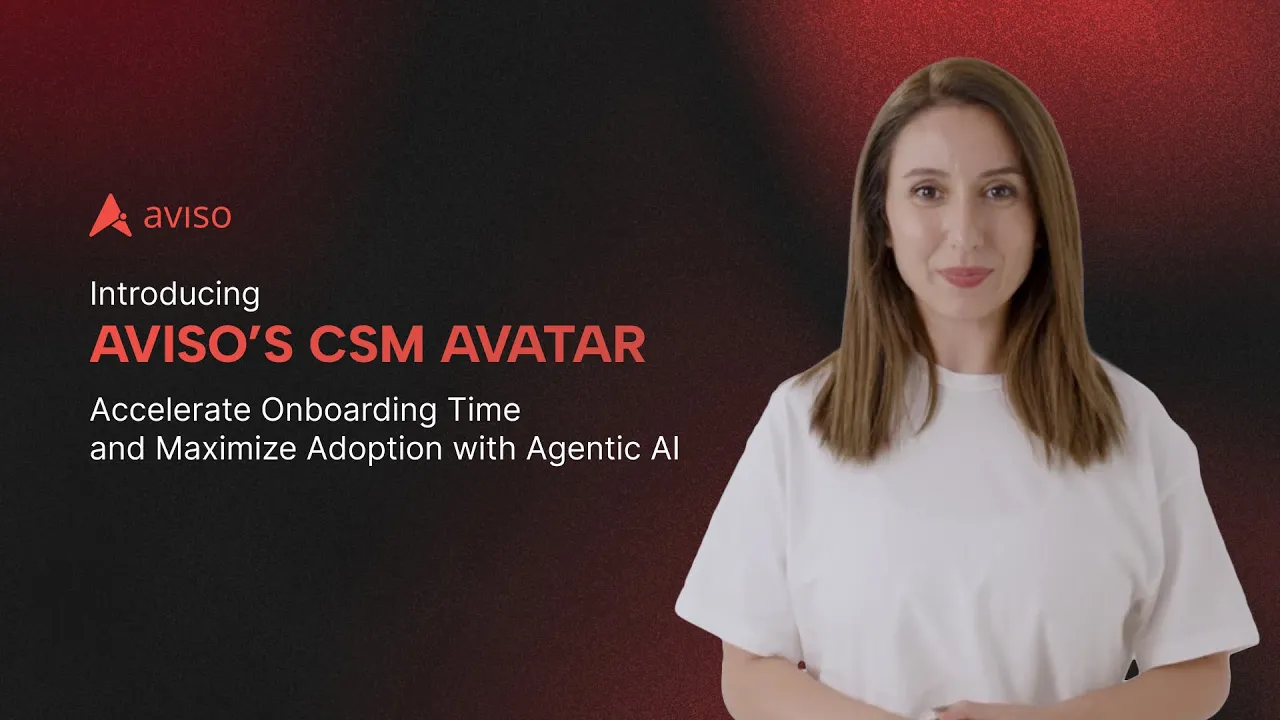
Aviso's Customer Success Avatar, Ava, is a conversational AI renewal assistant that lives inside the Customer Success dashboard and gives CSMs, renewal managers, and leaders instant, actionable intelligence on their entire renewal portfolio.
Ava doesn't just display data - she answers questions conversationally, via text or voice. A CSM can ask "Which renewals are due in the next 30 days?" and get a prioritized list sorted by renewal date, ARR, and health score, with risk drivers explained for each account. She can ask "Why is Acme Corp at risk?" and get a contextual summary: low health score, no sponsor assigned in CRM, no customer touchpoints in over 60 days.
What Ava handles across the renewal lifecycle:
Prioritized renewal intelligence: Ava surfaces your most urgent renewals first, ranked by a composite score that weighs renewal date proximity, ARR value, and account health. Each account card shows the key context - ARR, health score, sponsor status, last engagement date - so CSMs can triage without clicking through five different CRM screens. If an account has multiple deals, Ava lets you drill into individual deal details.
Contextual AI summaries and risk explanations: Instead of manually assembling account context before a renewal call, CSMs ask Ava for a summary. She pulls together ARR, renewal date, health score trend, sponsor status, last QBR date, and usage trajectory into a single view. When health scores are low, she explains why - declining product usage, missing executive sponsor, or no engagement logged in the last quarter.
AI-powered email drafting and outreach: When it's time to act, CSMs can draft renewal outreach directly inside the avatar panel. Ava generates contextually aware email drafts - adapting tone based on the risk driver. A re-engagement email for an inactive account reads differently from a routine check-in on a healthy renewal. CSMs edit and send directly through Gmail or Outlook integration without leaving the dashboard.
Proactive nudges and CRM hygiene: Ava doesn't wait for CSMs to ask. She surfaces proactive reminders - accounts with missing sponsors that need CRM updates, high-value renewals with no recent engagement, and deals approaching renewal with incomplete data fields. These nudges turn reactive firefighting into systematic renewal management.
Smart search across the portfolio: CSMs and leaders can search across their entire renewal book by account name, ARR threshold, health score range, sponsor status, or renewal timeframe. Ava handles natural language variations - "contract end" is understood the same as "renewal date" - making the experience feel like talking to a knowledgeable colleague rather than querying a database.
What this changes for different roles: For CSMs, renewal prep drops from hours to minutes - Ava assembles the context, explains the risks, and drafts the outreach. For managers and VPs, Ava provides portfolio-level views: renewal pipeline by segment, percentage of accounts showing warning signals, and team-level risk concentration. For AEs looking at expansion, Ava identifies which healthy renewals have upsell potential based on usage patterns and engagement history.
The target outcomes: teams using Ava are targeting GRR improvement of 3-5 points, NRR uplift of 5-8 points, and forecast accuracy of 85% or higher - driven by the simple fact that CSMs now spend their time on relationships and strategy instead of data assembly and manual outreach.
How Aviso's Unified Approach Differs From Point Solutions
The AI avatar market is growing fast - Vidyard builds personalized video avatars, Hyperbound and Second Nature run coaching simulations, Qualified deploys an AI SDR chatbot for websites, and dozens of newer entrants tackle individual pieces of the puzzle.
The challenge with point solutions is structural: each tool operates with its own data, its own interface, and its own context. Your coaching platform doesn't know what your inbound avatar learned about a prospect. Your website engagement tool can't inform how your SE avatar supports the same deal two weeks later.
Aviso's four avatars are native to a single revenue intelligence platform. That means shared CRM context, shared knowledge base, and shared intelligence across every stage. The inbound SDR avatar's qualification data feeds directly into the sales coach's simulation scenarios for the same deal. The sales engineer avatar's live call insights flow into pitch adherence tracking. Every avatar interaction makes the system smarter because the data is compiled in one place.
Coordinating it all is MIKI, Aviso's agentic AI Chief of Staff, backed by a library of 50+ specialized AI agents built and deployed through Aviso's no-code Agent Studio. MIKI orchestrates avatar activity across the revenue lifecycle - identifying at-risk deals that trigger coaching simulations, flagging accounts for proactive CS engagement, preparing executive-level QBR insights, and ensuring nothing falls between the cracks as deals move from pipeline generation through close and into post-sale.
It's the difference between assembling a Frankenstein stack of five different tools and deploying a coordinated system where every avatar is working from the same playbook.
What's Next for Your Revenue Team?
AI avatars are not speculative technology. They are actively deployed across revenue teams today, handling real pipeline, real coaching, and real customer interactions. The question is not whether to adopt them. It is whether you do it with disconnected point solutions or with a unified platform where every avatar makes the others smarter.
Aviso gives you four specialized avatars, SDR, Sales Engineer, Sales Coach, and Customer Success, all operating from shared intelligence, coordinated by MIKI. That is every rep executing at the level of your top 10%, consistently, on every deal. That is the unfair advantage.
See it in action → Request a Demo