Clari Revenue Cadences Alternative: Aviso vs Clari Cadences Compared
No time to lose? Summarize with AI
ChatGPT
Claude
Your pipeline review ends on time. The data is clean. The recommendations are clear. And by Thursday, half the actions from that session are still sitting in someone's notes.
Deals slip not because your team lacks visibility. They slip because visibility and execution are two different things, and most revenue cadence software only solves the first one.
This comparison covers Clari Revenue Cadences and Aviso AI Cadences on execution model, signal depth, setup, and role coverage, so you know which one closes that gap.
TL;DR
Clari Revenue Cadences structures what your team should review. Executing those actions still happens across separate tools after the session.
Aviso ships a pre-built 13-week framework with MIKI orchestration and one-click in-session execution, included in the core platform.
If your gap is post-review follow-through, not review structure, Clari was not built to close it.
Clari Revenue Cadences vs Aviso AI Cadences at a Glance
Category | Aviso AI Cadences | Clari Revenue Cadences |
Execution model | One-click execution inside the cadence session | Clari Guide recommends; teams act in separate tools |
Cadence setup | Pre-built 13-week library plus Rhythm of Business | Custom playbooks only; no out-of-the-box library |
Execution rhythm | Daily signal detection, weekly executive cadence | Weekly review cycle |
Workflow automation | MIKI orchestrates via LLMs, LQMs, time series data | Reps manually action insights after session ends |
Rep access | Dashboard-native via Cadence Agent, no switching | Rep-level access via Clari Guide inside platform |
Signal source | CRM, CI, health scores, forecast, attribution, call mentions | CRM, email, calendar, call data, engagement signals |
Role coverage | AE, FLM, SLM, Exec: MIKI handpicks per persona | Manager, exec, GTM teams; rep-level via Clari Guide |
Missed cadence handling | Auto-detected, queued, no manual tracking needed | Not a documented native capability as of May 2026 |
Next best actions | One-click from inside the same cadence card | Clari Guide recommends; execution happens elsewhere |
Territory configuration | Rhythm of Business: territory-configured from admin panel | Not a documented native capability |
Cadence invocation | Agent-first invocation, no manual rep initiation needed | Session-initiated within scheduled review sessions only |
Pricing model | Included in core platform, no additional cost | Modular platform; Revenue Cadences within broader stack |
What Clari Revenue Cadences Actually Does
Clari Revenue Cadences structures weekly pipeline reviews, forecast calls, and 1:1s across GTM teams.
Clari cites 3,000+ enterprise cadences, though deployment volume and execution outcomes are different measures.
Flexible playbook builder: set up cadences without spreadsheet dependencies
Shared workspace: GTM teams work from the same live data in one view
Clari Guide: surfaces AI-recommended next steps inside the platform. (But acting on them happens elsewhere)
Cross-team coverage: sales, marketing, CS, and operations
Documented outcomes: up to 15% forecast accuracy improvement and 8% whitespace increase at Gamma
That handoff is where the pipeline dies.
Ideal for: Teams whose primary gap is review structure, and who have RevOps bandwidth to build and maintain the playbooks that structure requires.
Where Clari Revenue Cadences Falls Short
Clari's playbook builder lets you create cadence structures from scratch. For teams with RevOps bandwidth to maintain them quarterly, that flexibility has value.
For teams that do not, there are two problems:
No out-of-the-box cadence library to fall back on
Configuration work required before the first cadence runs
Aviso ships a complete 13-week framework on day one. For teams that also want to configure their own cadences, Rhythm of Business gives revenue leaders full control to build, adjust, and align cadences to their territory structure, without starting from scratch.
The deeper issue is structural:
Review-dependent execution: Clari Revenue Cadences is built around the session. What happens after depends entirely on your team's follow-through
Fragmented action: Clari Guide recommends the next step. Opening the calendar, drafting the email, creating the task, and updating the CRM all happen separately after the session closes
No catch-up mechanism: Missed cadences from prior weeks have no documented native auto-detection or catch-up queue as of May 2026
Manager-level by design: The weekly rhythm covers GTM teams well. Daily rep-level execution is not what the product is built for
Mid-integration platform: The December 2025 Clari-Salesloft merger means you are evaluating a platform mid-integration. Full unification is, per company communications, a multi-year effort. Request a current roadmap before signing
These are not dealbreakers for every team. But if your gap is in the execution that should happen between reviews, Clari Revenue Cadences was not built to close it.
What Aviso AI Cadences Does Differently
Your reviews are not the problem. What happens between them is.
Aviso AI Cadences is a pre-built 13-week executive operating framework included in Aviso's core offering at no additional cost.
Every persona, AE, FLM, SLM, and Senior Executive, gets cadences handpicked by MIKI based on their role, their live data, and where their quarter stands.
No extra licensing
No configuration sprint
No playbook design required
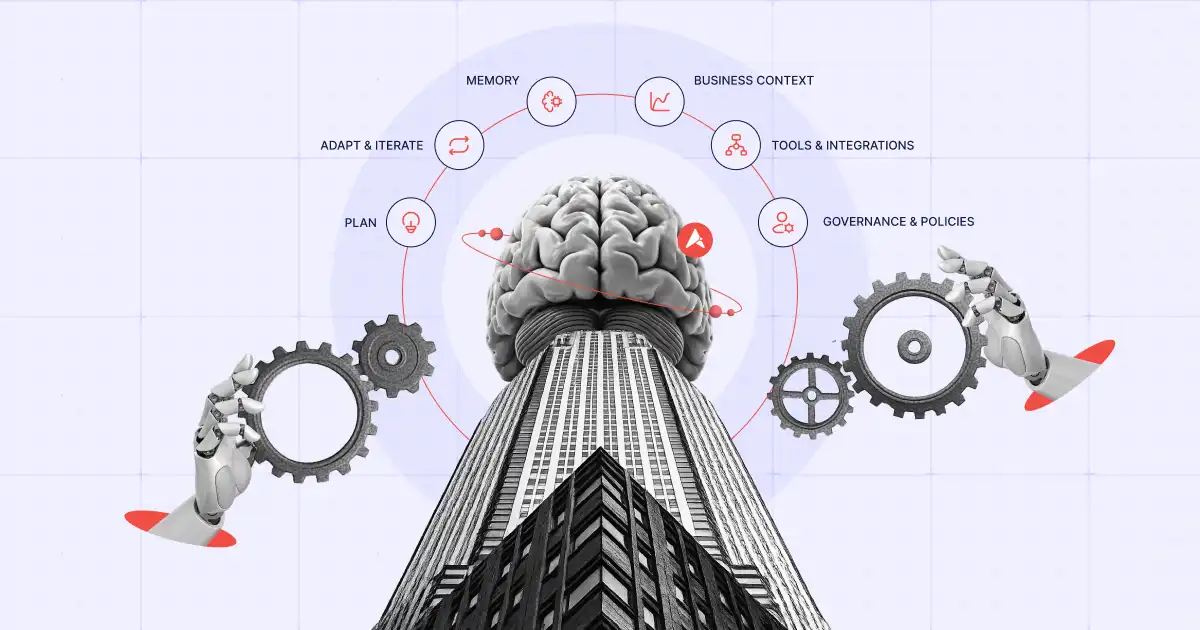
MIKI is not a dashboard layer. It is the end-to-end orchestrator.
Searches across your entire revenue platform for live signals
Fetches what matters for your role, your deals, and your week
Delivers a logical next best action at the close of every cadence
Your team never gets navigated to a dashboard and left there.
MIKI pulls signals from:
CRM opportunity and stage history
Conversation intelligence and competitive mentions from call transcripts
Customer health scores and forecast data
Campaign attribution and marketing spend efficiency
MIKI is powered by:
Large Language Models for conversational natural language insights
Large Quantitative Models for forecast and pipeline precision
Time series database for historical deal pattern detection across your revenue motion
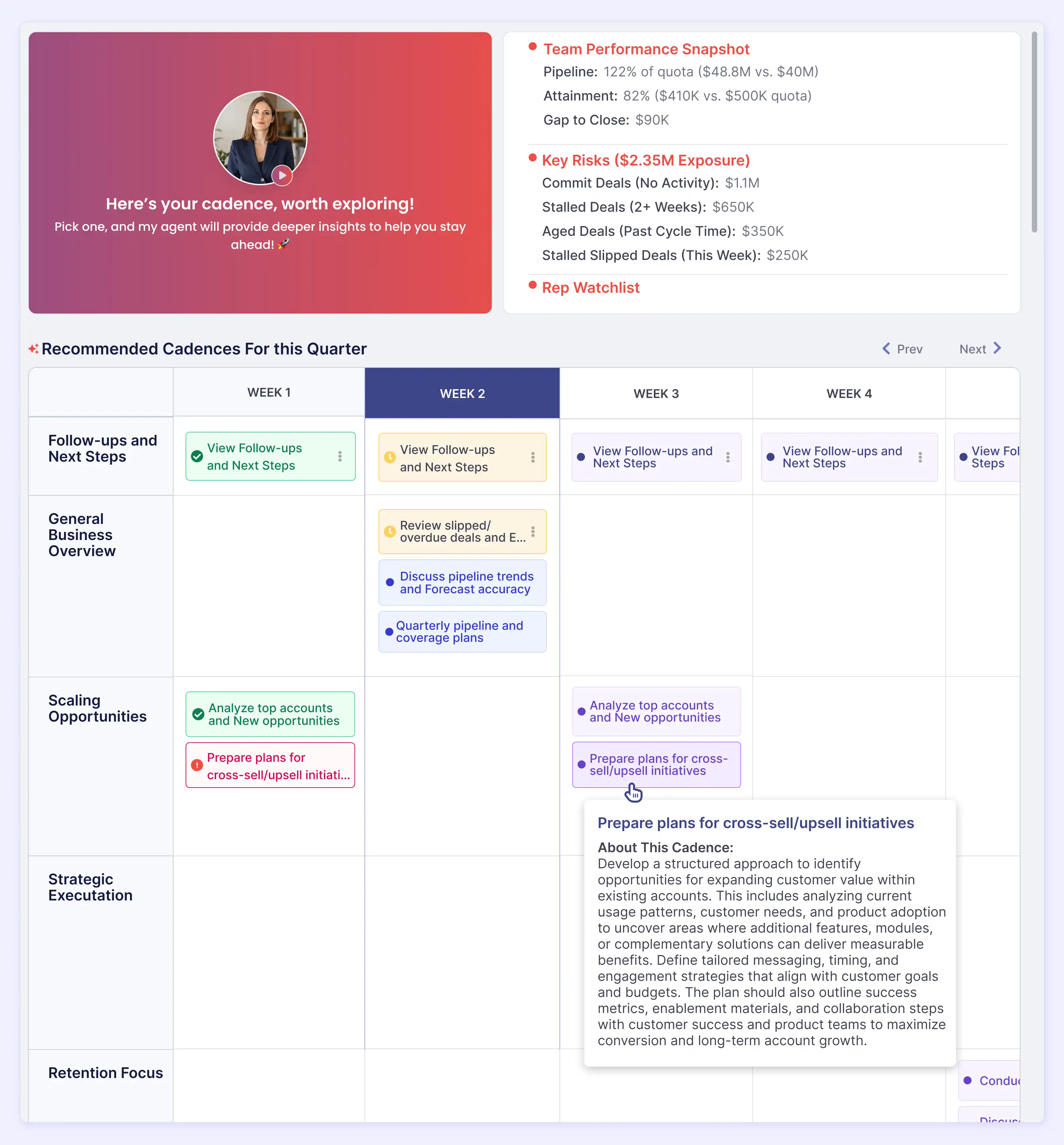
Your quarter runs on a five-bucket repeating framework:
Weeks 1, 5, 9 — General Business Overview: slipped deals, engagement gaps, pipeline coverage, forecast accuracy
Weeks 2, 6, 10 — Strategic Execution: deal inspection, sales process adherence, QBR preparation
Weeks 3, 7, 11 — Scaling Opportunities: upsell and cross-sell plays, top account analysis, pipeline impact
Weeks 4, 8, 12 — Retention Focus: renewal and churn risk, customer health, retention risk mitigation
Week 13 — Exceeding Targets: slipped deal recovery, goal planning, next-quarter pipeline readiness
The framework runs out of the box for every persona.
For revenue leaders who need to run their business their way, Aviso also offers Rhythm of Business.
Configure your own cadences: QBRs, MBRs, forecast calls, or any operating rhythm your business runs on
Territory alignment built in: associate cadences to specific territories from an admin panel
Full control: revenue leaders configure, adjust, and run cadences without RevOps dependency
Clari does not offer territory-based cadence configuration.
Both the pre-built framework and Rhythm of Business run through the same engine: the Cadence Agent.
Sales teams miss quota when weekly cadences are skipped and the quarterly plan slips week by week. Cadence Agent fixes that by running the 13-week revenue cadence directly on the rep dashboard, against live signals, without reps leaving their workflow.
The moment your rep or executive logs in, Cadence Agent surfaces:
Missed cadences auto-detected and queued before they compound into a quarter-ending gap
Account prioritization ranked by upsell potential, churn risk, and call urgency in dollars, not gut feel
Deal reviews prepped from calls, health scores, and forecasts pulled into one place before the meeting opens
Next best actions executed in one click from the same screen as the insight, no tab switching
Execution visibility across rep, team, and quarter level for managers, no chasing reports
The result is a revenue organization that runs the quarterly plan week by week, not just at QBR time.
Beyond the pre-built framework, cadences can also run agent-first:
Any orchestration MIKI runs can be triggered through agents
No rep initiation required
Your entire revenue cadence runs without manual input
This happens across two surfaces, each designed for a different moment in your day.
Aviso surfaces cadences across two distinct interfaces:
Daily Moment: Recommended cadences on the home dashboard the moment your rep logs in. Cadence Agent runs upsell, sentiment, and health checks inline, no app switching, no context loss
Quarterly Planning Workspace: Full 13-week rhythm in one place. Team performance snapshots, rep watchlists, renewal exposure, and key risks visible without switching tools
Same MIKI. Same Context Graph. Same 13-week framework. Available to every persona: AE, FLM, SLM, and Senior Executive.
Here is what that looks like in practice.
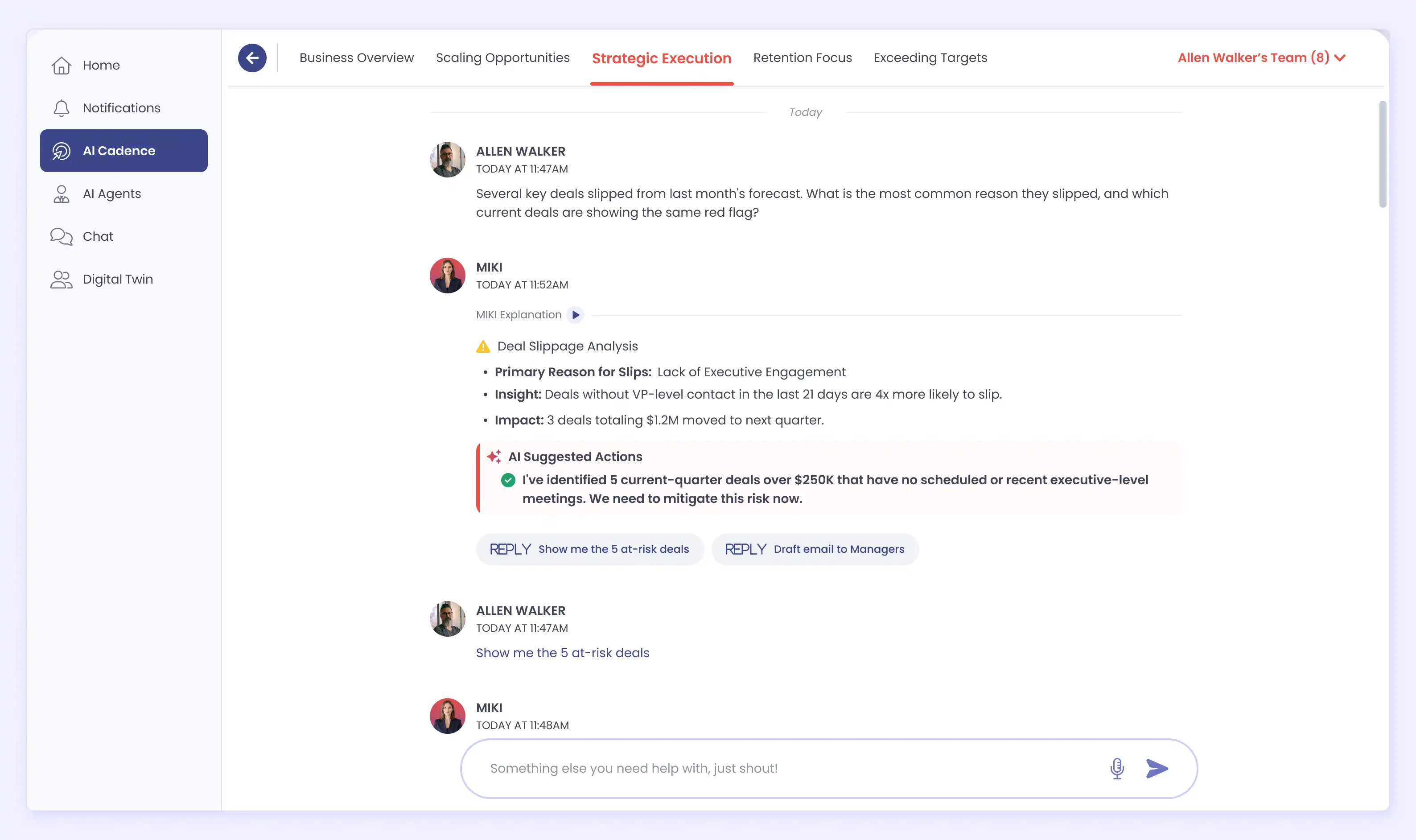
When MIKI surfaces an insight, the action executes in one click:
Seven enterprise deals stalled in InfoSec review → one click drafts the email to your CISO
Budget reallocation opportunity detected → one click generates a one-pager for your CMO
Executive sponsor changed at four key accounts → one click creates four personalised outreach drafts
Swing deals need coordination → one click creates the Slack war room, invites deal owners, schedules daily standups
The cadence does not end with a list of things to do. It ends with those things done.
The time your team gets back reflects that.
Aviso reports the following time reclaimed per rep per week across three core workflows:
Meeting Prep: 5-7 hours reclaimed. Every meeting opens with risky deals flagged, pipeline metrics pre-loaded, and previous actions carried forward
Plan My Day: 4-6 hours reclaimed. MIKI surfaces 2-3 highest-priority actions at 8 AM with suggested time slots, no inbox triage required
Pending Actions: 3-5 hours reclaimed. Overdue items auto-sorted, past meeting actions rolled into today's queue, rescheduling done in one click
Across the customer base, that compounds into measurable revenue outcomes.
Aviso reports the following outcomes across its customer base:
98%+ forecasting accuracy
20% win rate improvement
25%+ CRM cost savings
70+ competitive replacements of Clari, Gong, People.ai, Gainsight, and others
See how Lenovo switched from Clari to Aviso and how LogicMonitor replaced Clari, Gong, and Outreach with Aviso.
Ideal for: Revenue executives and GTM leaders who need a complete quarterly operating framework with live signal detection, in-session execution, and territory-configurable cadences from day one, included in the core platform at no extra cost.
Three Execution Differences Your Team Will Feel
1. In-Session Execution vs Post-Session Follow-Through
When Clari Guide surfaces a recommendation, acting on it means leaving the session. Your calendar, your inbox, your task manager. Three separate tools. Three separate moments where follow-through can break.
In Aviso, the action executes from the same card. No context switching. No open loop waiting to be closed next week.
2. Signal-Driven Cadence Questions vs Standing Weekly Agenda
Clari Revenue Cadences provides a structured framework for weekly reviews. What your team discusses depends on what managers bring to the session. That is a human dependency, not a data dependency.
Aviso cadence questions are computed from live signals. MIKI identifies what matters most in your quarter right now, based on CRM data, call transcripts, health scores, and attribution, not a standing agenda.
3. Pre-Built Operating Rhythm vs Build-Your-Own Playbook
Clari's flexibility is real. It is also a prerequisite. Someone has to design the playbook, configure the cadences, and maintain them as your revenue motion evolves. That work sits with RevOps.
Aviso ships a complete 13-week operating rhythm on day one. For teams that need more, Rhythm of Business adds territory-configured cadences without a configuration sprint. Week one, your cadences run.
Strengths and Considerations
Aviso AI Cadences
Strengths:
Pre-built 13-week framework covers five executive priority areas with no RevOps setup needed
Included in Aviso's core offering at no additional cost across all GTM personas
In-session execution: drafts, tasks, invites, and reports happen from inside the cadence card
MIKI orchestrates every cadence using LLMs, LQMs, and time series data across your full revenue platform
Signal detection spans CRM, CI, health scores, forecast, competitive call data, and attribution
Missed cadence detection queues skipped weeks without manual tracking
Rhythm of Business enables territory-aligned configurable cadences for revenue leaders who need custom operating rhythms
Deployed at Lenovo, NetApp, RingCentral, and LogicMonitor at enterprise scale
Considerations:
Like any enterprise deployment, onboarding works best when your revenue motion is documented upfront
Teams running highly custom quarterly plays can use Rhythm of Business to configure territory-aligned cadences from an admin panel, no pre-built dependency required
The pre-built 13-week framework covers most enterprise revenue motions out of the box; Rhythm of Business extends that for teams with specific operating rhythms
Clari Revenue Cadences
Strengths:
Deployed across 3,000+ enterprise cadences, though deployment volume and execution outcomes are different measures
Customizable playbook setup gives flexibility to teams with RevOps capacity to use it
Clari Guide surfaces next steps inside the platform; execution of those steps happens outside it
Customer results at Gamma, Tanium, and SOCi are specific to review discipline improvements
Considerations:
Execution happens after the session ends, across your calendar, inbox, and task manager separately
Playbook design and maintenance requires active RevOps capacity each quarter
No out-of-the-box cadence library; every cadence structure must be built and maintained by your team
Territory-based cadence configuration is not a documented native capability
Missed cadence auto-detection is not a documented native capability as of May 2026
Full platform integration with Salesloft is still in progress per company communications
Which Revenue Cadence Platform Should You Choose?
Choose Aviso if:
Your reviews happen but the actions sit in someone's notes until next week
You need a complete executive operating cadence from day one
Reducing time between insight and execution is a primary deployment goal
You want a fully shipped revenue execution platform, not one mid-merger
You need automatic missed cadence detection without manual RevOps tracking
You need cadences included in your core platform at no extra cost
You want territory-configurable cadences without building from scratch
You need one framework covering AE, FLM, SLM, and exec from day one
Choose Clari if:
Your RevOps team has the bandwidth to design, configure, and maintain custom playbooks every quarter
Your GTM reviews are the problem, not what happens after them
You are mid-contract with Clari, and switching is not currently on the table
You are willing to wait for the Clari-Salesloft integration to mature before evaluating what the combined platform actually ships
The Bottom Line
Clari Revenue Cadences organises what your team should do next. Whether that happens is a separate question.
For teams where it consistently does not, the gap compounds every week until it shows up in your quarterly number.
Aviso ships the pre-built framework, the configurable layer, the agent orchestration, and the in-session execution. One platform. Included in the core offering.
Aviso has driven 70+ competitive replacements of Clari alone. Explore Aviso AI Cadences or see the full Aviso vs Clari comparison before your next evaluation.
FAQs
What is Clari Revenue Cadences?
Clari Revenue Cadences structures weekly pipeline reviews, forecast calls, and 1:1s using customizable playbooks. Clari Guide surfaces AI-recommended next actions inside the platform. Executing them happens outside it.
What is Clari Guide?
Clari Guide is the in-platform action hub inside Clari Revenue Cadences. It surfaces AI-recommended next steps based on CRM, email, and calendar signals. Reps review recommendations in-platform then execute actions across their calendar, inbox, and task manager separately.
What are the main shortcomings of Clari Revenue Cadences?
Execution happens after the session ends in separate tools. Missed cadence auto-detection is not documented. Playbook setup requires RevOps capacity. Post-merger integration with Salesloft is still in progress. No out-of-the-box cadence library exists.
How is Aviso AI Cadences different from Clari Revenue Cadences?
Aviso ships a pre-built 13-week framework included in the core platform at no extra cost. MIKI orchestrates every cadence using LLMs, LQMs, and time series data. Rhythm of Business adds territory-configurable cadences on top. Cadences can also run agent-first.
What is the difference between Clari Guide and Aviso MIKI?
Clari Guide recommends next actions; your team executes them after the session in separate tools. MIKI orchestrates via LLMs, LQMs, and time series data and executes the action in one click inside the cadence.
What is Aviso Rhythm of Business?
Rhythm of Business is Aviso's territory-configurable cadence layer. Revenue leaders configure QBRs, MBRs, forecast calls, or any operating rhythm, associate cadences to specific territories from an admin panel, and run them without RevOps dependency. Clari does not offer this natively.
What is the difference between a revenue cadence and a sales cadence?
A sales cadence is a rep-level outbound sequence of calls, emails, and touches against a prospect. A revenue cadence is a leadership-level operating rhythm covering pipeline reviews, forecast calls, deal inspection, and QBR prep across the full GTM team.
What is the difference between Daily Moment and Quarterly Planning Workspace?
Daily Moment surfaces recommended cadences on the rep dashboard at login, no app switching. Quarterly Planning Workspace shows the full 13-week rhythm with team performance, rep watchlists, and renewal exposure in one place. Same MIKI, same framework, two interfaces.
Can Aviso cadences run agent-first without rep initiation?
Yes. Any orchestration MIKI runs can be triggered through Aviso's agents with no rep initiation required. Cadences surface across Daily Moment and Quarterly Planning Workspace. Clari Revenue Cadences is session-initiated only.
Can your team act on cadence insights without switching tools in Aviso?
Yes. MIKI executes the downstream action, whether a draft email, meeting invite, task, or report, directly from the cadence card. No context switching required.
How much time does Aviso AI Cadences save per rep per week?
Aviso reports three categories of time reclaimed: Meeting Prep at 5-7 hours, Plan My Day at 4-6 hours, and Pending Actions at 3-5 hours per week. All figures are Aviso-reported.
How much does Clari Revenue Cadences cost?
Clari does not publish Revenue Cadences pricing publicly. Enterprise contracts combine per-seat platform fees with module-based add-ons. Aviso AI Cadences is included in the Aviso core platform at no additional cost for cadence functionality.
Does the Clari-Salesloft merger affect Revenue Cadences?
The merger closed in December 2025. Revenue Cadences remains available in the combined platform. Full unification is a multi-year effort, per company communications. Request a current roadmap before committing to a contract.
Can Aviso replace both Clari and Salesloft?
Yes. Aviso unifies revenue intelligence, sales engagement, conversation intelligence, and forecasting on one platform. Aviso has driven 70+ competitive replacements of Clari, Gong, and others. LogicMonitor publicly replaced Clari, Gong, and Outreach with Aviso.
Is Aviso a proven Clari Revenue Cadences alternative for enterprise teams?
Yes. Aviso has driven 70+ competitive replacements of Clari, Gong, and others. Lenovo switched from Clari to Aviso citing platform breadth and execution depth across their global sales org.
Does Aviso AI Cadences require RevOps configuration to go live?
No. The 13-week framework ships pre-built and runs day one. Rhythm of Business provides an admin panel for territory-aligned cadence design for teams needing custom operating rhythms without a configuration sprint.
How difficult is it to switch from Clari Revenue Cadences to Aviso?
No playbook rebuild required. Aviso's 13-week framework runs day one. Aviso integrates with Salesforce, HubSpot, Microsoft Dynamics, and other CRMs your team already uses. See integration options or book a demo to discuss migration specifics.
Which is better for enterprise revenue teams?
Clari fits teams needing structured weekly GTM review discipline. Aviso fits teams needing a complete executive operating cadence with in-session execution, agent invocation, and territory configurability from day one, included in the core platform.
See Aviso AI Cadences in Action
Your next pipeline review does not have to end with a list of things no one gets to.
Book a demo and see how Aviso closes the gap between insight and execution in a single session.