Everyone Is Building Better Models. That's Not the Hard Part.

No time to lose? Summarize with AI
ChatGPT
Claude
For the past two years, the AI industry has been obsessed with one question: Which model is the smartest?
Every major announcement revolves around bigger benchmarks, higher reasoning scores, faster responses, or lower hallucination rates. The assumption is simple. The assumption is that a better model will naturally lead to a better AI agent.
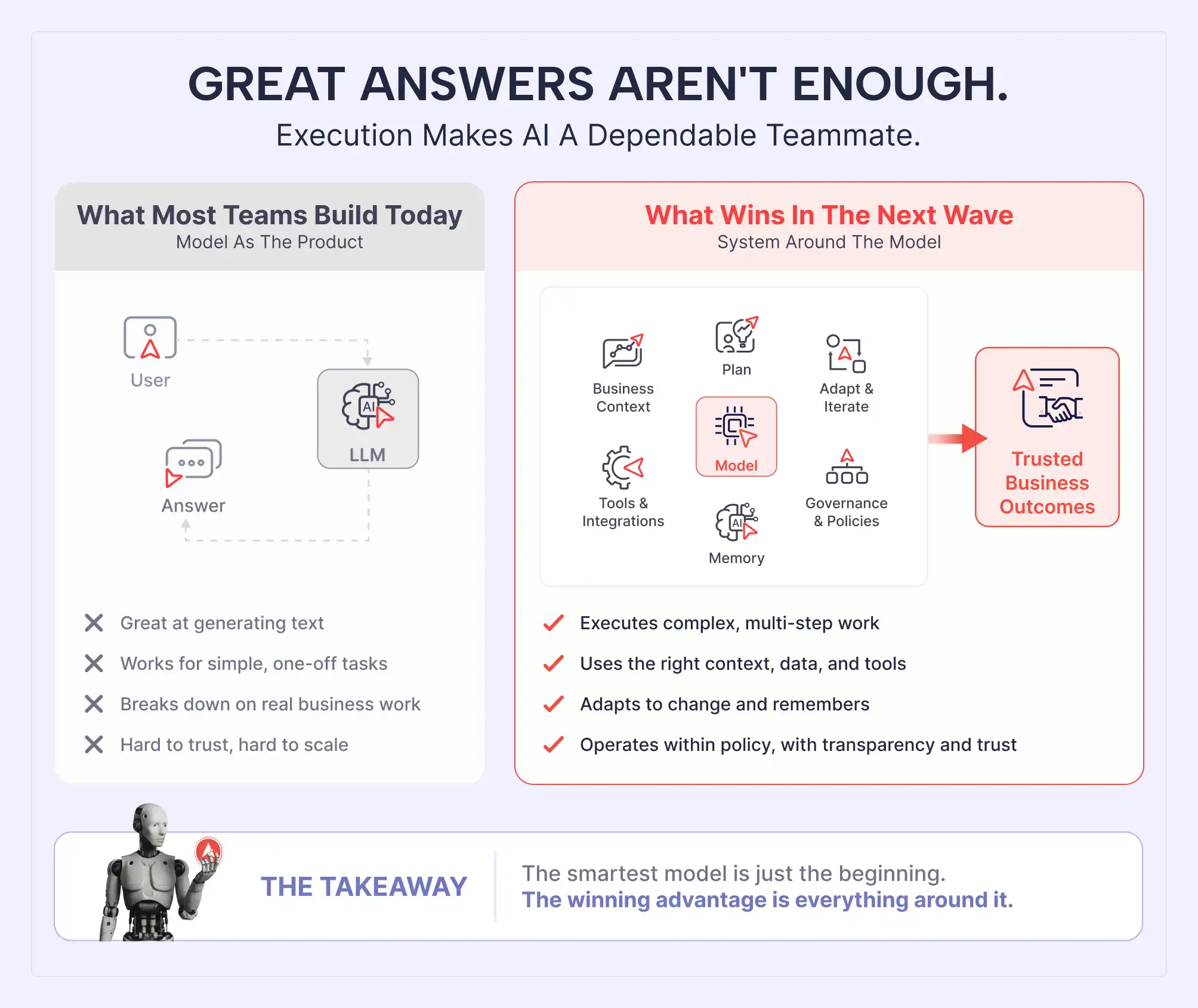
That assumption is only partly true. While model quality certainly matters, treating the model as the product is where many enterprise AI initiatives begin to break down.
Large language models have become remarkably good at generating text, answering questions, summarizing meetings, and writing code. They can reason through problems that once required human expertise. But enterprise work, especially in go-to-market teams, is rarely a single reasoning task.
Consider what happens when a sales leader asks AI to prepare for an executive account review. The request sounds straightforward, but the work behind it is anything but. The AI needs to retrieve CRM data, analyze customer interactions, identify deal risks, review historical pipeline changes, gather competitive insights, generate a presentation, and ensure every recommendation respects the organization's access policies. If new information arrives midway, the plan may need to change. If a manager wants to review the output, the AI should pause before taking the next step.
None of this is simply a language problem.
It is an execution problem.
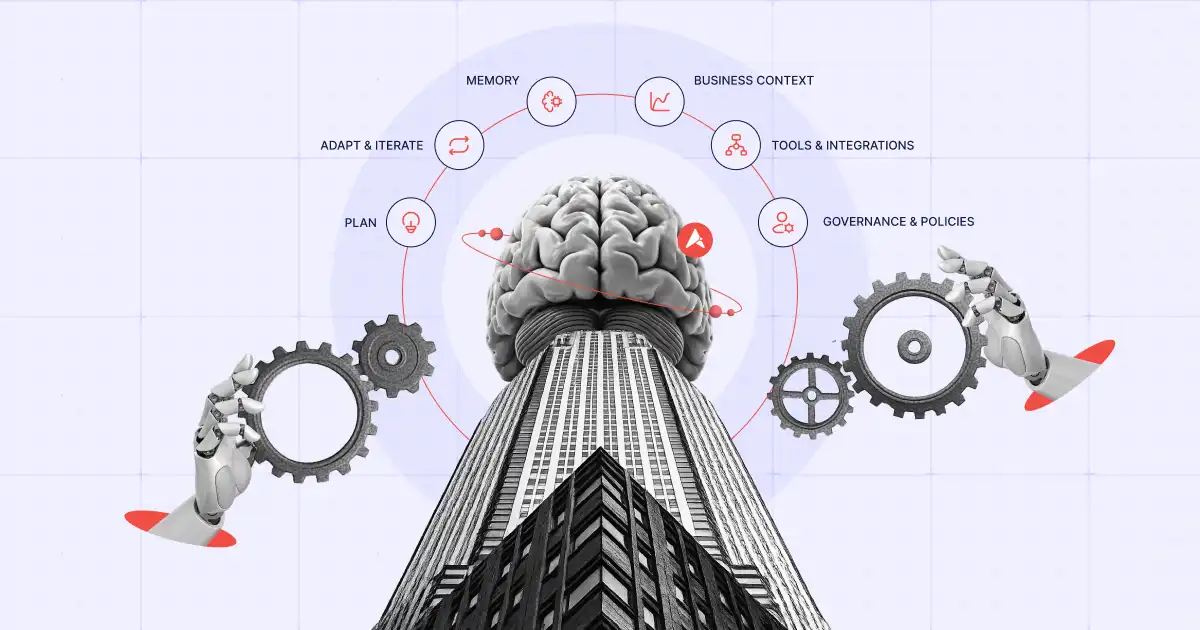
For AI to become a dependable teammate rather than an intelligent chatbot, the model must be part of a much larger system. It needs a way to plan work, access the right business context, invoke tools, remember previous interactions, and operate within governance boundaries.
This is where many AI platforms fall short. They invest heavily in making the model more capable, but give far less attention to everything that surrounds it. As a result, impressive demos often struggle to become dependable production systems.
For enterprise GTM teams, success will not be determined by who has access to the smartest model. It will be determined by who builds the architecture that allows AI to execute real business workflows with consistency, transparency, and trust.
How Aviso Turns AI Into an Execution Platform
At Aviso, every AI request begins with a business objective, not a prompt. When a revenue leader asks, "Prepare my QBR," the platform doesn't immediately send the request to a language model. Instead, it first creates an execution plan.
The Planner breaks the objective into logical tasks, identifies dependencies, and determines the best sequence for execution. Before anything runs, the plan is validated to catch issues such as missing steps, circular dependencies, or unreachable tasks. This ensures workflows are reliable before they interact with business systems.
Next, Aviso's Context Graph assembles the informatio‹‹‹n needed to complete the work. Rather than retrieving isolated records, it understands how accounts, opportunities, contacts, activities, meetings, forecasts, and customer interactions are connected. Underpinning this is Aviso's Ontology, which gives business meaning to the data by defining concepts such as pipeline, account ownership, deal stage, forecast category, and revenue hierarchy. This allows AI to reason using your business context instead of generic language patterns.
Unlike stateless AI systems that start from zero with every interaction, Aviso's Persistent Agents retain context across the entire customer lifecycle. They remember previous conversations, account history, user preferences, and prior actions, enabling every interaction to build on existing knowledge rather than repeating the same work.
Execution is coordinated by the Agent Harness, which orchestrates specialized agents, retrieves information from enterprise systems, invokes the right tools, and manages every step of the workflow. Whether the task involves analyzing pipeline health, updating Salesforce, generating a QBR, drafting follow-up emails, or working through browser-based applications, the Agent Harness ensures each action happens in the right order and with the right context.
Throughout execution, governance remains built in. Role-based access controls ensure agents only access authorized data, validation prevents unsafe actions before they occur, and every decision, tool invocation, and workflow step is traced through an observability layer. If an output needs to be reviewed or an issue investigated, teams can see exactly what the agent did, which data it used, and why it reached a particular conclusion.
This is what makes Aviso's architecture fundamentally different. The language model provides intelligence, but the execution platform provides planning, business context, persistent memory, orchestration, governance, and transparency. Together, these capabilities transform AI from a conversational assistant into a trusted execution partner for enterprise revenue teams.
The Difference Between Claims and Evidence
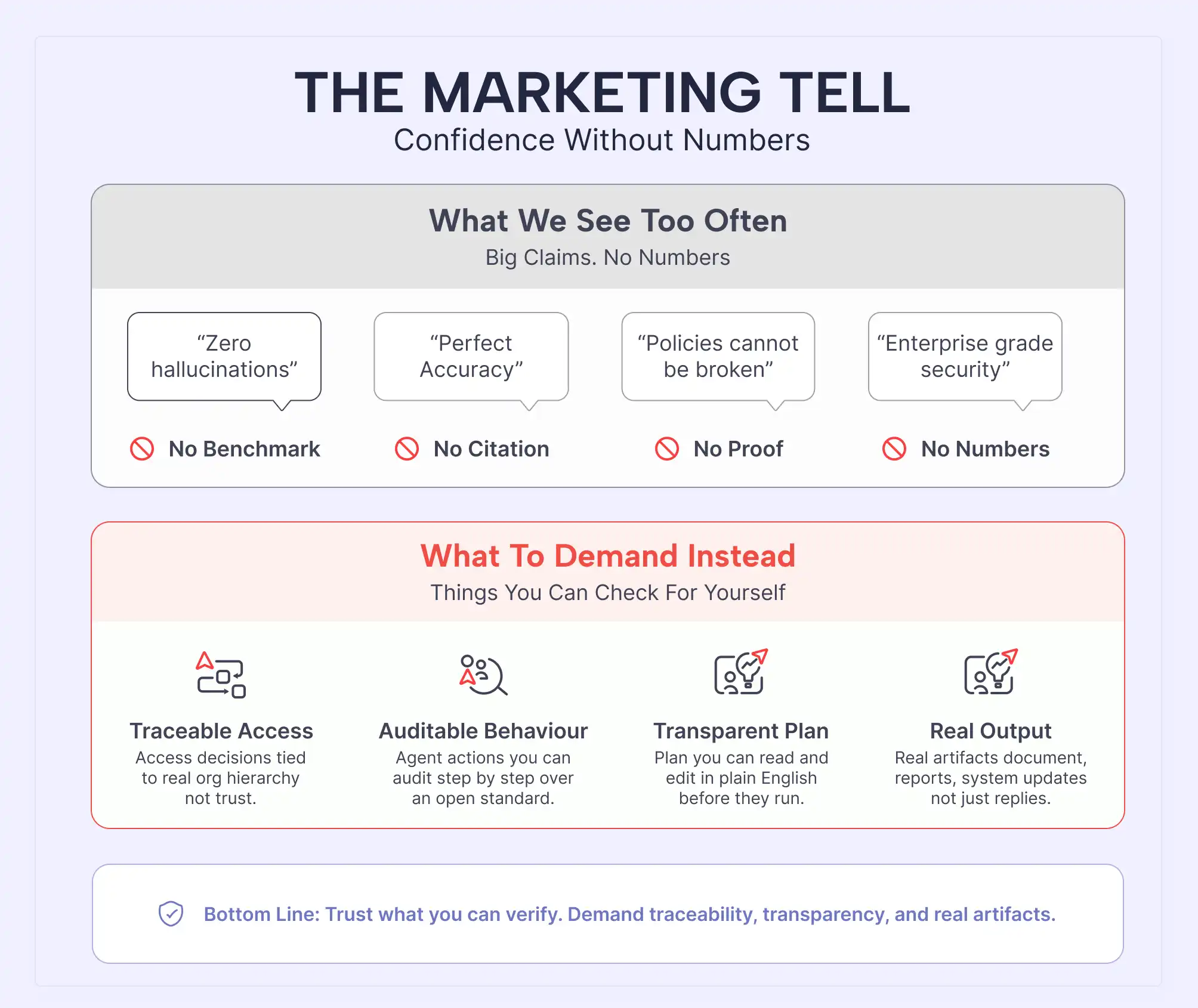
There is a pattern worth watching for on vendor websites and in sales decks across this category: a lot of confident language, and very few numbers to back it up. Phrases like zero hallucinations, perfect accuracy, or policies that cannot be broken show up often. These are strong claims. They are also, on their own, unverifiable. None of them is a benchmark score, a citation, or a number you can independently check against your own use case.
This is not unique to any one company. It is a broader tendency in a market still young enough that marketing can outrun measurement. The healthier posture, and the one worth demanding from any vendor you evaluate, is one built around things you can check yourself:
Access decisions you can trace back to a real org hierarchy, not a property you are asked to trust
Agent behavior you can audit step by step over an open tracing standard
Plans you can read and edit in plain English before they run, with structural problems caught ahead of execution
Outputs that are real artifacts, chat replies, but also documents, reports, and system updates, not just a response
Reliable Intelligence Is Table Stakes Now
A year ago, a model that reliably held a coherent conversation was itself a differentiator. That is no longer true. Frontier models from multiple providers are now reliable enough, on their own, that the model is rapidly becoming a commodity input rather than a defensible product. What actually differentiates one AI agent platform from another going forward is not which model sits at the center, but what has been built around it: the planning layer that breaks a request into steps, the memory system that carries context forward, the governance layer that makes access decisions inspectable rather than assumed, and the breadth of systems the agent can actually act inside, CRM, email, calendar, documents, code, not just a conversation window.
For GTM and revenue teams evaluating this category, the practical takeaway is simple. Ask what happens the moment the work leaves the conversation. Ask to see the trace, not just the claim. Ask whether switching the underlying model means switching vendors, or just switching a setting. The answers to those three questions will tell you more about which bet a vendor is actually making than anything on their homepage.
Reliable intelligence was the hard problem for a while. It is quickly becoming the baseline. What you build on top of it, and how much of it you can actually verify, is where the real product now lives.
At Aviso, we've built an AI execution architecture that makes this possible. By combining intelligent planning, persistent memory, contextual reasoning, enterprise governance, and seamless orchestration, Aviso transforms AI from a conversational assistant into a trusted execution partner for revenue teams.
Ready to see what enterprise AI can do beyond conversations? Explore how Aviso's AI platform helps GTM teams automate complex workflows, accelerate execution, and drive predictable revenue outcomes.
Read More Like This
