Best Conversation Intelligence Tools (2026): Features, Pricing & Use Cases

No time to lose? Summarize with AI
ChatGPT
Claude
Conversation Intelligence Has Outgrown the Call Recorder Label
Capturing and transcribing calls is not conversation intelligence anymore. Every tool on this list does that. What separates the platforms worth buying in 2026 is whether conversation data connects directly to revenue outcomes: pipeline movement, forecast accuracy, deal risk, and rep behavior change.
This guide gives B2B revenue leaders, RevOps, and enablement teams an honest look at what each tool does, who it suits, and where it falls short.
What Is Conversation Intelligence?
Conversation Intelligence (CI) software records and transcribes sales calls. That is the baseline, and in 2026, it is not a differentiator.
What actually matters is what happens after transcription. Does a missed next step flag a deal as at-risk in your forecast? Does a competitor mention trigger a coaching workflow? If the answer is no, you have a call recorder with a search bar, not a CI platform.
The platforms worth evaluating connect conversation signals directly to pipeline health, forecast categories, deal stage progression, and rep coaching workflows. The conversation is the input. Revenue outcomes are the output.
What CI is not:
A passive call recorder
A standalone reporting tool
A compliance system with analytics bolted on
What it should deliver:
Deal risk identified from conversation signals before it shows up in the forecast
Rep behavior change driven by patterns from actual calls, not manager intuition
CRM accuracy maintained by call data, not manual rep input
Forecast confidence built on what buyers said, not what reps estimated
Coaching at scale tied to specific conversation moments, not general feedback
How to Evaluate CI Tools
Weight your evaluation against revenue outcomes, not feature lists:
Deal workflow fit (30%) Does it connect conversations to open opportunities, deal stages, and forecast categories?
Coaching and enablement (25%) Can managers run repeatable coaching workflows from call data?
Signal quality (20%) How reliably does it surface objections, intent, competitor mentions, talk ratios, and next steps?
Integrations (15%) Bi-directional CRM sync, meeting capture, dialer support, Slack, data export.
Security and governance (10%) SSO, SCIM, role-based access, retention policies, audit logs.
The 10 Best Conversation Intelligence Platforms in 2026
1. Aviso AI
Best for: Enterprise GTM teams that need CI connected to forecasting, pipeline inspection, and AI-driven rep guidance
Aviso is a revenue platform where CI is one layer of a system that also handles forecasting, pipeline management, and AI agents. A conversation signal does not sit in a coaching queue. It flows into deal health scores, forecast categories, and rep guidance workflows. Its GenAI assistant, MIKI, lets reps and managers query call history in plain language and push CRM updates without touching Salesforce directly.
Pros:
Conversation signals tie directly to pipeline and forecast data, not just coaching dashboards
Ask MIKI handles natural language queries and CRM field updates from call context
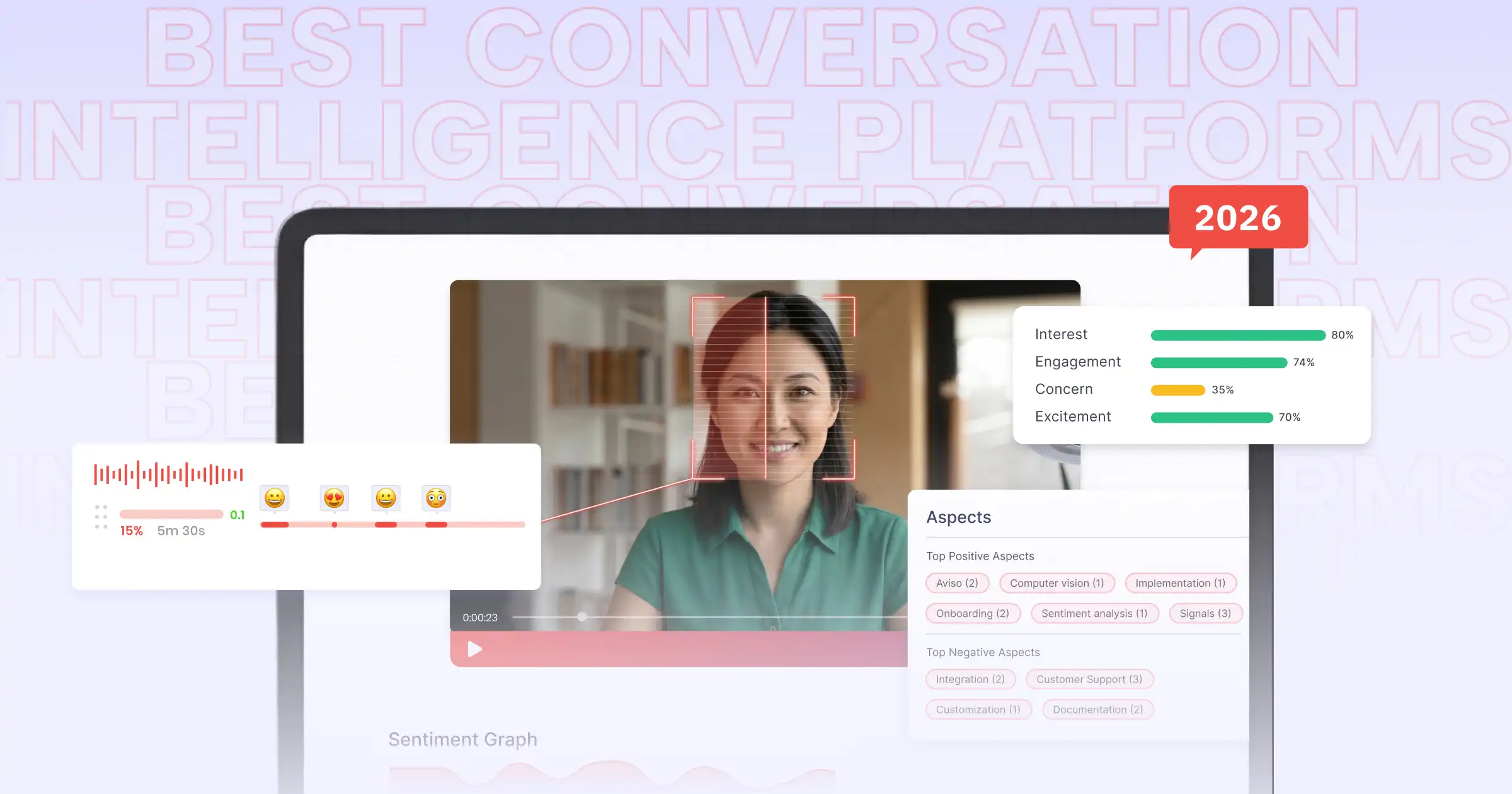
Acoustic and text-based sentiment analysis, not keyword tracking alone
AI agents surface next-best actions inside rep workflows
Enterprise governance covers SSO, SCIM, RBAC, and audit trails
Earnings call analysis adds account and competitive intelligence to the platform
Watch Outs:
Like any enterprise platform, getting the most out of Aviso requires upfront planning around coaching cadences and RevOps workflows. Teams that go in with a clear adoption plan see results faster
The platform covers a lot of ground. Identifying two or three priority use cases at the start works better than trying to activate everything at once
Pricing: Quote-based ($150-300+/user/month)
Integrations: Salesforce, HubSpot, Outreach, Salesloft, Zoom, Microsoft Teams, Snowflake
2. Gong
Best for: Teams that want the most mature CI analytics on the market with deep coaching and deal intelligence workflows
Gong remains the reference point every other CI tool gets measured against. It captures calls, emails, and meetings, then surfaces risks, deal momentum signals, next steps, and coaching opportunities through one of the most developed manager experiences available. Its core strength is still the depth and reliability of call analytics, though it has expanded into CRM assistance, deal boards, and forecasting.
Pros:
99% interaction capture across calls, emails, and web conferencing
Predictive deal intelligence with risk flags and momentum signals
Coaching workflows built for managers: scorecards, playlists, dashboards, and call libraries
CRM automation for next step capture and field updates
Large integration ecosystem and an established customer community
Watch Outs:
Gong's contract and pricing model has drawn consistent criticism for lack of flexibility, particularly at renewal. Understand the terms before signing
The platform generates a significant volume of data and dashboards. Without a clear adoption plan, managers get overwhelmed and usage drops fast
If your primary need is forecasting accuracy, Gong alone will not solve it. It surfaces deal signals but does not replace a dedicated forecasting tool
Requires a real RevOps function to operationalize. It does not run itself
Pricing: Quote-based (~$160+/user/month)
Integrations: Salesforce, HubSpot, Outreach, Salesloft, Zoom, Microsoft Teams, Slack
3. ZoomInfo Chorus
Best for: Organizations already buying ZoomInfo that want CI fused with B2B contact and intent data
Chorus layers B2B contact data, buyer intent signals, and relationship intelligence directly on top of call analysis. No other CI tool on this list can pull ZoomInfo's prospecting data into conversation insights the way Chorus does. If your team is already in the ZoomInfo ecosystem, it creates a connected intelligence layer rather than a separate tool to manage.
Pros:
ZoomInfo contact and intent data overlaid on conversation insights
40+ language transcription for global teams
Smart trackers for competitor mentions, pricing objections, and deal signals
Compliance workflows and audit trails included
Strong call review and coaching library workflows
Watch Outs:
Chorus development has slowed since the ZoomInfo acquisition. Ask specifically about the product roadmap before committing
The bundled pricing structure makes it difficult to know what you are actually paying for CI versus the broader ZoomInfo contract
If your team does not actively use ZoomInfo data in the sales workflow, the core differentiator does not deliver value
Outside the ZoomInfo ecosystem, the value proposition weakens significantly. Evaluate it as a standalone CI tool before assuming it competes with Gong
Pricing: ~$1,200-2,000+/user/year (bundled with ZoomInfo)
Integrations: Salesforce, HubSpot, Slack, Outreach, Zoom, Microsoft Teams
4. Clari Copilot
Best for: Teams running their revenue process in Clari who want call signals feeding directly into forecasting
Clari Copilot, formerly Wingman, is the real-time intelligence layer built for Clari's revenue orchestration platform. Buyer signals captured during a live call flow directly into Clari's forecasting engine and pipeline inspection views. For teams already running forecast calls and deal reviews in Clari, that loop is tight in a way no standalone CI tool can replicate.
Pros:
Live battlecards and objection prompts delivered during calls, not after
Buyer signals push directly into Clari's forecasting and pipeline views
Auto-captures intent, objections, timeline signals, and next steps into CRM
Coaching playbooks and call scoring are built into the workflow
Watch Outs:
Copilot's value is almost entirely dependent on Clari Core being actively used for forecasting and pipeline management. If Clari adoption is low in your org, Copilot will underperform
Battlecard content needs to be built and maintained by your team. Out of the box, it requires setup investment before it delivers value on live calls
The combined cost of Clari Core and Copilot can exceed standalone CI platforms. Run the numbers before assuming this is the cost-efficient option
Pricing: ~$60-110/user/month (add-on to Clari Core)
Integrations: Salesforce, HubSpot, Outreach, Zoom, Slack
5. Outreach Kaia
Best for: SDR and AE teams on Outreach that need real-time guidance on outbound and deal calls
Kaia is Outreach's native CI layer. Transcription runs during calls, battlecards surface as objections arise, and summaries generate automatically when the call ends. For teams that live in Outreach for sequencing and deal execution, Kaia keeps the rep in one place from dial to debrief without adding another tool to manage.
Pros:
Real-time transcription and battlecard delivery during live calls
Automatic meeting summaries and action items cut post-call admin time
No context switching for Outreach users: CI lives inside the same tool
Global language translation for international teams
Watch Outs:
Kaia is not a standalone CI investment. If your team moves off Outreach, the CI layer goes with it
Manager-level coaching workflows are limited. Teams with a serious coaching program will hit the ceiling quickly
Battlecard effectiveness depends entirely on how well your team configures and maintains the content behind them
Pricing is bundled into Outreach packaging, which is not always transparent. Confirm what is included in your tier before signing
Pricing: Bundled in Outreach (~$100-200+/user/month)
Integrations: Salesforce, HubSpot, Outreach (native), Zoom, Slack
6. Salesloft Conversations
Best for: Revenue teams standardized on Salesloft that want conversation capture and coaching inside one platform
Salesloft Conversations embeds CI directly into the platform teams already use for cadences and deal execution. The case for it is consolidation: conversation capture, coaching scorecards, and buying group tracking without adding a separate tool or creating data silos between engagement and conversation data.
Pros:
Automatically captures buying group contacts from conversations, reducing CRM gaps
AI-assisted coaching scorecards for consistent rep evaluation
Meeting prep cheat sheets surfaced before calls
Custom smart topics for tracking the signals that matter to your team
Watch Outs:
Real-time assist depth varies significantly by package tier. Do not assume it works the way Kaia or Copilot does without confirming in the demo
Salesloft has been through significant product and go-to-market changes following its merger with Drift. Validate current roadmap commitments before signing
Conversations works best when Salesloft cadences are actively used. If rep adoption of the broader platform is inconsistent, CI data will be patchy
Coaching analytics depth is limited compared to dedicated CI platforms. Teams with a mature coaching program will need more
Pricing: ~$100-150+/user/month (bundled in Salesloft)
Integrations: Salesforce, HubSpot, Zoom, Slack, Outreach
7. Revenue.io (Moments)
Best for: Salesforce-centric teams that want real-time AI guidance during live calls without leaving Salesforce
Revenue.io combines dialer, CI, and deal intelligence in one platform built natively on Salesforce. Its Moments feature delivers in-call prompts for objection handling, compliance reminders, and talk track cues, with everything logging back to Salesforce automatically. No integration work sits between the call and the CRM.
Pros:
Salesforce-native architecture: call data, deal data, and CRM all in one place
Moments delivers real-time prompts during calls for objections, compliance, and talk tracks
Ask Revenue lets reps and managers query and update CRM data using natural language
Deal health scores tied to conversation signals
Unified dialer and CI remove the need for a separate platform
Watch Outs:
The Salesforce-native architecture is the core selling point, but it also means the platform inherits Salesforce's limitations. Data quality in, data quality out
Teams running HubSpot or Microsoft Dynamics as the CRM will find Revenue.io a poor fit
Coaching program depth is limited. Teams with a mature enablement function will likely need a separate tool alongside it
Integration breadth beyond Salesforce is thinner than multi-platform CI tools. Confirm your full stack is supported before purchase
Pricing: ~$100-200+/user/month
Integrations: Salesforce (native), Zoom, Outreach, Slack, RingCentral
8. Proshort
Best for: Revenue teams that want CI to drive rep behavior, not just surface insights
Most CI platforms produce insights. Proshort is built to produce actions. It delivers in-workflow guidance to reps across calls, emails, and CRM based on deal stage, buyer persona, and live conversation signals. Its SuperCoach capability tells reps what to do next while the deal is still in play, and its everboarding model keeps coaching active long after onboarding ends.
Pros:
Real-time, in-workflow guidance across calls, emails, and CRM, not just post-call summaries
Next-best-action recommendations based on live deal context and buyer signals
Deal intelligence focused on progression: what actually moves deals forward, not vanity metrics
SuperCoach continuously analyzes deal context and guides reps on what to do next
Everboarding model keeps coaching active after onboarding, not just during ramp
Transparent, published pricing at $75/user/month
Watch Outs:
As a newer platform, enterprise-grade governance features are still maturing. Verify SSO, RBAC, and audit log capabilities against your security requirements before purchase
Manager reporting and analytics are less developed than platforms like Gong or Aviso. If retrospective call review is a core use case, factor that in
Teams expecting deep post-call analytics alongside the coaching layer may need to pair Proshort with a separate tool
Pricing: $75/user/month
Integrations: Salesforce, Slack, Zoom, Gong (migration), HubSpot
9. Avoma
Best for: Mid-market and cross-functional teams that want transparent pricing and fast deployment
Avoma covers sales, customer success, and internal meetings under one platform. It is one of the few CI tools with fully published pricing, which matters more than people admit during procurement. Teams that want to evaluate, decide, and deploy without a six-week negotiation cycle will find that alone a genuine advantage.
Pros:
Fully published pricing: no quote requests to start an evaluation
Fast deployment with minimal IT involvement
Works across sales, CS, and product teams, not just for sellers
MEDDIC and BANT framework tracking built in
Meeting assistant and CI add-on combination delivers solid value at the price point
Watch Outs:
The base meeting plan and the full CI tier are meaningfully different products. Factor in the add-on cost from the start to avoid sticker shock after the trial
Enterprise security requirements around SSO and SCIM are available but may require the higher tier. Confirm before assuming they are included
Pipeline and forecast linkage is limited compared to revenue-platform competitors. If that is a core requirement, Avoma will fall short
CI analytics depth does not match Gong or Aviso at enterprise scale. It is a mid-market tool and works best when treated as one
Pricing:
Meeting plans from $19/recorder seat/month (billed annually)
Enterprise meeting plan: $39/recorder seat/month
Conversation Intelligence add-on: $29/seat/month (billed annually)
Integrations: Salesforce, HubSpot, Pipedrive, Google Meet, Zoom, Slack
10. Fireflies.ai
Best for: Startups and small teams that need fast, affordable meeting capture with searchable transcripts
Fireflies is the easiest tool on this list to deploy. A calendar bot joins calls, transcribes everything, and makes it searchable. It is not a revenue platform or a coaching system. It is built specifically to make sure nothing falls through the cracks after a meeting.
Pros:
Fastest deployment of any tool here: calendar bot setup takes minutes
Supports 100+ languages with around 95% transcription accuracy
Most affordable pricing on the market by a significant margin
Topic detection, speaker labeling, and conversation tagging included
Integrates with productivity platforms for task and follow-up creation
Watch Outs:
Fireflies is a meeting capture tool, not a revenue intelligence platform. Teams that buy it expecting CI-grade analytics will be disappointed within the first month
Data governance is limited. For any team in a regulated industry or with strict data residency requirements, Fireflies is unlikely to pass a security review
Growing teams often find themselves migrating to a proper CI platform within 12 to 18 months, which means paying migration costs on top of the switch
No real-time guidance, no deal analytics, no pipeline linkage. The ceiling is low and you will hit it faster than you expect if your team is scaling
Pricing:
Pro: $10/seat/month (billed annually)
Business: $19/seat/month (billed annually)
Enterprise: $39/seat/month (billed annually)
Integrations: Google Meet, Zoom, Slack, Notion, Salesforce, HubSpot
Comparison Table
The blog covers tools in this order: Aviso, Gong, Chorus, Clari Copilot, Outreach Kaia, Salesloft, Revenue.io, Proshort, Avoma, and Fireflies. Here is the corrected table:
Comparison Table
CI Solution | Best For | Real-Time Assist | Coaching Workflows | CRM Automation | Forecast/ |
Aviso | Enterprise revenue execution | ✅ | ✅ | ✅ | ✅ |
Gong | CI depth + Revenue AI | ✅ | ✅ | ✅ | ✅ |
Chorus | Enablement + coaching libraries | ⚠️ (varies) | ✅ | ✅ | ⚠️ |
Clari Copilot | Forecast + pipeline inspection | ✅ | ✅ | ✅ | ✅ |
Outreach Kaia | Outbound + battlecards | ✅ | ✅ | ✅ | ❌ |
Salesloft | Cadence teams | ⚠️ (varies) | ✅ | ✅ | ❌ |
Revenue.io | Salesforce-native guidance | ✅ | ✅ | ✅ | ⚠️ |
Proshort | Continuous enablement + contextual AI coaching | ✅ | ✅ | ✅ | ⚠️ |
Avoma | Mid-market + add-ons | ⚠️ (limited) | ✅ | ✅ | ❌ |
Fireflies | Fast deployment | ⚠️ (limited) | ⚠️ | ✅ | ❌ |
Who Should Buy What
The best CI tool is the one your managers will run coaching cadences from and your RevOps team can tie to pipeline data. A platform with every feature that nobody uses is just an expensive call recorder.
Need CI connected to forecasting and deal execution: Aviso AI or Clari Copilot
Want the deepest call analytics and coaching workflows in the market: Gong
Already buying ZoomInfo and want CI fused with contact intelligence: Chorus
Running outbound on Outreach and want in-call guidance: Kaia
Want CI to change rep behavior rather than just report on it: Proshort
Need clear pricing and fast deployment without enterprise procurement: Avoma
Starting out and just need calls captured and searchable: Fireflies.ai
FAQs
Q1. What is conversation intelligence software, and how does it work?
Conversation intelligence software records, transcribes, and analyzes sales calls to extract topics, objections, buyer signals, and next steps. The output feeds into CRM updates, coaching workflows, and pipeline reviews. The difference between basic CI and revenue-grade CI is whether those signals connect to deal outcomes or sit unused in a dashboard.
Q2. What is the difference between conversation intelligence and conversational AI?
Conversation intelligence analyzes recorded human-to-human sales calls to improve rep performance and pipeline accuracy. Conversational AI powers bots that talk directly to customers. If your goal is rep coaching and forecast reliability, buy CI. If your goal is automating customer interactions through chatbots or voice agents, buy conversational AI.
Q3. Do conversation intelligence tools replace a CRM?
No. The CRM remains the system of record. CI reduces manual data entry by capturing next steps, contacts, objections, and deal context from calls and syncing it back automatically. The result is higher CRM field completion and better data quality without adding to rep admin work.
Q4. Do we need real-time guidance during calls or is post-call analysis enough?
High-volume outbound and SDR teams get the most from real-time guidance since live battlecards and objection prompts change outcomes in the moment. For coaching programs and pipeline hygiene, post-call analysis is sufficient. The decision comes down to whether your primary gap is frontline execution or manager-led rep development.
Q5. What is the biggest implementation risk with conversation intelligence?
Low adoption from unclear ownership. CI requires managers to run consistent coaching cadences and RevOps to operationalize outputs through CRM rules and deal workflows. Before purchase, confirm who owns the coaching motion and how call data connects to your forecast and pipeline review process.
Q6. How do we handle compliance and consent when recording calls?
Recording consent laws vary by country and US state. Define consent rules by region before rollout, set data retention policies aligned with legal requirements, and enforce role-based access so recordings reach only the people who need them. SSO, SCIM provisioning, and audit logs are non-negotiable for enterprise deployments.
Read More Like This