How AI Quote Creation Agents Modernize CPQ with Conversational Intelligence
No time to lose? Summarize with AI
ChatGPT
Claude

The Quote Creation Bottleneck Costing Revenue Teams Millions
Enterprise sales teams face a persistent paradox: the final mile between verbal agreement and signed contract (quote creation) remains the slowest, most error-prone part of the revenue cycle.
The Hidden Cost of Manual Quoting
According to Salesforce, sales reps spend 70% of their time on non-selling tasks. Quote generation represents one of the largest time sinks.
For a sales organization with 100 reps earning $120K each, that administrative burden translates to millions in salary spent navigating CPQ tools instead of closing deals.
But time isn't the only cost:
Pricing Inconsistency: Without centralized discount governance, reps approve margin-eroding discounts inconsistently across deals.
Deal Desk Bottlenecks: High-value quotes require manager approval, but approval workflows happen through email threads and Slack messages. Deals languish in approval queues, extending sales cycles and creating friction during critical negotiation windows.
Context Isolation: Reps build quotes in CPQ systems disconnected from deal intelligence. They can't see which product bundles won similar deals, what pricing tiers converted comparable accounts, or which terms accelerated close dates. Every quote becomes a blind experiment.
Configuration Errors: Complex product catalogs with dependency rules, compatibility constraints, and tiered pricing create configuration landmines that require revision, extending cycles and damaging buyer confidence.
Why CPQ Needs a Conversational Layer
Configure, Price, Quote (CPQ) platforms have been the backbone of enterprise quoting since the early 2000s. They enforce pricing rules, manage product dependencies, and maintain quote integrity. But CPQ architectures carry fundamental limitations:
Form-Based Navigation: Reps must click through multi-screen workflows, manually selecting products, price books, discount types, and approval routing. The CPQ logic is sound, but the interface pulls them away from customer conversations.
Rules Without Reasoning: CPQ systems enforce rules (e.g., "Bundle A requires Product B") but can't explain why certain configurations won similar deals or recommend alternatives when standard bundles don't fit buyer needs.
Disconnected Approvals: Manager approval workflows often operate outside CPQ, creating visibility gaps where high-priority deals get lost in generic queue systems.
The result: CPQ platforms contain essential pricing logic and governance, but need conversational interfaces that match how modern sales teams work.
What Is a Quote Creation Agent?
A Quote Creation Agent is an AI-powered conversational system that brings natural language interaction to CPQ capabilities. Instead of replacing CPQ systems, agents act as an intelligent layer that makes pricing rules and configuration logic accessible through conversation.
Core Definition
Unlike traditional CPQ platforms that require form-based navigation, Quote Creation Agents interpret text or voice commands like:
"Add 50 licenses of the Enterprise module and apply 5% discount for Q2 promotion"
"Suggest a bundle for HR + Payroll with standard onboarding services"
"What's the appropriate discount allowed for an Enterprise-tier customer?"
"Show me the difference between version 3 and version 5 of the quote"
The agent retrieves relevant deal context (opportunity data, account history, product catalog, pricing rules, historical quotes), applies pricing logic automatically, and generates compliant quotes in seconds, all through the conversation. Unlike basic chatbots that only answer questions, Quote Creation Agents execute transactions, modify CRM/CPQ records, and complete end-to-end workflows autonomously.
The Architectural Shift: From Navigation to Intelligence
Traditional CPQ requires users to understand how the system works: which screens contain pricing data, where discount approvals are configured, how version control functions.
Quote Creation Agents require users to understand only what they need: the business outcome. The agent translates intent into execution.
According to a Martal Group research, the average B2B sales cycle in 2025 was 25% longer than five years ago, with longer approval processes and more stakeholders contributing to delays. Quote Creation Agents address this by collapsing multi-step workflows into single conversational commands:
Traditional CPQ Workflow:
Navigate to Opportunity → Quotes → New Quote
Select Price Book from dropdown
Click "Add Products" → Search Product Catalog
Manually select each SKU, input quantities
Navigate to Pricing tab → Apply discounts
Check discount against approval matrix (in separate system)
Submit for approval via Slack/email
Wait for manager response
Navigate back to quote to finalize
Generate PDF, send to customer
Quote Creation Agent Workflow:
Tell the agent: "Create a quote for Enterprise plan, 100 seats, and 10% discount."
Agent generates compliant quote, routes for approval if needed, notifies you when ready
Deliver to customer
The reduction from 10+ steps to 3 natural language commands represents a fundamental shift in how revenue software operates. The CPQ rules remain intact—the interface becomes conversational.
How Quote Creation Agents Work: Architecture and Intelligence
Quote Creation Agents combine six technical capabilities into a unified conversational system:
1. Natural Language Understanding (NLU)
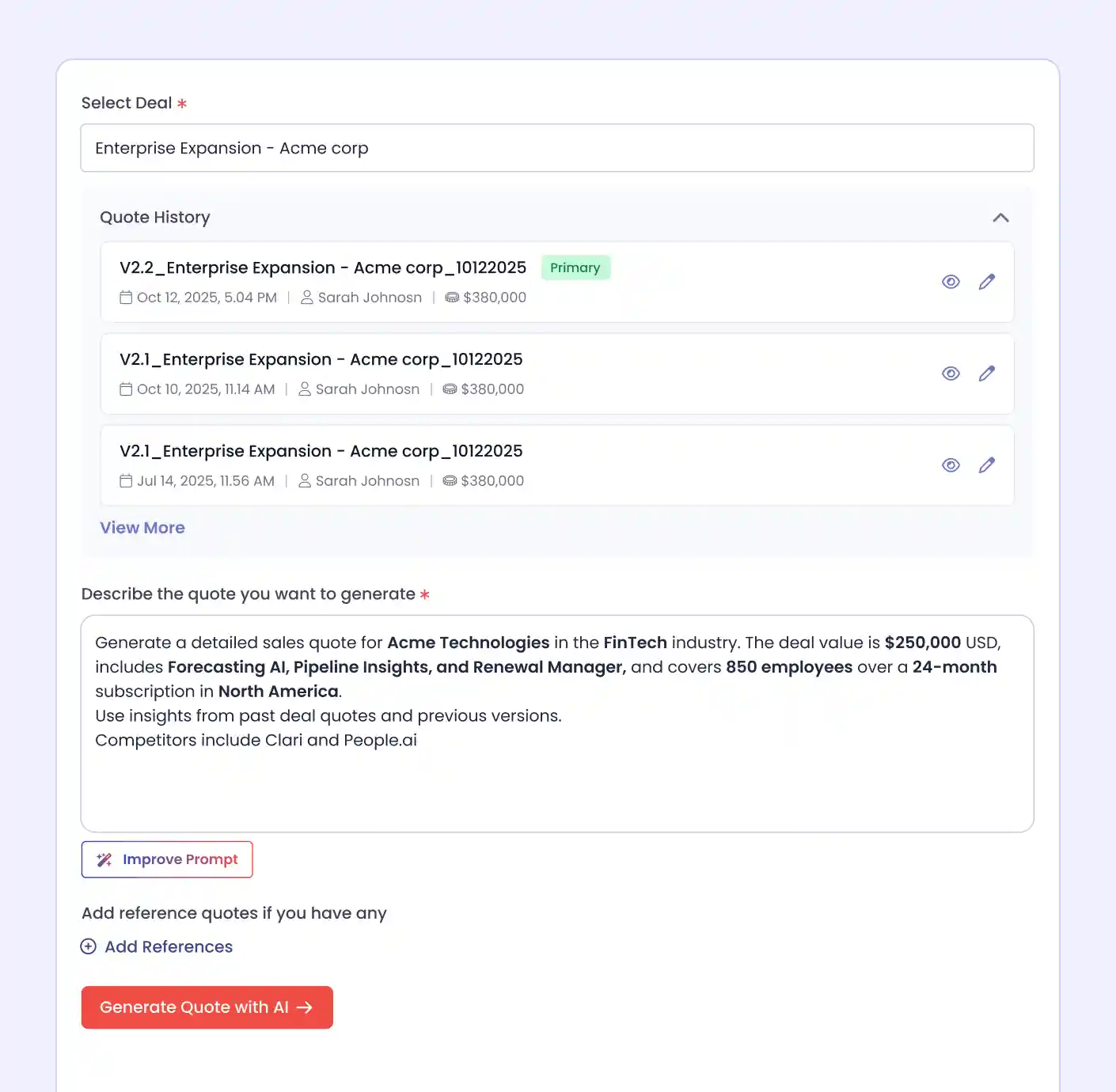
Large Language Models interpret user instructions through text or voice input, parsing intent even when phrased informally. The NLU layer handles ambiguity, context switching, and multi-turn conversations, allowing reps to refine quotes iteratively without restarting workflows.
The system maps conversational requests to structured quote actions: product additions, quantity adjustments, discount applications, term modifications. It maintains conversation context across multiple turns, so reps can make incremental changes ("now add 10 more licenses", "apply the enterprise discount") without repeating the full quote configuration.
Business Value: Eliminates the learning curve of traditional quote systems. Reps can configure quotes in their own words without memorizing screen locations, field names, or navigation paths. New hires become productive in hours instead of weeks.
2. Context Retrieval & Reasoning
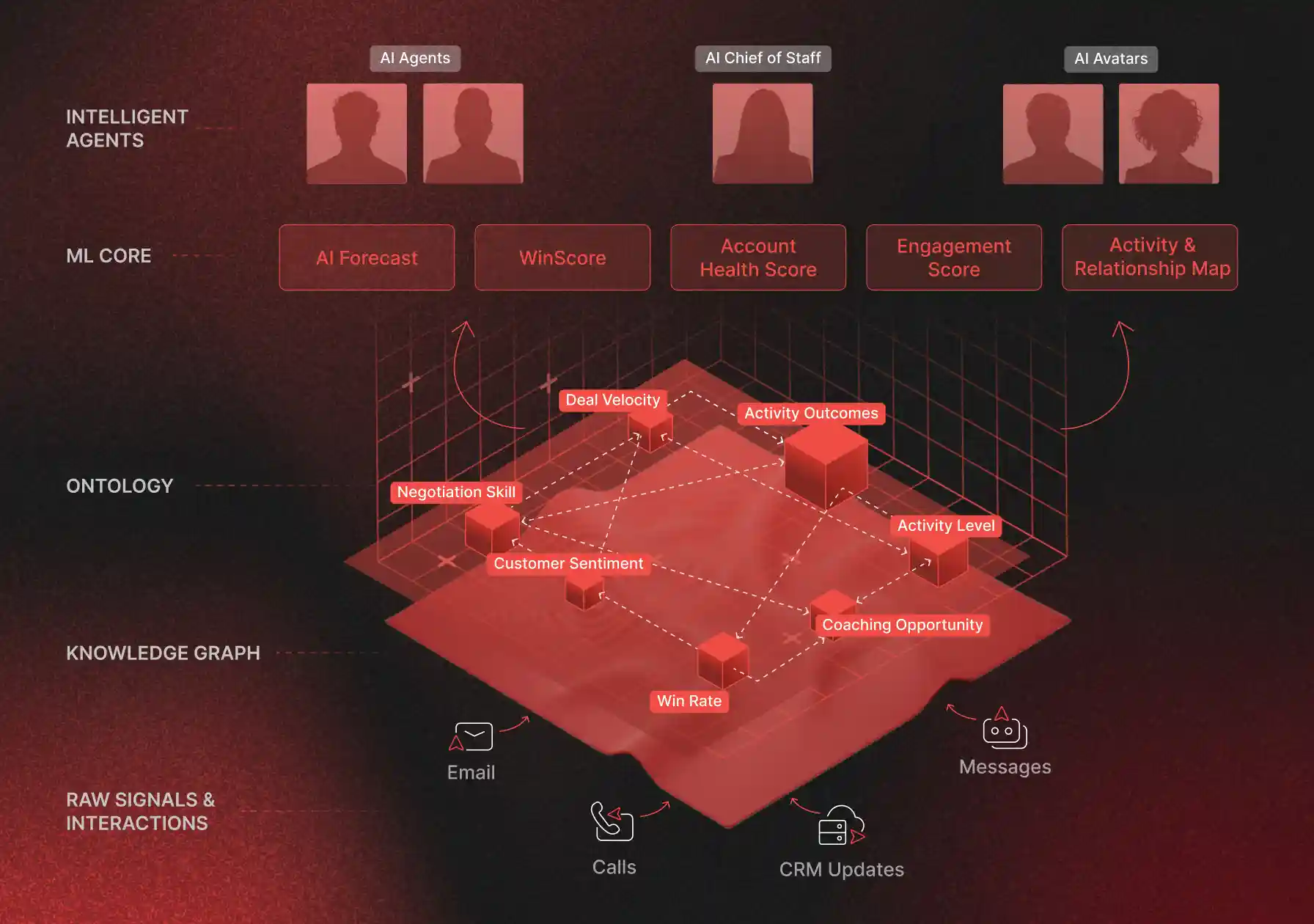
Before generating any quote, the agent retrieves comprehensive deal context from multiple systems: Opportunity data (stage, close date, deal size, stakeholders), Account intelligence (industry, size, existing contracts, renewal history), Product Catalog (SKUs, dependencies, compatibility rules), Price Books (region-specific pricing, volume discounts), and Historical Quotes (win patterns for similar deals, pricing benchmarks).
This context allows the agent to reason about what configurations are likely to win, not just what's technically valid. The system identifies patterns across closed deals—which bundles closed fastest in specific industries, what discount levels maximized win probability in comparable situations, and which payment terms accelerated close dates.
Business Value: Every quote starts with deal intelligence, not a blank form. Reps benefit from collective knowledge across all closed deals, surfacing configurations that worked in similar situations. Quote recommendations are backed by actual win data, not guesswork.
3. Rule-Based & AI-Driven Configuration
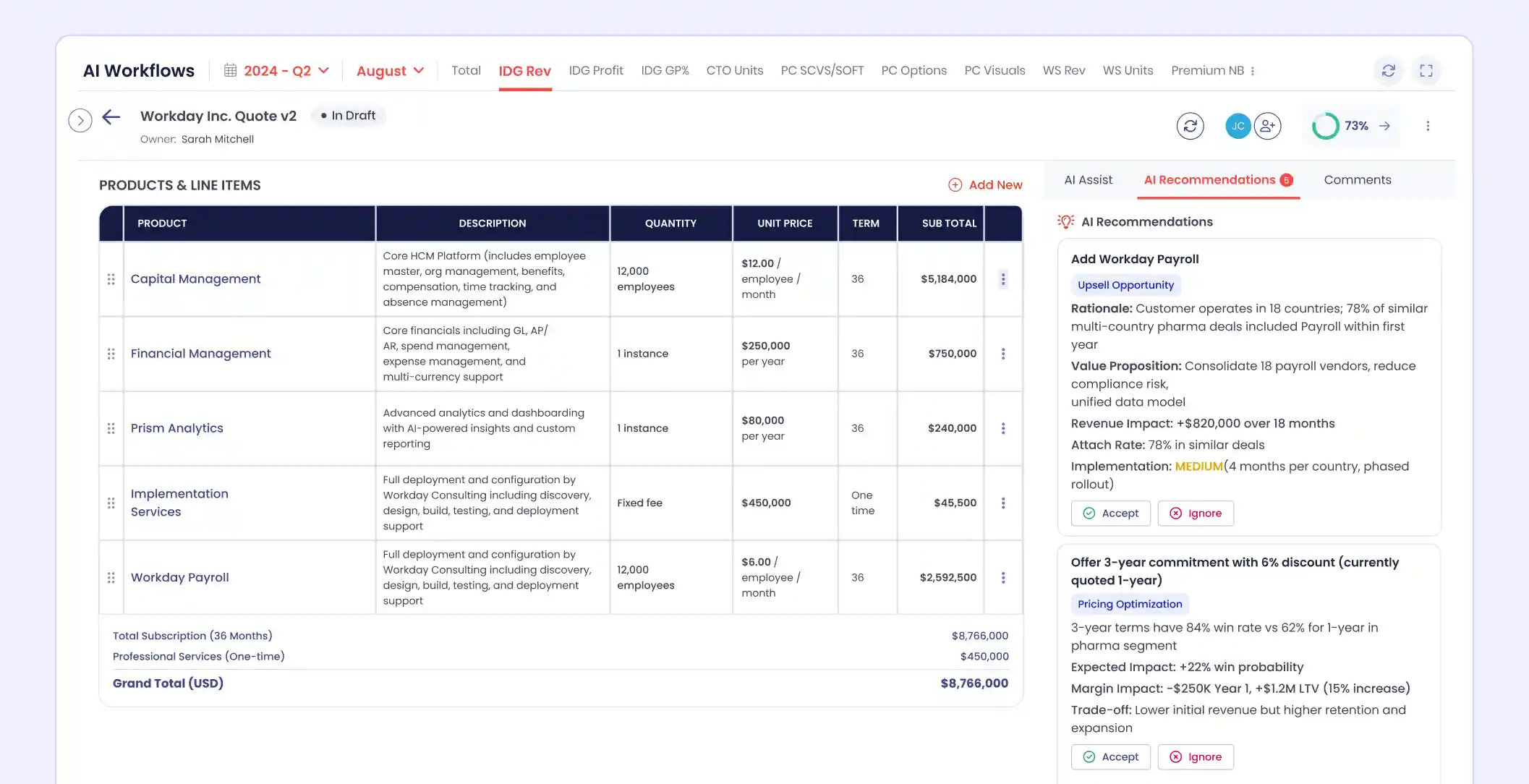
The agent applies two layers of logic simultaneously. Deterministic rules enforce hard constraints: product dependencies (Product A requires Product B), pricing tiers (Enterprise unlocks at 100+ seats), and approval thresholds (discounts above 15% require VP approval). These rules ensure every quote remains compliant with company policies.
AI recommendations operate on top of these rules, suggesting optimal configurations based on historical patterns: bundles that closed fastest in specific industries, pricing tiers that maximized win probability in similar deals, and upsell opportunities based on expansion patterns in comparable accounts.
Business Value: Compliance without constraint. Reps operate within guardrails that protect margins and maintain pricing discipline, while receiving intelligent recommendations that improve win rates. The system suggests what's likely to close, not just what's allowed.
4. Quote Modification Engine
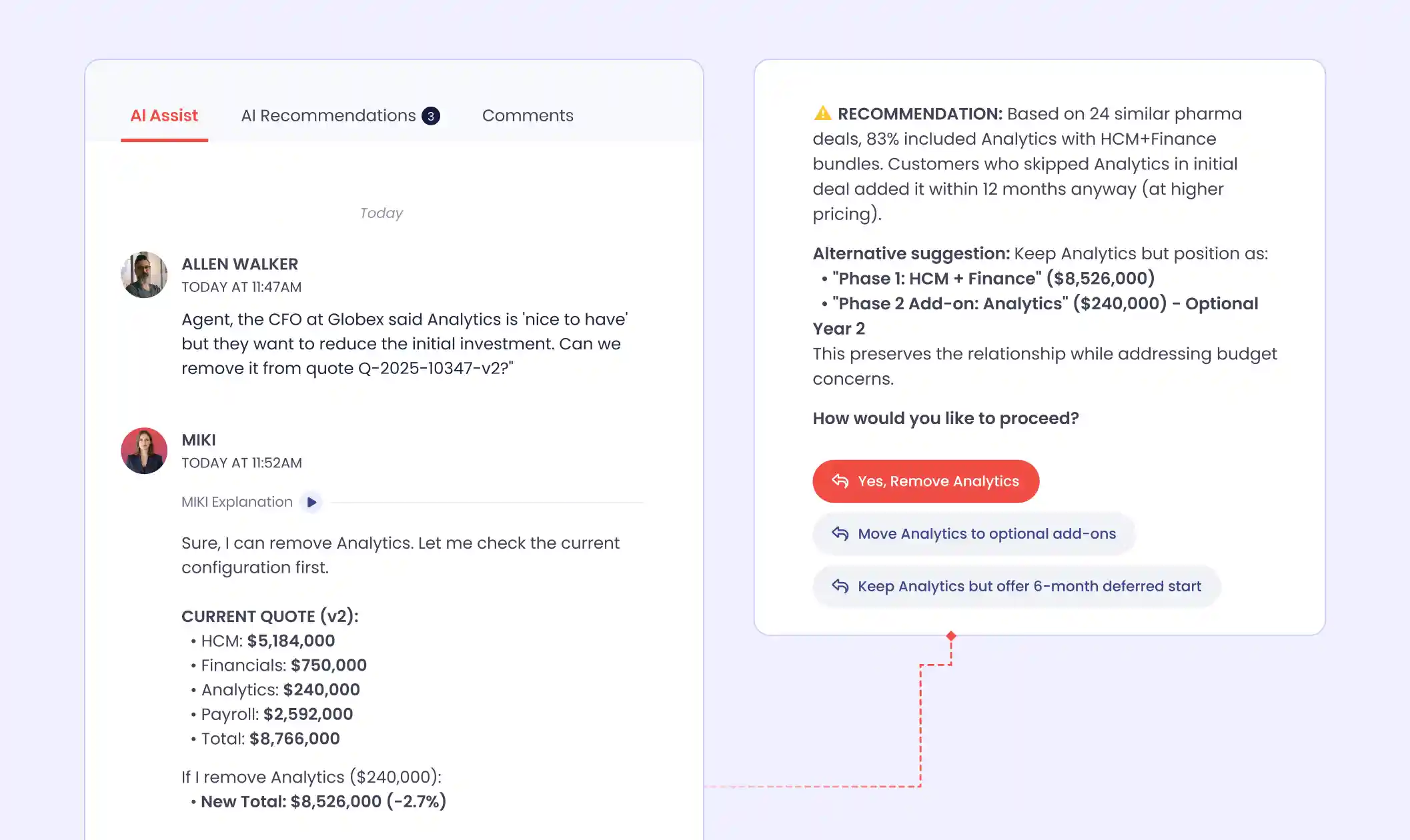
During quote creation and revision cycles, reps can modify quotes conversationally. Each modification triggers intelligent recalculation that adjusts product dependencies, re-validates pricing rules, recalculates bundle discounts, and preserves quote integrity across changes.
The modification engine handles complex interdependencies automatically. When a rep swaps products, the system identifies affected bundle discounts, validates compatibility constraints, adjusts quantities that depend on the changed products, and recalculates total pricing according to current tier structures—all in a single operation.
Business Value: Quote revisions happen in seconds instead of minutes. Reps don't manually recalculate bundle discounts, check dependency rules, or validate pricing tiers. The system handles complexity automatically, reducing errors and accelerating negotiation cycles.
5. Versioning & Comparison
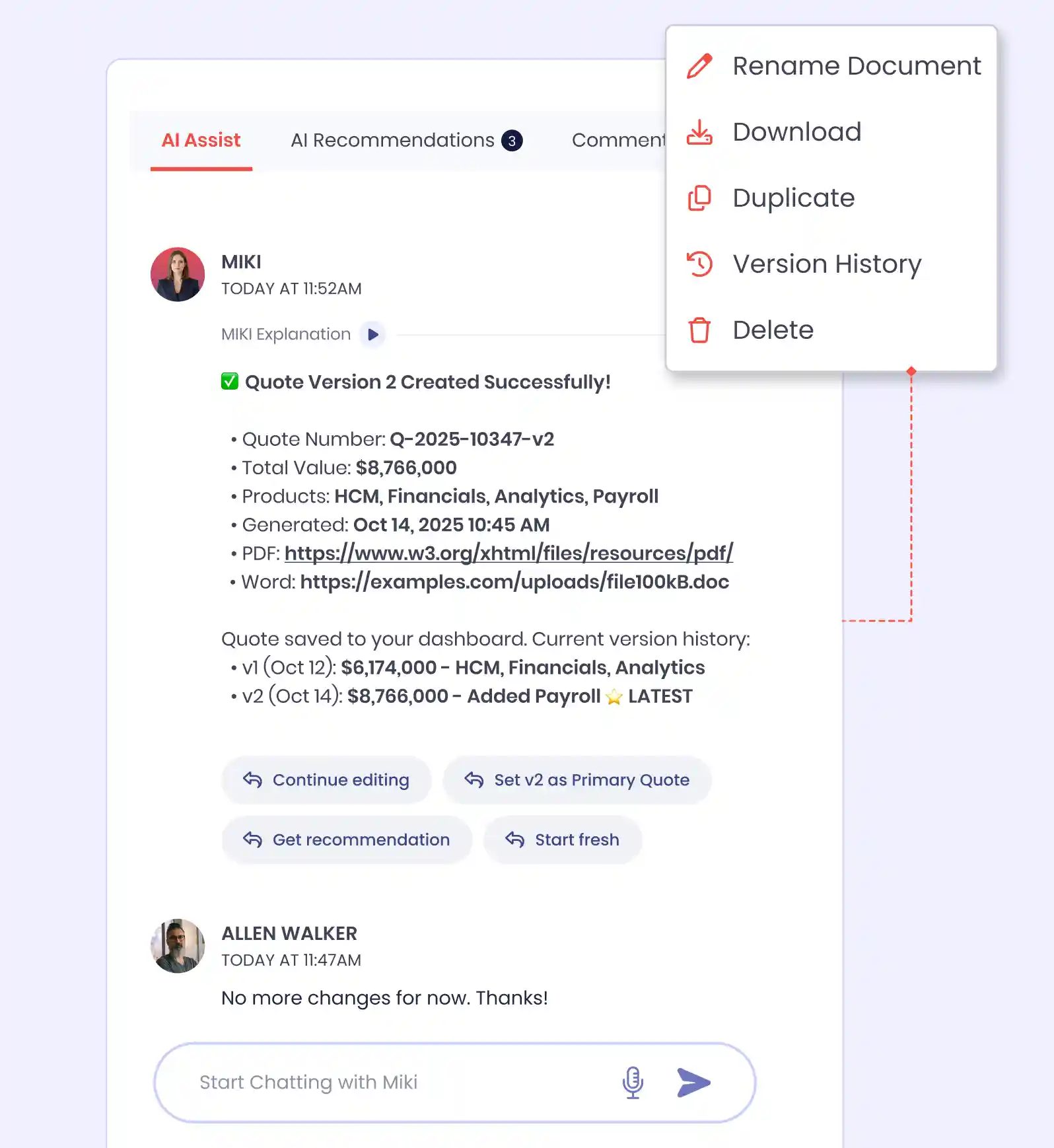
The agent automatically saves every quote modification as a distinct version, maintaining complete revision history without manual file management. Each version preserves the full quote configuration: line items, pricing, terms, discount structures, and approval status.
The comparison engine highlights differences between any two versions: products added or removed, pricing changes, discount adjustments, and term modifications. The system calculates win-probability scoring for each configuration based on historical deal patterns, helping reps choose the version most likely to close.
Business Value: Eliminates version control chaos. No more "Quote_v3_final_FINAL.xlsx" files. Reps can experiment with different configurations, compare alternatives side-by-side, and revert to any previous version instantly. Win-probability scoring turns quote optimization from guesswork into data-driven decisions.
6. Bi-Directional CRM/CPQ Integration
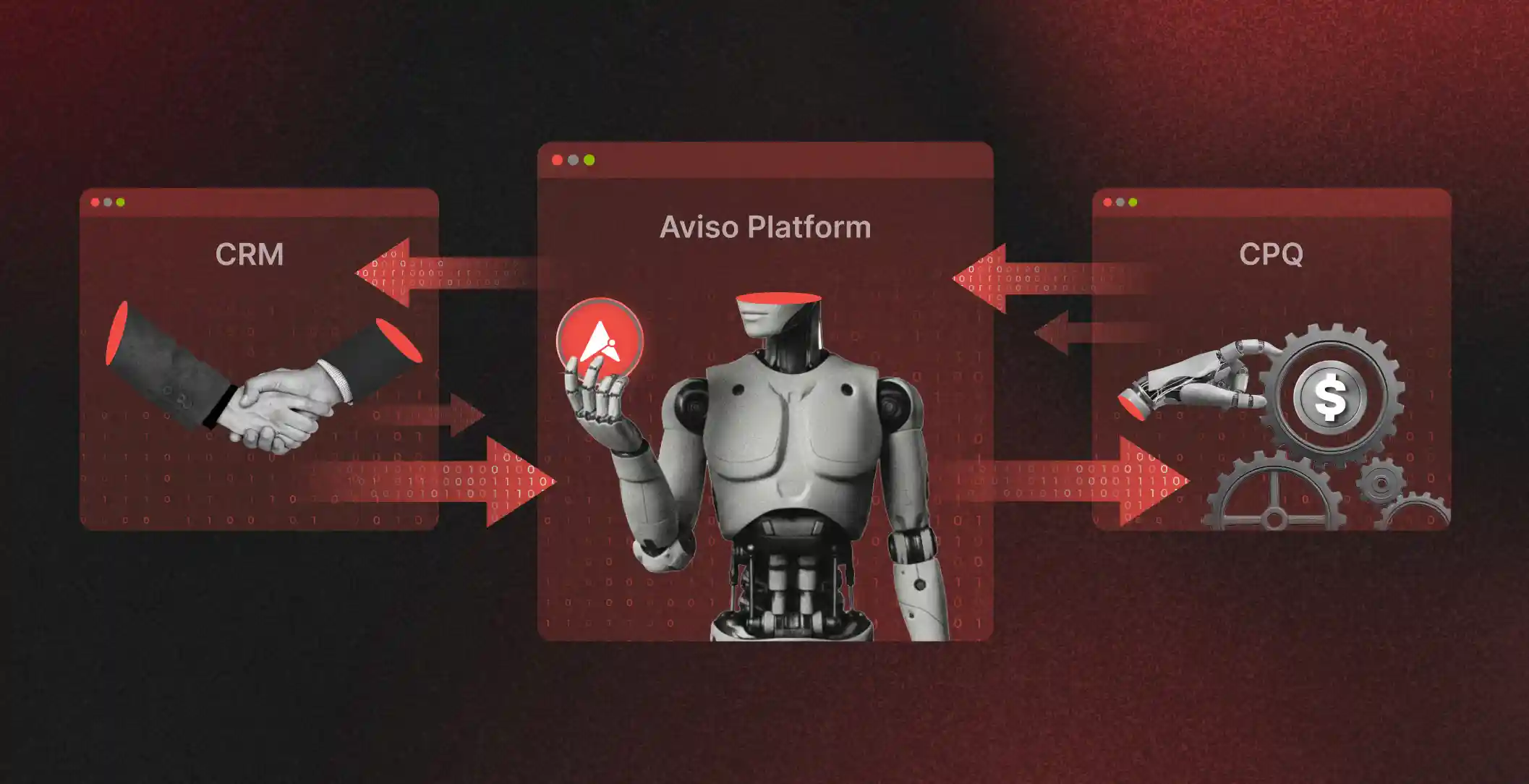
Once finalized, the agent syncs quotes to CRM and CPQ systems with complete audit trails. Every quote modification is logged with timestamp, user attribution, approval workflow status, and version history. This maintains system of record integrity while eliminating manual data entry.
The integration is bi-directional: changes made in the agent flow to CRM/CPQ systems, and changes made directly in those systems are reflected back in the agent. This ensures data consistency across platforms and provides a single source of truth for quote status, regardless of where updates occur.
Business Value: No data entry, no synchronization errors, no orphaned quotes. Sales operations maintain complete visibility and control. Compliance and audit requirements are automatically satisfied through comprehensive activity logs. Rep productivity increases because administrative overhead disappears.
The Intelligence Layer: Win-Pattern Learning
Advanced Quote Creation Agents continuously analyze closed deals to identify win patterns:
Which product bundles close fastest in specific industries?
What discount levels maximize win probability without eroding margin?
Which payment terms accelerate close dates?
What add-on products have highest attach rates in renewals?
This intelligence feeds back into the recommendation engine, making every quote smarter than the last.
Working with Existing CPQ Systems
Organizations that have invested in CPQ platforms like Salesforce CPQ, Oracle CPQ, or SAP CPQ can enhance those investments rather than replace them.
What Gets Preserved
Quote Creation Agents maintain critical CPQ capabilities:
CPQ Governance:
Product dependencies and compatibility rules
Pricing tiers and discount approval thresholds
Bundle configurations and promotional pricing
Contract compliance and audit requirements
System Integration:
Bi-directional sync with CPQ platforms
Maintains CPQ as system of record
Preserves approval workflows
Adds AI intelligence layer
Quote Creation Agent vs. Traditional CPQ
Dimension | Traditional CPQ | Quote Creation Agent | Impact |
|---|---|---|---|
Quote Generation Time | Multi-screen navigation (10-15 min) | Natural language command (<2 min) | Significant time reduction |
Configuration Guidance | None (reps guess product bundles) | AI recommendations based on win patterns | Improved win probability |
Discount Approval | Manual routing via Slack/email | Automatic validation with intelligent recommendations | Reduced approval delays |
Learning Mechanism | Static rules (manual updates required) | Continuous learning from won/lost patterns | Improves recommendations over time |
Version Control | Manual | Automatic versioning with diff tracking | Eliminates version confusion |
CRM Integration | Manual data entry or batch syncs | Real-time writeback with audit trails | Enhanced data accuracy |
User Training Required | 2-3 weeks (complex navigation workflows) | 1-2 hours (conversational commands) | Faster time-to-productivity |
Error Rate | Configuration errors common | Automated validation reduces errors | Fewer quote revisions required |
Adoption Barrier | High (complex UI, steep learning curve) | Low (natural language, intuitive) | Faster adoption across teams |
Results vary based on implementation complexity and organizational context.
When Quote Creation Agents Deliver Maximum Value
Organizations with existing CPQ investments see significant impact when:
High Quote Complexity: Product catalogs with 100+ SKUs, multiple pricing tiers, complex bundling rules benefit most from conversational access to CPQ logic.
Fast-Moving Negotiations: Deals requiring quick quote adjustments without navigating multi-screen CPQ workflows.
Distributed Sales Teams: Remote reps who need instant access to pricing logic without waiting for deal desk support.
Margin-Sensitive Industries: Sectors where 2-3% margin protection translates to millions in annual revenue.
High Sales Velocity: Organizations closing 50+ deals per month, where time savings compound significantly.
How Aviso Delivers Conversational Quoting
Aviso's Quote Creation Agent integrates with leading CPQ platforms (Salesforce CPQ, Oracle CPQ, SAP CPQ) to bring conversational intelligence to existing quote systems.
Built on Aviso's Context Fabric intelligence layer, the Quote Creation Agent combines natural language understanding, win-pattern analysis, and automated rule enforcement to help revenue teams close deals faster while maintaining pricing discipline.
Core Capabilities:
Conversational quote creation via text or voice
AI-driven bundle recommendations based on historical win patterns
Intelligent discount guidance with automated approval routing
Automated version control and CRM writeback
Bi-directional sync with CPQ platforms
CPQ Compatibility: Works with Salesforce CPQ, Oracle CPQ, SAP CPQ, and other enterprise CPQ platforms.
Conclusion: The Future of Enterprise Quoting
CPQ platforms contain essential pricing logic, product rules, and governance frameworks. But form-based interfaces built for 2000s workflows don't match how modern sales teams operate.
Quote Creation Agents bring CPQ capabilities into the conversational AI era. They preserve existing investments, all the pricing rules, approval workflows, and governance frameworks organizations have built, while adding natural language interfaces and AI intelligence.
Organizations deploying Quote Creation Agents enhance their CPQ investments with faster quote creation, higher win rates through AI recommendations, protected margins via maintained governance, and scalable growth without abandoning existing systems.
The shift to conversational, intelligent quoting is happening now. Revenue teams that adopt Quote Creation Agents will maximize existing investments while gaining competitive advantages.
Ready to transform your quote-to-cash process? Request a Demo